Antietam National Battlefield

Dunker Church after the battle of Antietam, September 17, 1862.
Associate Pages
Visitor Statistics
197,340 Visitors
Antietam
#191 Most Visited National Park Unit
Source: NPS, Rank among 398 National Park Units 2024.Park Size
2,741 acres (Federal), 3,228 acres (Total)Park Fee
Individual
$10 for 3 days (16 and older)
Car
$20 for 3 days, $15 motorcycle for 3 days
Fees subject to change without notice.
Weather
Summer - Average temperatures of 90 degrees during July and August with thunderstorms possible.
Winter - Cold with average temperatures in the 30 and 40 degree range. Snow possible.

Photo above: After the Union victory at the Battle of Antietam, Abraham Lincoln announced the Emancipation Proclamation. Photo below: Battle walk beside the corn. Just imagine soldiers fighting through that.


President Abraham Lincoln visiting the Union camp at Antietamwith General George B. McClellan and his staff after the battle. Not long after this photo was taken, Lincoln removed McClellan from his position and issued the preliminary Emancipation Proclamation. Mathew Brady photo courtesy of NARA.

Antietam
Antietam. Sharpsburg. The bloodiest day of the four arduousyears of the Civil War, in fact, the bloodiest one-day battle inAmerican history. For historians of the American Civil War, there is no debate about its importance. For others, Antietam sometimes gets lost between other battles, including Gettysburg to its north. It was not the high water mark of the Confederacy, although it did prevent General Robert E. Lee from making his planned major foray into northern territory in the fall of 1862, instead of the summer of 1863 when Gettysburg would occur. Photo above: Lithograph of the Antietam battle at Burnside Bridge, Photo courtesy Library of Congress.
Click here to Sponsor the page and how to reserve your ad.
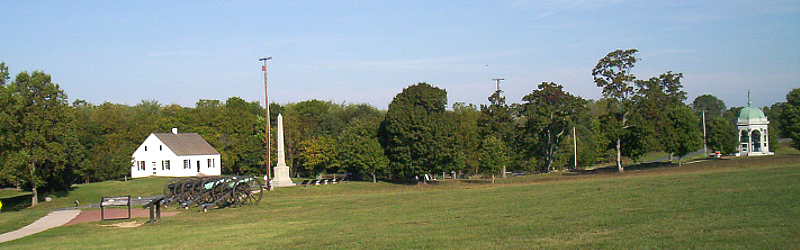
Antietam Then
It did not provide Abraham Lincoln with a reason to promote General Grant from the western theatre, even though his displeasure after the battle of Antietam would lead to his final removal of Union General George McClellan from commander of the army and spur his election rival in the presidential election of 1864. There would be several commanders in between before the ascension of Grant after Vicksburg. What made Antietam important, beyond the terrible fighting that occurred all over its cornfields, sunken roads, fords, bridges, woods, and hillsides, was the rationale. The northern victory at Antietam, no matter how marginal it may have been, gave President Abraham Lincoln the right time to announce to all nations on earth that the rationale for this war was finally going to change. He issued the Emancipation Proclamation in response to the Union victory on these Maryland fields, changing forever the idea that the Civil War was mostly about states rights, and yes, the idea about whether new states entering into the Union would be free or slave. It changed the rationale to that of a war that was about human dignity, and whether slavery should end, at some time in the future, altogether. Once the Emancipation Proclamation was issued, even before its enactment the next year, and in years to come, it would predominantly halt the idea in the European capitals of London and Paris that recognition of the Confederacy would come, once a victory on northern soil was achieved. They were not hesitant to be seen as backers of a fight for slavery. Once General Robert E. Lee would finally move into northern territory again in June of 1863, he had lost one main rationale for northern victory. Antietam had cost him that.
The day of September 17, 1862, was an infamous day. The armies of both North and South had gathered on these verdant farm fields of Maryland over the several days before. Fighting had begun on the north end of the field the day before, but it had been nothing like the terrible slaughter that was about to begin. It was a foggy and damp morning as the troops began to mass for battle. For twelve hours they would fight, from the initial section of the battle in the north with Union General Hooker advancing into the Cornfield, East, and West Woods. As the day advanced, fighting continued around the Dunker Church (historic photo left with battle damage, by Alexander Gardner, September 1862, courtesy LOC), then into the center of the battlefield at the Sunken Road, and later at Burnside Bridge, where General Ambrose Burnside's men would attack the Confederate right. The small force of Confederates on the steep hillside above the bridge would hold steady for three hours, before finally relenting at 1:00 p.m. At that point, the Union army was winning the day, despite its terrible toll in men, but a delay by Burnside to continue pushing the battle allowed Confederate troops approaching the Harpers Ferry to get into position, and stem the advance of the Union army.
One day later, the Confederate army retreated, allowing the Union to claim victory, and Lincoln to have a victory that would allow the Proclamation to emancipate. Antietam, the creek in Sharpsburg, Maryland, and the battlefield that would forever hold its name, would now take its place in American history as one of the most important landscapes, a symbol of the day that would change the face of the the United States forever.
Dunker Church - The small white church was the site of a good part of the major fighting and sustained damage from the shot and shells of the troops.
The Cornfield - The bloody sight of a massive conflict between Union and Confederate troops that saw waves and men within its stalks cut down with one hour. This was the site of most of the heavy casualties of the day, 23,000 killed, wounded, and missing, making this the bloodiest day in Civil War history.
The Sunken Road - As the battle of September 17 moved forward into the central part of the day, this central area was defined by a sunken farm road, six to eight feet below the surface of the fields. Confederate troops massed there in defense of the middle section of their line. Their fire into approaching Union soldiers was a heinous example of Civil War fighting. Eventually, Union soldiers overtook the Sunken Road. Scores of bodies were strewn along the fence work and depression.
Burnside Bridge - On the southern end of the field, northern troops were massed in a valley beside Antietam Creek. To join the day's fighting, they were ordered to cross the Burnside Bridge spanning the water and take the hillside filled with Confederate soldiers. This narrow bridge was crossed, and the hill taken, but many casualties ensued.
Photo above: Dunker Church and the Maryland Monument on Antietam National Battlefield. Below: Sunken Road in the center of the Antietam Battlefield.

Antietam Now
Antietam and Sharpsburg Today - One of the best examples of an intact battlefield and growing through the last decade and today due to extensive preservation efforts, the almost pristine landscape allows the Civil War visitor to get a sense of the scope of battle and its landscape as well as any of the preserved battlefields across the Virginia theatre. Most of the major sites are intact, including Dunker Church, the Cornfield, the Sunken Road, Burnside Bridge, as well as the Pry House, which served as General McClellan's headquarters.
Minute Walk in History
Above: It's a Minute or More Walk in History around the entire battlefield, from the Cornfield where the men of both sides walked through, many times to their demise, to the Sunken Road, Burnside Bridge, and then the preliminary Emancipation Proclamation that a thin Union victory allowed President Lincoln to make after the battle. Below: Walk with us through scenes of the 160 Anniversary of the Battle of Antietam fought around Antietam Creek in Sharpsburg, Maryland, including the battles walks, demonstrations, and commemoration of the worst single day of casualties in American military history.
T-Shirts and Souvenirs
Antietam T-Shirts and Souvenirs. Official gifts from
Americabesthistory.com.

Antietam
Things You Should Not Miss
1. The visitor park center film on the battle, a twenty-six minute introduction to what went on here. Once per day, a second film, one hour long, is also shown, for those with enough time.
2. Take a ranger guided tour. The men and women who interpret the Antietam Battlefield have a breadth of knowledge about the particulars that should not be missed. They're some of the best in the park service. On the annivesary week in September, you can get even more detail by hiking the entire battlefield for three hours at a time with several rangers who describe the fighting as you tred. Crossing the fields on foot gives you a great sense of the landscape and how the soldiers would have seem the battle unfold. Antietam has more hills than the first impression gives you from the visitor center.
3. Don't miss a walk in the depths of the Sunken Road. Walk the length of the road and imagine the horror of what took place there. After walking its length, climb the tower at the eastern end. There is a great view of the remaining battlefield from there.
4. Climb down the steep hill above Burnside Bridge, cross Antietam Creek, and look back at the heights that were battled for. Can you imagine facing the fire from that hillside, which Union troops encountered, and actually defeated? How did they possibly defeat that position? Well, one reason was that the Confederates soldiers, only five hundred there, were told to hold as long as possible, then retreat to their second line. They did what they were told, in major part because the Federal force was in the thousands. Photo above: Burnside Bridge today. See the tree to the left; it was there during the battle. The bridge will be closed much of 2016, because of a major renovation project. You will be able to see it from the overlook, but not cross during that time.
5. A relatively new addition to the Antietam experience, is the opening of the Pry House as a Field Medical Museum. This house was the headquarters of Union General McClellan during the battle. It is about four miles from the visitor center and is open from April to early December.
Photo above: Burnside Bridge at Antietam Battlefield.

Get Baseball History and Books at Stat Geek Baseball, including Baseball's Best 150.
Visitor FAQ

What's There Now
Visitor's Centers/Museums
Visitor Center - The Visitor Center to Antietam National
Battlefield sits atop a small hill with a view of the majority of the park. It is near the Dunker Church. Stop by the center to pay the fee, see exhibits, inquire about a ranger walk, visit the museum bookstore, and view the films.
Dunker Church. Stop one on the auto tour or just a short walk from the visitor center.
The Cornfield, plus the East and West Woods - The opening hours of the battle of Antietam were contested across these fields and woods.
The Sunken Road and Tower - Located in the central section of the Auto Tour, the Sunken Road, and the tower at the eastern end of the road, saw a contested battle for the depression, with Union soldiers attacking the Confederates who were defending the road.
Burnside Bridge - The most famous section of the southern section of the battlefield where Confederates forestalled Union troops from taking the hillside for three hours.
The Pry House (Photo below) - Headquarters of Union General George McClellan, and now, in spring, summer, and fall, transformed into a museum of Civil War medicine.
National Cemetery - Located at the edge of Sharpsburg proper.
Newcomer House - This historic home, here since the battle, is now the Visitors Center for the Heart of the Civil War Heritage Area. It is open most days in the summer and staffed sporadically throughout the year. Above the parking lot is the statue of Robert E. Lee, which is now on park service property.


Lodging and Camping
Antietam is located in a rural setting and Sharpsburg,
Maryland, the town where the battlefield is located has few lodging choices, beyond a number of Bed and Breakfasts. For more choices, there are a variety of hotels and motels in Hagerstown, Frederick, and Martinsville, as well as on the road to Martinsville. Check out your favorite online lodging site for the lodging type of your choice.
There is a small, primitive group campsite inside the park, Rohrbach Campground, available to scout and other groups. Check the park website for its availability. Other campsites dot the area, from Catoctin Mountain Park down into the Shenandoah, but perhaps the best for a visit to Antietam, is the Antietam Creek Campground four miles south off Harpers Ferry Road in the Chesapeake and Ohio National Historic Park. There, in a National Park campground, you can camp on the berm between the canal and the Potomac River. There are vault toilets, no hookups, pump water, and you can't park right next to your site. Parking is across the dry canal. There is a fee there, but if you hike down the canal path a couple miles in either direction, there are additional campsites without one. It's a good hike though.
One quite note about Sharpsburg. Small quaint village with no gas station as of spring 2016. Used to be one, but it's closed. So gas up before coming. Closest gas in Hagerstown, Boonsboro, or Shepherdstown.
Photo above: Burnside Bridge, Antietam National Battlefield, September 1862. Photo by Alexander Gardner, courtesy Library of Congress. Photo below: The Potomac River at Antietam Creek Campground.


Preservation
If you wish to be involved in protecting Antietam National Battlefield, the group Antietam Partners and the Civil War Trust is always looking for assistance. They have been doing a wonderful job over the last decade and one half of expanding the park, including much of the ground on the Final Attack and Reel Farm. Some of this land is still owned by the Trust, but may in the future be transferred to the park.
During the last six months of 2015, an amazing amount of preservation has taken place, including the Miller Farm, a triangle piece of property fought over during the cornfield battle to the Dunker Church, basically the center of the park. Photo above shows the scene during one of the first ever battle walks across that property. The old farm buildings as well as the land itself will be restored over the next couple years to look like it did in 1862. Now the invasive trees, barn, and home are gone. At this time, 2024, another important parcel, eleven acres directly behind the Dunker Church, is under a fundraising effort to be bought by the American Battlefield Trust.
Two other parcels had also been procured in 2015, including a North Woods parcel bought at the same time of the September Battle Walk in an auction by the Civil War Trust, now the American Battlefield Trust. Photo below: Newly acquired tract in North Woods area at the top of the image. House and barn are now gone as well.