
Image above: The U.S.S. Constitution captures the British war ship Guerrier, War of 1812. Courtesy Wikipedia Commons. Right: Battle of New Orleans, E. Percy Moran, 1910. Image courtesy Library of Congress.

Sponsor this page. Your banner or text ad can fill the space above.
Click here
to Sponsor the page and how to reserve your ad.
-
Timeline
-
More
-
More
-
More
-
More
-
More
-
More
-
More
-
More
-
More
-
More
-
More
-
More
-
More
-
More
-
More
-
More
-
More
-
More
-
More
-
More
-
More
-
More
-
More
-
More
-
More
-
More
-
More
-
More
-
More
1810
June 23, 1810 - The Pacific Fur Company is formed by John Jacob Astor.
During 1810, the causes of the War of 1812 began to emerge. Four thousand naturalized American sailors had been seized by British forces by this year, which forced trade between England and the United States to grind to a halt.
September 8, 1810 - Thirty-three employees of the Pacific Fur Company founded by John Jacob Astor embark on a six month journey around South America from New York Harbor. Arriving at the mouth of the Columbia River on the ship Tonquin, in present day Oregon, they found the fur-trading town of Astoria.
December 3, 1810 - Ex-slave Tom Molineaux, born at a Virginia plantation in 1784, fought English boxing champion Tom Cribb, and was narrowly defeated after 35 rounds when he collapsed from exhaustion. A rematch was held on September 28, 1811 with Cribb retaining his title in 11 rounds.
August 6, 1810 - The center of the population of the United States, listed as 7,239,881 in the 1810 census, was only 40 miles northwest of Washington, D.C. in the state of Virginia.
Buy Chronology

1811
February 3, 1811 - American journalist, editor, and
publisher,
Horace Greeley, is born.
May 8, 1811 - The contract for construction of the Cumberland
Road is assigned. The road, an important route through the
Allegheny Mountains for westward expansion, was begun five
years after authorization as the first federal highway by Thomas
Jefferson in 1806. It broadly followed Braddock's Road, a military
route used by George Washington in 1754. The National Road, as it would
later be called, and now known as Rt. 40, measured 128 miles from
Cumberland, Maryland to Wheeling, West
Virginia, and would later have its terminus in Vandalia, Illinois.
October 11, 1811 - The first steam-powered ferry service between New York City and Hoboken, New Jersey is started on John Stevens' ship, the Juliana.
November 7, 1811 - At the battle of Tippecanoe, Indian warriors under the command of Tecumseh and his brother Tenskwatawa, known as the Prophet, are defeated by William Henry Harrison, the governor of Indiana.
December 16, 1811 - An earthquake near New Madrid, in the Mississippi Valley, reverses the course of the Mississippi River for a period of time. This quake was the first of two major earthquakes which preceded the largest quake ever in the United States two months later.
1812
February 7, 1812 - With an estimated magnitude of 7.4 to 8.3, the final New Madrid earthquake strikes near New Madrid, Missouri. This quake was the largest earthquake ever recorded in the continental United States, destroying one-half of the town of New Madrid. It was felt strongly for 50,000 square miles, created new lakes, caused numerous aftershocks, and reversed the course of the Mississippi River. A request by William Clark, the Missouri territory governor, for federal help, may have been the first request for disaster relief.
June 1, 1812 - U.S. President James Madison asks Congress to declare war on the United Kingdom. Before the vote could be approved, on June 16, British ships raise a blockade against the United States.
June 18, 1812 - Although unaware of the blockade at the time of their vote, Madison signs declaration after Congress narrowly approves war with Great Britain. Western states generally favored the action while New England states disapproved. This included the state of Rhode Island, which would refuse to participate in the War of 1812.
August 13, 1812 - August naval battles in the War of 1812 begin with the United States Navy defeating the British when the U.S.S. Essex captured Alert. Three days later, the tide would turn in British favor as English forces capture Fort Detroit without a fight. This would be followed up on August 19 when the U.S.S. Constitution secured another victory for the Navy of the United States off the coast of Nova Scotia when it destroyed the British frigate Guerriere, earning the nickname "Old Ironsides" when British shot bounded off the Constitution's side. On October 25, off the Azores, the U.S.S. United States defeated the Macedonian, towing the ship back to the U.S., the first British warship brought back to an American port.
October 30 to December 2, 1812 - President James Madison defeats De Witt Clinton in the U.S. presidential election, securing a second term as the United States engages in the War of 1812 by an Electoral College margin of 128 votes to 89.
1813
April 27, 1813 - The Battle of York (Toronto, Canada) is held when American troops raid and destroy, but do not occupy the city.
June 1, 1813 - The city directory of Albany, New York is first published.
June 6, 1813 - Despite having a force three times the size of its British foe, Americans lose the Battle of Stoney Creek to a British army of 700 men under John Vincent.
September 10, 1813 - The Battle of Lake Erie is won by the American navy when Commodore Perry's fleet defeats the ships of British Captain Robert Barclay. This victory allows U.S. forces to take control of the majority of the Old Northwest and lake region.
October 5, 1813 - A United States victory at the Battle of Thames, Ontario allows American forces to break the Indian allies of the English and secure the frontier of Detroit. Native Indian leader Tecumseh of the Shawnee tribe is killed during this battle.
1814
March 27, 1814 - Settlement opens in large parts of
Alabama and Georgia after Andrew Jackson's militia from Tennessee defeat the Red Stick Creeks of Chief Menawa along the
Tallapoosa River at Horseshoe Bend.
August 24, 1814 - The White House is burned by British forces
upon the occupation of Washington,
D.C. during the War
of
1812. This act, in retaliation for the destruction
by U.S. troops of Canadian public buildings, causes President Madison
to evacuate. The British advance would be halted by Maryland militia
three weeks later on September 12. Another United States president,
James Monroe, would have to wait three years before he could reoccupy
the executive mansion.
September 11, 1814 - The Battle of Lake Champlain is won by
U.S. naval forces with the U.S.S. Ticonderoga leading the way.
September 13-14, 1814 - Francis Scott Key writes the words to
the Star Spangled Banner during the twenty-five hour
bombardment of Fort McHenry at the head of the river leading to
the Baltimore harbor.
December 24, 1814 - A peace treaty is signed between the British and American government at Ghent, bringing to an end the War of 1812.
1815
January 8, 1815 - On the Chalmette plantation at New Orleans, five thousand three hundred British troops still unaware of the peace treaty signed two weeks earlier, but not ratified until February 17, attack American forces in the last battle of the War of 1812. Major General Andrew Jackson leads his American soldiers to victory over British troops under the command of Sir Edward Pakenham. British troops take over two thousand casualties; American forces seventy-one.
February 6, 1815 - The first American railroad charter is granted by the state of New Jersey to John Stevens.
April 10, 1815 - The Mount Tambora volcano erupted in Indonesia, causing unprecedented climate change across the USA and world, leading to the entire "Year without a Summer" in 1916.
August 6, 1815 - Piracy on the high seas by Algiers, Tunis, and Tripoli is effectively ended by a flotilla from the United States.
November 12, 1815 - American women's rights activist Elizabeth Cady Stanton in born.
December 25, 1815 - The oldest continuing performance arts organization in the United States, the Handel and Haydn Society of Boston, gives its first performance.
1816
April 10, 1816 - Second Bank of the United States is chartered, five years after the expiration of the 1st Bank of the United States.
June 21, 1816 - The entire "Year without a Summer" occurs in the northern hemisphere and around the world due to global cooling caused by the eruption of Mount Tambora in 1815.
August 1816 - E. Remington and Sons is founded in 1816.
November 1 to December 4, 1816 - James Monroe defeats Rufus King in the United States presidential election, garnering 183 Electoral College votes to 34 for the Federalist King.
December 11, 1816 - The territory of Indiana is admitted into the United States of America as the 19th state.
1817
March 4, 1817 - James Monroe is inaugurated as the
President
of the United States, succeeding James Madison. His vice
president, Daniel D. Tompkins, who would serve alongside
Monroe for his entire eight years, was also inaugurated.
April 28-29, 1817 - The Rush-Bagot treaty is signed. This would
limit the amount of armaments allowed on the Great Lakes by
British and American forces.
July 4, 1817 - The construction of the Erie Canal begins at Rome, New York. The first section between Rome and Utica would be completed two years later. The canal would eventually connect the Atlantic Ocean, through the Hudson River, to the Great Lakes, with 83 locks over its 363 miles. The canal, when completed in 1825, would cut transport costs by 90%.
December 10, 1817 - The United States of America admits its 20th state, Mississippi.
The second wave of Amish immigration to North America begins in 1817, bringing 3,000 Amish from Europe to relocate in the United States. The first wave of Amish immigration occurred through 1770.
1818
January 1, 1818 - The first edition of the Farmer's Almanac is published in Morristown, New Jersey.
March 15, 1818 - Andrew Jackson and his American army invade Florida in the Seminole War, causing repercussions with Spain as negotiations to purchase the territory had just begun.
April 4, 1818 - The flag of the United States is officially adopted by Congress with the configuration of thirteen red and white stripes and one star for each state in the union. At the time of adoption, with the most recent addition of Mississippi, the flag had twenty stars.
October 20, 1818 - The northern boundary of the United States and Canada is established between the U.S.A. and the United Kingdom. Its location from the Lake of the Woods to the Rocky Mountains would be the 49th parallel.
December 3, 1818 - The state of Illinois is admitted to the Union, making the U.S.A. a republic with twenty-one states.
1819
January 2, 1819 - The first financial crises in the United States, the Panic of 1819, occurs, leading to foreclosures, bank failures, and unemployment. Several causes have been identified, including the heavy amount of borrowing by the government to finance the War of 1812, as well as the tightening of credit by the Second Bank of the U.S. in response to risky lending practices by wildcat banks in the west.
February 15, 1819 - The Tallmadge Amendment is passed by the U.S. House of Representatives, stating that slaves would be barred in the new state of Missouri, which becomes the opening vote in the Missouri Compromise controversy.
February 22, 1819 - The territory of Florida is ceded to the United States by Spain in the Adams-Onis Treaty.
May 22, 1819 - The American steamship Savannah, under part steam and sail-power, crosses the Atlantic Ocean from Savannah, Georgia to Liverpool, England, arriving on June 20.
August 6, 1819 - The first private military school in the United States, Norwich University, is founded by Captain Alden Partridge in Vermont.
History Photo Bomb

Sunset at the mouth of the Columbia River, near Astoria,
Oregon. Courtesy National Archives.
Timeline Book

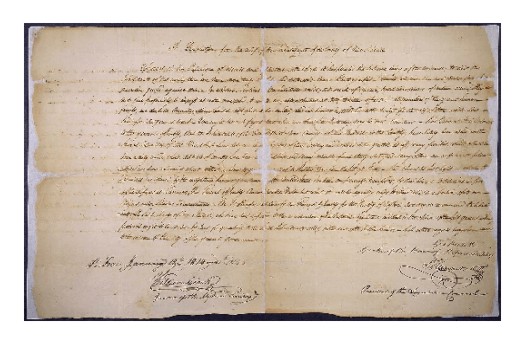
Resolution for federal aid from the Missouri Territory during
the time of the New Madrid earthquakes in 1811-12. Courtesy National Archives.
ABH Travel Tip
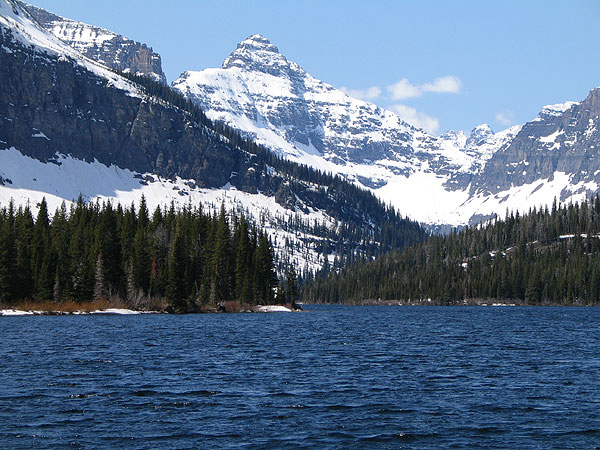
The National Park Service has, over the past several years,
announced increases in the entrance fees to several of the most visited National Parks. For a list of those fees, please visit National Park Service and
check for the park of your interest. A national park vacation is one of the most economical in the nation, but they are subject to the same inflationary pressures of theme parks and other attractions. We, at americasbesthistory.com are urging, however, that the park service keep these increases at a minimum, so that america's best classrooms remain open to all who seek to witness their history and beauty.

Capture of the Sloop of War Frolic by the U.S. Sloops of War
Wasp, October 18, 1812. Print by F. Kearny from sketch by Lt. Claxton. Courtesy National Archives.