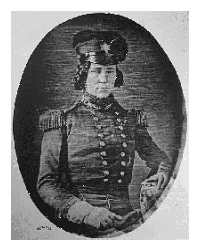
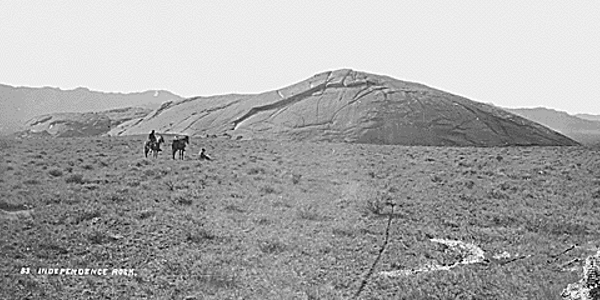
Above Photo: Bezaleel W. Armstrong, circa 1846. 2nd Lt., 1st and 2nd Dragoons. Served in the Mexican War at Vera Cruz and Mexico City. Right: Independence Rock on the Oregon Trail in Wyoming. Photo from Hayden Survey, William H. Jackson, 1870. Courtesy National Archives.
Sponsor this page. Your banner or text ad can fill the space above.
Click here to Sponsor the page and how to reserve your ad.
-
Timeline
-
More
-
More
-
More
-
More
-
More
-
More
-
More
-
More
-
More
-
More
-
More
-
More
-
More
-
More
-
More
-
More
-
More
-
More
-
More
-
More
-
More
-
More
-
More
-
More
-
More
-
More
1840
January 13, 1840 - Off the coast of Long Island, New York, 139 people lose their lives when the steamship Lexington burns and sinks four miles off the coast.
January 19, 1840 - Antarctica is claimed for the United States when Captain Charles Wilkes circumnavigates the continent and claims Wilkes Land for the nation.
June 1, 1840 - The census of the United States grows to 17,063,353, up 33% from the decade before. Four states now exceed one million in population; New York, Pennsylvania, Ohio and Virginia. The center of the nation's population continues to move slowly west, now sixteen miles south of Clarksburg, West Virginia.
May 7, 1840 - The Great Natchez Trace Tornado strikes Natchez, Mississippi and wreaks havoc. In the second most deadly tornado in U.S. history, 317 people are counted among the dead and 209 are injured.
December 2, 1840 - President Martin Van Buren is defeated for reelection by William Henry Harrison. Harrison, a Whig, receives 234 Electoral College votes to 60 and also wins the popular vote contest.
1841
March 9, 1841 - The Supreme Court of the U.S. states that in the case of the slave ship Amistad that the Africans who had wrested control of the ship had been bound into slavery illegally.
April 4, 1841 - President William Henry Harrison, sworn into
office only one month before on March 4, dies of pneumonia. His
tenure of one month is the shortest in history and his death in
office the first for a president of the United States. He is
succeeded by Vice President John Tyler.
May 1, 1841 - The first wagon train to California, with sixty-nine adults and several children, leave from Independence,
Missouri. The journey would take until November 4.
May 1, 1841 - Second Seminole War, ongoing since 1835, starts to wind down when Lieutenant William Tecumseh Sherman escorts Seminole chieftain Coacoochee to meeting, leading to surrender of many of his band. By 1842, the few remaining Seminoles would be allowed to remain on an informal reservation in south Florida.
August 16, 1841 - President Tyler vetoes the bill re-establishing the Second Bank of the United States, causing an angry riot among Whig party members on White House grounds. It was the most violent demonstration on those grounds in U.S. history.
1842
January 31, 1842 - Elizabeth Tyler, the president's daughter, marries William Nevison Walker, at the White House in
Washington, D.C.
March 5, 1842 - In a prelude four years prior to the start of the Mexican War, troops under Mexican leader Rafael Vasquez
invade Texas and briefly occupy San Antonio in the first invasion since the Texas Revolution.
May 16, 1842 - The second organized wagon train on the Oregon Trail leaves with more than one hundred pioneers from Elm Grove, Missouri. Although not welcomed due to company policy that discouraged emigration, they were offered food and farming equipment at Fort Vancouver by the Hudson Bay Company upon arrival.
May 19, 1842 - The People's Party of Providence, Rhode Island, founded by lawyer Thomas Wilson Dorr in 1841, wanted to liberalize the Rhode Island charter of 1663 to extend voting to those that didn't own property. The Dorr Rebellion of 1842 of this date, with militiamen attacking an arsenal in Providence that was later repulsed, however, forced conservatives to abolish the charter and adopt a new constitution one year later.
August 9, 1842 - The border between the United States and Canada is fixed east of the Rocky Mountains, including Maine and Minnesota, due to the signing of the Webster-Ashburton Treaty.
November 26, 1842 - The University of Notre Dame is founded by Father Edward Sorin of the Congregation of the Holy Cross. The University would be granted a charter by the state of Indiana two years later.
1843
February 6, 1843 - At the Bowery Amphitheatre in New York City, the first minstrel show in the United States debuts.
May 22, 1843 - The first major wagon train headed for the
northwest via the Oregon Trail begins with one thousand
pioneers from Elm Grove, Missouri.
June 4, 1843 - The Black Horse Troop of the 1st United States Dragoons from Fort Scott, Kansas join a military escort into Indian Territory along the Santa Fe Trail and apprehend Jacob Snively and his Texas freebooters.
June 21, 1843 - Edgar Allan Poe publishes his story The Gold Bug in the Dollar Newspaper. He is paid more than a dollar, however, winning the grand prize of $100.
November 28, 1843 - The Kingdom of Hawaii is officially recognized by European nations as an independent nation. This date signifies Hawaiian Independence Day.
1844
April 6, 1844 - Edgar Allan Poe, the highly regarded writer of short stories, departs his home in Philadelphia for New York City. Although most of this best works were written while in the City of Brotherly Love for two years, he left the city with $4.50 to his name.
May 24, 1844 - Samuel B. Morse, inventor of the telegraph,
sends the first message over the first telegraph line from
Washington to Baltimore. His words were, "What God hath
wrought."
June 15, 1844 - The patent for vulcanization, the process for strengthening rubber, is granted to Charles Goodyear.
July 3, 1844 - The United States signs the treaty of Wanghia with China. It is the first treaty signed between the two nations.
December 4, 1844 - Democrat James K. Polk defeats Henry Clay for president with 170 Electoral College votes to 105 for Clay.
1845
March 3, 1845 - Congress overrides a presidential veto.
President Tyler's veto of a military appropriation was overturned.
July 4, 1845 - The Congress of Texas votes for annexation to the
United States of America with the majority of voters in Texas
approving a constitution on October 13. These actions followed
the signing of a bill by President Tyler on March 1, authorizing the United States to annex the Republic of Texas and led to the
United States adding the Republic of Texas into the Union as the
28th state on December 29.
October 21, 1845 - The New York Herald becomes the first newspaper to mention the game of baseball. In this year, Alexander Cartwright and his New York Knickerbockers baseball team codify the "rules of baseball" for the first time, including nine men per side.
December 2, 1845 - U.S. President Polk invokes the concept of Manifest Destiny, announcing to Congress that the Monroe Doctrine should be strictly enforced and that the settlement of the West should be aggressively pursued.
American inventor Elias Howe, working as a machinist after losing his factory job in the Panic of 1837, invents his sewing machine. Howe would patent the device on September 10, 1846.
1846
January 5, 1846 - The United States House of Representatives
changes its policy toward sharing the Oregon Territory with the
United Kingdom. On June 15, the Oregon Treaty is signed with
Great Britain, fixing the boundary of the United States and
Canada at the 49th parallel from the Rocky Mountains to the
Straits of Juan de Fuca.
May 8, 1846 - The first major conflict of the Mexican War occurs north of the Rio Grande River at Palo Alto, Texas when United States troops under the command of Major General Zachary Taylor rout a larger Mexican force. Zachary had been ordered by President Polk to seize disputed Texas land settled by Mexicans. War is declared by the United States against Mexico on May 13, backed by southerners while northern Whigs were in opposition. Ten days later, Mexico declares war back.
June 10, 1846 - The Republic of California declares independence from Mexico. Four days later, the bear flag of the Republic of California is raised at Sonoma.
July 28, 1846 - The Army of the West, under the command of Brigadier General Stephen Watts Kearny, travel down the Santa Fe Trail and arrive at Bent's Old Fort en route to the conquest of New Mexico.
August 14, 1846 - South of the town of Cape Girardeau in Missouri, the Cape Girardeau meteorite strikes. It is a 2.3 kg chondrite type meteorite.
1847
March 27-29, 1847 - Twelve thousand American troops under the command of General Winfield Scott take Vera Cruz, Mexico after a siege.
May 7, 1847 - The American Medical Association is founded in Philadelphia.
July 1, 1847 - The first adhesive postage stamps in the United States went on sale with Benjamin Franklin gracing the 5 cent stamp and George Washington fronting the 10 cent stamp.
July 24, 1847 - One hundred and forty-eight Mormons under Brigham Young settle at Salt Lake City, Utah after leaving Nauvoo, Illinois for the west on February 10, 1846 due to violent clashes over their beliefs, which included the practice of polygamy through the end of the 1800s.
September 8-15, 1847 - The Battle for Mexico City is fought, beginning two miles outside the city at King's Mill. The main assault against the fortress Capultepec came on September 12 under the command of General Winfield Scott, with combatants including Ulysses S. Grant and John Quitman's 4th Division, of which George Pickett and James Longstreet were a part. Quitman's division entered a deserted city, which had been abandoned by Santa Anna's forces during the night on September 15.
1848
January 12, 1848 - Abraham Lincoln, as Congressman from
Springfield, Illinois, attacked President Polk's handling of the
Mexican War in a speech in the House of Representatives.
January 24, 1848 - Gold was discovered in California by James
W. Marshall at Sutter's Mill in the town of Colona. Seven months
later, on August 19, the New York Herald breaks the news of the
gold rush to East Coast readers, prompting eighty thousand
prospectors to flood California and the Barbary Coast of San
Francisco in 1849.
February 2, 1848 - The Treaty of Guadalupe Hidalgo ended the Mexican War with Mexico relinquishing its rights to Texas above the Rio Grande River and ceding New Mexico and California to the United States. The United States also gained claims to Arizona, Nevada, Utah, and part of Colorado. In exchange, the United States assumed $3 million in American claims and paid Mexico $15 million. The treaty is ratified one month later on March 10 by the U.S. Senate. Mexico would ratify the treaty on May 19.
July 20, 1848 - The Declaration of Sentiments calling for equal rights for women and men is signed by 100 men and women in the Wesleyan Methodist Chapel, Seneca Falls, New York at the 1st Women's Rights Convention led by Lucretia Mott and Elizabeth Cady Stanton.
November 7, 1848 - Zachary Taylor, hero of the Mexican War, defeats Lewis Cass in the presidential election of 1848. Whig Taylor garners 163 Electoral College votes to 127 for the Democratic candidate. This was the first U.S. election held on the same date in every state.
1849
January 23, 1849 - The first woman doctor in the United States, Elizabeth Blackwell, is granted her degree by the Medical Institute of Geneva, New York.
April 4, 1849 - The first baseball uniforms are introduced by the New York Knickerbockers club; blue and white cricket outfits
were used.
February 28, 1849 - With the arrival of the SS California in San Francisco after a four month twenty-one day journey around the Cape Horn from New York City, regular steamboat service is inaugurated between the east and west coasts.
March 3, 1849 - The United States Department of the Interior is established.
Minute Walk in History - Crazy Horse Memorial
Take a walk and ride around the partially completed memorial to Lakota Chief Crazy Horse, being carved seventeen miles south of Mount Rushmore. Witness native dances and exhibits in the Visitor Center that is one of the best Visitor Centers at any National Park or private attraction. The monument will likely take thirty more years to be completed, ... if you wish, they could use your financial help. Contribute at Crazy Horse Memorial Fund.
December 4, 1849 - Crazy Horse, Chief of the Oglala Sioux, is born.
History Photo Bomb

Photo above: The history of Texas as it moved from nation to state, told at the missions of San Antonio Missions National Historical Park. Courtesy Library of Congress.
Timeline Book

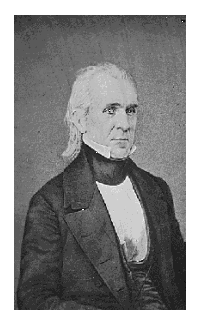
President James K. Polk. Courtesy National Archives.

A replica Conestoga Wagon train on the Oregon Trail. Courtesy National Archives.
ABH Travel Tip

Take a Ranger Guided Tour. These are some of the most knowledgeable folks in the nation about our history. Pick their brains for the tidbits that make history come alive.