
Photo above: John Brown. Courtesy National Archives. Right: Engraving of U.S. Army raid against John Brown's fort led by Robert E. Lee. Courtesy Library of Congress.

Sponsor this page. Your banner or text ad can fill the space above.
Click here to Sponsor the page and how to reserve your ad.
-
Timeline
-
More
-
More
-
More
-
More
-
More
-
More
-
More
-
More
-
More
-
More
-
More
-
More
-
More
-
More
-
More
-
More
-
More
-
More
-
More
-
More
-
More
-
More
-
More
-
More
-
More
-
More
1850
January 29, 1850 - Debate on the future of slavery in the territories escalates when Henry Clay introduces the Compromise of 1850 to the U.S. Congress. On March 7, Senator Daniel Webster endorses the bill as a measure to avert a possible civil war.
June 1, 1850 - The United States census of 1850 counts 23,191,876 population, a 35.9% increase from a decade before. Over three million people now live in its most populous state, New York.
July 10, 1850 - Millard Fillmore is sworn into office as the 13th President of the United States after the death of Zachary Taylor the day before. His policies on the topic of slavery did not appease expansionists or slave-holders.
September 9, 1850 - The Compromise of 1850, pushed by Senator Henry Clay, admits California as the 31st state, without slavery, and adds Utah and New Mexico as territories with no decision on the topic. The Fugitive Slave Law is strengthened under the Compromise, which also ended the slave trade in the District of Columbia.
September 11, 1850 - P.T. Barnum, entrepreneur extra ordinaire, introduces the Swedish Nightingale, Jenny Lind, to an American audience of six thousand at a charge of $3 per person (and more). Her debut at Castle Garden, a converted fort on Manhattan Island, is a rousing success.
1851
May 1, 1851 - The United States of America participates in the opening ceremony of the first World's Fair in history, the Great Exhibition of the Works of Industry of All Nations, in the Crystal Palace designed by Joseph Paxton, in Hyde Park, London, England. The world's fair becomes the first major gathering of the works of nations in one location under the idea of Prince Albert and support of Queen Victoria.
August 22, 1851 - The America's Cup yachting race is inaugurated with the victor crowned in the yacht aptly named, "America."
October 11, 1851 - The first world's fair closes after 141 days of exhibition. 6,039,195 visitors attend the Crystal Palace exhibition, held on twenty-six acres in London's Hyde Park, with exhibits from fifty nations and thirty-nine colonies. The United States had 499 exhibits, of which McCormick's reaper won a gold medal and Charles Goodyear a council medal. To this day, profits from the first world exposition still provide funds for scholarships and cultural endowments throughout England, and this exhibition would spawn over one hundred more, including expos in Shanghai, China in 2010, Yeosu, South Korea in 2012, Milan, Italy in 2015 and Astana, Kazakhstan in 2017.
Minute Walk in History - London Crystal Palace 1851
The first world's fair, conceived and constructed from the ideas of Henry Cole and Prince Albert, Queen Victoria's husband, that for the first time the exhibits of the industries and arts would be shown at one place at one time. Prior to this exhibition, there were just national exhibits and very little international trade. This exhibit, in a building known as the Crystal Palace designed by Joseph Paxton, has forever been the model for International Expos now sanctioned by the Bureau of International Expositions, an international treaty organization begun in 1928. The next world's fair, or international expo, will be held in Osaka, Japan, Expo 2025.
November 14, 1851 - The American publishing industry
manufactures Herman Melville's "Moby Dick." The industry also
publishes Nathanial Hawthorne's "House of Seven Gables," in
1851, and the painting of "Washington Crossing the Delaware" is
completed by German-American artist Emmanuel Leutze.
December 29, 1851 - The first YMCA opens in Boston, Massachusetts.
1852
February 16, 1852 - The Studebaker Brothers Wagon Company is established and would become the largest producer in the world of wagons.
February 19, 1852 - At Jefferson College in Canonsburg, Pennsylvania, the Phi Kappa Psi fraternity is begun.
March 20, 1852 - Harriet Beecher Stowe's masterpiece of American slavery, Uncle Tom's Cabin, is published. Stowe wrote this work of anti-slavery in response to the Fugitive Slave Act. It sold 300,000 copies in its first years of publication.
June 29, 1852 - American Senator Henry Clay, author of much legislation on the topic of slavery, dies. Later that year, on October 24, statesman Daniel Webster, would also pass away. This void in American politics would be felt throughout the next decade as the difficult days of slavery and Civil War would consume the nation.
November 2, 1852 - Franklin Pierce, a Democrat, wins a convincing victory for President, defeating Whig Winfield Scott by a tally of 254 to 42 electoral votes. He also garners the majority in the popular vote. His four years as President, which began March 4, 1853, would cause dismay among Democrats, who would fail to nominate him for office again in 1856.
1853
January 11, 1853 - John Ericsson, designer of the ironclad
Monitor one decade later, tests his ship powered by a caloric, hot air, engine in New York Harbor, but the experiment fails due to lack of power.
April 22, 1853 - The Indian Frontier Post, Fort Scott, in Indian
Territory (Kansas) is evacuated by the United States Army
riflemen.
July 8, 1853 - Commodore Matthew C. Perry and the United States Navy arrive in Edo Bay, Japan. They would negotiate a treaty to allow U.S. ships into Japan.
July 14, 1853 - U.S. President Franklin Pierce opens the first world's fair held in the United States, the Exhibition of the Industry of All Nations. Located on 6th Avenue in a large palace on the site of the current New York Public Library, twenty-three foreign nations and colonies participated.
Minute Walk in History - New York World's Fair 1853
After the success of London's 1st ever World Exhibition in 1851, other cities in the world started making plans for ones of their own. In the United States, the first was a two year fair known as the "The Exhibition of the Industries of All Nations." Take a trip around the site with narration from Jason Donovan and one of the songs played on opening day, "Hail to Columbia."
December 30, 1853 - The Gadsden Purchase is consummated,
with the United States buying a 29,640 square mile tract of land
in present-day Arizona and New Mexico (approximately from
Yuma to Las Cruces) for $10 million from Mexico to allow railroad
building in the southwest and settle continued border disputes
after the Mexican-American War. This act finalized the borders
of the Continental United States.
1854
February 28, 1854 - In Ripon, Wisconsin, the Republican Party is founded, in opposition to the Kansas-Nebraska Act. It would hold its first convention later that year on July 6 in Jackson, Michigan.
May 30, 1854 - The Kansas-Nebraska act becomes law, allowing the issue of slavery to be decided by a vote of settlers. This established the territories of Kansas and Nebraska and would breed much of the rancor that culminated in the actions of the next years of "Bleeding Kansas."
June 10, 1854 - The United States Naval Academy graduates its first class at Annapolis, Maryland.
October 26, 1854 - C. W. Post, American cereal manufacturer, is born.
October 31, 1854 - The New York World's Fair, extended for a second season, closes after 393 exhibit days. The second season, under the presidency of P.T. Barnum, raises the total attendance to over 1,150,000.
1855
March 3, 1855 - The United States Camel Corps is created with a $30,000 appropriation in Congress.
March 24, 1855 - American businessman, banker and philanthropist, Andrew Mellon, is born.
July 1, 1855 - Quinault River Treaty between the United States and the Quinault and Quileute tribes of the Olympic Peninsula in Washington Territory cedes their lands to the United States. It was a goal of territorial governors at the time to acquire land cession treaties with Native Americans.
October 9, 1855 - The Shuttle Sewing Machine and its machine motor are patented by Isaac M. Singer, improving the development of the sewing machine.
1856
April 5, 1856 - Booker T. Washington was born in slavery on a tobacco farm in Franklin County, Virginia, and would later emerge as one of the foremost black leaders and educators of the 20th century.
April 21, 1856 - The first railroad train crosses the Mississippi River on the first bridge constructed at Rock Island, Illinois to Davenport, Iowa.
May 21, 1856 - Pro-slavery forces under Sheriff Samuel J. Jones burn the Free-State Hotel and destroy two anti-slavery newspapers and other businesses in Lawrence, Kansas. Three days later, the Pottowatomie Massacre occurs in Franklin County, Kansas when followers of abolitionist John Brown kill five homesteaders.
May 22, 1856 - South Carolina Congressman Preston Brooks attacks Senator Charles Sumner with a cane in the hall of the U.S. Senate after Sumner gave a speech attacking Southern sympathizers for the pro-slavery violence in Kansas. Sumner would take three years to recover while Brooks was lionized throughout Southern states.
November 4, 1856 - John C. Fremont, the first candidate for president under the banner of the Republican Party, loses his bid for the presidency to James C. Buchanan, despite support for Fremont from Abraham Lincoln. Buchanan, the only bachelor to become president as well as the sole Pennsylvanian garnered 174 Electoral College votes to 114 for Fremont. Millard Fillmore, running on the American Know-Nothing and Whig tickets was also defeated.
November 17, 1856 - Fort Buchanan is established by the U.S. Army on the Sonoita River in current southern Arizona to administrate the new land bought in the Gadsden Purchase.
1857
March 4, 1857 - James Buchanan is sworn into office as the 15th President of the United States. His tenure as President would be marred by the question of slavery and a compromise stance that would neither alleviate nor eradicate the intractable question from American society.
March 6, 1857 - The United States Supreme Court rules in the
Dred Scott decision, 6-3, that a slave did not become free when
transported into a free state. It also ruled that slavery could not be banned by the U.S. Congress in a territory, and that blacks were not eligible to be awarded citizenship.
March 23, 1857 - The first elevator is installed by Elisha Otis on Broadway in New York City.
August 11, 1857 - Colonel Isaac Neff Ebey, leader of the first permanent white settlers to Whidbey Island, Washington Territory seven years earlier, is beheaded and shot by Indian raiders.
December 21, 1857 - Two companies of the 1st Cavalry under Captain Samuel Sturgis arrive at Fort Scott, Kansas to attempt to bring the disorder of "Bleeding Kansas," the slavery versus anti-slavery battle, in check.
1858
April 28, 1858 - Frederick Law Olmsted and Calvert Vaux, landscape architects, win the competition and adoption of their plan for Central Park in New York City.
June 23, 1858 - With strife between pro-slavery and anti-slavery partisans escalating to dramatic chaos, the 2nd Infantry and 3rd Artillery regiments under the command of Captain Nathanial Lyon attempt to restore order during the "Bleeding Kansas" campaign.
August 5, 1858 - The first transatlantic cable is completed by Cyrus West Field and others. It would fail its test due to weak current on September 1.
August 21 to October 15, 1858 - A series of seven debates between politicians Stephen Douglas and Abraham Lincoln occur in Illinois.
September 17, 1858 - Dred Scott, the American slave who precipitated the decision by the Supreme Court on the topic of slavery, dies.
1859
February 14, 1859 - Oregon is admitted to the Union as the 33rd state.
August 27, 1859 - The first productive oil well for commercial use is drilled by Edwin L. Drake in Titusville, Pennsylvania.
October 16, 1859 - The United States Armory at the confluence of the Shenandoah and Potomac Rivers at Harper's Ferry, Virginia (now West Virginia) is seized by twenty-one men under the leadership of abolitionist John Brown. This act to cause an uprising of slaves in the surrounding territories fails when federal troops on October 18, under the command of Colonel Robert E. Lee, kill several of the raiders and capture John Brown. The town of Harper's Ferry, now a spectacular National Park on the topic, remains one of the under recognized historic treasures in the United States.
November 1, 1859 - The Cape Lookout, North Carolina lighthouse, with a Fresnel lens seen nineteen miles away, is lit for the first time.
December 2, 1859 - John Brown is hanged for treason by the state of Virginia due to his leadership role in the raid on the Harper's Ferry armory and failed attempt to spur revolt among Virginia slaves.
History Photo Bomb

Fifty nations, including the United States, plus thirty-nine colonies and protectorates participate in the 1st World's Fair, The Great Exhibition of the Arts and Industries of All Nations in London's Hyde Park. This event signalled the beginning of international trade.
Timeline Book

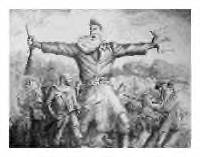
John Brown in Kansas mural. Courtesy National Archives.
ABH Travel Tip
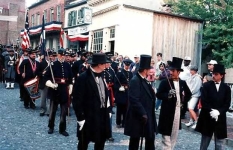
Some of the most surprising locations of historical significance within the National Park Service lay in little known or less attended sites. One gem is Harper's Ferry. This town, site of not only John Brown's famous abolitionist uprising, but Civil War battles throughout the Great Rebellion, includes dozens of restored buildings, with exhibits on the topics, as well as the Appalachian Trail, Jefferson's Rock, and whitewater rafting opportunities on the Shenandoah and Potomac Rivers. Almost the entire town is restored within the park system, and access to it, outside a small parking lot, is through a Park Service shuttle bus on the bluff above town.
