-
Timeline - The 1890s
Immigrants streamed into the halls of Ellis Island in the shadow of the Statue of Liberty, they crossed the nation, growing the cities of the east coast, taking part in land rushes, and adding to the experiment that was the United States of America.
More 1800s

Image below: Return of Casey's scouts from the battle of Wounded Knee, 1890-1891. Courtesy Library of Congress.

Image above: Mining camp at Bennet Lake, May 1898. Photo courtesy Woodside, H.J., 1858-1929. Library and Archives Canada. Right: Engraving of the immigrant scene at Ellis Island, New York harbor. Courtesy Library of Congress.

Sponsor this page. Your banner or text ad can fill the space above.
Click here to Sponsor the page and how to reserve your ad.
-
Timeline
-
More
-
More
-
More
-
More
-
More
-
More
-
More
-
More
-
More
-
More
-
More
-
More
-
More
-
More
-
More
-
More
-
More
-
More
-
More
-
More
-
More
-
More
-
More
-
More
-
More
-
More
1890
September 27, 1890 - Rock Creek Park in Washington, D.C. is created when President Benjamin Harrison signs legislation creating natural preservation in the wooded valley within urban District of Columbia.
December 13, 1890 - Wilbur and Orville Wright print the "Dayton Tattler" in their print shop in Dayton, Ohio. The paper was the creation of Paul Laurence Dunbar, an African American poet.
December 29, 1890 - The Battle of Wounded Knee, South Dakota, occurs in the last major battle between United States troops and Indians. Hundreds of Indian men, women, and children are slain, along with twenty-nine soldiers.
June 1, 1890 - Preparations for the United States census begin using an automated tabulating machine with punch cards invented by Herman Hollerith. It was a historic moment in the history of computing; Hollerith's company eventually became IBM.
June 2, 1890 - The 1890 census indicates a population in the United States of 62,979,766, an increase of 25.5% since the 1880 census. Twenty miles east of Columbus, Indiana is now the geographic center of U.S. population.
Buy Chronology

1891
March 3, 1891 - The 51st Congress of the United States passes the International Copyright Act of 1891.
April 1, 1891 - The Wrigley Company is founded in Chicago, Illinois, originally selling soap, baking powder, and the next year, chewing gum.
May 5, 1891 - Carnegie Hall, then known as Music Hall, opens its doors in New York with its first public performance under the guest conductor, Tchaikovsky.
May 20, 1891 - The first showing to a public audience, the convention of the National Federation of Women's Clubs, of Thomas A. Edison's new strip motion picture film occurred at Edison's West Orange, New Jersey laboratory. Later that year, Thomas Edison would patent the radio.
June 21, 1891 - Alternating current is transmitted for the first time by the Ames power plant near Telluride, Colorado by Lucien and Paul Nunn.
1892
January 1, 1892 - Ellis Island, in New York Harbor, opens as the main east coast immigration center, and would remain the initial debarkation point for European immigrants into the United States until its closure in 1954. More than 12 million immigrants would be processed on the island during those years. Ellis Island replaced Castle Garden, in Manhattan, as the New York immigration center.
January 15, 1892 - James Naismith publishes the rules of basketball and the first official game of basketball is held five days later at the YMCA in Springfield, Massachusetts.
April 15, 1892 - The General Electric Company is formed, merging the Edison General Electric Company with the Thomson-Houston Company.
October 12, 1892 - The first recital of the Pledge of Allegiance in U.S. public schools is done to mark the 400th anniversary of Columbus Day.
November 8, 1892 - Grover Cleveland returns to the presidency with his victory in the presidential election over incumbent President Benjamin Harrison and People's Party candidate James Weaver. Weaver, who would receive over 1 million votes and 22 Electoral College votes, helped defeat Harrison, who garnered only 145 Electoral College votes to Cleveland's 277.
1893
January 14-17, 1893 - The United States Marines, under the direction of U.S. government minister John L. Stevens, but no authority from the U.S. Congress, intervene in the affairs of the independent Kingdom of Hawaii, which culminated in the overthrow of the government of Hawaiian Queen Liliuokalani.
May 1, 1893 - The 1893 Chicago World Columbian Exposition, held on 686 acres and known affectionately as the White City, opens to the public. The world's fair hosted fifty nations and twenty-six colonies. Known today as the architectural wonder that saw replication of the styles of its white buildings throughout the United States in many public buildings for years to come, as well as the public initiation to the Ferris Wheel, a behemoth construction that held up to 2,160 riders.
May 5, 1893 - The New York Stock Exchange collapses, starting the financial panic of 1893. It would lead to a four year period of depression.
September 16, 1893 - The fourth of five land runs in Oklahoma's dash, known as the Oklahoma Land Race or the Cherokee Strip Land Run, opened seven million acres of the Cherokee Strip. It was purchased from the Indian tribe for $7,000,000. Nearly 100,000 people gathered around the 42,000 claims that were available to the first person, with a certificate, to stake a claim.
October 30, 1893 - The Chicago World's Fair closes after 179 days of public admission and over 25 million in attendance. It cost $27,291,715 and included a moving sidewalk and the first sighting of picture postcards. Considered by many historians as the greatest national event in American history through the year 1900.
Minute Walk in History - World's Columbian Exposition 1893
From the World's Fair that many historians think of as the best, one that spawned many a city hall, the White City movement in architecture, and continued the idea, begun in Philadelphia 1876, that the United States was now an equal to its European counterparts. Filled with public domain photos from the 1893 World's Columbian Exposition Illustrated, the World's Columbian Exposition, and the Library of Congress, with words from the official broadsheet of the fair, as well as music written for the fair, the Chicago Day Waltz, step back in time to one of the best world expos ever.
November 7, 1893 - Women in Colorado are granted the right to vote.
1894
April 14, 1894 - The first public showing of Thomas Edison's
kinetoscope motion picture is held. Edison had invented the
process seven years earlier.
April 29, 1894 - In a march of five hundred unemployed workers
into Washington, D.C. that had begun on March 25 in Massillon,
Ohio, leader James S. Coxey is arrested for treason.
May 11, 1894 - A wildcat strike of three thousand Pullman Palace
Car Company factory workers occurs in Illinois.
September 7, 1894 - The fight between heavyweight boxing champ Gentleman Jim Corbett and Peter Courtney is caught on motion picture film by Thomas Edison at the Black Maria studio of his New Jersey laboratory.
December 27, 1894 - Shiloh National Military Park in Shiloh, Tennessee is created to commemorate the field of the two day battle in April of 1862. It was one of the largest engagements between Union and Confederate forces in the western theatre of the U.S. Civil War.
1895
February 20, 1895 - Frederick Douglass, the ex-slave who rose to prominence in national politics as a civil rights advocate and abolitionist during Civil War times died at his home in Washington, D.C.
September 3, 1895 - The first professional football game is played in Latrobe, Pennsylvania. The Latrobe YMCA defeated the Jeannette Athletic Club 12-0.
October 4, 1895 - The first United States Golf Open run by the USGA is held in Newport, Rhode Island. A thirty-six hole competition between ten professionals and one amateur, the winner was Englishman Horace Rawlins, who received prize money of $150.
November 5, 1895 - The first United States patent for the automobile, #549160, is granted to George B. Selden for his two stroke automobile engine.
November 25, 1895 - Oscar Hammerstein opens the first theatre, Olympia, in the Times Square section of New York City.
1896
May 18, 1896 - Plessy versus Ferguson decision by the Supreme Court states that racial segregation is approved under the "separate but equal" doctrine.
April 6-15, 1896 - The first modern Olympic Games is held in
Athens, Greece. Thirteen nations participated, including the
United States of America. It was held in Panathinaiko Stadium
and had originated from an 1894 congress organized by Pierre
de Coubertin who established the International Olympic
Committee.
June 11, 1896 - Funds are appropriated by legislation signed into law by President Grover Cleveland to acquire the house across from Ford's Theatre. This home was the location where Abraham Lincoln died from his wounds in the theatre assassination by John Wilkes Booth.
August 16, 1896 - Gold is discovered by Skookum Jim Mason,
George Carmack and Dawson Charlie near Dawson, Canada,
setting up the Klondike Gold Rush which would cause a boom in
travel and gold fever from Seattle to prospector sites surrounding Skagway, Alaska.
November 3, 1896 - Republican William McKinley claims victory in the presidential election with a majority of Electoral College voters, 271 selected him over Democratic and People's Party candidate William J. Bryan with 176.
December 10, 1896 - The New York City Aquarium at Castle Clinton opens on the tip of Manhattan Island. Castle Clinton, or Castle Garden, had been previously utilized in many capacities during the history of New York City; as a fort, entertainment location, and immigrant depot.

1897
April 15, 1897 - Oil is discovered in Indian territory for the first time on land leased from the Osage tribe, leading to rapid population growth near Bartlesville, Oklahoma.
April 19, 1897 - The first Boston Marathon is run with fifteen runners, won by John McDermott.
April 27, 1897 - The tomb of Ulysses S. Grant is dedicated in New York City, twelve years after his death.
July 17, 1897 - The Klondike Gold Rush begins with the arrival of the first prospectors in Seattle. The Gold Rush would be chronicled beginning eight days later when Jack London sails to the Klondike and writes his tales.
September 1, 1897 - The era of the subway begins when the first underground public transportation in North America opens in Boston, Massachusetts.
1898
February 15, 1898 - The rallying cry, "Remember the Maine" is struck when the United States battleship Maine explodes and sinks under unknown causes in Havana Harbor, Cuba, killing two hundred and sixteen seamen. The sentiment becomes a rallying point during the coming Spanish-American War.
April 22, 1898 - The blockade of Cuba begins when the United States Navy aids independence forces within Cuba. Several days later, the U.S.A. declares war on Spain, backdating its declaration to April 20. On May 1, 1898, the United States Navy destroyed the Spanish fleet in the Philippines. On June 20, the U.S. would take Guam.
May 12, 1898 - San Juan, Puerto Rico is bombed by the American navy under the command of Rear Admiral William T. Sampson. Puerto Rico is overtaken by the United States between July 25 with its landing at Guanica Bay and August 12. These acts during the Spanish-American War would ultimately result in Spain deciding in December to cede lands, including Puerto Rico, to the United States.
July 7, 1898 - The United States annexes the independent republic of Hawaii.
December 10, 1898 - The Peace Treaty ending the Spanish-American War is signed in Paris. The Spanish government agrees to grant independence to Cuba and cede Puerto Rico, Guam, and the Philippines to the United States.
1899
February 4, 1899 - Filipino independence fighters under leader Emilio Aguinaldo begin a guerrilla war after failing to gain a grant of independence from the United States, which they had been fighting for from Spain since 1896.
February 14, 1899 - The United States Congress approves the use of voting machines in federal elections.
March 2, 1899 - Mount Rainier National Park is established in Washington State.
March 28, 1899 - August Anheuser Busch, Jr., grandson of founder of the Anheuser-Busch brewery company, is born. Known for beginning use of Clydesdale in company logo and for buying the St. Louis Cardinals. Also born this year are Al Capone, January 17, and Fred Astaire, May 10.
September 6, 1899 - The Open Door Policy with China is declared by Secretary of State John Hay and the U.S. government in an attempt to open international markets and retain the integrity of China as a nation.
History Photo Bomb
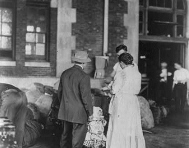
An immigrant family on Ellis Island, March 1917. Courtesy Library of Congress.

Chilkoot Pass, Klondike Gold Rush. Courtesy Library of Congress.
Timeline Book


Frederick Douglass. Courtesy National Archives.
ABH Travel Tip

Don't forget the America the Beautiful Pass, at $80 for one year, the bargain of a lifetime for a family visiting the parks of the National Park Service.

World's Fair History, 1890's
Chicago 1893
San Francisco 1894
Atlanta 1895
Nashville 1897
Omaha 1898
For the history of baseball, check out our friends at Stat
Geek Baseball with unique stats from 1871 to today you can get nowhere else.