-
Timeline - The 1990s
A presidential scandal amidst prosperity and a world that is beginning to show signs of the conflicts to come with the first Gulf War and attacks in New York City.
More 1900s

President Clinton and Boris Yeltsin. Courtesy National Archives.

President Bush with Gulf War troops. Courtesy National Archives. Right: New York Stock Exchange in 1921 by Irving Underhill, Courtesy Library of Congress.

Sponsor this page. Your banner or text ad can fill the space above.
Click here to Sponsor the page and how to reserve your ad.
-
Timeline
-
More
-
More
-
More
-
More
-
More
-
More
-
More
-
More
-
More
-
More
-
More
-
More
-
More
-
More
-
More
-
More
-
More
-
More
-
More
-
More
-
More
1990
February 7, 1990 - The Central Committee of the Soviet Communist Party gives up its monopoly of power, continuing the trend, since the beginning of the Berlin Wall coming down, that the Cold War was about to end. The ending of the Cold War was completed, in many ways, by the strong policies of U.S. President Ronald Reagan toward the Soviet block. Six days later, a plan to reunite Germany was announced.
March 18, 1990 - The largest art theft in U.S. history occurs in Boston, Massachusetts, when two thieves posing as policemen abscond more than one dozen works of art worth an estimated $100-200 million from the Isabella Stewart Gardner Museum.
April 1, 1990 - The 1990 census is conducted, counting 248,718,301, for an increase of 9.8% over the 1980 census. This is the smallest increase in the population rate since 1940. The geographic center of the United States population is now ten miles southeast of Steelville, Missouri.
April 24, 1990 - The Hubble Telescope is placed into orbit by the United States Space Shuttle Discovery. One month later, the telescope becomes operational.
June 1, 1990 - U.S. President George H.W. Bush and his Soviet counterpart Mikhail Gorbachev sign a treaty to eliminate chemical weapon production and begin the destruction of each nation's current inventory.
August 2, 1990 - Iraq invades its neighbor, Kuwait, setting into motion the beginning of U.S. involvement in the Gulf War. Four days later, the United Nations begins a global trade embargo against Iraq. On November 29, the United Nations passes a resolution, #678, stating that Iraq must withdraw its forces from Kuwait by January 15, 1991 or face military intervention.
August 6, 1990 - Tumacacori National Monument is enlarged and re-titled a Historical Park by legislation signed into law by President George H.W. Bush. The site, including the historic Spanish mission church of San Jose de Tumacacori, was founded by Padre Eusebio Kino in 1691.
Buy Chronology

Great Book for the History Fan with Fifty Short Essays Telling the Story of American History.
1991
January 12, 1991 - U.S. Congress passes a resolution authorizing the use of force to liberate Kuwait. Operation Desert Storm begins four days later with air strikes against Iraq. Iraq responds by sending eight Scud missiles into Israel.
February 27, 1991 - The Gulf War ends one day after Iraq withdraws its forces from Kuwait and sets the oil fields on fire. A cease fire is declared and Iraq accepts the condition of disarmament after one hundred hours of ground fighting. On April 3, the United Nations Security Council passes Resolution 687, calling for the destruction and removal of the entire Iraqi chemical and biological weapons stockpile, plus ballistic missiles with a range greater than 150 kilometers. Iraq also agrees to withdraw its support of international terrorism.
October 3, 1991 - The governor of Arkansas, William Jefferson Clinton, announces his intention to seek the 1992 Democratic nomination for the Presidency of the United States.
July 29, 1991 - Bank of Credit and Commerce International is indicted in New York for the largest bank fraud in history.
November 27, 1991 - The United Nations Security Council unanimously votes to adopt Resolution 721, which would lead the way to establishing peacekeeping forces in Yugoslavia. Three months later, another resolution would approve a peacekeeping force be sent.
1992
January 26, 1992 - The renewed nation of Russia, part of the
Soviet Union dissolved on December 26, 1991, and their leader
Boris Yeltsin announce that they will stop targeting the cities of the United States with nuclear weapons.
February 24, 1992 - The Salt River Bay National Historical Park
and Ecological Preserve is established through legislation signed by President George H.W. Bush. The park in St. Croix, U.S. Virgin Islands is the only location under the jurisdiction of the United States where the men of Christopher Columbus are known to have been.
May 7, 1992 - The 27th Amendment to the Constitution is passed two hundred and two years after its initial proposal. It bars the United States Congress from giving itself a midterm or retroactive pay raise. This amendment had been originally proposed by James Madison in 1789, as part of twelve amendments, of which ten would become the original Bill of Rights on December 15, 1791.
August 21, 1992 - The Siege of Ruby Ridge is begun by United States Marshals, lasting ten days. The incident would end with the acquittal of all but one minor charge against the Weaver family and lead to admonishment of the handling of the incident by Federal authorities.
November 3, 1992 - In a three way race for the presidency of the United States, Democratic candidate Bill Clinton defeats incumbent President George H.W. Bush and businessman H. Ross Perot of the Reform Party. Many trace the loss of President Bush to his reneging a pledge for "no new taxes." Clinton received only 43% of the popular vote, but 370 Electoral votes to Bush with 37.4% and 168 Electoral College votes. Perot garnered 18.9% of the popular vote, but no Electoral College delegates.
1993
February 26, 1993 - The World Trade Center is bombed by
Islamic terrorists when a van parked below the North Tower of
the structure explodes. Six people are killed and over one
thousand are injured.
February 28, 1993 - The fifty-one day Waco standoff begins
when the Bureau of Alcohol, Tobacco, and Firearms attempt to
arrest the Branch Davidian leader David Koresh on federal arms
violations. Four agents and five members of the cult are killed in the raid. The siege would end on April 19 when a fire, started by the Davidians, killed seventy-five members of the group, including the leader.
March 22, 1993 - Intel ships the first Pentium chips, revolutionizing the processing of computers around the world.
June 27, 1993 - President Bill Clinton orders a cruise missile attack on the Iraqi intelligence headquarters in Baghdad, responding to the attempted assassination attempt cultivated by the Iraq Secret Service on former U.S. President George H.W. Bush during his visit to Kuwait two months before.
November 30, 1993 - The Brady Handgun Violence Prevention Act is signed into law by President Bill Clinton.
1994
January 1, 1994 - The North American Free Trade Agreement (NAFTA) goes into effect, creating a free trade zone between Canada, the United States, and Mexico.
June 12, 1994 - The bodies of Nicole Brown Simpson and Ronald Goldman are found outside her home in Los Angeles, California. Five days later, her husband, former football star O.J. Simpson is arrested for the crime, but is later acquitted on October 3, 1995. The Simpson case was one of the highest profile murder cases in the nation's history.
September 13, 1994 - President Bill Clinton signs the Assault Weapons Ban, which bars the use of these weapons for ten years.
September 14, 1994 - For the first time since 1904, the World Series of Major League Baseball is cancelled, this time due to a player's strike begun in August by the Major League Baseball Players Association.
October 8, 1994 - The President of the United Nations Security Council states that Iraq must withdraw its troops from the Kuwait border and cooperate with weapons inspectors. Iraq had threatened in September to withdraw their cooperation with UNSCOM inspectors, and began a deployment of Iraqi troops near the Kuwaiti border. A United States reaction to this development during the months of September and October included the deployment of its military force to Kuwait. On October 15, Iraq began to withdraw its troops from the Kuwait region.
November 8, 1994 - The Republican revolution concludes with the midterm elections when for the first time in forty years, the party gains control of both the Senate and the U.S. House of Representatives.
1995
January 1, 1995 - The World Trade Organization (WTO) is
created, replacing the General Agreement on Tariffs and Trade
(GATT) formed from a series of post-war treaties on trade. The
World Trade Organization is more highly structured than the
previous GATT and counted seventy-six nations among its
members in 1995.
January 31, 1995 - U.S. President Bill Clinton invokes emergency
powers to extend a $20 billion loan to Mexico to avert a financial disaster that had begun on December 19, 1994 during a planned exchange rate correction between the Mexican peso and
American dollar.
April 19, 1995 - Anarchists Timothy McVeigh and Terry Nichols
explode a bomb outside the Murrah Federal Building in
Oklahoma City, killing one hundred and sixty-eight people in a
domestic terrorism attack.
May 11, 1995 - One hundred and seventy nations decide to
extend the Nuclear Non-proliferation Treaty indefinitely.
June 29, 1995 - For the first time, the Space Shuttle Atlantis docks with the Russian space station Mir.
July 27, 1995 - The Korean War Memorial in Washington, D.C. is dedicated in ceremonies presided by President Bill Clinton and South Korean President Kim Yong-sam.
1996
June 25, 1996 - The Khobar Towers bombing in Khobar, Saudi
Arabia kills nineteen U.S. military personnel, destroying the
majority of a six building apartment complex that was home to
the 440th Fighter Wing. It was carried out by Islamic terrorists
seeking removal of the U.S. presence in Saudi Arabia.
July 5, 1996 - At the Roslin Institute in Scotland, Dolly, the sheep, becomes the first mammal to be cloned. This begins a rampant debate on the ethics of the procedure in animals and the viability and morality of cloning in human beings.
July 19, 1996 - The Summer Olympics Games are opened in
Atlanta, Geogia by U.S. President Bill Clinton. The games are
positively known for the achievements of American track and
field athlete Michael Johnson, who won both the 200 and 400
meter races, setting a new World Record in the 200, and for the
victory of the American women's gymnastics team. These games
would be marred, however, by the Centennial Park bombing of
Olympic tourists on July 27, which killed one person and injured
one hundred and eleven.
November 5, 1996 - President William J. Clinton defeats
Republican Presidential candidate Bob Dole, as well as the
second run of businessman Ross Perot. Clinton gained 49.2% of
the popular vote, and increased his total in the Electoral College to 379. Dole gained 40.7% of the popular tally and 159 in the Electoral College. Perot's influence on this race was marginal compared to 1992, receiving only 8.4% of the vote in 1996.
December 5, 1996 - A speech by the Federal Reserve Board
Chairman Alan Greenspan suggests that irrational exuberance
may be causing the extraordinary runup of stock prices.
1997
February 9, 1997 - The Simpsons, a ribald cartoon about a family
of misfits, becomes the longest running prime-time cartoon
television series in history, surpassing the Flintstones.
March 4, 1997 - Federal funding for any research into human
cloning is barred by President Bill Clinton.
May 25, 1997 - Strom Thurmond becomes the longest serving member of the United States Senate at forty-one years and ten months.
July 8, 1997 - The NATO alliance expands into eastern Europe when it extends an invitation to the Czech Republic, Hungary, and Poland to join the alliance in 1999.
October 29, 1997 - Iraq states that it will begin to shoot down U-2 surveillance planes used by United Nations UNSCOM inspectors attempting to mandate Saddam Hussein meet the provisions of surrender in the 1991 Gulf War.
1998
January 26, 1998 - The Monica Lewinsky scandal begins when
U.S. President Bill Clinton denies his relationship with the White House intern in a televised interview. This denial, and other denials to a grand jury investigation, would lead to the
impeachment of the president.
February 23, 1998 - Osama bin Laden publishes his fatwa that
announced a jihad against all Jews and Crusaders. This
announcement would push forward the Islamic fundamentalist
agenda toward terrorism against western interests.
May 18, 1998 - The United States Department of Justice and
twenty states file the anti-trust case, U.S. versus Microsoft. On November 5, 1999, a preliminary ruling stated that Microsoft had monopoly power.
August 7, 1998 - Attacks on two United States embassies in
Africa, in Dar es Salaam, Tanzania, and Nairobi, Kenya kills two
hundred and twenty-four and injures four thousand five hundred.
The attacks are linked to Osama Bin Laden and his Al-Qaeda
organization. On August 13, the United States launches cruise
missile strikes against Al-Qaeda camps in Afghanistan and a
suspected chemical plant in the Sudan.
September 29, 1998 - The United States Congress passes
legislation, the Iraq Liberation Act, that states the U.S. wants to remove Saddam Hussein from power and replace it with a
democracy.
October 29, 1998 - John Glenn, thirty-six years after becoming the first American astronaut to orbit the earth, becomes the oldest astronaut in space at seventy-seven years old. His role on the Space Shuttle Discovery flight tests the effect of space travel on aging.
1999
January 1, 1999 - The Euro currency is introduced as a competitive tool to stem the power of the dollar and maximize the economic power of the European Union nations.
February 12, 1999 - President Bill Clinton is acquitted by the U.S. Senate in the Monica Lewinsky scandal. The Senate trial, which began January 7 and needed a 2/3 majority to convict, ended with a 55-45 not guilty vote on the charge of perjury and 50-50 vote on the charge of obstruction of justice.
March 29, 1999 - The Dow Jones Industrial Average closes above 10,000 for the first time.
May 3, 1999 - A series of tornadoes strikes Oklahoma, including an F5 category storm that slams Oklahoma City, killing thirty-eight. The fastest wind speed ever recorded on earth is measured by scientists at 509 km (318 mph) during this tornado.
November 30, 1999 - The first major mobilization of the anti-globalization movement occurs in Seattle, Washington, during the days before the 1999 World Trade Organization meetings. The protests and rioting caused the cancellation of the WTO opening ceremonies.
History Photo Bomb
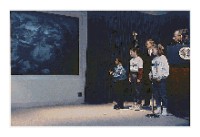
President George H.W. Bush, Vice President Dan Quayle and
school children in conversation with astronauts at NASA. January 24, 1992. Photo: Photographic Office.
Official Souvenirs
America's Best History


Towers of the World Trade Center. Courtesy National Archives.
Timeline History

Want a copy of the Timeline. Now available in easy to search
digital format for your Kindle, Nook, or pdf format. Also comes in paperback, too.

Christopher Columbus, by Ridalfo Ghirlandaio, 1520. New U.S.
preserve, Salt River Bay, on land Columbus actually visited dedicated in the Virgin Islands. Courtesy Wikipedia Commons.
ABH Travel Tip

If you've never been there, or it's been awhile since you've taken a trip to Washington, D.C., the nation's capitol is a treat for anyone interested in the USA and its history. From the spectacular museums of the Smithsonian, to the recent addition of the Holocaust museum and the Newseum, too, there's so much to see and do. One of the best new attractions is the World War II Memorial. It will make you wonder what took them so long and just why there was any controversy about adding this museum to the space between the Washington Memorial and the Lincoln Memorial.