-
Timeline - The 1870s
The decade would hold a celebration of the nation's 100th birthday barely ten years after a Civil War, but most remarkable was not the anniversary, but the intellectual and industrial progress that the USA would make. By 1876, the genius of its inventors was being noticed around the world. Previously thought as a former rube colony well beneath the nations of Europe, the United States was beginning to show not only their equality, but that soon they would surpass them.
More 1800s
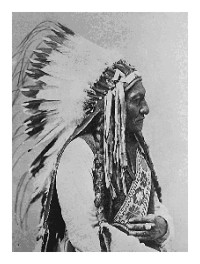
Chief Sitting Bull, (Tatonka-I-Yatanka) Hunkpapa Sioux, circa 1885.
Click here to Sponsor the page and how to reserve your ad.
-
Timeline
1874 - Detail
August 15, 1874 - First arranged marriage between European royalty harmed by the Economic Collapse of 1873 to wealthy families in the USA who maintained their money during the crash occurs. They would become known as the Dollar Princesses.

Article by Jason Donovan
For millennia, the noble classes of the world over have used their children to secure alliances of
one type or another. The long-used trope of a young woman dreaming of marrying a prince
possibly goes back millennia as well. Most of these arrangements are between noble families or
"old money" in Europe, but it has always been a fact of history, many times over, that money
talks, no matter where the funds come from. Love is not the main concern in such situations; it is
just a transaction between the families involved. Many may think that such arrangements are part
of long-ago history, but that is not true. During the Gilded Age, wealthy American new-money
robber barons used their daughters, marrying them into the royal families of Europe. Even
though these marriages are lesser-known unions, their history is important to relate. In the words
of a popular history channel on YouTube, this is "history that deserves to be remembered."
The phenomenon of the "dollar princesses" emerged from a combination of factors. In Europe,
the prices of agricultural staples declined due to global competition. Combine this with the
substantial losses suffered by many in the royal classes as a result of the financial crash in 1873.
The crash was caused by speculation of overextended railroads, which resulted in their collapse.
Even though many European investors got out in time, the situation worsened. Inevitably, as with
every busted economic bubble, many investors did not make it out in time. With titles came the
expectation of maintaining estates that were an unsustainable drain on the noble class's finances;
a cash infusion was inescapable.
On the other side of the pond, even with the economic crash, the top of the economic ladder was
still flush with cash. Being part of the top crust of American society was not enough; having
royalty in the family was the ultimate goal. The American upper crust married off their daughters
in exchange for that cash infusion. The setup was a win-win for many, not all, of the parties
involved.
These arrangements were not always agreeable to the young ladies at their center. These
marriages were not, primarily, love marriages, and in some cases, the parents put horrendous
amounts of pressure on their daughters' shoulders. A notorious example of the lengths some
parents would go to get what they wanted is that of Consuelo Vanderbilt. Her mother, Alva, was
strict and abusive. One of the stories that Consuelo would later relate is that her mother told her
that her daughter's refusal to marry Charles Richard John Spencer-Churchill, 9th Duke of
Marlborough, was literally killing her. Alva would be carried around their estate by her servants
and was constantly pressuring her till she finally agreed. Another account states that Consuelo
also said she was locked in a room till she agreed to the marriage. These actions are severe
abuse, but are not out of line when you consider that growing up, Consuelo would have a riding
crop used on her when she was not obedient. After Consuelo finally agreed, her mother was
reported as saying, ...
"I forced my daughter to marry the Duke. I have always had absolute power over my daughter."
These are the things these young women were subjected to so their parents could achieve their
own ambitions. Many of these marriages were much the same, horrible.
Consuelo cried throughout the entire 1895 wedding in New York. The marriage would be
loveless. Consuelo would be neglected by her husband throughout their entire marriage, resulting
in them being separated for much of their 25-year marriage. There are conflicting accounts of
how their marriage came to an end. One account states that the Duke, who had become a
Catholic, asked the pope for an annulment, which was granted. Another account states that
Consuelo sued for divorce, based on the severe coercion used on her, which was granted. In any
case, a New York Times article dated 10 November 1920 states that her divorce was granted the
previous day.
And There Were More
Consuelo was just one of roughly 500 individual women who would become Dollar Princesses,
but, just like any other trend or phenomenon, there is always a first person to blaze the way for
others to follow, even if many were forced to walk that path. The first dollar princess was Jennie
Jerome, the daughter of a New York financier. She was engaged to Lord Randolph Churchill
three days after they met, but their wedding would take place in Paris after two years of
negotiations over money. The day after the money was transferred. Jennie, on April 15, 1874, was in a loveless
marriage where money was always short. Without love in her marriage Jennie was well know for
having affairs with upper society men who, like her husband, held positions of power including
Prince Karl Kinsky, who's family were rulers in Bohemia modern day Czechia. As well as
Herbert von Bismarck, whose father was the German Chancellor. Allegedly, her biggest catch
was King Edward VII himself. Jennie was not the only one to stray from the marriage; Lord
Randolph did the same thing, contracting syphilis. Their marriage lasted 20 years until Lord
Randolph's death. Enduring the 20 years of pain and distance, she unknowingly helped to save
the world from the darkness of the German war machine in World War II. She was the mother of a future "British
bulldog" named Winston Churchill.
Jennie Churchill was not the only princess who would bring forth a person who would become
loved and admired by people all over the earth. Francis Ellen Work was the daughter of Frank
Work, the son of an Englishman who moved to New York City, where he became Cornelius
Vanderbilt's protege and personal stockbroker. Francis's father, unlike Consuelo's mother, was
dead set against his daughter's marriage. Being headstrong as she was, she married the son of an
Irish lord, James Burke Roche. Her father made his feelings clear when he said, ...
"I am an American to my backbone... I have only contempt for these helpless, hopeless, lifeless
men that cross the ocean to carry off the very flower of our womanhood... If I had anything to
say about the matter, I'd make international marriage a hanging offense!"
Francis's father may have seen something in his son-in-law that his daughter did not. James had
a knack for bad business decisions to such an extent that his business partner, Moreton Frewen,
whose own family gave him the nickname of "Mortal Ruin." Francis paid for her decision to
marry her father, reducing her allowance to $7,000 a month, roughly $200,000 in 2026. James
spent her money like water over the Niagara Falls. The breaking point for the lady of the house
came when the manor was stripped bare by the repo men in order to cover James' debts. This was
one of many times her husband had to be bailed out; his father-in-law had to pay off his then
future son-in-law's gambling debts that totaled $100,000, $3.17 million in 2026. With her eyes
finally opened, Francis moved back to New York City with her daughter. Her husband refused to
allow her to take their twin sons with her. She would file for divorce in New York, claiming
desertion as the reason for her filing. The divorce was drawn out due to a war that erupted over
the custody of the children. Another snag was the fact that American divorces were not
recognized in England.
Francis would marry for a second time when she married her driving instructor in 1905. The
marriage would also end in divorce. She would spend her later years traveling between her lavish
5th Avenue apartment in New York City. Like Jennie Francis was part of a chain that would bare
an individual who would be respected and loved the world over, her great-granddaughter,
Princess Diana Spencer.
There was a dollar princess who was not just royalty but an ambitious politician in her own right.
Nancy Witcher Langhorn was born in 1879 to a once-wealthy former Civil War soldier. Nancy's
father, Chiswell Dabney Langhorn, was financially wiped out by the war. He would, after a
decade of struggle and a move to Richmond, rebuild his fortune in the post-war railroad industry.
Nancy would meet her first husband, Robert Gould Shaw II, and they would produce one son,
Robert Gould Shaw III. The marriage was stormy and lasted only four years. It was said by some
that her husband's excessive drinking was the reason for the divorce. She would move back into
the family home.
This decision would change her life. While living at home, it was at her father's urging that she
moved to England in 1905 along with her sister Phyllis. Due to Nancy's "American glamor and
quick wit," she would easily slide into the orbit of British high society. Within these circles, she
met Waldorf Astor. Astor was American by birth and bonded with Nancy over their shared
country of birth; within six months, they were married. Nancy's father-in-law, William Waldorf
Astor, gifted the couple the 152-hectare, 375-acre Cliveden estate along the Thames.
Waldorf was a member of parliament representing Plymouth. He gave up his seat when his father
died in 1919 to become the 2nd Viscount Astor, thereby being elevated to the House of Lords. At
her husband's urging, she entered the political arena. Lady Astor was good at networking,
especially because she was a great party hostess. She ran for her husband's seat in parliament,
thus becoming the first woman member of parliament. Her wit and outspokenness on lowering
the voting age for women to 21, and she gave many speeches on women's rights. Her wit, a
sharpened tool of speech, was on full display when Churchill made the remark that the "feeling
of having a woman in Parliament as having someone intrude on him in the bathroom." Her reply
was perfect, she simply replied, "Sir, you are not handsome enough to have such fears."
The Astors thought that appeasement towards Hitler was the correct path, but once the war
kicked off, they used their substantial fortune to run hospitals for wounded soldiers and many
projects in the Plymouth area. The end of the war also spelled the end to her political career. Her
husband urged her to stand down. By the time she retired, a total of 24 women had been elected
that year.
After a life that defined an era and changed British society, Lady Astor spent her later years, living apart from Waldorf after she retired from parliament, which caused a rift between the two. She
appears to have regretted this situation when, after he died, she said, ...
"Waldorf was no good without me, and alas, I am no good without Waldorf, ... "These last 7
years have been heartbreaking ... how it makes me grieve for the years wasted."
Her life came to an end on 2 May 1964 after she suffered a stroke. The love she had for her
husband was visible till the end, when, as she began to slip away, she called out for him.
She died surrounded by her family; she was 84. She was cremated, and her ashes were buried
next to her husband on the Cliveden estate. Her legacy lives on not only in Plymouth but in the
fact that the United Kingdom has had three female prime ministers.
Today, a prime minister is the top position of the constitutional monarchy, but in
the Victorian era, the queen defined an era of colonial empire that was so large that the sun
never set. India was called the crown jewel of the empire. It would be an American princess
who would become the empress of India, the second highest woman in the empire, only
below the queen herself. Mary Victoria Leiter was born on 27 May 1870. Her father, Levi Z.
Leiter, made his fortune first by investing in a department store that would later be owned by his
business partner, Marshall Field & Co. Levi sold his share in 1881. He then invested his money
in Chicago real estate. This fortune allowed her mother to pursue her quest for social dominance. Her mother took her daughters to Europe in search of a royal husband. They first went to France, but they
found the French to be snobs and self-centered. They turned to England to continue their
search. It was here that she fell in love with George Nathanial Curzon. George did not fall in love
with his wife right away; it took time for his heart to melt. Unlike many marriages of dollar
princesses, their love for each other was a deep one. George was a member of parliament,
diplomat, and Asian expert, He would be appointed viceroy of India in 1898 when he was made
Baron Curzon of Kedleston, making Mary Baroness Curzon and vicereine of India. With his
promotion, the Curzons moved to India in 1898.
They arrived in Bombay to great fanfare, and a few days later, upon arriving in Calcutta, there
were around one hundred thousand people gathered to greet the couple. Mary soon became
known for her beauty and for her respect for the Indian people. Her beauty was written into verse
when Indian poet Ram Sharma, in his welcome address, stated that Lady Curzon was "A rose of
roses bright, A vision of embodied light." Another poet said she was "Like a diamond set in gold,
the full mood in a clear autumnal sky." She had empathy and compassion for the Indian people
when she, her husband, and their entourage came across a flooded village. She made them stop,
listened to the villager's concerns, and proceeded to have food and other supplies taken from
their own and fairly distributed to the villagers.
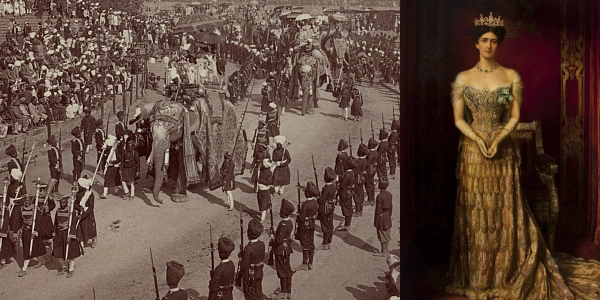
Lady Curzon is also known for her ability to throw a wicked party, i.e. the 1903 celebration of King
Edward's coronation, known as the Delhi Durbar. She wore the now-famous "Peacock dress."
The peacock is a traditionally important religious symbol in India. Through her support of local
craftsmen, the dress consisted of a traditional fabric worn by the Mughal court. The materials
that made up the dress include intricate embroidery with gold and silver threads, green beetle
wing covers on silk taffeta, a lining of Indian cotton muslin, lace net, rhinestones, and white silk
roses. The night was a huge success.
Although Lady Curzon had a fondness for India, the climate was not easy on her.
Whilst in India, her health suffered from headaches that only grew worse over time. By 1903, the
headaches grew into a full-blown acute sickness, which left her bedridden for at least a month.
Not only did she have these acute health problems, but she was pregnant with the couple's third
daughter. After the birth of their daughter, she continued to have headaches and bouts of illness.
By that summer, she was pregnant again, but the pregnancy ended in a miscarriage. Some say
she was pushing herself too hard and even though she would survive her illness and return to India
with her husband once again, their time there was numbered.
By 1905, George would be forced to resign and return to England after being abandoned by his
parliamentary allies. They had been crushed by this with Mary writing to her mother that
returning to India was a great mistake. In the same letter, she states that "I shall go out of my
mind if I have to bare much more strain and worry."
All the years of sickness and strain mixed with a bout of influenza resulted in a battle that this
time her body could not win. The end came quickly. She had a heart attack and died on 18 July
1906 at 5:40 p.m., according to a newspaper account. She was only thirty-six years old.
Lady Curzon was survived by her husband and their three daughters. She is not remembered for
her illness but, in part, for her tireless work to improve the lives of women in India through
education and healthcare. She was also remembered for her beauty and gracefulness.
Conclusion
Dollar princesses were a product of their time. The ambition that their parents used to make their
fortunes also pushed their daughters into marriages that were, as a rule, unhappy, painful unions
that did not take into any account the young lady's wants, needs, or desires they may have had for their own lives.
These transactions were not only about the ambition mentioned above, but also about power and a need to be counted among the highest heights of the social mountain, like Zeus on Mount
Olympus. Unlike Olympus, which was made of rock and stone, theirs was made of pain, misery,
broken dreams, and broken hearts with veins of golden love running through it. May these ladies'
struggles serve as a cautionary tale for the rich and social climbers. Sometimes the reality of the
fairytale is that of a nightmare.
Image above: Montage from left to right; Consuelo Vanderbilt, Jennie Jerome Churchill (1880s Jose Maria Mora), Francis Ellen Work Roche (1910/1915 Bain News Service), Lady Astor (1922 Bain News Service). Courtesy Library of Congress and Wikipedia Commons. Image below: Montage (left) of the Grand tusker, carrying Lord and Lady Curzon, Delhi, India, 1903, Underwood and Undwerwood. Courtesy Library of Congress. (right) Portrait of the Famous Peacock Dress worn by Lady Curzon at the Coronation Ball in 1903, 1909, William Logsdall. Courtesy National Trust via Wikipedia Commons. Info Source: Richardson, Gary, and Tim Sablik. "Banking Panics of the Gilded Age," 2015, Federal Reserve; Preskar, P. "The American dollar princesses - the dirty rich heiresses who married British aristocrats. ShortHistory.com," 2023; "Armstrong, N. "There was a real gutsiness about them: How the heiresses dubbed the "dollar princesses" brought US flair to the UK. BBC, 2025; Saelee, M. "Research guides: Dollar princesses: Topics in Chronicling America: Introduction," Library of Congress; "The dollar princesses," Epochs-of-Fashion: Costume and Dress throughout History, 2025, Epochs-of-fashion.com; Henry Poole Savile Row; West, L. "Consuelo Vanderbilt, the first dollar princess of the Gilded Age," untappedcities.com; "Duchess Divorced from Marlborough; Former Consuelo Vanderbilt Wins a Decree After a Short Hearing in London Court," 1920, New York Times; "Jennie Jerome (1854-1921)." American Aristocracy; Old Money Allure. "Dollar Princesses: When American "Old Money" Heiresses Marry British Aristocrats." YouTube, 2024; "Franklin H. Work (1819-1911) - American Aristocracy." americanaristocracy.com; "Nancy Astor." Historic UK; "Waldorf Astor (1879-1952) - American Aristocracy."; "Later Years, Plymouth.gov.uk," 2025; "Levi Leiter (1834-1904) - American Aristocracy."; "The (1999). Mary Victoria Leiter Curzon | British Aristocrat, Viceroy's Wife & Philanthropist," Encyclopedia Britannica; Timenote.info. Mary Victoria Curzon; Trust, N. The Peacock Dress 107881. National Trust Collections; coloradohistoricnewspapers.com, "Death of Lady Curzon, 1906, The Salida Record; Library of Congress.
History Photo Bomb
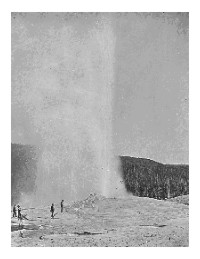
Old Faithful Geyser, Yellowstone National Park, circa 1872. By the Hayden Survey, William H. Jackson, Photographs.
Buy Chronology


Jesse James, circa 1882. Courtesy Library of Congress.

Get historical fiction about the son of Jesse James, nothing like his father, in Freeborn. Unique humor fiction.
Official Souvenirs
America's Best History

Get history and national park souvenir t-shirts, mugs, stickers, posters, and other gifts from the official gear of America's Best History, now available on Zazzle, Cafepress, Amazon, and Redbubble.