-
Timeline - The 2000s
It began a decade before, although in many ways the intensity of the dynamic was missed, but when the hijacked planes hit the World Trade Center, the Pentagon, and the Shanksville field on September 11, 2001, there was no denying that a new order had emerged. It was a war against our way of life, a war of terror, and our response would dominate the decade and years come.
More 2000s

President Barack Obama. Courtesy Wikipedia Commons.
Click here to Sponsor the page and how to reserve your ad.
-
Timeline
2002 - Detail
February 8, 2002 - Amid tight security due to terrorism concerns, the Winter Olympic Games are opened by President George W. Bush in Salt Lake City, Utah. They would continue without major incident until the closing ceremony on February 24.
With the destruction of 9/11 less than six months before, and the prospect for terrorism on everyone's minds, hosting the Olympic Games in the United States after the worst attack on the homeland since that of Pearl Harbor was a tentative and Herculean task. Taking on the hosting of any Olympics was always difficult, and terrorism was not new to the genre after the Munich Summer Olympics of 1972, but the dynamic at Salt Lake City certainly held a heightened concern. Fortunately for the games, future governor of Utah and Utah Senator Mitt Romney had been, and continued to be a major force in running a successful event. Coupled that with the George Bush Administration's narrow focus on keeping the nation safe (perhaps losing a grip on the national economy over his final years in office), as well as pursuing the Islamic Fundamentalists who caused the Trade Center, Pentagon, and Flight 93 attacks.
Most preparation had been well on their way when September 11, 2001 struck the nation. Salt Lake City had been granted hosting rights to the 2002 Winter Olympics on June 16, 1995, besting competitors Jaca, Spain; Östersund,
Sweden; and Val d'Aosta, Italy. A public referendum had been held with overwhelming support. The initial budget for the games, circa 1998, was $1.45 billion, with venue development, $40 million for a legacy foundation and a $55 million contingency. However, there would be problems. In January 1999, SLOC chairman since 1991, Frank Joklik, and Vice President Dave Johnson left the organization under allegations of impropriety in the bidding process; this also cost six officials from the International Olympic Committee their jobs.
In February 1999, the Salt Lake City Olympic Committee hired Mitt Romney, a businessman man involved with Bain Capital, to run the games. He installed five principles for heightening the integrity of the organization and focused on providing the best experience for the athletes. A twenty member management committee was created. In all, the new management team trimmed their budget to cull any deficits that were occuring; the budget was now $1.27 billion. After the attacks of 9/11 brought up questions about whether the games should continue, Romney made assurances that they could host a safe games.
"Like you, I have been overwhelmed with emotion. The Olympics is needed in America and the world more now than it was a few days ago ... the Olympic Games are an important symbol that civilization will not come to a stop, will not come to its knees and will not cease being because of terrorists," Mitt Romney.
The budget for security was raised from $200 million to $350 million.
The Salt Lake City Winter Olympics would begin with their opening ceremony on February 8, 2002 with fifty-six thousand people attending in Rice-Eccles Stadium. It was the culmination of thirty years of pursuing an Olympic Games. They had bid in 1966 to host the 1972 Winter Games. The crowd watched the 1980 Gold Medal Hockey Team light the silver Cauldron with the Olympic torch. The games were held from Feburary 8-24, 2002, including 2,399 athletes from 77 (nations and teams). There were seventy-eight events held. There were nightly concerts.
"The Olympic cauldron has been lit heralding the formal start of the 19th Winter Olympiad in Salt Lake City. ... Beneath a sky lit up by fireworks, more than 52,000 spectators -- the largest Opening Ceremonies crowd in the history of the Winter Olympics -- braved 30 degree temperatures and packed Rice-Eccles Stadium on the University of Utah's campus for the festivities ... The Olympic flag was brought into the stadium by such noted figures as astronaut and former Sen. John Glenn, Nobel Peace Prize recipient Desmond Tute, and director Steven Spielberg ... The U.S. flag recovered from the World Trade Center rubble was brought into the stadium before the parade of athletes by eight American athletes and several New York City area police and firefighters ... The ongoing terrorism threat in the United States, meanwhile, will be reflected in the Games' tight security. Some 10,000 security personnel - including 5,600 members of the U.S. military -- will canvas the 110-by-35 mile swath of Utah where Olympic events will be held, making this year's Olympics the most heavily fortified in history." CNN Report.
The venues, including the speedskating Oval, nordic skiing and biathlon venue Soldier Hollow, and the Utah Olympic Park would remain for future generations. The games would finish with a $56 million surplus. Today, those Olympics are held with great esteem from residents of Utah and journalists.
"... Then came the closing ceremonies. Some 45,000 people crowded into Rice-Eccles Olympic Stadium for closing ceremonies, where IOC President Jacques Rogge called Salt Lake City’s Games “superb� and the crowd sang along with "Happy Trails to You." Performers that night included Christina Aguilera, Bon Jovi, Harry Connick Jr., Earth Wind & Fire, Gloria Estefan, KISS and Willie Nelson. ‘N Sync sang the national anthem," Chris Miller, Deseret News.
Athletes of the Salt Lake City 2002 Games
Who were the stars of the Winter Olympics in 2002? From an international standpoint, multiple athletes won multiple medals. At the top of the list was Ole Einar Bjørndalen, the Norwegian Biathlon skier who won four gold medals. Not far behind was Croatian skier Janica Kostelic with three gold and one silver and Samppa Lajunen, from Finland, with three gold medals in Nordic Combined (ski jumping and nordic skiing).
At these United States games, there were many amazing stories of the athletes from the fifty American states. Apolo Anton Ohno won one gold and one silver in short track speedskating, tying Derek Parra with the same total in long track speedskating. As figure skating is often one of the most watched and talked about sports, Sarah Hughes won gold in the women's single competition after falling behind the apparent favorite, fellow American Michelle Kwan after the short program. Her long program would surpass Kwan, gaining the gold. Kwan would win the bronze. It would be until 2026 until another American woman would win the same medal, Alysa Liu.
Salt Lake City to Host Again in 2034
As the Olympic Committee attempts to control costs and not put extra monetary pressure on future Olympic Games, they are attempting to place future Summer and Winter Olympics back in cities that have hosted before and have most of the venues already built. Not that there won't be some new venues at any of the games, for example the sliding tracks at Milan-Cortina 2026, but to limit the extraordinary builds of past games, and venues never to be used again. So with this new mantra, it was no great surprise that Salt Lake City was awarded the 2034 Winter Olympics. It would be the second games chosen with the new criteria, called the IOC's dialogue approach. On July 24, 2024, with 83 yes votes and 6 no, Salt Lake City was chosen. Now, today, there will likely be no head of the games named Mitt Romney, although he may have a role. But the Utah city has experience, and will likely put on another great games.
What is the IOC Dialogue Approach? Adopted in 2019, this new selection process includes continuous dialogue with prospective cities, split into IOC summer and winter commmittees. There is no large scale, and expensive, bid plan, and the dialogue is not tied to a specific year. If the candidate passes the first dialogues, they are considered an Interested Party. Feasibility studies are conducted by the IOC; no financial commitment from the cities, then if that goes well, they become Preferred Hosts. At this point, the Executive Committee of the IOC can call an election by secret ballot. So what are the differences from previous selection processes? One is that the bidding cities of the past would spend enormous sums just to get to the election process, but only one city would win. Part of the criteria includes no necessity to build new venues for games, as well as legacy and sustainability plans. For two of the past candidates, this has reduced their bid costs by eighty percent. For four recents games held or to be held; Paris 2024, Milan-Cortina 2026, Los Angeles 2028, and Brisbane 2032, the use of existing facilities ranges from 84% (Brisbane) to 100% (Los Angeles).
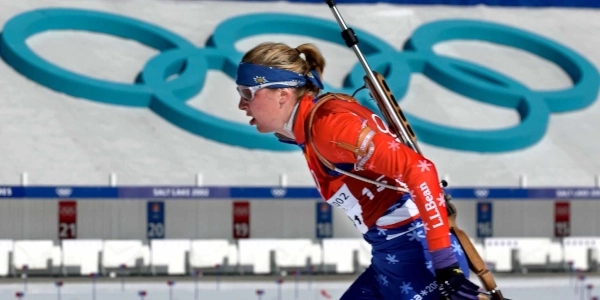
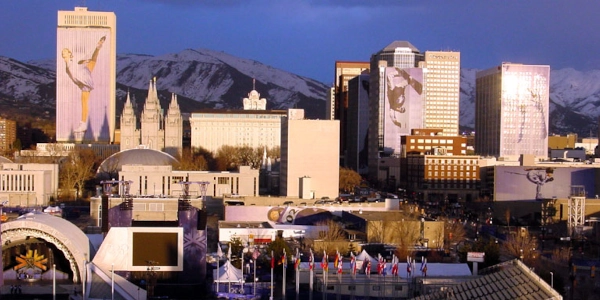
Photo above: World class athlete Specialist Andrea Nahrgang passing the shooting range during the women's 4 X 7.5km relay in the 2002 Winter Olympic Games, 2002, Journalist 1st Class Preston Keres. Courtesy U.S. Navy via Wikipediam Commons. Photo below: Salt Lake City during the Winter Olympics in 2002, 2002, Debaird. Courtesy Wikipedia Commons C.C. 2.0. Info sources: Olympics.org; "2002 Olympics Came to a Close with a Bang," 2025/2026, Chris Miller, Deseret News; Utah Archives and Records Service; "Official Report of the XIX Olympics Winter Games," 2002, Salt Lake City Olympic Committee, LA84foundation; "Winter Games Open with Celebration of American Heros," 2002, CNN; Wikipedia Commons.
History Photo Bomb
Bush-Cheney campaign bus on their presidential campaign through the Philadelphia suburbs in 2004.
Timeline History

Want a copy of the Timeline. Now available in easy to search
digital format for your Kindle, Nook, or pdf format. Also comes in paperback, too.
Baseball History

Check out our partners at Stat Geek Baseball and Baseballevaluation for a history of baseball with stat geeks in mind, including their books Fields of Gold, Baseball's Best Glove Work, and Baseball's Best @ 150.

Site of the former World Trade Center.
ABH Travel Tip

Much of America's best history takes in the beauty and nature of our national parks. From the first park in Yellowstone, from the coast of Maine to the shores of Hawaii Volcanoes, check out the history of the USA as made by our land.
Damage across the Gulf Coast from Mississippi to New Orleans after Hurricane Katrina.
Official Souvenirs
America's Best History

"... Then came the closing ceremonies. Some 45,000 people crowded into Rice-Eccles Olympic Stadium for closing ceremonies, where IOC President Jacques Rogge called Salt Lake City’s Games “superb� and the crowd sang along with "Happy Trails to You." Performers that night included Christina Aguilera, Bon Jovi, Harry Connick Jr., Earth Wind & Fire, Gloria Estefan, KISS and Willie Nelson. ‘N Sync sang the national anthem," Chris Miller, Deseret News.
At these United States games, there were many amazing stories of the athletes from the fifty American states. Apolo Anton Ohno won one gold and one silver in short track speedskating, tying Derek Parra with the same total in long track speedskating. As figure skating is often one of the most watched and talked about sports, Sarah Hughes won gold in the women's single competition after falling behind the apparent favorite, fellow American Michelle Kwan after the short program. Her long program would surpass Kwan, gaining the gold. Kwan would win the bronze. It would be until 2026 until another American woman would win the same medal, Alysa Liu.
What is the IOC Dialogue Approach? Adopted in 2019, this new selection process includes continuous dialogue with prospective cities, split into IOC summer and winter commmittees. There is no large scale, and expensive, bid plan, and the dialogue is not tied to a specific year. If the candidate passes the first dialogues, they are considered an Interested Party. Feasibility studies are conducted by the IOC; no financial commitment from the cities, then if that goes well, they become Preferred Hosts. At this point, the Executive Committee of the IOC can call an election by secret ballot. So what are the differences from previous selection processes? One is that the bidding cities of the past would spend enormous sums just to get to the election process, but only one city would win. Part of the criteria includes no necessity to build new venues for games, as well as legacy and sustainability plans. For two of the past candidates, this has reduced their bid costs by eighty percent. For four recents games held or to be held; Paris 2024, Milan-Cortina 2026, Los Angeles 2028, and Brisbane 2032, the use of existing facilities ranges from 84% (Brisbane) to 100% (Los Angeles).
Photo above: World class athlete Specialist Andrea Nahrgang passing the shooting range during the women's 4 X 7.5km relay in the 2002 Winter Olympic Games, 2002, Journalist 1st Class Preston Keres. Courtesy U.S. Navy via Wikipediam Commons. Photo below: Salt Lake City during the Winter Olympics in 2002, 2002, Debaird. Courtesy Wikipedia Commons C.C. 2.0. Info sources: Olympics.org; "2002 Olympics Came to a Close with a Bang," 2025/2026, Chris Miller, Deseret News; Utah Archives and Records Service; "Official Report of the XIX Olympics Winter Games," 2002, Salt Lake City Olympic Committee, LA84foundation; "Winter Games Open with Celebration of American Heros," 2002, CNN; Wikipedia Commons.
History Photo Bomb
Bush-Cheney campaign bus on their presidential campaign through the Philadelphia suburbs in 2004.
Timeline History
Want a copy of the Timeline. Now available in easy to search
digital format for your Kindle, Nook, or pdf format. Also comes in paperback, too.
Baseball History
Check out our partners at Stat Geek Baseball and Baseballevaluation for a history of baseball with stat geeks in mind, including their books Fields of Gold, Baseball's Best Glove Work, and Baseball's Best @ 150.
Site of the former World Trade Center.
ABH Travel Tip
Much of America's best history takes in the beauty and nature of our national parks. From the first park in Yellowstone, from the coast of Maine to the shores of Hawaii Volcanoes, check out the history of the USA as made by our land.
Damage across the Gulf Coast from Mississippi to New Orleans after Hurricane Katrina.
Official Souvenirs
America's Best History