Sponsor this page. Your banner or text ad can fill the space above.
Click here to Sponsor the page and how to reserve your ad.
-
Timeline
Detail - 1507
1507 - A new world map by Martin Waldseemuller names the continents of the New World "America" in honor of Amerigo Vespucci's contention that Brazil and the West Indies were not the far reaches of Asia, but actually a new continent.
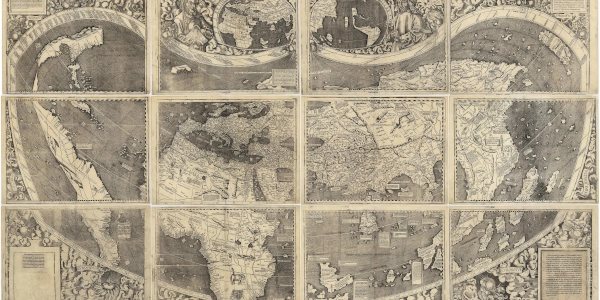
The maps of the ancient world are fascinating looks at how the cartographers of the time thought the world appeared. Those views were greatly challenged after Christopher Columbus came back from his journey to the New World, i.e. Hispaniola and the Caribbean islands around it. However, for nearly a century, the world thought Columbus was in the Orient and the explorers who came after, still searched through the Americas for a passage to the Far East that was on the other side of the East Coast of the Americas. It would not be until the voyages of Amerigo Vespucci to Brazil, etc. during and after Columbus made his four journeys, and his thought that this land was not the Orient, that minds began to change. It changed for cartographer Martin Waldseemuller and his humanities colleague Matthias Ringmann; they were about to pay homage to Amerigo, as well as change the way the world thought about the globe. Yes, they were going to construct a map that included a separate America and a separate Asia.
The project started out in St. Dié, France. The men, both cartographer Martin Waldseemuller and humanities expert, Mattias Ringmann, plus others in their fields, would take the information gathered during the voyages of the 15th and 16th century to the New World, including those of Amerigo Vespucci, a Florentine merchant who sailed for Spain and Portugal, that he had recounted in his letter, "Mundus Novus," four voyages, some contend two, from 1497 to 1504, and construct a new map. This map would include a new ocean, the Pacific, and a new continent, America. There are two inset maps of the separate Western and Eastern Hemispheres. Illustrations by Claudius Ptolemy (who had drawn previous ancient maps) and that of Vespucci are included, as well as graphics of winds. The map included twelve sheets, 18 inches by 24 inches. When put together, the map spans four feet by eight feet.
Who should be credited with using the word, America, to describe the new continent? Think Mattias Ringmann in the introduction to the map.
"I see no reason why anyone could properly disapprove of a name derived from that of Amerigo, the discoverer, a man of sagacious genius. A suitable form would be Amerige, meaning Land of Amerigo, or America, since Europe and Asia have received women's names. ... It is found to be surrounded on all sides by the ocean," Mattias Ringmann.
Who should be credited with coining it and the concept? Amerigo Vespucci.
"In the past, I have written to you in rather ample detail about my return from thsoe new regions ... and which can be called a new world, since our ancestors had no knowledge of them, and they are entirely new matter to those who hear about them. Indeed, it surpasses the opinion of our ancient authorities, since most of them assert that tyhere is no continent south of the equator ... I have discovered a continent in those southern regions that is inhabited by more numerous peoples and animals than in our Europe, or Asia or Africa," Amerigo Vespucci.
One thousand copies of this map were engraved; however, only one remains, in the Library of Congress in the United States. It was bought by the Library for ten million dollars in 2001, finalized in 2003, five million dollars appropriated by Congress and the rest given by private donors. The final transfer of the map occurred on April 30, 2007 when German Chancellor Angela Merkel made the official handoff. It is located in the Thomas Jefferson building in the Pavilion of Discoverers. The full title of the map is "Universalis cosmographia secunda Ptholemei traditionem et Americi Vespucci aliorum que lustrationes" ("A drawing of the whole earth following the tradition of Ptolemy and the travels of Amerigo Vespucci and others").
So how did this one map travel from Martin Waldseemuller's hand? It was bought by cartographer and mathematician Johannes Schoner, a German constructor of globes, and later got into the hands of the family of Prince Waldburg-Wolfegg. It remained in the Wolfberg Castle, going unnoticed until the early 20th century, 1901, when found by Jesuit priest Josef Fischer, a professor of history and geography. It was offered to the Library of Congress for sale as early as 1992 by Prince Johannes Waldberg-Wolfegg.
So was the name America continuously used in succeeding maps. No. Martin Waldseemuller thought within the decade that it was probably inappropriate to use a derivation of one person's name. Subsequent maps used the word, Terra Incognita or Unknown Land. When he separated North America from South America, that map in 1516 called South America Terra Nova or New World. For some reason he had reverted on the position of North America, thinking Cuba, his term for this land, was part of Asia. Oh, the ignominity of that. Fortunately other cartographers still used the world America, including Johannes Schoner, 1515, and Peter Apian, 1520, and it became the adopted name for the Western Hemisphere.
Did Vespucci ever know that a continent was named after him. Probably not.
History Short - Ancient Maps of the World
Yes, this will be a difficult one to try and guess what maps and their makers or finders are in this video of maps of the world prior to 1510. These are maps from prior to Columbus making his voyages to one century afterward. Imagine trying to put these together without satellites, gps, and AI.
Martin Waldseemuller
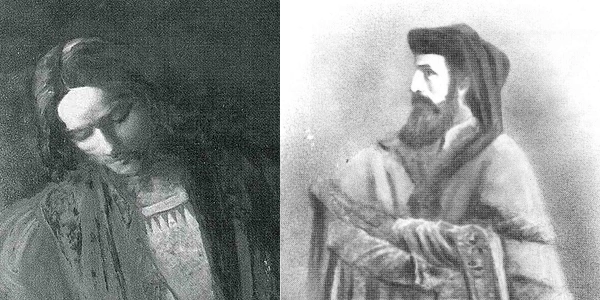
Martin Waldseemuller was born in 1470 to 1475, in today's Schallstadt, Germany, but then called Wolfenweiler, Margraviate of Baden, part of the Holy Roman Empire. He came from common stock, father a butcher, but mananged to enroll in the University of Freiberg after moving there with his father Conrad, who became a city councilman. Gregor Reisch was his professor in the humanities; after graduation he would become a printer of woodcuts under Johann Amerbach. It is reported after moving to France near the Benedictine monastery in St. Dié, that he was ordained a priest. Waldseemuller would become part of the intellectual circle called the Gymnasium Vosagense in St. Dié. The group was formed by Walter Lud under the patronage of René II, Duke of Lorraine. Lud wanted to produce works of science; he bought a printing press for that purpose. Waldseemuller would serve as the master cartographer; Mattias Ringmann as a writer, with experience in the field of geography and for his knowledge of Greek and Latin.
Matthias Ringmann
Matthias Ringmann was born in Alsace, the town of Eichhoffen, in 1482. His studies began in 1898 at the University of Heidelberg, with continued eduction at the University of Paris. After his studies were concluded, Matthias worked as a proofreader for a printing company in Strasbourg after moving there in 1505. He taught school and wrote poetry. His true passion was classical geography as shown in the work of Claudius Ptolemy, including the concepts of longitude and lattitude. When Lud offered him a task as copy editor for the Gymnasium at his age of 22, Ringmann accepted the invitation.
Image above: Waldseemuller map from 1507 is the first map to include the name America, and first to depict the Americas as separate from Asia. There is only one surviving copy of the map, which was purchased by the Library of Congress in 2001 for $10 million, 1507, Martin Waldseemuller. Courtesy Library of Congress via Wikipedia Commons. Image below: Montage (left) Martin Waldseemuller, 19th Century, Gustav Save. (right) Matthias Ringmann, 19th Century, Gustav Save. Both courtesy Wikipedia Commons. Source info: "Recognizing and Naming America: Waldseemuller's 1507 Map," Library of Congress; "The Map That Named America," 2003, John R. Herbert, Library of Congress; "Prince Johannes Waldberg-Wolfegg," 2009, Toby Lester, Smithsonian Magazine; "A Mapmaker's Life, the Early Years," University of Minnesota Library; "Mattias Ringmann," notablepeople.org; Wikipedia;
History Photo Bomb


Christopher Columbus, by Ridalfo Ghirlandaio, 1520. Courtesy Wikipedia Commons.
ABH Travel Tip
Much of America's best history takes in the beauty and nature of our national parks. From the first park in Yellowstone, from the coast of Maine to the shores of Hawaii Volcanoes, check out the history of the USA as made by our land.