-
Timeline - The 2000s
It began a decade before, although in many ways the intensity of the dynamic was missed, but when the hijacked planes hit the World Trade Center, the Pentagon, and the Shanksville field on September 11, 2001, there was no denying that a new order had emerged. It was a war against our way of life, a war of terror, and our response would dominate the decade and years come.
More 2000s

President Barack Obama. Courtesy Wikipedia Commons.
Sponsor this page. Your banner or text ad can fill the space above.
Click here to Sponsor the page and how to reserve your ad.
-
Timeline
2006 - Detail
September 25, 2006 - In New Orleans, the Louisiana Superdome reopens after repairs caused by Hurricane Katrina damage. The repairs included the largest re-roofing project in U.S. history and took thirteen months following the destruction to the Gulf Coast region.
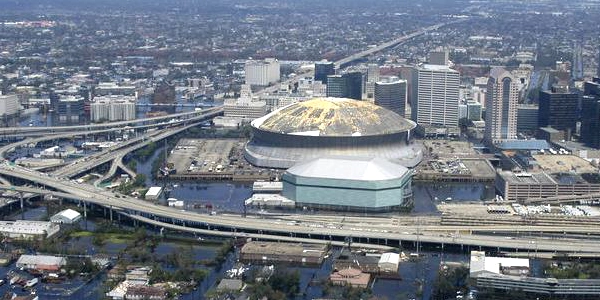
One year earlier, during Hurricane Katrina, it had been the site refuge for residents, although some would say with the conditions there, less than that. However, for fifteen thousand of New Orleans residents who had used its halls and fields as a disaster relief center, the Louisiana Superdome, was the location they needed to flee to as the storm surge hit. But the Superdome had also been damaged by the winds and rains of the worst hurricane to hit the region for decades and would need significant repair.
On August 29, 2005, Hurricane Katrina made landfall at 6:10 a.m. CST, downgraded to a Category Three hurricane, but larger in its outer eyewall than when it had been churning through the Gulf of Mexico as a Category Five. A storm surge was pushed forward, engulfing the lower 9th Ward of New Orleans under six to eight feet of water. Residents, due to levee breaks all around the city, and in a city that was below sea level at many points, were forced to look for shelter any place they could, if they had not left before. Fortunately, between eighty to ninety percent of residents had evacuated, but that left tens of thousands of citizens seeking shelter in the Superdome, the Louisiana Convention Center near the Mississippi River and the Riverwalk shopping district, and the few other places above sea level such as the French Quarter and Garden District. Within two days, eighty percent of New Orleans was under water, some under fifteen feet of it.
For those that had not left the city during the evacuation order, estimated at one hundred thousand, the Louisiana Superdome was a shelter of last resort. It was thought able to withstand two hundred mile per hour winds and thirty-five feet of water. Buses began transporting those that hand not evacuated the city to the site; television cameras focused on the effort and sports complex.
While the Superdome withstood the majority of the winds and housed the fifteen to twenty thousand people during the first days after evacuation from their homes, it had sustained significant damage. Two sections of the waterproof membrane roof had been torn off. By August 30-31, Louisiana Governor Kathleen Blanco ordered the evacuation of the site, transporting the remaining evacuees to the Houston Astrodome on sixty-eight buses. FEMA is reported to have promised four hundred and seventy-buses to assist. The Superdome was completely evacuated by September 4, 2005.
There were initial reports that the Superdome would have to be demolished, although that was overstated. It did need, however, significant repairs, to get it refurbished and ready for the opening date of the next football season of the New Orleans Saints. It would be a Monday night game on September 25, 2006. Costs to repair the building were $185 million. It was shared by FEMA ($115 million), the State of Louisiana ($13 million), the Louisiana Stadium and Exposition District ($41 million), and the National Football League ($15 million.)
There were concerts (Goo Goo Dolls), performances by U2 and Green Day of "the Saints Go Marching In," and most importantly, a victory by the home team Saints, 23-3, over the Atlanta Falcons, in front of 70,003 fans, on that reopening day.
How the Louisiana Superdome Came About
So how did New Orleans gain such a large and illustrious sports facility in the first place? It was conceived by sports entrepreneur David Dixon in his attempt to lure a National Football League franchise to the city, and was told by the NFL that it would only happen if a domed stadium were constructed. Dixon worked toward that goal with a commitment by the NFL on November 1, 1966, to award a franchise to the city. Seven days later, bonds were passed for its construction. A modern design was chosen by architecture firm Curtis and Davis, to be built on seventy acres of ground in downtown New Orleans.
Construction began on August 12, 1971, several years late. It would have a two hundred and seventy-three foot dome, the largest fixed dome structure in the world and be estimated to cost $46 million. When the Superdome opened on August 3, 1975, it had cost more, yet in today's terms, a scant $134-165 million, to build, only $637 million even in 2019 dollars. This late opening caused the 1975 Super Bowl, initially scheduled for the Superdome, to be held at Tulane University. The capacity of the structure in 1975 was 74,452.
The first event was a large open house attended by forty-five thousand people, and included concerts by the Allman Brothers, the Marshall Tucker band, and the circus entertainments of the Ringling Brothers and Barnum and Bailey Circus. The Superdome has hosted a variety of the largest sporting events in the United States since that date, including Super Bowls, BCS Football Championships, and NCAA Basketball Final Fours. It is perhaps best known as the home of the New Orleans Saints, but at one time was also home to the Tulane University Green Wave football team for twenty-seven seasons. Other events from concerts to boxing matches, soccer to baseball, and more have been held there as well.
Photo above: Louisiana Superdome surrounded by Hurricane Katrina flood waters, September 1, 2005, U.S. Navy. Courtesy Wikipedia Commons. Below: Image of Hurricane Katrina from Google Earth on August 28, 2005. Courtesy National Oceanic and Atmospheric Administration. Info sources: Report on Hurricane Katrina, National Hurricane Center, December 20, 2005; A Performance Review of FEMA's Disaster Management Activities in Response to Hurricane Katrina, Department of Homeland Security, March 2006; National Oceanic and Atmospheric Administration; National Weather Service; "Dome sweet Dome: The birth of the Superdome -- and a New Orleans landmark," 2017, New Orleans Times-Picayune; Wikipedia Commons.

History Photo Bomb
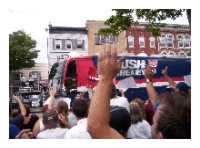
Bush-Cheney campaign bus on their presidential campaign through the Philadelphia suburbs in 2004.
Timeline History

Want a copy of the Timeline. Now available in easy to search
digital format for your Kindle, Nook, or pdf format. Also comes in paperback, too.
Baseball History

Check out our partners at Stat Geek Baseball and
Baseballevaluation for a history of baseball with stat geeks in mind, including their books Fields of Gold, Baseball's Best Glove Work, and Baseball's Best @ 150.

Site of the former World Trade Center.
ABH Travel Tip

Much of America's best history takes in the beauty and nature of our national parks. From the first park in Yellowstone, from the coast of Maine to the shores of Hawaii Volcanoes, check out the history of the USA as made by our land.
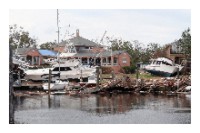
Damage across the Gulf Coast from Mississippi to New Orleans after Hurricane Katrina.
Official Souvenirs
America's Best History
