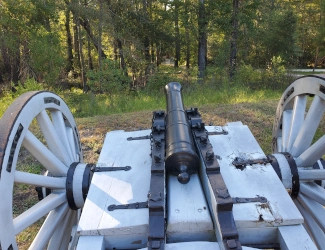
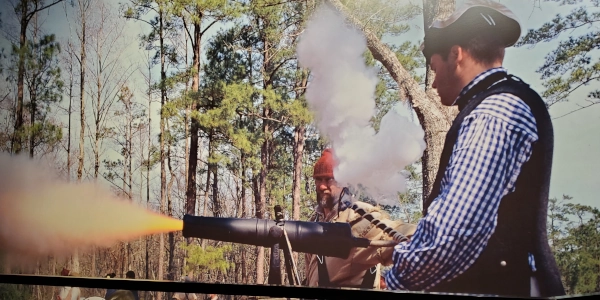
Image above: Continental Cannon at Moores Creek Bridge National Battlefield pointing toward Moores Creek Bridge, 2025, America's Best History.
Spotlight on Lesser Known History
Battle of Moores Creek Bridge, North Carolina
America's Best History Spotlight
On this page we're going to Spotlight the lesser known historic sites and attractions that dot the history landscape across the USA and are worth a visit if you're in their area. And while they may be lesser known, some are very unique, and will be that rare find. You'll be, at times, on the ground floor, or maybe even know something others don't. It'll be fun. Visit them.
Battle of Moores Creek Bridge, North Carolina
There had been battles in New England, essentially starting the American Revolution in 1775 after the continued impetus from 1770 and the Boston Massacre, including Lexington and Concord, as well as Bunker Hill. The Minutemen surrounded Boston, the British New York City and New Jersey, and the south was shaping up, in what the British thought was a superior amount of Loyalists, Torie militiamen from Scotland, loyal to the Crown versus the inferior Patriots wanting to be left alone. A plan had been hatched by British Governor Josiah Martin to gather a group of Loyalists, word sent January 10, to intercept the Patriots and meet up with General Clinton's flotilla at the coast. They wanted to rid the area where the militiamen had skirmished with the Loyalists since the First Siege of Ninety-Six in November 1775. The British had Regulators and Highlanders. The Patriots had farmers and woodsmen. By February 27, 1776, the eight hundred to one thousand British troops under General Donald MacDonald thought they had them cornered eighteen miles northwest of Wilmington, on the homestead of Elizabeth Moore, today near the small town of Currie, not founded until 1888. However, the Patriots, one thousand and fifty-two strong and led by Richard Caswell, had hunkered down across the small bridge at Moores Creek, setting up cannons, breastworks, and entrenchments, unseen past the bridge. Beyond that, the North Carolina Patriots had taken up the wooden boards just leaving the beams, then greased them. Think sending Simone Biles across the balance beam slicked with tallow, then add hundreds of men.
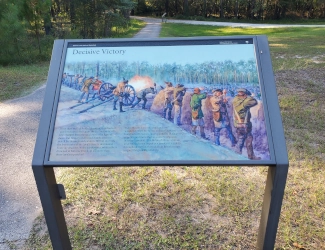
Once the British had crossed the bridge and waded through the swampy black water, with a similar way of grease and wet if retreat were needed, they went around the bend and were met with a volley of cannon fire and muskets that immediately halted any progress. They were overwhelmed, and would soon surrender eight hundred and fifty troops. It was a celebratory and needed victory for the Patriots. They had thrwarted the plan for the Loyalists to meet General Clinton and two thousand soldiers, then hold an invasion starting from the coast in 1776. After the battle at Fort Moultrie in Charleston several months later, any British presence or major battles would not occur in the South for five years. Only one Patriot died in the battle, another wounded; fifty British were dead or wounded. Some sources state that eight-hundred and fifty British soldiers and Loyalists were captured. Others believe it was less.
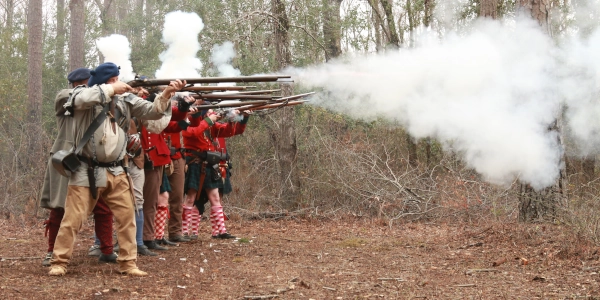
Image above: Reenactment at Moores Creek National Battlefield. Courtesy National Park Service.
Sponsor this page. Your banner or text ad can fill the space above.
Click here to Sponsor the page and how to reserve your ad.
Info, What's There Now, History Nearby
Battle of Moores Creek, North Carolina
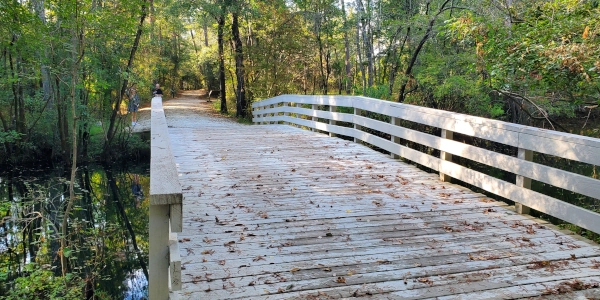
Today you can visit the Visitor Center in a North Carolina pine forest, which includes exhibits, a ten minute film, and a book store. There are battle walks certain days of the year. A paved trail circles around the grounds, taking you to the Patriot entrenchments, a boardwalk through the swamp forest, then up the road over the Moores Creek Bridge until reaching the Patriot entrenchments again. There are many waysides, with audio, and several monuments to the Patriot men who fought there and the women who assisted.
Image above: Moores Creek Bridge, 2025, America's Best History. Below: Exhibit inside the Visitor Center of Moores Creek National Battlefield, 2025, America's Best History.
Where Is It
Moores Creek National Battlefield is located eighteen miles northwest of Wilmington, North Carolina. Address is 40 Patriots Hall Drive, Currie, NC 28435. It is located off Route 210.
Minute Walk in History
The Battle of Moores Creek Bridge (1776) marked a turning point in the American Revolutionary War, becoming the first major Continental Army victory in North Carolina. This early triumph crushed the British plan to take the Revolution south, proving that Loyalist support was far weaker than expected. Walk with us through the forests, swamps, and across the historic Moores Creek Bridge, where patriots stood their ground and changed the course of America’s fight for independence.
What is There Now
Battle of Moores Creek, North Carolina
There is a large parking lot within the North Carolina pines, picnic benches, facilities, and a Visitor Center for orientation, a film, exhibits, and a book store. The trails outside include the Battle Trail, which take you to both the Loyalist area and their charge across the upended bridge, to the Patriot entrenchments.
When Open and How Much
Park Grounds are open daily. Visitor Center is open Tuesday through Saturday 9:00 a.m. to 5:00 p.m., except some holidays. Entrance is free.
Fees and hours are subject to change.
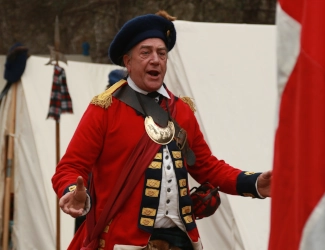
Photo above: Reenactor portraying British General Donald MacDonald at Moores Creek National Battlefield, 2025, America's Best History.
Website
Moores Creek National Battlefield
History Nearby
Yes, there are the beaches of the Wilmington area all the way to the Grand Strand of South Carolina, forts from the American Revolution as well as the Civil War, and natural history in both Carolinas.
Photos, History, and More Spotlights
The Women of Moores Creek Battlefield
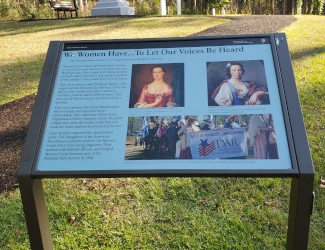
Penelope Barker - Organized a boycott of British Goods with other women on October 25, 1774 known as the Edenton Tea Party of North Carolina Colony. It is sometimes called the first organized by women political protest. Penelope was born on a two thousand acre plantation and led a life of wealth and duty. She raised her sister's children, married three times by outliving her husbands, and at one time was the wealthiest woman in the colony. Ms. Barker was a true loyalist backing the Revolution and revered by the Colonial American press while being laughed at by the British. A marker in Edenton celebrates her achievements. She did hold slaves.
Flora MacDonald - At one time held in the Tower of London for her political assistance to Charles Edward Stuart, heir to the exiled Stuart monarchy, after the Battle of Culloden. Flora would be given amnestry, marry Captain Allan MacDonald, and eventually settle in Anson County, North Carolina in 1774. Not long after the American Revolution started, the Captain and Flora began to recruit Loyalists for the British invasion of the Carolinas. The Captain had nearly one thousand troops in the Anson Militia, but never met General Clinton's invading force. He was captured at the Battle of Moores Creek Bridge. Flora was interrogated by the Committee of Safety, and her home Killegray confiscated a year later. When her husband was released in a prisoner exchange in September 1777, they were posted to Fort Edward in Nova Scotia.
Photo above: Wayside explaining the Women's Monument on the Battle Trail at Moores Creek National Battlefield, 2025, America's Best History. It is one of the few monuments to women on an American Revolution battlefield.
Buy Second Edition
America's Best History Timeline

Great book to keep middle school to college students up to date on their American history.
The Lead Up to Moores Creek
On January 10, 1776, British Royal Governor Josiah Martin ordered all loyalists to join and put down the rebellion. One day later, he approached the Patriot militiamen and sued for peace. After a month of failed negotiations, the new Patriot government of North Carolina ordered men to join their militia or lose their guns and go to jail. The Highlanders and Regulors prepared to meet at Cross Creek (Fayetteville), over one thousand strong after many defections. The militia under Richard Caswell left New Bern; other North Carolina militias also left to meet the British presence.
British General Donald MacDonald learned that the Patriot militias under Colonel James Moore had blocked his path to the coast on February 18, 1776, but MacDonald slipped past Moore only to be told that a Patriot force, eight hundred men, was heading toward him from the east. Colonel Moore would order Caswell to take his forces ahead; he would send him two hundred reinforcements. The Patriots made it to the ferry crossing of the Black River on February 23; the British arrived on February 24, but crossed on a boat five miles north of the ferry crossing. When Richard Caswell learned of that position, he retreated to Moores Creek Bridge, finding the Wilmington District Minute Men already there under Colonel Alexander Lillington. They began to build entrenchments and position their five cannons. The British had no guns with them.
With the Patriot militias camped on the west bank of the river, but their entrenchments placed on the east bank, this attempt to trick the British would work. The British planned a morning attack for February 27, 1776, leaving their camp six miles away at 1:00 a.m. When the Highlanders and Regulators reached the west encampment, it was abandoned. The Patriots were unseen behind trees and the earthworks on the eastern side. Lieutenant Colonel McLeod and fifty soldiers crossed that greased bridge, thinking that was enough to rout, what he thought, were the retreating Patriots. He was wrong, killed as they charged, and the Battle of Moores Creek Bridge over in short order.
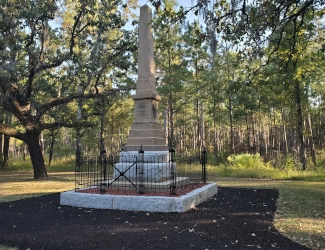
Image above: Patriot Monument at Moores Creek National Battlefield, 2025, America's Best History.
250th Battle Anniversary of Moores Creek Event
On February 27, 2026, the 250th Anniversary of the Battle of Moores Creek Bridge will be held at the Moores Creek Bridge National Battlefield. For two days, there will be ceremonies honoring the soldiers who fought there, living history camps, music programs, battle demonstrations, musket demonstrations, history talks, and other programs. It is free of charge. If you have an interest in the celebrations of the 250th Anniversary of the American Revolution, the Declaration of Independence, and the eventual democratic government of the United States, you might want to make plans for this event. However, if those dates don't suit, plan a later visit for the first battle and victory of the Continental Militias in their fight for independence from the British Monarchy.
Photo above: Patriot Victory Wayside at Moores Creek National Battlefield. Courtesy National Park Service.
T-Shirts and Souvenirs

America's Best History T-Shirts, Sweatshirts, Backpacks, and other Souvenirs from the official gear of americasbesthistory.com.
November Spotlight
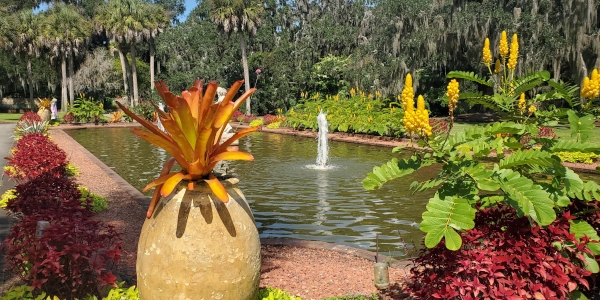
Brookgreen Gardens, South Carolina

January Spotlight
Atalaya Castle, South Carolina