-
Timeline - The 1960s
There were seasons of change in culture. There were Civil Rights to be won and legislation that would assist. And there was a war, the Vietnam war, that caused divide. It was a decade of turmoil that saw one President shot, another with the fatigue of war, and a third, who would not last until the end of his terms.
More 1900s

President Lyndon Johnson at Cam Ranh Bay, Vietnam, 10/26/1966. Pictured with General William Westmoreland, Lt. General Nguyen Van Thieu, and Prime Minister Nguyen Cao Ky of South Vietnam. Photo: White House Photograph Office.

Martin Luther King, with Mathew Ahmann, at the Civil Rights March on Washington, D.C., August 28, 1963. Photo: U.S. Information Agency, Press & Publications Service.
Sponsor this page. Your banner or text ad can fill the space above.
Click here to Sponsor the page and how to reserve your ad.
-
Timeline
1961 - Detail
April 17, 1961 - The Bay of Pigs invasion of Cuba is repulsed by Cuban forces in an attempt by Cuban exiles under the direction of the United States government to overthrow the regime of Fidel Castro.
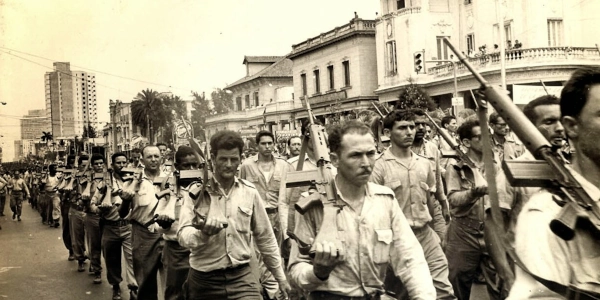
Cuba, so close to the state of Florida, had been in the eyes of the United States for several centuries. It had been under American control, a dictatorship, masked at first as a democracy, under Fulgencio Batista, and was now in the control of Fidel Castro, whom we had backed in the uprising that dethroned Batista. By the end of the decade President Eisenhower and his team had decided that a diplomatic solution to the Castro problem was not likely and with the assistance of the CIA, began to plan and fund the effort to oust the Premier. As of 1961, it was pretty apparent that Mr. Castro had no desire to become part of the democratic western hemisphere, he had chosen an alliance with Nikita Kruschev and the Soviet Union. Diplomatic relations had been severed in January of that year. Three months later a secret plan that had been brewing under the watchful eye of the Central Intelligence Agency and the National Security apparatus. With President John F. Kennedy now in office, and with his knowledge after outgoing President Eisenhower had urged the action, an invasion would be launched using Cuban exiles, with some reconnaisance by American planes. For want of a better explanation or sense of the outcome, ... it failed.
The invasion, known as Playa de Girón in Cuba, began on April 15, 1961, with part of the initial acts to be CIA planes striking the beaches, but made to look like generic planes that a rebel force would use. The execution of the strikes went poorly, and the world was not fooled by the American effort to state it was not a USA effort. On April 17, the ground invasion began under less than ideal circumstances. Fourteen hundred Cuban exiles made their assault at the Bay of Pigs by boat, but some got grounded on a reef, air support was not as helpful as designed, and the ragtag Cuban air force managed to sink one of the boats laden with men and supplies. Once ashore, the invading force did not know what to do; the plan was flawed. Several days of fighting occurred, but eventually the Cuban exiles had to surrender. Around one hundred of the attackers had been killed, the majority of the rest imprisoned, one thousand two hundred and fourteen, and later put on trial for treason. It is reported that one hundred and seventy-five of Castro's soldiers had been killed during the fighting.
It had been a boondoggle from the start and a lie from the President that the United States had been involved. By April 20, President Kennedy was giving a speech at the American Society of Newspaper Editors event in the District of Columbia and began to illuminate about the reasons and intervention. The United States could not allow a Communist nation, backed by the Soviet Union, that close to our shores. He spoke more about future efforts than the past, and framed the Bay of Pigs invasion as an effort by the Cuban exiles to free their country, not an attack by the Americans.
Reports and Comments About the Invasion
"Rebel army invades Cuba, Battles for Beachheads," UPI
Cuban revolutionaries invaded their island homeland by air and sea today and clashed with Fidel Castro's forces in a violent waterfront battle just 90 miles from Havana. Castro declared a state of national emergency signed a proclamation as "commander-in-chief" and in a radio broadcast to the nation promised to crush the invaders.
Launching a long-awaited offensive against Castro the revolutionaries invaded from the sea shortly after midnight. They struck into the swampy area around the Bay of Cochinos, south of Matanzas Province. It was not known where the invaders came from. However, it long has been known that revolutionary Cuban forces were training in Guatemala. Several hours after dawn the Cuban internal radio communications system -- commandeered by the army - reported the invaders were dropping by parachute, planes were bombing and strafing the beachhead area, and two gunboats were supporting the assault.
The radio said that five men were killed and three militiamen wounded in the initial attack. However, a Cuban Red Cross broadcast heard in mid-morning appealed for ambulances for the "many injured" at Jaguey Grande, about 17 miles north of the invasion area. It was not known whether the reference to Jaguey Grande meant the invasion force had pushed inland or whether it was a hospital center for troops wounded in the coastal fighting. A Cuban broadcast said the invaders had struck at three points: Cochinos Bay, Playa de Giron and Playa Larga. It said the Larga invasion by one boat had been stopped but that the Giron landing was "effective." It said gunfire was growing "steadily more intense."
There was no immediate report from Guantanamo Bay, the huge U.S. naval base. However, it was expected the base was under alert in event of reprisal by Castro forces, who blamed the U.S., for the invasion. This was the beginning of "the battle to liberate our homeland from the despotic rule of Fidel Castro and rid Cuba of international cruelty and oppression," said Jose Miro Cardona, president of the Cuban Revolutionary Council, in a statement released in New York. Radio Swan, the powerful anti-Castro transmitter on an unidentified island off Honduras, broadcast Miro Cardona's proclamation of revolt to all Cubans.
This morning's big assault came sometime before 3 a.m. when radio reports of firing were received from Matanzas Province. The first official acknowledgement of the situation came when CMQ, a government-controlled broadcast station in Havana, aired a general order that " all militia stations in Havana should join their units immediately." This was just before 8 a.m. Previous reports came from a local transmitter of the Ministry of the Interior in Matanzas Province, which was relaying beachhead reports from defending Castro forces to Havana. At 5:45 a.m. the Matanzas station told Havana that six landing craft had successfully discharged invasion troops. Asked if they were "North Americans," the Matanzas operator said he could not tell what they were. Twenty five minutes later, the operator at the battle scene said he heard the "firing of cannon," and that two trucks and seven buses filled with militiamen had passed en route to the landing area. At 6:13 a.m. the Matanzas station said a dark gray twin-engine plane with Cuban markings" was flying in the direction of Larga Beach.
Miro Cardona had told UPI earlier that the revolutionary forces had aircraft in the area. Radio Swan, which often is able to drown out Castro's commercial stations with its 50,000-watt transmitter, called on the Cuban people to "attack the Fidelista wherever you find him. Paralyze transportation. Help in any way possible to aid the liberation of Cuba. Follow instructions you are being given by radio."
Castro's government network reported at 6:32 a.m. that anti-aircraft ground units had opened up on two planes flying over the beach landing area -- apparently identifying them as anti-Castro aircraft. It had identified one plane shortly before as a B-26. At 7:05, the government network reported the four planes were bombing and strafing and dropping troops and crates of supplies by parachute. Ten minutes later the station said the planes "up to now have dropped six bombs and about 20 paratroops."
In his broadcast to the nation, Castro said the invaders, whom he described as barbarians, were trying to take away the land, mines and factories belonging to the people. He appealed to Latin American nations to make known their feelings about "Yankee imperialist aggression." "The glorious soldiers of the rebel army and the national revolutionary militia have already engaged in combat with the enemy at all points of disembarkation," Castro said. "They are fighting in defense of the sacred nation and the revolution against the attack of mercenaries organized by the imperialist government of the United States. Already our troops are advancing against the enemy sure of victory."
Revolutionary sources in the United States said they had reports through the underground that uprisings stated in the center of the island. They said they had reports that public buildings and the home of at least one top Castro functionary in the Camaguey city of Baraguabee had been set afire. The signal to begin the uprising was a 56-word coded message which sounded like a poem. It referred to a rainbow, the running of fish, the sky and "Chico." The fish has been the symbol of the Cuban underground for months. It has the same significance as the fish drawn on the ancient catacombs of Rome by the persecuted Christians. Cardona said that "before dawn, Cuban patriots in the cities and the hills began the battle to liberate our homeland from the despotic rule of Fidel Castro and rid Cuba of international cruelty and oppression." Last Thursday, as if giving the advance signal, two huge department stores were destroyed by fires started by phosphorus bombs-one in Havana and the other in Santiago. On Saturday, three Cuban Air Force pilots defected and took off from Cuban fields with their planes. They bombed and strafed key targets before fleeing the country. Two landed in Florida and the third at an undisclosed site.
"Cuba Proclaims Victory for Cuba," Los Angeles Times headline of April 20, 1961.
In May of 1961, the invasion's paramilitary chief, Colonel Jack Hawkins, released an after action report now declassified by the Central Intelligence Agency. In the report, Hawkins stated that he thought that the poor organization by the CIA doomed the effort, and that it would have needed a D-Day style bombing, but that had been cancelled. He was critical of the Kennedy administration for politicizing the invasion, and did not think that the public was ready for the harsh actions that would be necessary in the Cold War.
Sixty years after the invasion, the questions were still being asked. Some concerned the execution of the Cuban exiles who participated in the attempt to overturn Castro. Kennedy, supposedly, asked the President of Brazil, Joáo Goulart, to relay a proposal. If Castro did not execute them, Kennedy would pledge not to intervene in Cuban affairs. This mission, if it even existed, did not gain their release. In the summer of 1962, an attorney from New York, James B. Donovan, began negotiating for their release. Eventually it was gained for $53 million of food, medicine, and other supplies.
Minute Walk in History
Bay of Pigs Invasion, JFK Response
The invasion of the Bay of Pigs by the CIA and NSA Service of the John F. Kennedy Administration in 1961, was a failed effort to removed Fidel Castro and his new regime. Listen to Kennedy in a private conversation with his aide after the battle talking about the failures and how the press is handling the story.
Reflection of Participant Dean Rusk Nine Years Later
David Dean Rusk, Secretary of State: Oral History Interview - 2/19/1970
Interview by Dennis J. O'Brian.
O’BRIEN: Now, if you can perhaps reconstruct within the terms of the time, how was the
operation first described to you in that first briefing? Can you reconstruct that?
RUSK: Well, it was described as a group of Cuban exiles who were being prepared in
Central America for a movement to Cuba at some propitious time. The group
was described as a broadly-based political group -- in other words, they were
not just made up of Batista [Fulgencio Batista] refugees but rather had a broad base of liberal
democratic personnel involved with them. They were in training to go to Cuba to set off a
general reaction against the Castro regime. The assumption was that the Castro regime was
not sufficiently well emplaced in Cuba to be able to withstand the kind of popular revolt that
might be triggered by such a landing by these refugees. I suppose they had in mind
something of Castro’s own experience. They had landed with a rather small group and had
triggered a general reaction throughout Cuba. When Castro came to power there was a
feeling that there was a considerable disillusionment in Cuba about Castro -- he had
renounced the possibility of elections, for example, and by the summer of 1960 had
established a communist regime in Cuba -- and there was a feeling that there were a great
many Cubans who did not like that kind of thing and would do something about it if they had
an opportunity. But it was described in fairly accurate terms as to what kind of band it was, what kind of brigade, what kind of training they were getting, and what their eventual
purpose was.
O’BRIEN: Can you remember the people that were doing the briefing at this point?
RUSK: No, I don’t, quite frankly, in detail. The name of Tom Mann [Thomas C.
Mann] comes to mind, but I couldn’t be sure that he was principally involved.
But I just don’t recall at this stage. I think it ought to be pointed out fairly
early in this conversation that we’re conducting this interview in February 1970, some nine
years after the fact, and I have long since learned not to rely upon my memory on a good
many details because I’ve simply forgotten a good many details.
O’BRIEN: Sure. Can you recall your own feelings at that time when you were first
informed of and then briefed on this operation?
RUSK: My own feelings about the operation were highly skeptical from the very
beginning. I felt that there was not a very good theory of the case for such a
landing in Cuba. I felt that such an operation of this size could not be
conducted on a covert basis, that the hand of the United States was bound to show in it. I was
skeptical of the idea that a popular revolt in Cuba would, in fact, ensue from such an
operation or that such a popular revolt would have a chance to overwhelm the forces which
Castro had organized for controlling the country. I remember that in the many meetings we had on the subject where numbers of
people were sitting around the Cabinet room talking with the President about it that my role
was to raise searching questions. I tried to penetrate the weak points, tried to raise doubts
about the assumptions that were being taken for granted. Privately, I expressed my opposition
to President Kennedy, and looking back on it, I think I made a mistake in being so tactful
about the Bay of Pigs operation because I should have made my opposition clear in the
meetings themselves and taken a position on the Bay of Pigs in opposition in front of those
who were proposing the operation. I don’t think I served President Kennedy well in reserving
my stated opposition for private conversations with him because he was under pressure from
those who were trying to conduct the operation, as well as a number of other advisers, to go
ahead with it. I think I failed him in not making my own opposition more dramatic and more
forceful and rested rather on private conversations with him.
At that time I was feeling my way in relations with President Kennedy. We had just
taken office; we had not settled down into our regular habits of work; we were still trying to
arrange our relationships with each other in terms of delegation of authority and
responsibility and methods of advice and recommendation. I felt myself that it was very
important that the President himself be in charge of foreign policy and that a Secretary of State should not allow gaps to develop between himself and the President, that a President is
entitled to have his principal Cabinet officers support the decisions which he, the President, makes in
foreign policy. Dean Acheson once said that in the relation between the President and the
Secretary of State it’s always important for both of them to understand at all times which one
is President. I did not look upon the role of the Secretary of State as being an independent
role over against the President, and so habitually I would consult with the President privately
rather than express divergent points of view in a room filled with people where stories were
likely to leak to the press and where the position of the President would be undermined by
press reports that his Secretary of State opposed what he was doing.
Now in the case of the Bay of Pigs, my own skepticism was such that I should have
made it known more forcefully and more publicly, in a sense, before his final decision was
taken. I made it too easy for him to decide to go ahead with it by the way in which I
registered my opposition.
Some months later President Kennedy and I visited Prime Minister Macmillan
[Harold Macmillan] in Britain. Mr. Macmillan came out to the airport to see us off at the
airplane, and at the airport he came up to me and put his arm around me and said, "Rusk, I’ve
got to know you better. Jack tells me you were opposed to the Bay of Pigs but that when it
happened you acted as though you had done it yourself." Now President Kennedy never said
that to me, but he apparently said it to Prime Minister Macmillan.
I have always had a deep regret that I did not oppose the Bay of Pigs more forcefully.
But as far as the rest of the world was concerned, I did not let a gap show between me and
the President. I did not let my opposition come to be known even in the Department of State,
and my colleagues in the Department of State to this day believe that I was in favor of the
Bay of Pigs.
O’BRIEN: Well, in the group that is actually making the decision on the Bay of Pigs and,
of course, pressuring President Kennedy, do you have the feeling that they
have a good understanding of the way the Organization of American States
has developed and worked, and is the President aware of this and the possible reactions that
might occur as a result?
RUSK: I think there were many complications about handling the Bay of Pigs and the
theory on which it was to proceed. It could be anticipated that there would be
skepticism and objection in the Organization of American States by some
countries -- Mexico, for example, perhaps of Chile, perhaps Brazil, others -- that would be
largely overcome if the Bay of Pigs operation had been successful because success tends to
forgive theoretical problems of intervention and things of that sort.
Another great complication was the situation in the United Nations. It was inevitable
that this matter would come before the United Nations, and the theoretical base for the Bay
of Pigs operation was a weak one. We knew that Adlai Stevenson would have a very difficult
time of advocacy in supporting the Bay of Pigs operation at the United Nations, given the
attitude of the general membership about such activities carried out by whoever it might be,
by the Soviet Union or by Communist countries or whatever.
I think the overriding concern in President Kennedy’s mind was the dramatic
difference which it would make to the hemisphere and to our country if the Castro regime
could be overthrown. The movement of Cuba toward communism had been a deep shock to
the American people. Castro’s prestige in the hemisphere made his success in Cuba a real
threat to the stability of the other countries of the hemisphere. It would have been a very
important development if Cuba could have emerged with a noncommunist government as a
loyal member of the Organization of American States, as a country that was willing to refrain
from interference in the affairs of other countries in the hemisphere. This focus of revolution
that had been established in Cuba was a serious threat to the institutions of the hemisphere.
A secondary consideration was the very existence of this brigade in Central America
that was being trained for movement to Cuba. There were problems about disbanding it
without letting it go forward to its intended operation. There was a feeling that if it were
disbanded that these men would be disillusioned, that they would be politically activist, that
they would be deeply critical of American policy and American attitudes toward Cuba, and
that this would build up into severe political repercussions inside the United States; so that
one of the questions on President Kennedy’s mind was: If we don’t use the Brigade for the purpose for which it was organized, what do we do with it. And he was worried about
simply disbanding it and calling the whole thing off.
O’BRIEN: Well, as I understand it, the State Department was asked for some alternative
plans to the problem of Castro during that time and to the invasion. Do you
recall any of those that were submitted to the President.
RUSK: Well, we didn’t look upon those plans as being a specific alternative to the
Bay of Pigs. These were long range plans; they came to their fruition at the
Punta del Este conference in 1962 in Uruguay. At that meeting, you will
recall, the Organization of American States expelled the Castro government from
participation in the affairs of the hemisphere and declared that Castroism was incompatible
with the institutions of the Western Hemisphere. That process of isolation was a long term
process. We knew that there would be some difficulties about it because we were not sure
that there were the necessary two-thirds votes in the Organization of American States to
isolate Castro from the hemisphere. And, indeed, we had just the bare necessary majority at
Punta del Este to take the necessary actions when we actually got to the meeting. But we
never pretended that such steps would in fact overthrow the Castro regime in Cuba, and it
was therefore not looked upon as a substitute for the Bay of Pigs.
O’BRIEN: Well, while the plans are developing for the Bay of Pigs before the actual
operation takes place, there apparently is some question -- at least, a question
that’s reflected after the Bay of Pigs -- in the minds of some of the people who
are involved in the decisions as to whether it was going to be a rather large invasion kind of
operation or whether it was going to be an infiltration and basically a guerrilla, well,
infiltration of guerrillas. Did you have a clear understanding or was a clear understanding
presented to you of the nature of this operation?
RUSK: The main idea behind the use of the Brigade in Cuba was that it would make,
in effect, a frontal attack, more or less on the basis of conventional warfare,
and that it would establish a foothold in Cuba at some place which had access
to the main centers of population, and that alongside of the operation of the Brigade would be
defections from the armed forces of Cuba, would be revolt on the part of many Cubans who
did not like Castro, and there would be a popular uprising to change the Castro regime. There
was a fallback position of a guerrilla sort, mainly that if the Brigade did not succeed in
making headway as a brigade that it would fall back into guerrilla-type operations for an
indefinite period into the future.
One of the errors in the whole operation was that although we expected the Brigade to
go into guerrilla operations if it did not succeed in its main purpose, the Brigade had no
guerrilla training. And we learned afterwards that it had not been given any training to
conduct the very guerrilla operations which were supposed to be its fallback position. That
was one of the many errors in the actual execution of the Bay of Pigs operation.
O’BRIEN: Well, do you feel that the other people involved in the decision had this clear
understanding as you did prior to the actual operation, beginning of the
operation?
RUSK: The historian will find it very difficult to reconstruct the details of the Bay of
Pigs operation, particularly the planning for it, because there was very little
put on paper: it was handled orally. This is again one of the mistakes that was
made because Mr. Dulles and Mr. Bissel [Richard M. Bissell, Jr.] would come in and brief us
orally, would not distribute any papers for study, would not submit papers. And one of the
results is that there was some confusion between the actual operation and what we, the rest of
us, expected to happen. Now, the most important single document from the point of view of
the historian will be the report prepared by the Attorney General, Mr. Robert Kennedy, and
General Maxwell Taylor after the affair was over, trying to study what went wrong. And if
that detailed report is available to the historian, he will get a great deal of information out of
it. But apart from that, there was very little that was actually on paper.
I recall, for example, that there were some alleged defections of Cuban aircraft to
Florida during the Bay of Pigs operation. Well, I was taken by surprise when I learned that
these were not genuine defections but were feigned, that they were, in fact, a part of the Bay
of Pigs operation. Now, that point had completely escaped me in the oral discussions which
had preceded the Bay of Pigs operation.
Then I think there as some gap between what we were told, what President Kennedy
was told by those in charge of the operation, and what the Brigade was told in Central
America. I think the Brigade was given assurances of much more support than had been
agreed to at Washington, and the Brigade expected that if they got ashore that the United
States would use its own armed forces to support them; whereas, in Washington it was made
very clear that this was not to involve American armed forces in any way, shape or form. So
there were differences between the way the operation was presented to President Kennedy
and the way the operation was developed with the actual Brigade in Central America.
O’BRIEN: Now in terms of intelligence, does the intelligence that was available within
the Department of State -- from your own sources, in a sense -- did these
essentially raise any questions with the assumptions on which this plan was
involved and the intelligence that was coming through the other agencies, the CIA? Were
there any points of disagreement that you could see at that point?
RUSK: Another mistake that was made was that the operation was handled by such a
small circle that it did not involve the intelligence apparatus of the Department
of State. Indeed, the intelligence affecting the Bay of Pigs operation was
provided by the same people who were organizing and promoting the operation itself. One of
the lessons we learned from the Bay of Pigs was that intelligence should be independent from
the operations and that the same people should not be responsible both for the intelligence
and the operation because intelligence should not be a critical examination of any operation
by those who do not have a stake in the operation itself.
Now, part of my own skepticism arose from the fact that I did not see from the
intelligence in the Department of State evidence that Cuba was ripe for revolution. I doubted
very much that there would be a general uprising in support of the Bay of Pigs Brigade or
that Castro would fold up under pressure from such an operation. But the intelligence
apparatus in the Department of State was never given the chance to make judgments about
the probability of success of the Bay of Pigs operation because it was being handled by so
few people that the intelligence people were not brought into it.
O’BRIEN: Did any of the other members of the Department of State that had knowledge
of this operation ever discuss any of their reservations about the operation
with you?
RUSK: Well, I knew that the Under Secretary was opposed to it, but -- and I’m sorry
Approved For Release 1999/10/14 : NLK-00-015-1-1-5
that I can’t remember names of individuals at this point that were involved --
but…
O’BRIEN: I was thinking of Thomas Mann, perhaps.
RUSK: Yes, I think on balance Thomas Mann was in favor of the operation, but I will
have to double check that with him. I remember on one occasion President
Kennedy was in the Department of State, perhaps following a press conference, and we had a little meeting with a good number of junior officers in the little
conference room just off the office of the Secretary of State. The President went around the
table asking the various members what they would do about the Bay of Pigs operation, and
practically everybody at that meeting except me said that they would go ahead with it.
Now, President Kennedy made his decision based upon strong recommendations from
CIA, Mr. Dulles, and Mr. Bissell, with the comment of the Joint Chiefs of Staff that the
operation appeared to be feasible. Now, the Joint Chiefs of Staff did not make a thorough and
systematic military examination of the operation, partly because it was not their
responsibility; that is, they were not in charge of the operation. But they gave a relatively
favorable comment on the operation as they saw it from the Joint Chiefs of Staff point of
view. Had the Joint Chiefs of Staff themselves been responsible for the operation, my guess
is that they would have had serious reservations about it and would have seen the great
discrepancy between the objectives of the operation and the resources which were going into
it. But their comment, I think, tended to encourage President Kennedy to make the decision
to go ahead with it.
O’BRIEN: Now, by junior officers you mean people at the assistant secretary level and
under secretary level?
RUSK: No, below that.
O’BRIEN: Below that?
RUSK: Below that.
O’BRIEN: I see.
RUSK: We knew at the time that Senator Fulbright was opposed to it; that Chester
Bowles was opposed to it, the Under Secretary; that the Vice President was
very skeptical about it, Lyndon Johnson; so that President Kennedy was faced
with divided counsel on the operation. I think he finally made his decision based upon the
enormous advantage if the operation could succeed and the obvious problems if the operation
was simply disbanded and the Brigade operation liquidated.
I would like to make one other comment at this point, and that is that I do not accept
the view that was expressed by some of the Kennedy people later that Kennedy was simply
carrying out an operation that had been set in motion by the Eisenhower Administration. We
had a full opportunity to look at the operation and make a judgment of our own about it.
President Kennedy never tried to export responsibility for the Bay of Pigs to President
Eisenhower; he accepted the responsibility for it himself, as did I, because we had a clear
chance either to go ahead with it or to call it off, and we made the wrong decision.
O’BRIEN: Well, in your judgment, did the CIA, in a sense, I guess the phrase would be
“play it straight” with the people involved in the way they described this
operation, in your judgment?
RUSK: I wouldn’t want to throw any doubt about the motives of the CIA people.
They were high-minded; they were dedicated; they were loyal; they were
honest. But I think they got caught up with an enthusiasm for the project, and
this affected their judgment. I think they made intelligence estimates based upon flimsy
hopes. I think they were bemused by the dramatic effect of changing the Castro regime in
Cuba. It may be that they remembered the Guatemalan episode of a few years earlier and
thought that this would be as simple as that turned out to be. But we found the operation, as
far as CIA was concerned, was just too pat; the answers to probing questions were too glib.
There was a commitment on the part of Mr. Bissell and Mr. Dulles to the operation that
distorted their judgment.
O’BRIEN: A number of people have talked about this both publicly and privately and, of
course, one of those people is Under Secretary Bowles at this time. Do you
recall any of your discussions with him at that point?
RUSK: Well, as far as Bowles was concerned, he thought that I was in favor of the
Bay of Pigs. I maintained my solidarity with President Kennedy even over
against the Under Secretary, and the morale of the Department of State
suffered very considerably, not only over the failure of the Bay of Pigs but over the
impression that the Secretary of State had been in favor of the Bay of Pigs. Now, some of
these people took occasion to let the press know that they had been opposed to it -- Arthur
Schlesinger did that; Chester Bowles did that. President Kennedy deeply resented the lack of
solidarity in his own Administration over this catastrophe. He made the remark that failure is
an orphan and success has many fathers, and he did not like it when some of them abandoned
ship and failed to show solidarity in the face of failure.
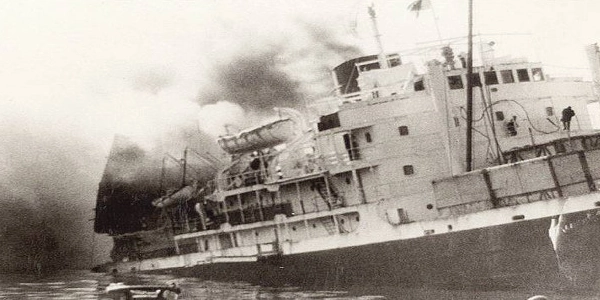
Photo above: Cuban soldiers marching down a Havana street, part of Fidel Castro's force that would take over the country as well as quell the invasion two years later, 1959, Unknown Author. Courtesy Wikipedia Commons. Photo below: The explosion of the Cuban ship La Coubre, which Castro considered USA sabatoge, 1960, Unknown Author. Courtesy Wikipedia Commons. Info source: "President Kennedy Audio Tapes on the Bay of Pigs," cc-span.org; Dean Rusk, recorded interview by Dennis J. O’Brien, February 19, 1970, John F. Kennedy Library Oral History Program; " "Record of Paramilitary Action Against the Castro Government of Cuba," 1961, Colonel Jack Hawkins. CIA Declassified Files; "Saving the Bay of Pigs Prisoners: Did JFK Send a Secret Warning to Fidel Castro through Brazil?," 2021, James G. Herschberg, National Security Archives; "Bay of Pigs, NSC Files," National Security Council; Wikipedia Commons; newspapers.com; "Rebel Army Invades Cuba, Battles for Beachheads," April 17, 1961, UPI, Francis L. McCarthy.
History Photo Bomb

Crowds of the Civil Rights March in Washington, D.C. surround the Washington Monument. August 28, 1963. Courtesy National Archives.
San Cristobal, Cuba. Aerial photo of the Medium Range
Ballistic Missile Launch Site, Number Two. Photo: Department of
Defense, November 1, 1962. Courtesy National Archives.
Official Souvenirs
America's Best History

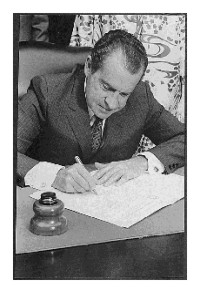
President Richard Nixon. Courtesy National Archives.
ABH Travel Tip
The bargains at the National Park Service continue, despite some recent increases in park fees. The National Park Pass is now called the America the Beautiful Pass, which admits all vehicle and family visitors for one year, and costs $80 for one twelve month period. The pass covers most Federal fee areas, including National Parks, Historic Sites, and National Forests. For those of 62 years of age or older, buy the America the Beautiful Senior Pass. For only $20 per year or $80 for a lifetime pass, you gain free entrance for the rest of your life to all National Parks, National Historic Sites, and National Forests, and other federal fee sites for you, your spouse, and your children, plus discounts of 50% on some use fees, such as camping. Must be purchased in person at a National Fee location, which are the one hundred or so National Park Service sites that charge for entry.