-
Timeline - The 1980s
Prosperity comes again and the Cold War ends. Plus there's Olympic triumphs and controversy, the personal computer age born, and a Supreme Court justice with a difference.
More 1900s
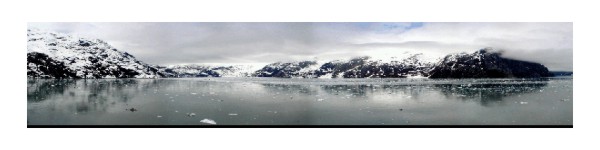
Exxon Valdez spill in Alaskan waters raises concerns about the environmental impacts of man-made disasters on our natural lands and waters.
Sponsor this page. Your banner or text ad can fill the space above.
Click here to Sponsor the page and how to reserve your ad.
-
Timeline
1985 - Detail
November 19, 1985 - The first meeting in six years between the leaders of the Soviet Union and the United States occurs when Mikhail Gorbachev and Ronald Reagan engage in a five hour summit conference in Geneva, Switzerland.
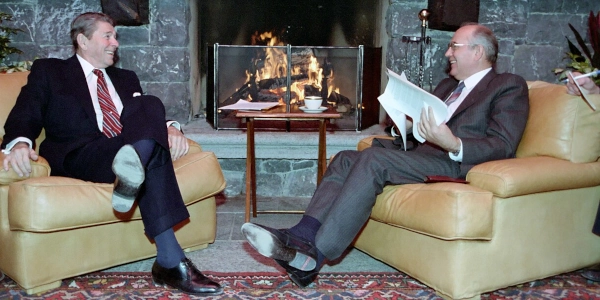
It had been quite some time since the leaders of the Soviet Union and the United States had been engaged in a summit of this proportion. Yes, the Cold War was technically still in place, however Mikhail Gorbachev had been making inroads into joining the rest of the world and perhaps solving some of the differences between the two nations and between they and the western world. He had risen to General Secretary of the Communist Party in Moscow and therefore the leader of the Soviet Union in March 1985. Within two months, the topic of meeting was on the agenda. However, both President Reagan and the leader knew there were many vexing problems that stood in the way. These meetings in Geneva, Switzerland from November 19-21, 1985, would be important first steps toward achieving that goal. And no, the collapse of the Soviet Union within a year was not on the agenda.
"My mission, stated simply, is a mission for peace. It is to engage the new Soviet leader in what I hope will be a dialog for peace that endures beyond my Presidency. It is to sit down across from Mr. Gorbachev and try to map out, together, a basis for peaceful discourse even though our disagreements on fundamentals will not change. It is my fervent hope that the two of us can begin a process which our successors and our peoples can continue -- facing our differences frankly and openly and beginning to narrow and resolve them; communicating effectively so that our actions and intentions are not misunderstood; and eliminating the barriers between us and cooperating wherever possible for the greater good of all," Ronald Reagan, November 14, 1985, address to nation prior to the summit.
It had been agreed that the meeting would be held in secret with no press conferences or statements until the entire summit was over.
Timeline of the Meetings
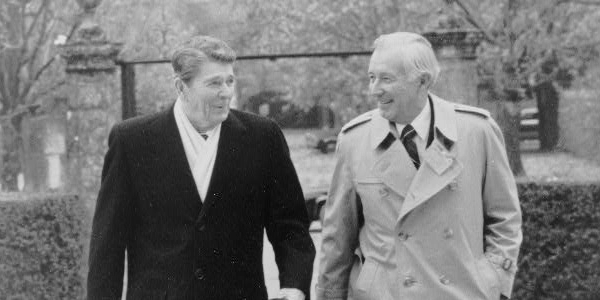
November 19, 1985 - The meeting was held at Villa Fleur d'Eau. The intended subjects under discussion would include diplomatic relations and the arms race. In the evening, a dinner was hosted by the Gorbachev's at the Soviet Mission from 8-10 p.m. Later statements noted that the first meeting lasted one hour. There were intepretors in the room for both men. Reagan noted that the two men came from similar backgrounds; Reagan grew up on a farm. In the second hour, additional cabinet members were part of a plenary meeting. This included, for the United States, Secretary of State George Shultz, Donald Regan, Chief of Staff, and six others. For the Soviet Union, the additional members of the meeting included Minister of Foreign Affair Eduard Shevardnadze, Chief Propoganda Department of the Central Committe Aleksandr Yakovlev, and six others. There was a second plenary meeting in the afternoon, as well as a second meeting and walk between the two leaders.
November 20, 1985 - The second day of meetings started at the Soviet Mission with a private meeting between Reagan and Gorbachev, with no aides inside the room, except the interpretors. Reagan, it was noted in later reports, stated that he did not want to interfere in the internal affairs of the Soviet Union, but did want to talk about human rights. A comfort had grown between the two men. There were also plenary meetings, the third in the morning, and fourth, in the afternoon. Gorbachev and Reagan met for a fourth time in the afternoon as well. At night, the Reagan's hosted a dinner at the Maison de Saussure.
November 21, 1985 - A joint statement was agreed upon and read (see below) about the Reagan-Gorbachev summmit. Agreements had been reached on a number of topics; nuclear non-proliferation, chemical weapons, space, and security. President Reagan would fly to Brussels and brief the allies of NATO about the progress made. President Reagan would fly to Washington in the evening and give a speech on the summit at a Joint Session of Congress.
Minute Walk in History - Summit 1985
Well, there was a time in 1985 when the Soviet, now Russia, leader was more amenable to foreign relations with the United States. So when Mikhail Gorbachev rose to power, President Ronald Reagan met him in Geneva, Switzerland for a summit. Watch the speeches, dialogue, dinners, and more in this montage of videos, now declassified, from the event, that did lead to better relations and arms control.
Words of the Leaders - President Reagan
Joint Session of Congress Speech, November 21, 1985
"Mr. Speaker, Mr. President, Members of the Congress, distinguished guests, and my fellow Americans:
It's great to be home, and Nancy and I thank you for this wonderful homecoming. And before I go on, I want to say a personal thank you to Nancy. She was an outstanding Ambassador of good will for all of us. She didn't know I was going to say that. Mr. Speaker, Senator Dole, I want you to know that your statements of support here were greatly appreciated. You can't imagine how much it means in dealing with the Soviets to have the Congress, the allies, and the American people firmly behind you.
I guess you know that I have just come from Geneva and talks with General Secretary Gorbachev. In the past few days, the past 2 days, we spent over 15 hours in various meetings with the General Secretary and the members of his official party. And approximately 5 of those hours were talks between Mr. Gorbachev and myself, just one on one. That was the best part—our fireside summit. There will be, I know, a great deal of commentary and opinion as to what the meetings produced and what they were like. There were over 3,000 reporters in Geneva, so it's possible there will be 3,000 opinions on what happened. So, maybe it's the old broadcaster in me, but I decided to file my own report directly to you.
We met, as we had to meet. I called for a fresh start, and we made that start. I can't claim that we had a meeting of the minds on such fundamentals as ideology or national purpose, but we understand each other better, and that's a key to peace. I gained a better perspective; I feel he did, too. It was a constructive meeting; so constructive, in fact, that I look forward to welcoming Mr. Gorbachev to the United States next year. And I have accepted his invitation to go to Moscow the following year. We arranged that out in the parking lot. I found Mr. Gorbachev to be an energetic defender of Soviet policy. He was an eloquent speaker and a good listener.
Our subject matter was shaped by the facts of this century. These past 40 years have not been an easy time for the West or for the world. You know the facts; there is no need to recite the historical record. Suffice it to say that the United States cannot afford illusions about the nature of the U.S.S.R. We cannot assume that their ideology and purpose will change; this implies enduring competition. Our task is to assure that this competition remains peaceful. With all that divides us, we cannot afford to let confusion complicate things further. We must be clear with each other and direct. We must pay each other the tribute of candor.
When I took the oath of office for the first time, we began dealing with the Soviet Union in a way that was more realistic than in, say, the recent past. And so, in a very real sense, preparations for the summit started not months ago, but 5 years ago when, with the help of Congress, we began strengthening our economy, restoring our national will, and rebuilding our defenses and alliances. America is once again strong, and our strength has given us the ability to speak with confidence and see that no true opportunity to advance freedom and peace is lost. We must not now abandon policies that work. I need your continued support to keep America strong.
That is the history behind the Geneva summit, and that is the context in which it occurred. And may I add that we were especially eager that our meetings give a push to important talks already underway on reducing nuclear weapons. On this subject it would be foolish not to go the extra mile or, in this case, the extra 4,000 miles. We discussed the great issues of our time. I made clear before the first meeting that no question would be swept aside, no issue buried, just because either side found it uncomfortable or inconvenient. I brought these questions to the summit and put them before Mr. Gorbachev.
We discussed nuclear arms and how to reduce them. I explained our proposals for equitable, verifiable, and deep reductions. I outlined my conviction that our proposals would make not just for a world that feels safer, but one that really is safer. I am pleased to report tonight that General Secretary Gorbachev and I did make a measure of progress here. We have a long way to go, but we're still heading in the right direction. We moved arms control forward from where we were last January, when the Soviets returned to the table. We are both instructing our negotiators to hasten their vital work. The world is waiting for results.
Specifically, we agreed in Geneva that each side should move to cut offensive nuclear arms by 50 percent in appropriate categories. In our joint statement we called for early progress on this, turning the talks toward our chief goal—offensive reductions. We called for an interim accord on intermediate-range nuclear forces, leading, I hope, to the complete elimination of this class of missiles—and all of this with tough verification. We also made progress in combating, together, the spread of nuclear weapons, an arms control area in which we've cooperated effectively over the years.
We are also opening a dialog on combating the spread and use of chemical weapons, while moving to ban them altogether. Other arms control dialogs—in Vienna on conventional forces and in Stockholm on lessening the chances for surprise attack in Europe—also received a boost. And finally, we agreed to begin work on risk reduction centers, a decision that should give special satisfaction to Senators Nunn and Warner who so ably promoted this idea.
I described our Strategic Defense Initiative, our research effort, that envisions the possibility of defensive systems which could ultimately protect all nations against the danger of nuclear war. This discussion produced a very direct exchange of views. Mr. Gorbachev insisted that we might use a strategic defense system to put offensive weapons into space and establish nuclear superiority. I made it clear that SDI has nothing to do with offensive weapons; that, instead, we are investigating nonnuclear defense systems that would only threaten offensive missiles, not people. If our research succeeds, it will bring much closer the safer, more stable world that we seek. Nations could defend themselves against missile attack and mankind, at long last, escape the prison of mutual terror. And this is my dream.
So, I welcomed the chance to tell Mr. Gorbachev that we are a nation that defends, rather than attacks; that our alliances are defensive, not offensive. We don't seek nuclear superiority. We do not seek a first strike advantage over the Soviet Union. Indeed, one of my fundamental arms control objectives is to get rid of first-strike weapons altogether. This is why we've proposed a 50-percent reduction in the most threatening nuclear weapons, especially those that could carry out a first strike.
I went further in expressing our peaceful intentions. I described our proposal in the Geneva negotiations for a reciprocal program of open laboratories in strategic defense research. We're offering to permit Soviet experts to see firsthand that SDI does not involve offensive weapons. American scientists would be allowed to visit comparable facilities of the Soviet strategic defense program, which, in fact, has involved much more than research for many years. Finally, I reassured Mr. Gorbachev on another point. I promised that if our research reveals that a defense against nuclear missiles is possible, we would sit down with our allies and the Soviet Union to see how together we could replace all strategic ballistic missiles with such a defense, which threatens no one.
We discussed threats to the peace in several regions of the world. I explained my proposals for a peace process to stop the wars in Afghanistan, Nicaragua, Ethiopia, Angola, and Cambodia—those places where insurgencies that speak for the people are pitted against regimes which obviously do not represent the will or the approval of the people. I tried to be very clear about where our sympathies lie; I believe I succeeded. We discussed human rights. We Americans believe that history teaches no clearer lesson than this: Those countries which respect the rights of their own people tend, inevitably, to respect the rights of their neighbors. Human rights, therefore, is not an abstract moral issue; it is a peace issue. Finally, we discussed the barriers to communication between our societies, and I elaborated on my proposals for real people-to-people contacts on a wide scale. Americans should know the people of the Soviet Union—their hopes and fears and the facts of their lives. And citizens of the Soviet Union need to know of America's deep desire for peace and our unwavering attachment to freedom.
As you can see, our talks were wide ranging. And let me at this point tell you what we agreed upon and what we didn't. We remain far apart on a number of issues, as had to be expected. However, we reached agreement on a number of matters, and as I mentioned, we agreed to continue meeting, and this is important and very good. There's always room for movement, action, and progress when people are talking to each other instead of about each other.
We've concluded a new agreement designed to bring the best of America's artists and academics to the Soviet Union. The exhibits that will be included in this exchange are one of the most effective ways for the average Soviet citizen to learn about our way of life. This agreement will also expand the opportunities for Americans to experience the Soviet people's rich cultural heritage, because their artists and academics will be coming here. We've also decided to go forward with a number of people-to-people initiatives that will go beyond greater contact, not only between the political leaders of our two countries but our respective students, teachers, and others as well. We have emphasized youth exchanges. And this will help break down stereotypes, build friendships, and, frankly, provide an alternative to propaganda.
We've agreed to establish a new Soviet consulate in New York and a new American consulate in Kiev. And this will bring a permanent U.S. presence to the Ukraine for the first time in decades. And we have also, together with the Government of Japan, concluded a Pacific air safety agreement with the Soviet Union. This is designed to set up cooperative measures to improve civil air safety in that region of the Pacific. What happened before must never to be allowed to happen there again. And as a potential way of dealing with the energy needs of the world of the future, we have also advocated international cooperation to explore the feasibility of developing fusion energy.
All of these steps are part of a long-term effort to build a more stable relationship with the Soviet Union. No one ever said it could be easy, but we've come a long way. As for Soviet expansionism in a number of regions of the world—while there is little chance of immediate change, we will continue to support the heroic efforts of those who fight for freedom. But we have also agreed to continue, and to intensify, our meetings with the Soviets on this and other regional conflicts and to work toward political solutions.
We know the limits as well as the promise of summit meetings. This is, after all, the 11th summit of the postwar era and still the differences endure. But we believe continued meetings between the leaders of the United States and the Soviet Union can help bridge those differences. The fact is, every new day begins with possibilities; it's up to us to fill it with the things that move us toward progress and peace. Hope, therefore, is a realistic attitude and despair an uninteresting little vice.
And so, was our journey worthwhile? Well, 30 years ago, when Ike, President Eisenhower, had just returned from a summit in Geneva, he said, "... the wide gulf that separates so far East and West is wide and deep." Well, today, three decades later, that is still true. But, yes, this meeting was worthwhile for both sides. A new realism spawned the summit. The summit itself was a good start, and now our byword must be: steady as we go. I am, as you are, impatient for results. But good will and good hopes do not always yield lasting results, and quick fixes don't fix big problems. Just as we must avoid illusions on our side, so we must dispel them on the Soviet side. I have made it clear to Mr. Gorbachev that we must reduce the mistrust and suspicions between us if we are to do such things as reduce arms, and this will take deeds, not words alone. And I believe he is in agreement.
Where do we go from here? Well, our desire for improved relations is strong. We're ready and eager for step-by-step progress. We know that peace is not just the absence of war. We don't want a phony peace or a frail peace. We didn't go in pursuit of some kind of illusory detente. We can't be satisfied with cosmetic improvements that won't stand the test of time. We want real peace.
As I flew back this evening, I had many thoughts. In just a few days families across America will gather to celebrate Thanksgiving. And again, as our forefathers who voyaged to America, we traveled to Geneva with peace as our goal and freedom as our guide. For there can be no greater good than the quest for peace and no finer purpose than the preservation of freedom. It is 350 years since the first Thanksgiving, when Pilgrims and Indians huddled together on the edge of an unknown continent. And now here we are gathered together on the edge of an unknown future, but, like our forefathers, really not so much afraid, but full of hope and trusting in God, as ever.
Thank you for allowing me to talk to you this evening, and God bless you all."
Words of the Leaders - President Gorbachev
"Our talks with the President of the United States of America,
the first in six and a half years, have just ended. This has been,
beyond any doubt, a significant event in international life. The
significance of this meeting becomes even more apparent if one
considers not only Soviet-American, but international relations
as a whole, which are experiencing an unusual, I would say,
a difficult, period.
First, a few words about what had preceded the Geneva meeting. It had been anxiously awaited around the world. People
linked with it great hopes for an improvement in the world situation and a relaxation of international tension which is reaching a dangerous level. True, there were some doubts: hasn’t the confrontation between the two powers gone too far to count
on any accords at all? All this took place, you know that no worse
than we do.
As regards the Soviet side, the Soviet Union, we were well
aware of the actual situation and did not harbour the slightest
illusion about American policy. We saw how far the militarisation of the economy and even of political thought in that country has gone.
But we understood well that the situation in the world was
too dangerous to neglect even the slightest chance of rectifying things and moving towards a more stable and lasting peace.
Well before the meeting, a few months prior to it, we began
to pave the way towards it, as it were, and create a favourable
climate for it. Back in the summer we unilaterally suspended all nuclear explosions, expressing readiness to resume immediately
the talks on complete cessation of nuclear tests. We also reaffirmed
our unilateral moratorium on the testing of anti-satellite
weapons and, as you know, put forward radical proposals for a
reduction of nuclear arsenals. Our proposals to prevent the arms
race from extending to outer space were accompanied by proposals to launch the broadest possible international cooperation
in peaceful exploration and use of outer space for the good of
all nations.
I repeat, we were doing everything to lay the ground for mutual understanding and create a healthier political atmosphere
even before the meeting. Prior to the Geneva summit, the Political Consultative Committee of the Warsaw Treaty member
states held a session in Sofia at which the socialist nations spoke
out strongly in favour of peace, detente, and cooperation, against
the arms race, against confrontation, and for an improvement
of the international situation in the interests of all peoples
of the Earth.
And although these moves of ours, prompted by a sense of responsibility for the future of the world, fetched no proper response
from our partners in the talks to be held in Geneva, we stood
firm by a constructive position. We considered it necessary to try
to reverse the dangerous course of events by the force of argument, the force of example, the force of common sense. The
very complexity of the international situation convinced us that
a direct conversation with the US President was necessary. In
the light of the tremendous role played by both the Soviet Union
and the United States of America, these states and their political
leaders naturally have just as tremendous a responsibility to bear.
Our conclusion was this: the time has come to learn the great
art of living together in the face of universal nuclear danger.
Both our Soviet people and, I am deeply convinced, the American people, are equally interested in this. All of the world’s peoples are interested in this.
We have always felt that people in all countries are in favour
of peace and not only want peace to be preserved but the situation to be improved and real progress to be made in the
struggle to halt the arms race. This striving is growing stronger
and it is of tremendous importance. Two major conclusions may
be drawn from it.
On the one hand, and this encouraged us, what we do corresponds to the hopes and aspirations of a great mass of people in
the world, regardless of where they live and whatever their political views, religious convictions and traditions. On the other
hand, this not only encouraged us but imposed many duties on
us, particularly responsibility.
What characterises the present stage of development of the
international situation? Briefly, it is the growing responsibility
for the future of the world. The peoples have realised this tremendous responsibility and they are acting in every way they
can.
This means that states and political leaders should be guided
by this situation and these characteristics in their practical policies. The absence of a policy appropriate for the needs of the
moment, which are felt by all the peoples of the world, cannot
be replaced by all sorts of propaganda wrappings. The peoples
have learned to see quickly what is what and put everything in
its proper place.
This is my profound conviction. This is how we in the political leadership of the Soviet Union have understood the situation and we have therefore focused our attention on a constructive search for a better and more tranquil world.
I was greatly impressed by the letters I received from citizens
in the Soviet Union, from the United States, Australia, Europe,
Asia and Africa. They were from children, women, men, war
veterans. It is important to emphasise that in those letters the
voice of the world’s youth, those to whom the future belongs,
those who are making a start in life and assuming responsibility
for the world’s future, was heard loud and clear.
Now about the meeting itself.
It was largely a tête-à-tête meeting with President Reagan.
When the US President and I were saying goodbye to one another just now, we wanted to count the number of private meetings
we had had. We counted five or six. Most of our meetings lasted for an hour, some a little longer. These are not just figures.
Our discussions were straightforward, lengthy, intense, at times extremely intense. Nevertheless, it seems to me they were also
productive to a certain extent. Of course, they took a great deal more time than we had planned. I would say they occupied the
greater part of these two days.
This enabled us to discuss a broad range of problems face to
face. We spoke the language of politics, open and straightforward, and I think that was of not only great, but I would say,
of decisive importance.
These discussions as well as the plenary sessions and broad
contacts between all members of the delegations and experts at
appropriate levels—on the Soviet and American side these were
authoritative people, known not only in our countries but internationally—made it possible to carry out a tremendous amount
of serious work in two days.
We acquainted the President with our views and our assessment of the situation in the world. The point of reference in
our analysis was as follows: during the past few decades dramatic changes have taken place in the world which require a
new approach and a fresh look at many aspects of foreign policy. The international situation today is distinguished by a very
important feature which we and the United States of America
must take into account in our foreign policy. What I mean is
this. In the present situation we are talking not only about confrontation between the two social systems, but about a choice
between survival and mutual annihilation.
In other words, the objective course of world developments itself has placed the problem of war and peace and the problem
of survival at the centre of world politics.. I would like to emphasise that I am using the word “survival” not in order to dramatise the situation or create fear, but in order that all of us should
deeply feel and comprehend the realities of the world today.
The problem of war and peace is one of paramount importance, a burning problem of concern for all of us living on earth.
I would like to emphasise that this problem is now at the centre
of world politics. We cannot avoid looking for a solution to this
crucial problem. This is our firm belief. This is the will of the
Soviet people, the will of the American people and that of all
the peoples of the world. This is all in the first place.
Second, we once again drew the attention of the American
side to the following factors which I have already mentioned.
These factors are so important, and we attach such serious significance to them that we deemed it necessary to bring this up
again in Geneva. Namely, it is indeed a fact that we already
find it very difficult now to commence a productive dialogue and talks on the cessation of the arms race and on nuclear disarmament. It will be even more difficult to do so tomorrow.
That is why a meeting, a responsible dialogue was necessary.
We have all reached a point at which we must stop, look round,
think things over, and decide, on the basis of the realities, on
the basis of a broad approach to defining national interests, what
is further to be done in the world. In the course of the meetings
and talks I wanted to understand the position of the present
US Administration on this cardinal issue—the question of war
and peace.
We have all read a great deal on this score. To be sure, you
journalists have also said quite a lot about this. But for the decision-makers it is essential to understand the starting-point for
the shaping of the partner’s policy, the initial design of the foreign policy of the present US Administration. It took a lot of
work and a lot of effort to appraise everything without bias,
with great responsibility and with a broad outlook, and to find
an answer to this very important question.
The analysis has shown that despite different approaches and
appraisals of the two sides, which came into the open during
this serious and necessary work—it was impossible to go to the
summit without having done this work—we saw that, as it seems
to me, we have elements in common which can serve as the starting-point for the improvement of Soviet-US relations. I mean
the understanding of the fact that a nuclear war is inadmissible,
that it cannot be waged and cannot be won. This idea was voiced
more than once both by us and by the American side. A conclusion follows from this that the pivotal problem in relations
between our countries at the present stage is the problem of security. We resolutely stand for the achievement of agreements
which will ensure equal security for both countries.
We are aware that consistent strengthening of mutual confidence and general improvement of the political atmosphere,
in which one could hope for development of a political dialogue,
for fruitful discussion of economic and humanitarian problems
and the problems of contacts and reciprocal information, will
become possible precisely on this basis. Herein lies the key to
the problem of preserving life on earth, to changing the political
atmosphere towards goodwill.
We told the President that we have not sought and will not seek to gain military superiority over the USA. Moreover, I
have repeatedly tried, both privately and at the plenary meetings, to express our profound conviction that a lower level of
security on the part of the United States of America as compared with that of the Soviet Union would not benefit us because this would lead to mistrust and generate instability. We
count on the same approach by the USA in what concerns our
country. At the same time, we told the President that we would
by no means let the USA gain military superiority over us. I
think, this is a logical approach to the question. Both sides had
better get used to strategic parity as a natural state of Soviet-American relations. What should be discussed is how to lower
the level of this parity through joint efforts, in other words, to
carry out real measures for reducing nuclear armaments on a
mutual basis. This is a field of activity worthy of the leaders of
such great states as the Soviet Union and the United States of
America, as well as of other leaders of states, for it is our common issue.
But this quite logically leads to the following conclusion of
fundamental importance. Neither of us, neither the United States
of America nor the Soviet Union, should do anything that might
open the door for the arms race in new spheres, specifically, in
outer space. If the door into outer space were to be opened for
weapons, the scope of military confrontation would grow immeasurably and the arms race would acquire an irreversible
character, which can definitely be predicted already now, and
would get out of control. In that event each side would constantly feel as though it had fallen behind in something, and
would be frantically looking for ever new counter-measures. All
this would spur on the arms race, not only in outer space but on
earth as well, for counter-measures should not necessarily be
taken in the same sphere. They must just be effective.
I am following the same line of reasoning now as I did while
talking to the President. If such a situation does arise, I repeat
that the possibility of agreement on any restraint in military rivalry and the arms race will grow extremely problematic. I
would like to return to what I have already said: the distinctive
feature of the present situation is that we have reached a certain
point. And unless we think things over with genuine responsibility, incorrect, erroneous conclusions by politicians may lead to such steps which would have dire consequences for all nations.
Of course, the differences and rivalry between our countries
will remain, but we must do everything to prevent this rivalry
from overstepping permissible bounds and leading to military
confrontation. Let each social system prove its advantages
through example.
We have a good idea not only of the weak but also of the
strong aspects of American society and of other advanced nations. We are aware of their accomplishments and their potentials. Naturally, we know our own capabilities better, including those which have yet to be realised. In other words, we are in
favour of competition with the USA, active competition. It was
history itself rather than mere theorising and speculations that
has confirmed the viability of the policy of peaceful coexistence.
A great deal in the development of relations between the
USSR and the USA depends on how each side perceives the
surrounding world. We feel that it is particularly important here
to have a clear understanding of historical realities and to take
them into account in policy-making. I am referring now both
to the Soviet and American leaders.
Today’s world is a highly diversified assemblage of sovereign
states, of nations with their own interests, aspirations, policies,
traditions and dreams. Many of them have just embarked on
the road of independent development. They make their first steps
under incredibly difficult conditions left over from the days of
colonialism and foreign dependence. Having acquired political
sovereignty, they are seeking now to gain economic independence.
They see that they have the resources and manpower, that
is, what can ensure a better life for them, given the appropriate
work process. Why, these are huge continents. So it is only natural that each nation should seek to exercise its sovereign right
in the political, economic and social spheres.
One may like or dislike this policy, but it does reflect the inner processes in each particular country and the interests of each
given nation which possesses that sovereign right. This is the
right to choose the way, the system, the methods, the forms and
the friends. This is the right of each nation. I don’t know how
international relations can possibly be built without the recognition of this right.
When I was in Britain last December, I recalled a phrase by Palmerston. I memorised this phrase when I was studying international relations in the Law Department of Moscow State University. Palmerston said that Britain had no eternal enemies
or eternal friends, only eternal interests. I told Margaret Thatcher
then that I agreed with this. But if both Palmerston and
you, the present political leader of Britain, admit that you do
have such interests, you must admit that other nations and other
countries also have their own interests.
When there are about two hundred states in the international
arena, each of them strives to have its own interests realised. But
to what extent are these interests realised? This depends on the
extent to which the interests of others are taken into account in
the course of cooperation. To look upon the world as somebody’s
private domain is an approach which we reject. We have always
said so—ten years ago and today—and we will continue to
say so tomorrow. We have no dual policy here. We pursue an
honest and open policy. We have been doing so and we shall
continue to do so.
Tension, conflicts in some regions, even wars between various
states in some part of the world or another, have their roots
both in the past and in the current socio-economic conditions
of those countries and regions. To present the whole thing as if
these contradiction knots have been born of the rivalry between
East and West is not only erroneous but also extremely dangerous. I said this to the President and the American delegation.
If today, for example, Mexico, Brazil and several other states
are unable to pay not only their debts but even the interest on
those debts, one can imagine what processes are going on in
those countries. The situation may become strained and lead to
an explosion. Will they then again talk about the “hand of Moscow”? But you simply cannot come out with such judgements on such issues in so irresponsible a manner before the entire world. These banalities still occur in some places, but
they are inadmissible, particularly at meetings such as the present one. That is why we said at the very start: let us not tell each
other banalities, for many were uttered before, in the course of preparations for the meeting. It was quite a clash, and not with
out the help of you journalists.
Of course, the Soviet Union and the United States are two mighty powers with their own global interests and with their own allies and friends. They have their priorities in their foreign policies. But the Soviet leadership sees this not as a source of
confrontation but rather as a basis for a special, greater responsibility for the destinies of the world borne by the Soviet Union
and the United States, and their leaders. This is how we see it. Of course, we can argue about the situation in some part of
the world or another. Our conclusions may be different, often contradicting, especially when the matter concerns particular
events and the causes of particular conflicts. In principle, we are not against discussing any particular regional problems to find
ways of promoting their settlement. We discussed this and the President and I agreed to continue to exert joint efforts, which
has been reflected in the final Joint Statement. Yet we always emphasise—and I want to repeat here—that this must not involve any kind of interference in the internal affairs of other
states. Such is our conception of Soviet-American relations,
which we brought to the meeting and presented to the President
and the American delegation. It was put forth in a more
detailed form, but here I have just tried to convey its essence to
you.
We believe that improvement of Soviet-US relations is quite
possible. Many problems have accumulated, I would say, whole
pile-ups that must be cleared away. Soviet leaders have the political will to tackle this job. But it should be done jointly with
the American side. As we know, when geologists or miners are
faced with cave-ins and find themselves in a critical situation,
rescue teams come converging to save people.
In order to keep our relations from being fuither strained, to
prevent them from moving towards confrontation and turn
them to a normal course towards improvement, this work should
be done through joint efforts. We are ready for this. I told the
US President that it would be a big mistake to fail to use this
opportunity that has presented itself for redirecting the situation in Soviet-US relations towards normalisation, and this
means towards improvement of the situation in the world as a
whole.
I would like to return again to the main issue which was pivotal to the Geneva meeting. There was not a single full-scale
meeting, not a single private face-to-face meeting, in which
questions of war and peace and arms control did not hold a central place. These were the pivot of the Geneva meeting. We
explained to the American side that the Star Wars programme
would not merely give an impulse to the arms race involving
weapons of all types, but that it would also put an end to any
restrictions on the arms race. In reply, we were told again and
again that the large-scale space-based anti-missile system was
allegedly defensive in character. We were told: what would you
tell the Soviet people after Geneva if you refused to carry out
a reduction in offensive arms? We gave an answer to that question, and I repeat it here: this isn’t so. We are prepared to carry
out a radical reduction in nuclear arms, provided the door is
firmly closed to starting an arms race in space. On that condition we are ready to go through the first stage on the basis of
the principle of a 50 per cent reduction in nuclear arms and then, drawing the other nuclear powers into this process, to move
further on the road of radical reductions.
A certain part of the world, perhaps even some politicians and journalists react positively, so to speak, to the SDL It is
said that this is a defensive weapon, a kind of shield. This is absolutely not so. As a matter of fact, mountains of weapons
have been stockpiled in the world, the arms race is going on and we are unable, in spite of all our efforts, to cope with this
process, put it under control, curb and reverse it. And yet in this highly complicated situation the United States proposes
that we start a race in space. Who could guarantee that we would then be able to organise any effective talks? I think no
man in his senses could guarantee this. The American side is reluctant to admit that the SDI means putting weapons in space.
And they are weapons. They would fly over people’s heads in waves—American and Soviet weapons. We would all watch this
sky and wonder what might fall from there. We said to the American side, let us imagine the consequences of even an ac
cidental collision in space. Say, something has become separated from a missile, the warhead goes off on its own and the detached
vehicle collides with some space weapon system. There would be signals which could be interpreted as an attempt of the other
side, I don’t even say which side, ours or the other, to destroy these weapons. All computers would be switched on, while politicians in such a case would not be able to do anything that is sensible. Shall we allow such things to prevail over us? We can imagine many such situations. I said to the US President: we feel that he is captivated by this idea as a man and to some extent we can understand this. What we cannot understand in this respect is the position he has taken as a politician who is responsible for such a mighty state, for security matters. We think that after our talks the American side would consider in earnest everything we said on this score.
The meeting has shown once again that the Americans do
not like our logic, while we cannot find logic in their arguments.
They say: believe us, if the Americans were the first to develop
the SDI, they would share their experience with the Soviet
Union. I said then: Mr. President, I call on you to believe us.
We have already said that we would not be the first to use nuclear weapons and we would not attack the United States. Why
then do you, while preserving the entire offensive potential on
earth and under water, intend to start the arms race also in space?
You don’t believe us? This shows you don’t. Why should we
believe you more than you believe us? We have all the more
reasons not to believe you, since we have proposed that both
sides should not put weapons into space and start disarmament
on earth. All this is comprehensible to everybody.
In general, it is to be hoped that this is not all the American
side has to say. The talk with the President was serious. We
listened attentively to each other’s arguments and recorded all
that. If the United States should find the will and the resolve
to consider the matter anew and evaluate all the pernicious aspects and implications of the Star Wars programme, the road
would be clear for solving the problems of international security in a constructive spirit and for ending the arms race. In
saying this, I have in mind the problems of verification as well.
There is much speculation around this issue, with the Soviet
stand being deliberately misrepresented. However, the truth is
that the Soviet Union is open for verification. Provided an
agreement is reached to ban the deployment of weapons in space,
we are prepared, on the basis of reciprocity, to open our laboratories for the monitoring of such an agreement. However, what
we are asked to do is something like this: let us open the laboratories and monitor the progress of the arms race in space.
This is naive and, besides, the very premise is wrong and unacceptable.
If the American side also stops all tests of nuclear weapons
and we sign a relevant agreement, there will be no problems of
verification, including international verification, on our side
too.
If both sides agree to cut their nuclear weapons by 50 percent, then, of course, it will be necessary to verify this process,
and we shall be no less interested in this than the Americans are.
Let me say briefly that at this stage differences have been
disclosed in our positions with regard to the 50 per cent cut in nuclear weapons. We have our reservations concerning the draft
submitted by the Americans, and the Americans have theirs with
regard to our drafts. But we do not dramatise these differences
and are ready to seek a mutually acceptable solution if, of course,
an arms race in space is not started. The proposals of the two sides form a basis for seeking mutually acceptable solutions.
There can be compromises here; this will require time and clarification of the situation. We are prepared to look for these so
lutions, proceeding from the basic principle that we are not striving to achieve military superiority and that we stand for equal
security.
There was an exchange of views on humanitarian issues at
the meeting. This has resulted in corresponding agreements
which are reflected in the Joint Statement. Let me remind you
that an understanding has been reached on some questions of
bilateral Soviet-American relations and on extending contacts
in the fields of science, culture, education and information.
There will be a broader exchange of students, TV programmes
and sports delegations. An understanding in principle has been
reached on concluding an agreement on air links. I think that
we already have information from Moscow that this problem
too seems to have been settled yesterday.
I would like to draw your special attention to the fact that it
has been decided jointly to appeal to a number of states concerning cooperation in the field of thermonuclear fusion. This
is a very interesting idea. Its implementation can open a new
page in a very important sphere—providing a practically inexhaustible source of energy to mankind. This is an area for joint
activity. This calls for tremendous efforts on the part of scientists, for tremendous inputs of technology, for new technological solutions. All this will promote technological progress and technology.
From the point of view of the political results and consequences
of this meeting it is important, it seems to me, to take one
more factor into account. We have seen what a great political
effect this meeting has had. It has revealed and heightened the
world public’s interest in the problems of Soviet-American relations, in the danger of the arms race, and in the necessity of
normalising the situation.
I cannot but mention several incidents in this connection. The
day before yesterday a group of leaders of the US pacifist movements, led by prominent politician Jesse Jackson, visited our
Mission. I would like to say that we regarded and regard them
as worthy and respected American citizens representing millions
of people in the United States who have signed the appeal to
President Reagan and to me with wishes of success of the meeting and with concrete proposals aimed at strengthening peace,
including a call for stopping the nuclear tests. American war
veterans who participated in the Elbe linkup came to Geneva,
and representatives of many public organisations of other countries, children’s organisations included, were also here these
days. The Soviet delegation received them at my request. It was
a moving meeting. It is hardly necessary for me to say that we
constantly felt the powerful support and solidarity of our socialist friends and of the non-aligned countries. Even before the
summit the leaders of six states—India, Mexico, Argentina, Tanzania, Greece and Sweden—proposed a freezing of all types
of nuclear weapons. We highly appreciate their initiative. A large group of Nobel Prize winners had put forward proposals
all of which I was ready to back right away except one. That was a wish, or demand, that we should not leave Geneva till we
had reached an accord. It would be risky to agree to this, for then it might be a long time before we could go home. Now I
would think differently. I would have most likely backed this proposal, too.
Ladies and gentlemen, comrades.
At sharp, crucial turns of history moments of truth are as
necesary as the breath of life. As a result of the intensified arms
race, the international situation has become too dangerous,
and too many fables on this score are invented to scare people.
It has really become necessary to dispel this fog and to test words
by deeds. The best way to do this is to have a frank talk, the
kind of talk one expects at a summit meeting, especially with
account taken of our states’ role and responsibility in the world.
Issues are discussed here on a different plane, one where it is
impossible to evade the truth. So, when we speak about the general results of the meeting, any one-dimensional appraisal
would hardly be right. Of course, it would have been much
better if in Geneva we had reached agreement on the crucial,
key issue—the problem of stopping the arms race. Regrettably,
this has not happened
At the moment, the American side has proved to be unprepared
for taking major decisions. But I think it was impossible to
complete this process within two days anyway, even if it had
moved in that direction. We have a negotiating mechanism. But
at the same time the meeting is too important an event to be
appraised by any simplified standards. It has enabled us to have
a better idea of the nature of our differences, to remove—at
least, I think and hope so—some of the biased notions about the
USSR and the policy of its leaders, and to eliminate a part of
the amassed prejudices. This may have a favourable effect on
the further course of events. It is impossible to restore trust at
once. This is a no easy process. We have taken note of the American President’s assurances that the United States does not seek
military superiority and does not want a nuclear war. It is our
sincere wish that these statements will be confirmed by deeds.
We would like to regard the meeting as the beginning of a
dialogue whose aim is to bring about changes for the better both
in Soviet-American relations and in the world in general. In this
sense I would appraise the meeting as one that has created opportunities for progress.
Generally speaking, such is our appraisal of the results and
significance of the Geneva meeting. And this gives me reason
to look to the future with optimism when I leave hospitable
Geneva. Common sense must prevail.
Till we meet again."

Joint Statement
"While acknowledging the differences in their systems and approaches to international issues, some greater understanding of each side's view was achieved by the two leaders. They agreed about the need to improve U.S.-Soviet relations and the international situation as a whole. In this connection the two sides have confirmed the importance of an ongoing dialogue, reflecting their strong desire to seek common ground on existing problems. They agreed to meet again in the nearest future. The General Secretary accepted an invitation by the President of the United States to visit the United States of America and the President of the United States accepted an invitation by the General Secretary of the Central Committee of the CPSU to visit the Soviet Union."
Photo above: "President Ronald Reagan and Soviet General Secretary Gorbachev at The First Summit in Geneva, Switzerland," 1985, White House Photographic Office. Courtesy National Archives via Wikipedia Commons. Below: President Reagan and Donald Regan walking at the Geneva Summit, 1985, White House Photographic Office. Courtesy Library of Congress. Info source: "The Meetings of President Ronald Reagan and
and General Secretary Mikhail Gorbachev," Reagan Library; University of Virginia, Miller Center; Marxists Internet Archive; Library of Congress; Wikipedia Commons.
History Photo Bomb

Sally Ride, America's first woman astronaut, communities with
NASA from the flight deck of the Challenger Space Shuttle, June 18-24, 1983. Photo: U.S. Information Agency.
Timeline History

Now in easy to search digital format for your Kindle, Nook,
or pdf format. Also comes in paperback, too.

President Reagan at the Berlin Wall. Courtesy National Archives.
ABH Travel Tip

Take a trip along the Appalachian Trail. There are a myriad of National Park and other historic sites either on the trail or just nearby. From Acadia National Park in Maine to Harper's Ferry National Park in West Virginia, plus other Civil War sites nearby, down to Georgia. So you can take a hike, visit some history, and see a whole lot a nature and beauty along the way.

Crowds of the Civil Rights March in Washington, D.C. surround
the Washington Monument. August 28, 1963. Courtesy National Archives.