-
Timeline - The 1860s
An election would lead to secession and that would lead to Civil War. For four long hard years, over 700,000 citizens of the United States of America would perish in an attempt to solve the state's rights issues surrounding slavery. They would fight across the nation at battlefields such as Gettysburg and Vicksburg with the Confederacy finally losing the battle due to attrition and bold decisions by Abraham Lincoln to emancipate the people enslaved. It was a decade that saw the binding together of a nation that looked as if it would forever be two, and that possibility existed if not for the leadership and bravery of all involved.
More 1800s

Civil War
Battle Timeline
Timeline History

Now in easy to search digital format for your Kindle, Nook, or pdf format. Also comes in paperback, too.
ABH Travel Tip
National Park Service sites are made available for your enjoyment of the history and recreation opportunities there. Please take time to keep your parks clean and respect the historic treasures there.
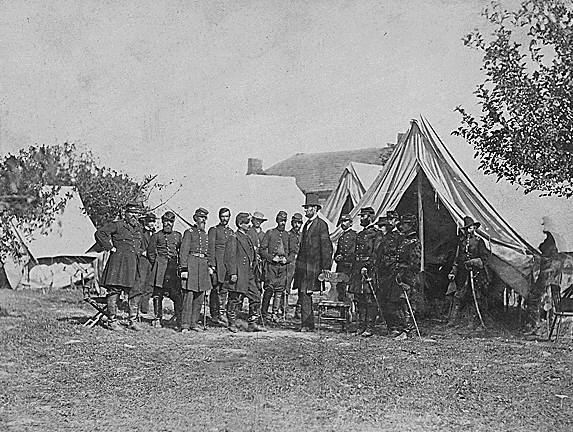
Photo above: President Lincoln and his generals at Antietam after the battle. Courtesy National Archives.

Photo above: President Abraham Lincoln. Courtesy National Archives. Right: Lithograph of Fort Sumter. Image courtesy Library of Congress.

Click here to Sponsor the page and how to reserve your ad.
-
Timeline
-
More
-
More
-
More
-
More
-
More
-
More
-
More
-
More
-
More
-
More
-
More
-
More
-
More
-
More
-
More
-
More
-
More
-
More
-
More
-
More
-
More
-
More
-
More
-
More
-
More
-
More
1860
February 22, 1860 - Twenty thousand New England shoeworkers strike and subsequently win higher wages.
April 3, 1860 - The Pony Express begins. Overland mail between Sacramento, California and St. Joseph's, Missouri is carried over the Oregon Trail for eighteen months by this series of riders on horseback, then rendered obsolete when the transcontinental telegraph is completed. Service ended on October 24, 1861.
1860-1861 - Emmanuel Leutze is commissioned by Congress and begins to paint the mural, "Westward Ho the Course of Empire Takes Its Way," in July 1861 for the U.S. Capitol. The mural represents frontier settlement.
November 6, 1860 - Republican candidate Abraham Lincoln, running on an anti-slavery platform, defeats three opponents in the campaign for the presidency; Democrats Stephen A. Douglas and John C. Breckinridge, and John Bell, Constitutional Union Party, leading to ardent cries of potential rebellion in southern slave states. Although Lincoln won the Electoral College by a large majority, 180 to 123 for all other candidates, the popular vote showed just how split the nation was. Lincoln garnered 1.9 million votes to the 2.8 million spread amongst his opponents.
December 20, 1860 - South Carolina responds to the election of Abraham Lincoln as President by being the first southern state to secede from the Union.
1861
February 4, 1861 - In Montgomery, Alabama, the convention to
form the Confederated States of America opens. Four days later,
with Jefferson Davis as president, seven southern states officially set up the C.S.A.
March 4, 1861 - Abraham Lincoln is sworn in as president of the
United States with Hannibal Hamlin as Vice President.
April 12, 1861 - Fort Sumter in Charleston, South Carolina harbor is bombarded for 34 hours by Confederate forces after the U.S. Army commander failed to evacuate, thus starting the four years of conflict and the U.S. Civil War. The Confederate States of America, formed two months earlier had sought to force federal troops from occupation of its territory. Fort Sumter was captured April 14 when Major Robert Anderson turned the fort over to the Confederacy.
April 15, 1861 - President Lincoln calls for 75,000 volunteers to fight the secessionist activities in the Confederated States of America, which rose to eleven southern states in secession by May.
July 21, 1861 - The first Battle of Bull Run at Manassas, Virginia occurs with the repulsion of Union forces by the Confederacy. Led by generals such as Stonewall Jackson, the overwhelming defeat by the Confederate forces of the Union, seen by onlookers who viewed the battle as nothing more than an exercise that would be easily won, showed vibrant indication that the Civil War would not be over quickly or without much cost.
1862
March 9, 1862 - The USS Monitor won the battle against the
Confederate ironclad Virginia off the coast of Hampton Roads,
Virginia.
April 7, 1862 - The Army of the Tennessee, under General Grant,
repulses the Confederate advance of the day earlier at the Battle of Shiloh, Tennessee, one of the largest battles of the western theatre in the U.S. Civil War. This battle, along with the unconditional surrender of Fort Donelson to General Grant on February 16, signaled the first major successes of the Union army in the west.
May 20, 1862 - The Homestead Act is approved, granting family farms of 160 acres (65 hectares) to settlers, many of which were carved from Indian territories. Two months later, on July 7, the Land Grant Act was approved, which called for public land sale to fund agricultural education. This act eventually led to the establishment of the state university systems.
September 17, 1862 - Emboldened by the victory at 2nd Manassas at the end of August, Confederate troops began the 1st invasion of Northern territory. Begun with a skirmish the night before north of Sharpsburg, Maryland, the day of September 17 along Antietam Creek burns bright as the bloodiest day of the Civil War. Along the Bloody Lane of the Sunken Road, around the Dunker Church, on the bluffs above Burnside Bridge, and in the ripped stalks of the cornfield, Union and Confederate troops fell in astounding numbers. Considered a victory by Union forces when the Confederates abandoned the field, even though Southern troops marching from Harper's Ferry had stemmed the Union tide the night before, Antietam. Antietam is known for several other outcomes, including McClellan's lack of pursuit of the enemy which would eventually lead to his dismissal, as well as a victory that stemmed the tide of Confederate advance to the north, and allowed the announcement of the Emancipation Proclamation.
September 22, 1862 - President Abraham Lincoln, fresh on the heals of the Antietam victory, issues the preliminary Emancipation Proclamation, stating that all slaves in places of rebellion against the Federal Government would be free as of January 1, 1863.
December 11, 1862 - General Ambrose Burnside begins the Battle of Fredericksburg when Union troops cross the Rappahannock River on pontoons, leading two days later to an ignominious and one-sided defeat by General Robert E. Lee. At locations such as Marye's Heights, Union troops engaged in futile and deathly charges against fortified positions only to be repulsed again and again. Subsequent withdraw to the other side of the river signaled Burnside's defeat, and the mud march of later days only underscores the mire of his decisions during the battle.
December 26, 1862 - The Dakota war that began in August between bands of Sioux and the U.S. government over late payments of annuities culminates in the jailing in Minnesota of over one thousand Dakota Sioux, and the hanging of thirty-eight in Mankato. It was the largest mass execution in U.S. history.
1863
January 1, 1863 - Daniel Freeman files one of the first homestead applications at the Brownsville Land Office in
Nebraska, cementing the Homestead Act of 1862 on its first day of implementation. The Emancipation Proclamation goes into
effect.
Minute Walk in History
Gettysburg 160th Anniversary - Day 3
The third day of the 160th Anniversary of the Battle of Gettysburg, included walks and talks on the action at Culp's Hill, Pickett's Charge, Farnsworth's cavalry action on the southern fields, as well as a program hosted by the Gettysburg Foundation and the Civil War Breakfast Club at the George Spangler farm, which was used as a Union hospital. Our most popular video ever, including popular Park Ranger Matt Atkinson.
July 1-3, 1863 - After three days of battle surrounding the tiny
town of Gettysburg
, including over 150,000 troops, Union defenders of Cemetery Ridge turn back General Pickett and Pettigrew during Pickett's Charge. With over 51,000 dead, wounded, or missing, the Battle of Gettysburg, on the farm fields of central Pennsylvania, proved to be the "high water mark of the Confederacy" and the last major push of Confederate forces into Union territory. Gettysburg remains a tribute of remarkable proportion to the men who fought and died on its fields, containing a reverence to the battle that played a major part in retaining the character of the United States of America.
July 4, 1863 - The city of Vicksburg surrenders to General Grant after a two month siege. The Vicksburg campaign included major battles from May 19, including the sinking of gunboats on the Mississippi River by Confederate defenders. This major accomplishment in the western theatre, plus the actions of Meade at Gettysburg one day earlier with the repulse of Pickett's Charge, prove to be the two most important victories of the Civil War. Even though it would take nearly two more years for the Confederate States of America to be defeated, these nearly simultaneous Union victories turned out to be the apex of the separatists.
July 13-16, 1863 - The New York draft riots kill about 1,000 people. Rioters protested the draft provision that allowed for money to be paid to get out of service. These payments would cease in 1864.
November 19, 1863 - "Four score and seven years ago," began what many perceive as the best speech in American history, delivered by President Abraham Lincoln in the town cemetery overlooking the fields of Gettysburg. The Gettysburg Address, only 272 words long and taking about two minutes to speak, captured the essence of the Civil War as both sacrifice and inspiration.
November 24, 1863 - Union General George Thomas scaled the heights of Chattanooga during one of the most arduous military charges in history. This charge caused Confederate forces to abandon the area, leaving Chattanooga and the majority of Tennessee under Union control.
1864
May 5-12, 1864 - At the Battles of the Wilderness and Spotsylvania, General Grant, now the first three star lieutenant general since George Washington and in charge of the U.S. Army, marched against the forces of General Lee in a remarkable series of clashes within the dense forests of Virginia. Union casualties alone numbered nearly 3,000 dead, 21,000 wounded, and 4,000 missing.
Minute Walk in History
Spotsylvania 160th Anniversary - Part 1
The 160th Anniversary events of the Overland Campaign continue as Grant pursues Lee a few miles down the road to engage again in the day after day Battle of Spotsylvania. This first part of the battle focuses on the opening action at Laurel Hill as well as the Bloody Angle at the Muleshoe. It's a commemoration and remembrance of the sacrifice that twenty thousand men who would perish or be wounded in the battle.
July 14, 1864 - In an attempt to cut the railroad supply route and stop General William T. Sherman's march on Atlanta, Lt. General Nathan Bedford Forrest engaged Union forces in the Battle of Tupelo, Mississippi. By the end of September 1st, Sherman had taken Atlanta and by December 22, Savannah was subdued.
September 29, 1864 - Union forces, including black Union soldiers, capture the Confederate Fort Harrison, south of Richmond. This caused a Confederate realignment of their southern defenses.
November 8, 1864 - President Lincoln defeats former Union General George B. McClellan to remain president of the United States, a repudiation of the tactics of delay favored by his former commander, and a signal of support for the President as he continued to prosecute the rebellion by the southern Confederate states. Lincoln receives 2.2 million votes and 212 in the electoral college compared to 1.8 million votes and 21 in the electoral college for McClellan.
November 29, 1864 - While awaiting terms of surrender, Cheyenne and Arapaho Indians are raided by 900 cavalrymen at Sand Creek. Between 150-500 men, women, and children from the tribes died.
1865
April 1, 1865 - Major General Philip H. Sheridan, leading his forces of cavalry and infantry, battle to victory at Five Forks against Major General George E. Pickett. This battle southwest of Petersburg, Virginia, cuts the railroad supply line to Confederate troops. One day later, General Grant holds his final assault on Petersburg, forcing the evacuation of General Robert E. Lee.
April 9, 1865 - General Robert E. Lee, as commander in chief of Confederate forces, surrenders his 27,000 man army to Ulysses S. Grant at Appomattox Court House, Virginia, effectively ending the four years of Civil War conflict. Additional troops under southern command would continue to surrender until May 26. The McLean House is the location for the surrender at Appomattox Courthouse.
April 14, 1865 - Abraham Lincoln is assassinated in Ford's Theatre, Washington, D.C.. five days after the signing at Appomattox of the Confederate surrender. The shot, fired by actor John Wilkes Booth, during the play "Our American Cousin," ends the life of the president who presided over the War of Rebellion and the end of slavery. Lincoln would die one day later.
June 28, 1865 - In the final desperate offensive act of the Civil War, two and one-half months after Lee's official surrender at Appomattox, the Confederate ship Shenandoah seized eleven American whaling ships in the Bering Strait, Alaska.
December 18, 1865 - The Thirteenth Amendment, abolishing slavery, takes effect.
1866
March 13, 1866 - The Civil Rights Act of 1866 is passed by Congress, the first federal law protecting the rights of African Americans. It is vetoed by President Johnson, but the veto overridden by Congress.
April 6, 1866 - The first post of the Grand Army of the Republic forms in Decatur, Illinois, and subsequently became a major political force. The G.A.R. began the celebration of Memorial Day in the north.
July 28, 1866 - Weights and measures are standardized in the United States when the Metric Act of 1866 passes Congress.
November 6, 1866 - The final Congressional elections of the year and election of additional Republicans lead to southern reconstruction being taken over by the federal government and freedman's rights backed.
December 24, 1866 - The Klu Klux Klan forms secretly to discourage blacks from voting, issuing in a brutal and shameful era of terror and crime amid southern states as civil rights for freed slaves emerged from the Civil War Era and made hesitant progress throughout the majority of the 20th Century.
1867
March 30, 1867 - Secretary of State William H. Seward consummates the sale of Alaska to the United States from Russia for $7.2 million dollars, approximately two cents per acre, by signing the Treaty of Cession of Russian America to the United States.
June 6, 1867 - The first running of the Belmont Stakes occurs at Jerome Park race track. The race was won by filly Ruthless at 1 5/8 mile with a winning purse of $1,850. The Belmont Stakes is the oldest of the three American Triple Crown races.
January 1867 - First of twelve installments of Ragged Dick by Horatio Alger is published and one year later expanded into a book in the "rags to riches" theme.
December 4, 1867 - The Grange organizes to protect the interest of the American farmer.
Christopher Sholes, Carlos Glidden, and S.W. Soule' invent the first practical typewriter. One year later, it was patented, then placed on the market in 1874 by E. Remington and Sons.
1868
March 5, 1868 - George Westinghouse invents and patents the air brake for railroad trains and organizes a company to produce them. Westinghouse would go on to patent four hundred inventions and found sixty companies, including Westinghouse Electric Company.
March 5, 1868 - The impeachment trial of Andrew Johnson begins in the Senate. Johnson was charged with violating the Tenure of Office Act by trying to remove the Secretary of War, Edwin M. Stanton. The President is acquitted by one vote.
October 28, 1868 - Thomas Edison applies for his first patent for the electric vote recorder.
November 3, 1868 - Republican Ulysses S. Grant, with Shuyler Colfax as his running mate, proves victorious in his quest to become the 18th President of the United States after defeating Horatio Seymour, 214 to 80 in the Electoral College. Grant would be sworn in on March 4, 1869.
November 27, 1868 - The Battle of the Washita River ends with Lt. Colonel George Custor's defeat of Black Kettle's Cheyenne. This ended the organized campaign of Indian forces against white settlers.
1869
May 10, 1869 - At Promontory, Utah, the final golden spike of the transcontinental railroad is driven into the ground, marking the junction of the Central Pacific and Union Pacific Railroads. This act, as much as any other, would signal the marked increase in the settlement of the west.
June 15, 1869 - John W. Hyatt, a New York printer, invents and
patents celluloid, the first synthetic plastic used widely for
commercial applications, including combs, dentures, curtains,
and photographic film, as well as the billiard balls he was seeking to find a substitute for the ivory commonly used.
August 15, 1869 - The first scientific expedition of the of the Colorado River is conducted by Major John Wesley Powell.
September 24, 1869 - Prompted by an attempt to corner the gold market, the financial Black Friday occurs in New York City.
December 10, 1869 - In one of the first acts of success in the women's suffrage movement, a Women's Suffrage law passes in the Territory of Wyoming.
History Photo Bomb

Above: The Cemetery Gate at Gettysburg after the battle. Courtesy National Archives. Below: The spike at Promontory, Utah of the Transcontinental Railroad.

Official Souvenirs
America's Best History

Get history and national park souvenir t-shirts, mugs, stickers, posters, and other gifts from the official gear of America's Best History, now available on Zazzle, Cafepress, Amazon, and Redbubble.
