-
Timeline - The 2000s
It began a decade before, although in many ways the intensity of the dynamic was missed, but when the hijacked planes hit the World Trade Center, the Pentagon, and the Shanksville field on September 11, 2001, there was no denying that a new order had emerged. It was a war against our way of life, a war of terror, and our response would dominate the decade and years come.
More 2000s

President Barack Obama. Courtesy Wikipedia Commons.

Now in Paperback,
Ebook and PDF

Photo above: World War II Memorial in Washington, D.C., opened April 29, 2004. Right: Court of Flags at the United Nations, Mateusz Stachowski, SXC Free Images.
Sponsor this page. Your banner or text ad can fill the space above.
Click here to Sponsor the page and how to reserve your ad.
-
Timeline
-
More
-
More
-
More
-
More
-
More
-
More
-
More
-
More
-
More
-
More
-
More
-
More
-
More
-
More
-
More
-
More
-
More
-
More
-
More
2000
April 1, 2000 - The 2000 census enumerates a population of 281,421,906, increasing 13.2% since 1990. As regions, the
South and West continued to pick up the majority of the increase
in population, moving the geographic center of U.S. population to Phelps County, Missouri.
April 3, 2000 - The ruling in the case of the United States versus Microsoft states that the company did violate anti-trust laws by diminishing the capability of its rivals to compete.
June 1, 2000 - For the first time since 1851, the United States of America does not participate in a major World's Fair, the Hannover 2000 World Expo, despite a record number, 187, of international participants. President Bill Clinton had withdrawn U.S. participation late in 1999 after agreement to participate in 1997. Congressional apathy toward participation in world events continues a decline in U.S. involvement after the fall of the Soviet Union and victory in the Cold War. A consequence of this policy has led to a rise, among some experts, of anti-American sentiment and a decline of U.S. influence in diplomatic affairs. Less than half, 18.1 million, of the original attendance estimate, 40 million, visit Hannover's event.
November 7, 2000 - George W. Bush, son of the former President, and Vice President Al Gore hold a virtual dead-heat for the presidency, with a disputed vote in Florida holding off the naming of the winner of the Presidential Election until the Supreme Court of the United States voted in favor of Bush on December 12. This ruling gave Florida to the Bush camp by a 527 vote majority and a victory in the Electoral College, 271-266, despite gaining less popular votes than Gore.
November 7, 2000 - Hillary Rodham Clinton wins a seat for the United States Senate from New York. It is the first time a former First Lady wins public office.
December 28, 2000 - Montgomery Ward, the retail giant since its founding one hundred and twenty-eight years before, announces its intention to cease business. Competition from newer, low-cost retail behemoths such as Wal-Mart lead to its demise.
2001
January 6, 2001 - Certification of the Electoral College victory of the 2000 United States Presidential election in the U.S. Senate confirms George W. Bush as the victor, with Dick Cheney as his Vice-President.
April 1, 2001 - China-U.S. incident. An American spy plane
collides with a fighter plane of China and makes an emergency
landing in Hainan, China. The U.S. crew is detained for ten days.
April 8, 2001 - Tiger Woods becomes the first golfer to hold all four major golf titles simultaneously by winning the Master's tournament in Augusta, Georgia. This followed a remarkable run in 2000 when Woods claimed victory at the final three majors of that season; the U.S. Open, the British Open, and the PGA Championship.
September 11, 2001 - Islamic fundamentalist terrorists hijack four U.S. airliners and crash them into the Pentagon and the World Trade Center in New York City. The attack of two planes levels the World Trade Center and the crash of one plane inflicts serious damage to the Pentagon in Arlington, Virginia, causing nearly 3,000 deaths. The fourth plane is heroically crashed by passengers into a Shanksville, Pennsylvania cornfield when they learn of the plot, preventing destruction of another structure in Washington, D.C., supposed to be the White House or the Capitol building. The plot is attributed to the Al-Qaeda organization led by Osama Bin Laden.
September 18, 2001 - Anthrax attacks by mail from Princeton, New Jersey against news and government targets begin. Federal officials announce the first case on October 4.
October 7, 2001 - In response to the tragedy of September 11, the United States military, with participation from its ally the United Kingdom, commence the first attack in the War on Terrorism on the Taliban and Al-Qaeda in Afghanistan. By November 12, the Taliban government leaves the capital, Kabul.
2002
February 8, 2002 - Amid tight security due to terrorism concerns, the Winter Olympic Games are opened by President George W. Bush in Salt Lake City, Utah. They would continue without major incident until the closing ceremony on February 24.
May 21, 2002 - The United States State Department issues its report in the War on Terror. It states that there are seven nations that a State-Sponsors: Iran, Iraq, Cuba, Libya, North Korea, Sudan, and Syria.
July 5, 2002 - Continuing its pattern of the past several years, Iraq refuses new proposals from the United Nations concerning weapons inspections. The inspections were part of the cease-fire agreement and terms of surrender in the 1991 Gulf War. On September 12, U.S. President George Bush addresses the United Nations and warns the members that Iraq presents a grave danger to the world that they must confront, or that the United States and others will act unitarily. On October 2, 2002, the United States Congress passes a resolution giving the President of the U.S. the authority to use the military forces of the country as he thinks necessary.
November 8, 2002 - The United Nations passes Resolution 1441 in a unanimous Security Council vote. It forces Saddam Hussein and Iraq to disarm or face serious consequences.
November 21, 2002 - NATO invites additional members of the former Soviet bloc to join its membership. Seven nations are included in the invitation; Bulgaria, Estonia, Latvia, Lithuania, Romania, Slovakia, and Slovenia.
2003
February 1, 2003 - A tragedy at NASA occurs when the Space
Shuttle Columbia explodes upon reentry over Texas. All seven
astronauts inside are killed.
March 19, 2003 - The War in Iraq begins with the bombing of
Baghdad after additional measures and mandates from the
United Nations and the United States coalition fail to gain
concessions or the removal of Saddam Hussein from power. The
U.S. coalition, upon failure to extract authority from the U.N. for action due to the veto power of France, begin land operations one day later with participation from U.S., British, Australian, and Polish troops.
April 9, 2003 - The U.S. coalition seizes control of Baghdad in the Iraq conflict.
July 2, 2003 - The International Olympic Committee votes in Prague that the Winter Olympic Games are coming back to North America, selecting Vancouver, Canada as host of the XXI Olympic Games in 2010.
December 13, 2003 - Saddam Hussein, former leader of Iraq, is captured in a small bunker in Tikrit by the U.S. 4th Infantry Division.
2004
February 3, 2004 - The Central Intelligence Agency admits that the imminent threat from weapons of mass destruction was not present before the 2003 Iraq war began.
March 2, 2004 - Mars rover MER-B (Opportunity) confirms to
NASA that the area of their landing was once covered in water.
July 4, 2004 - The groundbreaking ceremony for the Freedom Tower at Ground Zero, the former site of the World Trade Center complex destroyed during the September 11, 2001 attacks, occurs in New York City.
November 2, 2004 - President George W. Bush wins reelection over Democratic Senator John Kerry from Massachusetts. He wins 50.7% of the popular vote and 286 votes in the Electoral College.
December 26, 2004 - The southeast Asian tsunami occurs following a 9.3 Richter scale earthquake in the Indian Ocean. Two hundred and ninety thousand people die from Sri Lanka to Indonesia, creating one of the greatest humanitarian tragedies in history. A worldwide relief effort, led by the United States and many other nations, is mobilized to assist.
2005
May 31, 2005 - After more than thirty years in suspense, the
identity of Deep Throat, the contact for reporters Woodward and
Bernstein in the uncovering of the Watergate scandal, is revealed when W. Mark Felt, the second in command at the FBI at the time, confirms that he was their contact.
July 26, 2005 - In the first Space Shuttle flight since the tragedy of 2003, Discovery goes into orbit on a mission that returns to earth safely on August 9.
August 29, 2005 - Hurricane Katrina strikes the Gulf Coast,
inundating the city of New Orleans with water from Lake
Pontchartrain when the levees that maintain the below sea level
city break. Over one thousand three hundred people perish from
Alabama to Louisiana in one of the worst natural disasters to
strike the United States.
October 24, 2005 - Civil Rights activist, Rosa Parks, dies.
October 26, 2005 - The War of Terror continues. With elections in Iraq to confirm a new constitution vying with internal terrorism amid the U.S. military presence on October 15, eleven days later a statement from the Iranian President, Mahmoud Ahmadinejad, calls for the destruction of Israel and condemns the peace process.
December 15, 2005 - First active service in the United States Air Force for the new F22-A plane constructed by Lockheed Martin and Boeing. This f-22 raptor was a one-pilot plane that changed the course of military aviation design.
2006
February 22, 2006 - In a continuing shift of the retail industry to new platforms, it is announced that the one billionth song is downloaded from the internet music store, Apple iTunes. This shift comes at the expense of many brick and mortar chains, including Tower Records.
September 25, 2006 - In New Orleans, the Louisiana Superdome
reopens after repairs caused by Hurricane Katrina damage. The
repairs included the largest re-roofing project in U.S. history and took thirteen months following the destruction to the Gulf Coast region.
October 17, 2006 - The population of the United States reaches the milestone of three hundred million, taking only about forty years to gain one hundred million people since the two hundredth million person was added in 1967*. At the same time, a vibrant debate on immigration policy, particularly illegal immigration, ensues across the nation. *Some sources list that date at 1964.
November 7, 2006 - In the mid-term elections, both houses of Congress change back to Democratic hands for the first time since 1994. This is seen as a referendum by many on the Iraq policy of the Bush administration as well as personal Republican scandals among some House and Senate members.
December 1, 2006 - United States manufacturing capacity and esteem wanes, signaled by the sale of the last shares of his General Motors stock by U.S. billionaire Kirk Kerkorian.
2007
January 4, 2007 - The first female speaker of the U.S. House of Representatives, Representative Nancy Pelosi of San Francisco, California, is sworn into office.
January 10, 2007 - President George W. Bush announces a
troop surge of 21,500 for the war in Iraq to stem the violence at
the request of new commander General Petraeus. This
controversial policy begins to show positive signs once fully
implemented during the summer months, with a reduction in
violent attacks against coalition forces and Iraqi civilians.
Progress on the political front within the Iraqi national
government, however, does not keep pace with positive
developments on the military front.
June 2, 2007 - A terror plot to blow up JFK International Airport in
New York City is thwarted when four terrorists are arrested and
charged with its plan.
July 4, 2007 - The fifty star flag of the United States of America becomes the longest flying flag in American history after flying over forty-seven years.
December 13, 2007 - The Mitchell Report on the Steroids Scandal in baseball is published. It recounted a year long investigation into the use and abuse of performance enhancing drugs over a two decade period, including steroids and human growth hormone. Nearly ninety players were named, and blame for the scandal was spread among players, the union, and the commissioner's office. Headed by former Senator George Mitchell, the report urged enhanced testing to stem the problem and a look forward attitude to restore the integrity of the game and its statistics. The report comes after a season when Barry Bonds broke the home run record of Hank Aaron amid suspicion of steroid use.
2008
July 1, 2008 - A report by the U.S. embassy in Iraq states that 15 of the 18 goals set for the Iraqi government have been met, largely due to the surge implemented over the last year. The increase of 21,500 United States troops, commonly known as the surge, reduced violence and restored order to the nation,
allowing the government of Iraq to focus more on solving other
problems needed to establish a stable nation.
August 17, 2008 - Michael Phelps, the United States swimmer
from Baltimore, wins his 8th Gold Medal of the Beijing Summer
Olympic Games, surpassing the record of seven won by Mark
Spitz.
August 29, 2008 - John McCain chooses Sarah Palin, 1st term Governor of Alaska, as his running mate, making the contest between Barack Obama and himself, the first time a presidential election included both an African-American candidate and a woman amongst the Presidential and Vice Presidential nominees for president among the Democratic and Republican tickets.
October 3, 2008 - The United States Congress passes legislation, signed by President Bush, for a $700 billion bailout, the Emergency Economic Stabilization Act, giving the Treasury Department authority to assist distressed Wall Street and banking businesses of the United States due to the housing, banking, and subprime mortgage crises caused by excessive greed and speculation among Wall Street firms. This economic distress, coupled with oil prices above $140 per barrel during the summer, deepened the world economic crises that had been brewing all year. The bailout was supported by current President George W. Bush and both presidential candidates, Barack Obama and John McCain.
November 4, 2008 - Barack Obama, Democratic Senator from Illinois, the land of Abraham Lincoln, wins a landslide margin in the Electoral College, 365 to 173 in the election for the 44th President of the USA over John McCain, making him the first African-American president in the history of the United States of America.
2009
January 20, 2009 - Barack Obama takes the oath of office for
President of the United States, becoming the first
African-American president in the history of the nation. The
Democratic Senator from Illinois comes into the office on a
message of Change. The city of Washington, D.C. hosts more
than one million visitors to the inauguration, covering the National Mall in a way reminiscent of the Civil Rights March of Martin Luther King forty-six years earlier.
April 15, 2009 - After a succession of big government spending
projects beginning in the Bush administration and expanded
under President Obama, 750 grass roots Tea Party protests
spring up across the nation. More than one half million citizens
concerned with increased deficits due to actions such as the
bailout of the banking industry, car industry, potential cap and
trade legislation, and other administration projects that project a ten trillion dollar deficit over the next decade take part.
June 11, 2009 - The H1N1 virus, named the Swine Flu, is deemed a global pandemic by the World Health Organization. This is the first such designation since the Hong Kong flu in 1967-1968.
October 31, 2009 - The economic recession continues to deepen as jobless claims climb above 10.0%, reaching 10.2% with October's monthly figures. This occurs despite efforts by the Obama administration to ramp up massive government spending pushed by the $780 billion economic stimulus package passed earlier in the year.
December 1, 2009 - President Obama announces a surge of 30,000 additional troops to Afghanistan to stem increased efforts by the Taliban in the country. The surge, which was suggested by military officers, was not popular with the liberal base of the Democratic party which had put the President in power on a pledge to end both Middle Eastern wars. The war in Afghanistan, which started as a response to the terror attacks on 9/11/2001, and the war on terror in general, comes into focus again on December 25 when an airliner headed for Detroit is attacked by a Muslim extremist, 23-year-old Umar Farouk Abdulmutallab, who attempts to detonate a bomb, but fails.
History Photo Bomb

Bush-Cheney campaign bus on their presidential campaign through the Philadelphia suburbs in 2004.
Timeline History

Want a copy of the Timeline. Now available in easy to search
digital format for your Kindle, Nook, or pdf format. Also comes in paperback, too.
Baseball History

Check out our partners at Stat Geek Baseball and
Baseballevaluation for a history of baseball with stat geeks in mind, including their books Fields of Gold, Baseball's Best Glove Work, and Baseball's Best @ 150.

Site of the former World Trade Center.
ABH Travel Tip

Much of America's best history takes in the beauty and nature of our national parks. From the first park in Yellowstone, from the coast of Maine to the shores of Hawaii Volcanoes, check out the history of the USA as made by our land.
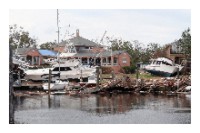
Damage across the Gulf Coast from Mississippi to New Orleans after Hurricane Katrina.
Official Souvenirs
America's Best History
