Sponsor this page for $75 per year. Your banner or text ad can fill the space above.
Click here to Sponsor the page and how to reserve your ad.
-
Timeline
Detail - 1513
March 4, 1513 - Ponce de León leaves Puerto Rico to explore the coast of Florida, looking for the Fountain of Youth. There were two hundred men and three ships undertaking the exploration.

History of Ponce de León Prior
Juan Ponce de León (1474–1521) was a veteran of Spanish excursions around the Caribbean by the time anyone even thought about Fountains of Youth or gold on the land to the north, today's Florida. He had accompanied Christopher Columbus, at nineteen years of age, on his second voyage to the New World in 1493, part of his twelve hundred person crew. Born in Santervás de Campos, Valladolid, Spain, he was a nobleman from Castile and had fought in expelling the Moors from Spain. Ponce de León accompanied Columbus around the Caribbean for two to three years, part of the discovery of Dominica, the northern islands of the Lesser Antilles, Virgin Islands, Jamaica, and Puerto Rico, known as Boriquén by the native Taino, and sighted by the crew on November 18/19, 1493. So Ponce de León knew the area well, including the first voyage port and settlements on Cuba and Espanola.
It is not known just what Juan Ponce de León was doing over the next decade; there are thoughts he returned to Castile, the came back with Nicolás de Ovando, the new Spanish Governor of Española, also known as Hispaniola, in 1502. With Hispaniola serving as Spain's administrative center in the New World, Juan Ponce de León played roles in the defeat of the Taino, was given a huge land grant on the eastern side of the islands, now the Dominican Republic, native labor, and built a large house in 1505, which is still there. He made many friends, including Vasco Nuñez de Balboa. However, as the end of the decade approached, a problem rose. The vast gold mines on Hispaniola were running short of the ore that was making the encomendaros and King rich and the battles with the Taino, plus the disease brought by the Europeans, had depleted the labor force. Puerto Rico was up next, due to Ponce de León's personal knowledge with an Indian chief there. Ovando agreed, sending the explorer on several journeys there, in 1506 and 1508, plus giving him a large royal commission to enrich his own and Spanish coffers once disagreements with the son of Columbus, Diego, over rights after his death had been mollified.
During the 1508 voyage, his first official voyage, Juan Ponce de León expanded his camp at Caparra (what is now thought the first settlement founded in what is now United States territory), and started his search for gold. However, Diego Columbus (Col@ón) had not been satisfied at all and had been sent, in 1509, to succeed Ovando as interim Viceroy of the Indies in Santo Domingo. Juan Ponce de León, however, was now the acting governor of Puerto Rico. On August 14, 1509, Ovando, now back in Spain, convinced King Ferdinand to make Juan the permanent governor of Puerto Rico, however with slow communications, Diego Columbus fired him in October prior to the news reaching the Caribbean on November 28, 1509. This quieted the disagreements enough (they did not go away) so that Ponce de León could rule as he wished. The Spanish population on Puerto Rico grew as the native Taino population succumbed to disease, which led to war. The war would still be going on when his excusion to Florida commenced.
The Idea to Sail North
There has been very little written correspondence about how the Florida, Fountain of Youth, expedition, started. In one of the few early surviving letters from the Americas, the only one found from Juan Ponce de León, he reports to an official, Ochoa Alvarez de Isásaga, one of several governors of Casa de Contratación de Indias, on October 7, 1511. Quotes from the letter follows.
Ponce de León promises to "send the gold that has been cast every four months."
"The mines are running well, though war is no help since every day more caciques rebel and refuse to go [to work]. The Caribs have always been bad for this island." "The gold has not been sent because no furnaces to smelt it are available."
"I am also sending the letters and list to the court, since Pedro Moreno, who is empowered to negotiate my position is already there. If any matters concerning my affairs should be communicated to your worship from those gentlemen, I beseech you to look after them as I shall do here with your own interests. Also enclosed with the packet addressed to your highness are ones to the secretary and another to Pedro Moreno to explain about the issues to be discussed with your Highness. Pedro Moreno has not sent me any good news nor identified the specific person who will present them to the court and it is very important to me that he contacts me and I get answers to what I have written."
And what were some of the answers he was looking for? Who would, and he wanted to be, appointed to make the excursion to the mainland of what would become the United States, Florida. He had heard of discussions in summer 1511 with Miguel de Pasamonte, royal treasurer of the Indies, that some slavers had ventured into unknown territory to the north, what was then referred to collectively, as Bimini (Beniny). There was no real mention of a Fountain of Youth, which would become the embellishment to the story. He may have been told of curative springs. Finally, a royal contract was signed on February 23, 1512. He would have three years to discover and make settlements on what they thought an island and bring back the riches, which would be apportioned.
But Diego Columbus was still petitioned for his rights and won a court case giving him control, despite King Ferdinand's displeasure. By this time, Juan Ponce de León was preparing to leave to a place, where those rights had been given to him.

Preparations
Enlisted were sixty-five to two hundred men and the use of three ships; Santiago, the San Cristobal and the Santa Maria de la Consolacion, all paid through his private funds. They would leave Puerto Rico on March 3/4 (there is debate on which date), 1513, and sail northwest, passing Turks and Caicos and the Bahamian Islands. A storm hit the expedition on March 30 for two days. Although the debate on exactly where he landed is ongoing, the ships sighted land somewhere about thirty miles north of Daytona Beach and Cape Canaveral, near the eventual settlement of St. Augustine. On April 3, 1513, Ponce de León rowed ashore, becoming the first recorded European man to set foot on the North American continent (beyond those slavers, the Vikings, and likely fishing expeditions in the north). The land was called La Florida, due to its nature and flat topography in honor of the time of year, the Festival of Flowers, aka ... Easter. He would be, according to the contract with King Ferdinand, governor for life. They would remain at their original landing location for five days before exploring further.
Image above: Drawing of Juan Ponce de León, date unknown, taken from 1858 book "Die illustrierte neue welt," John Ledyard Denison. Courtesy Library of Congress. Photo below: Political cartoon depicting politicians in 1894 with McKinley portraying Ponce de León. They are gathered around a pool of water labeled "High Protection Doctrine", thinking that it's the fountain of youth, 1894, Udo J. Keppler, Puck. Courtesy Library of Congress. Source info: Bullock Museum, "1511 Letter from Ponce de Leó"; christies.com; "Charting Juan Ponce de LeĂłn’s 1513 Voyage to Florida: The Calusa Indians amid Latitudes of Controversy," 2014, Jerald T. Milanich; University of South Florida; Florida Historical Society, myfloridahistory.org; Library of Congress; Wikipedia.

History Photo Bomb

Christopher Columbus, by Ridalfo Ghirlandaio, 1520. Courtesy Wikipedia Commons.
ABH Travel Tip
Much of America's best history takes in the beauty and nature of our national parks. From the first park in Yellowstone, from the coast of Maine to the shores of Hawaii Volcanoes, check out the history of the USA as made by our land.
It is not known just what Juan Ponce de León was doing over the next decade; there are thoughts he returned to Castile, the came back with Nicolás de Ovando, the new Spanish Governor of Española, also known as Hispaniola, in 1502. With Hispaniola serving as Spain's administrative center in the New World, Juan Ponce de León played roles in the defeat of the Taino, was given a huge land grant on the eastern side of the islands, now the Dominican Republic, native labor, and built a large house in 1505, which is still there. He made many friends, including Vasco Nuñez de Balboa. However, as the end of the decade approached, a problem rose. The vast gold mines on Hispaniola were running short of the ore that was making the encomendaros and King rich and the battles with the Taino, plus the disease brought by the Europeans, had depleted the labor force. Puerto Rico was up next, due to Ponce de León's personal knowledge with an Indian chief there. Ovando agreed, sending the explorer on several journeys there, in 1506 and 1508, plus giving him a large royal commission to enrich his own and Spanish coffers once disagreements with the son of Columbus, Diego, over rights after his death had been mollified.
During the 1508 voyage, his first official voyage, Juan Ponce de León expanded his camp at Caparra (what is now thought the first settlement founded in what is now United States territory), and started his search for gold. However, Diego Columbus (Col@ón) had not been satisfied at all and had been sent, in 1509, to succeed Ovando as interim Viceroy of the Indies in Santo Domingo. Juan Ponce de León, however, was now the acting governor of Puerto Rico. On August 14, 1509, Ovando, now back in Spain, convinced King Ferdinand to make Juan the permanent governor of Puerto Rico, however with slow communications, Diego Columbus fired him in October prior to the news reaching the Caribbean on November 28, 1509. This quieted the disagreements enough (they did not go away) so that Ponce de León could rule as he wished. The Spanish population on Puerto Rico grew as the native Taino population succumbed to disease, which led to war. The war would still be going on when his excusion to Florida commenced.
Ponce de León promises to "send the gold that has been cast every four months."
"The mines are running well, though war is no help since every day more caciques rebel and refuse to go [to work]. The Caribs have always been bad for this island." "The gold has not been sent because no furnaces to smelt it are available."
"I am also sending the letters and list to the court, since Pedro Moreno, who is empowered to negotiate my position is already there. If any matters concerning my affairs should be communicated to your worship from those gentlemen, I beseech you to look after them as I shall do here with your own interests. Also enclosed with the packet addressed to your highness are ones to the secretary and another to Pedro Moreno to explain about the issues to be discussed with your Highness. Pedro Moreno has not sent me any good news nor identified the specific person who will present them to the court and it is very important to me that he contacts me and I get answers to what I have written."
And what were some of the answers he was looking for? Who would, and he wanted to be, appointed to make the excursion to the mainland of what would become the United States, Florida. He had heard of discussions in summer 1511 with Miguel de Pasamonte, royal treasurer of the Indies, that some slavers had ventured into unknown territory to the north, what was then referred to collectively, as Bimini (Beniny). There was no real mention of a Fountain of Youth, which would become the embellishment to the story. He may have been told of curative springs. Finally, a royal contract was signed on February 23, 1512. He would have three years to discover and make settlements on what they thought an island and bring back the riches, which would be apportioned.
But Diego Columbus was still petitioned for his rights and won a court case giving him control, despite King Ferdinand's displeasure. By this time, Juan Ponce de León was preparing to leave to a place, where those rights had been given to him.
Image above: Drawing of Juan Ponce de León, date unknown, taken from 1858 book "Die illustrierte neue welt," John Ledyard Denison. Courtesy Library of Congress. Photo below: Political cartoon depicting politicians in 1894 with McKinley portraying Ponce de León. They are gathered around a pool of water labeled "High Protection Doctrine", thinking that it's the fountain of youth, 1894, Udo J. Keppler, Puck. Courtesy Library of Congress. Source info: Bullock Museum, "1511 Letter from Ponce de Leó"; christies.com; "Charting Juan Ponce de LeĂłn’s 1513 Voyage to Florida: The Calusa Indians amid Latitudes of Controversy," 2014, Jerald T. Milanich; University of South Florida; Florida Historical Society, myfloridahistory.org; Library of Congress; Wikipedia.
History Photo Bomb
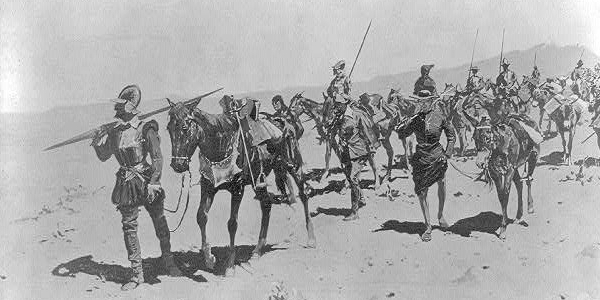

Christopher Columbus, by Ridalfo Ghirlandaio, 1520. Courtesy Wikipedia Commons.
ABH Travel Tip
Much of America's best history takes in the beauty and nature of our national parks. From the first park in Yellowstone, from the coast of Maine to the shores of Hawaii Volcanoes, check out the history of the USA as made by our land.