-
Pre-Revolution Timeline - The 1700s
Wars amongst colonial powers from Queen Anne to French and Indian led to growing unrest within the colonies themselves as taxes were levied without representation, which would lead to the next decade to come and revolution. American leaders began to emerge in a variety of ways, including George Washington trying to become a British General and Ben Franklin beginning his publishing career and flying a kite.
More 1700s

Sponsor this page. Your banner or text ad can fill the space above.
Click here to Sponsor the page and how to reserve your ad.
-
Timeline
1741 Detail
March 18, 1741 - Twenty-nine years after the first revolt of slaves in New York, a second uprising occurs. Seventeen slaves were hanged after the revolt, thirteen burned, and seventy deported.
Was it a slave rebellion, a conspiracy, or an accident? Those questions are still pondered. It would seem like one of the first two, as thirteen fires set in New York during the period of what was that slave revolt or conspiracy seems too high to label accidental. And when one of the buildings that was burned was the Governor's home in Fort George two weeks after the first arrests, even today's fractious media might deem it a social or political act. And there was just as much disagreement then or would be now who was to blame. New York, in 1741, was a highly populated slave state. It's percentage of households with slaves, forty-two percent, was only lower than Charleston.
While it may have been true that certain white settlers in New York wanted to blame their black slaves, even if they were not guilty, it is likely that at least some participated. Slave rebellions in northern states were commonplace prior to common sense outlawing the practice. There had been one in New York in 1712. Rebellions in the South were even more recent, including the Stono Rebellion in South Carolina in 1739. The cold harsh winter in 1740-41 had caused desperation in the Province of New York. Britain's war with Spain had also caused a lack of troops to keep control of the masses. Limits on assembly for blacks were enacted. This did not stop free blacks and enslaved blacks, plus poor whites, from congregating. One place, John Hughson's Tavern on the Hudson River waterfront, was of great concern for the authorities. So they arrested Hughson, who had been an illiterate cobbler, and his wife for selling stolen goods, plus slaves Caesar and Prince. The initial arrest stemmed from the robbing of Robert Hogg, a merchant's house on Broad Street, on February 28. Linens, coins, and medals were stolen to the value of sixty pounds.
The Accused Acts
Beyond the robbery at Robert Hogg's House, and while some of the conspirators were under suspicion of that crime, the fires began two weeks after their arrest. Governor George Clarke's house at Fort George on March 18, plus the remainder of the fort spurred by the wind which burned the fort down in one hour and a quarter, and a number of other houses; Captain Warren's on March 25, Van Zant's warehouse on April 1, Mrs. Hilton's house on April 6, were burned, and post the trial for Caesar and Prince, seven barns were additionally burned. There was a total of thirteen fires. It was not until the tenth fire on April 6 that suspects beyond the robbery conspirators began to arise. One, a black man called Quack or Quaco, was seen running from the fire and yelling suspicious words. While most residents were content with blaming those held for trial in the thought of burning New York by blacks and their allies, some contended a conspiracy on the other side of the equation should be considered. What if elite whites had hired blacks, promising their freedom, to do the burning in an effort to take over the city? In every way, the conspiracy spun. Some historians contend that the officials thought the two thousand blacks in the city intended to burn down the town and slaughter the nine thousand white settlers. Others concluded that the Spanish and other Catholics should be held with suspicion as England had been at war, the War of Jenkins Ear, since 1739. Yes, it is confusing.
In the end, one hundred and seventy-two black and white men, plus several white women, were arrested and put on trial.

Trials and Outcomes
During the jailing of Hughson and the two slaves, Mary Burton, a sixteen year old indentured servant from Ireland who worked for John Hughson, was pushed into testifying against them. This is when the fires started to burn. Burton stated, under pressure from one of the judges, Daniel Horsmanden, that she could be jailed, that Caesar, Prince, and Cuffie were the instigators of the fires with help from Hughson and his wife Sarah, plus Peggy Kerry, an alleged Irish prostitute to blacks.
Grand Jury at Supreme Court, April 21, 1741
The Grand Jury judges were Frederick Philipsz and Daniel Horsmanden. The foreman of the jury Merchantman Robert Watts. There were sixteen jurors. The first person brought before them, Mary Burton, at first refused to testify, but upon threats of jail, she relented, but said her testimony would only be about the theft at Mr. Hogg's, not about the fires. She would relent on that as well under duress. In the equation was a promise by the court that Mary Burton would gain one hundred pounds, enough to buy out her indentured servitude.
Mary Burton's Testimony ...
"That Prince and Ceasar brought the Things of which they had robbed Mr. Hogg, to her Master, John Hughson's House, and that they were handed in through the Window, Hughson, his Wife, and Peggy receiving them, about Two or Three o'clock on a Sunday Morning. That Ceasar, Prince and Mr. Phillip's Negro Man (Cuffee) used to meet frequently at her Master's House, and that has heard them (the Negroes) talk frequenty of burning the Fort; and that would go down to the Fly and burn the whole Town; and that her Master and Mistress said, they would aid and assist them as much as they could."
"That in the common Conversation they used to say, that when all this was done, Ceasar should be Governor, and Hughson her Master should be King. That Cuffee used to say, That a great many People had too much, and others too little; That his old Master had a great deal of Money, but that, in a short Time, he should have less, and that he (Cuffee) should have more."
"That at the same time when the Things of which Mr. Hogg was robbed were brought to her Master's House, they brought some Indigo and Bees Wax, which was likewise received by her Master and Mistress. That of the Meetings of the Three aforesaid Negroes, Ceasar, Prince, and Cuffee, at her Master's House, they used to say, in their Conversation, That when they set Fire to the Town, they would do it in the Night, and as the white People came to extinguish it, they would kill and destroy them."
"That she has known at Times, seven or eight Guns in her Master's House, and some Swords, and that she has seen Twenty or Thirty Negroes, Cuffee, Prince, and Ceasar, were generally present and most active, and that they used to say, That the other Negroes dare not refused to do what they commanded them, and they were sure that they had a Number sufficient to stand by them."
"That Hughson (her Master) and her Mistress used to threaten, that if she the Deponent ever made mention of the Goods stolen from Mr. Hogg, they would POISON her; and the Negroes swore, if ever she published, or discovered their design of burning the Town, they would burn her wherever they met her."
"That she never saw any white Person in Company when they talked of burning the Town, but her Master, her Mistress, and Peggy."
April 23, the Grand Jury Continues ...
The Foreman Robert Watts wanted to hear what Peggy Kerry had to say, but the Judges thought her testimony should be gained in secret. The judges elicited her words in jail. She positively denied knowing any Thing about the Fires.
The Grand Jury recommended several indictments; one, the KING vs. Caesar and Prince, Negroes; the second, the KING vs. John Hughson, Sarah Hughson, and Margaret (Peggy) Socurbiero (Kerry). All defendents pleaded Not Guilty. There was also discussion that John Romme was also in question. On Friday, May 1, the first trial was held; Caesar and Prince. They were found guilty. Other depositions were taken, including that of Arthur Price, who had been charged with stealing from Captain Vincent Pearse upon the Fire at Fort George, which he had denied, saying that he took them to save them.
On Wednesday May 6, the second trial commenced against John and Sarah Hughson, plus Peggy Kerry. The Hughson's stood trial for receiving stolen goods on March 3 from the Hogg House robbery. The Hughson's were found guilty. Arthur Prince testified against Peggy Kerry about the Fort Fire, stating in his testimony, "That on Monday last Peggy came to him, and bid him no discover any thing for his Life, that she had told him; for if he did, by G-d she would cut his Throat. Arthur Prince also stated that he knew nothing about the fire at the Fort.
Peggy Kerry's Testimony (Confession in Writing), May 7, 1741
"That she was several times at the House of John Romme, Shoemaker, and Tavernkeeper, and saw several Meetings of the Negroes from time to time: and in Particular, in the Month of December last past, she saw assembed there in or about Ten or Twelve in Number (including Cuff, Caesar, and others). The rest of their Names, that was in the Combination, I cannot remember, or their Master's Names. They proposed to burn the Fort first, and afterwards the City; and then sical, rob and carry all the Money and Goods they could procure, and was to be carried to Romme's, and was to be joined by the Country Negroes, and that they were to murder every one that had Money."
"The Reason why I did not make this Discovery before, Romme swore them all never to discover, and swore me tes; and I thought, I would wrong my own soul, if I discovered it. And that all the rest of the Negroes in City and Country were to meet in one night."
Her testimony was a last ditch effort for mercy. However, on the next day, Caesar and Prince were sentenced to death by hanging. Another day later, testimony continued, including that of John Romme's wife. She denied knowing anything about the fires. The judge determined that the plot was planned at both Romme's and the Hughson's. John Romme had already fled the country. During the next days, various of the other Negro conspirators were brought before the court.
Motions in the indictments of John Hughson and His Wife, plus Peggy Kerry, now included the Hughson's daughter Sarah. On June 4, Judge Daniel Horsmanden found John and wife Sarah plus Kerry guilty on all three charges of the day; daughter Sarah on two. On June 8, they were sentenced to execution by hanging. The daughter's execution was delayed as the court weighed her fate further. On July 8, daughter Sarah Hughson confessed that she knew of the conspiracy, relented, then testified against John Uly, thought a Catholic priest by authorities, which he denied. Uly was convicted to hang; Sarah Hughson, the daughter, was pardoned.
After the trials concluded, the Province of New York executed thirty-four for their part in the conspiracy near the Poor House in the North End; thirty black men, two white men (John Uly, a priest, perhaps, thought agent for Spain, and Hughson), and two white women, wife Sarah Hughson and Peggy Kelly. The remainder of the involved, one hundred and eighty-one in total, at a lower scale, were banished from the city. Those banished included seventy blacks, many sold to other countries, and twenty whites. Part of their punishment for thirteen of the black men reached back to the witch hunts, which considered blacks as witches due to their lack of civilized control in seductiveness and moral conduct, and thus the penalty was the same. But even the judge, despite his harsh findings, agreed that perhaps there was more to it.
"... we have not been able entirely to unravel the Mystery of this Iniquity; for 'twas a dark Design, and the Veil is in some Measure still upon it!" Judge Daniel Horsmanden.
Mary Burton finally received her bonus, one hundred pounds, for her testimony. She bought out her indentured contract.
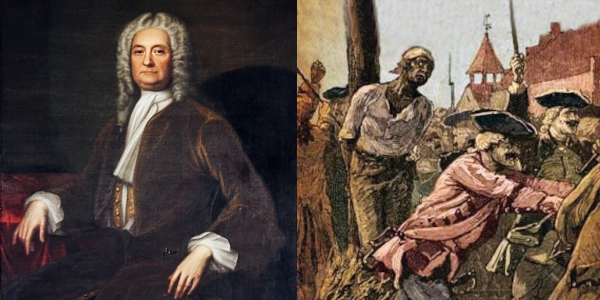
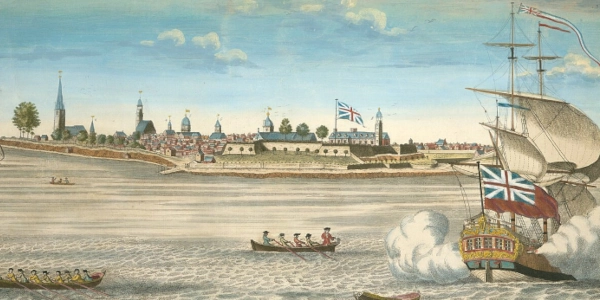
Image above: Montage (left) New York Colonial Governor George Clarke, 1750, James Fellowes. Courtesy Wikipedia Commons. (right) Drawing of those who were convicted in 1741, of conspiring to burn city of New York, unknown date and author. Courtesy Wikipedia Commons. Image Below: A View of Fort George with the City of New York from the Southwest, 1731/1736, John Carwitham Engraver, William Burgis Artist. Courtesy New York Public Library via Wikipedia Commons. Info Source: Library of Congress; "African Americans Burned at the Stake in America, Secret History of the Witches," 2000, Max Dusha; "1741 New York Rebellion of Enslaved People," New York City Archaeological Repository; "The New York Conspiracy of 1741 Introduction," Gilder-Lehman Institute; "A Journal of the Proceedings in the Detection of the Conspiracy Formed by Some White People, in Conjunction
with Negro and Other Slaves, 1744, Judge Daniel Horsmanden; "Was the Conspiracy That Gripped New York in 1741 Real," 2023, Ashawnta Jackson, daily.jstor.com; Wikipedia Commons.
History Photo Bomb

Replica of the Walker cabin in Barboursville, Kentucky, 2009. Courtesy Wikipedia Commons. Cabin built after his European discovery of the Cumberland Gap.

Official Souvenirs
Check out the official souvenirs of America's Best History on some of the best historic sites and national parks of the United States at our partners at Teepossible.
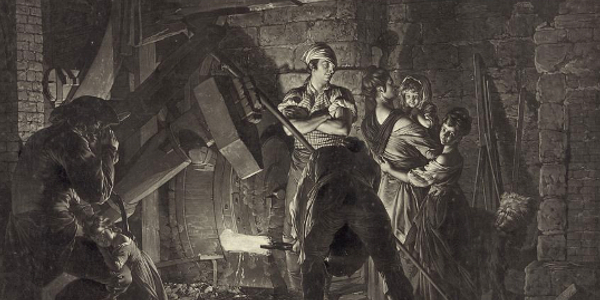
Drawing of an Iron Forge, example of one that would have been affected by the rules of England establishing the Iron Act, Boydell. Courtesy Library of Congress. Image Below: Iron Mountains in Clifton Forge, Virginia, circa 1900/1910, Detroit Publishing Company. Courtesy Library of Congress.
Timeline Book

Plymouth Rock from the site of the landing of the Mayflower and start of the Plymouth Colony. Courtesy Wikipedia Commons.
ABH Travel Tip

To get a great idea of how the decades before the Declaration of Independence was written take a trip to Boston. It's a great place to learn about the colony of Massachusetts Bay, too.
Was it a slave rebellion, a conspiracy, or an accident? Those questions are still pondered. It would seem like one of the first two, as thirteen fires set in New York during the period of what was that slave revolt or conspiracy seems too high to label accidental. And when one of the buildings that was burned was the Governor's home in Fort George two weeks after the first arrests, even today's fractious media might deem it a social or political act. And there was just as much disagreement then or would be now who was to blame. New York, in 1741, was a highly populated slave state. It's percentage of households with slaves, forty-two percent, was only lower than Charleston.
While it may have been true that certain white settlers in New York wanted to blame their black slaves, even if they were not guilty, it is likely that at least some participated. Slave rebellions in northern states were commonplace prior to common sense outlawing the practice. There had been one in New York in 1712. Rebellions in the South were even more recent, including the Stono Rebellion in South Carolina in 1739. The cold harsh winter in 1740-41 had caused desperation in the Province of New York. Britain's war with Spain had also caused a lack of troops to keep control of the masses. Limits on assembly for blacks were enacted. This did not stop free blacks and enslaved blacks, plus poor whites, from congregating. One place, John Hughson's Tavern on the Hudson River waterfront, was of great concern for the authorities. So they arrested Hughson, who had been an illiterate cobbler, and his wife for selling stolen goods, plus slaves Caesar and Prince. The initial arrest stemmed from the robbing of Robert Hogg, a merchant's house on Broad Street, on February 28. Linens, coins, and medals were stolen to the value of sixty pounds.
The Accused Acts
Beyond the robbery at Robert Hogg's House, and while some of the conspirators were under suspicion of that crime, the fires began two weeks after their arrest. Governor George Clarke's house at Fort George on March 18, plus the remainder of the fort spurred by the wind which burned the fort down in one hour and a quarter, and a number of other houses; Captain Warren's on March 25, Van Zant's warehouse on April 1, Mrs. Hilton's house on April 6, were burned, and post the trial for Caesar and Prince, seven barns were additionally burned. There was a total of thirteen fires. It was not until the tenth fire on April 6 that suspects beyond the robbery conspirators began to arise. One, a black man called Quack or Quaco, was seen running from the fire and yelling suspicious words. While most residents were content with blaming those held for trial in the thought of burning New York by blacks and their allies, some contended a conspiracy on the other side of the equation should be considered. What if elite whites had hired blacks, promising their freedom, to do the burning in an effort to take over the city? In every way, the conspiracy spun. Some historians contend that the officials thought the two thousand blacks in the city intended to burn down the town and slaughter the nine thousand white settlers. Others concluded that the Spanish and other Catholics should be held with suspicion as England had been at war, the War of Jenkins Ear, since 1739. Yes, it is confusing.
In the end, one hundred and seventy-two black and white men, plus several white women, were arrested and put on trial.
Trials and Outcomes
During the jailing of Hughson and the two slaves, Mary Burton, a sixteen year old indentured servant from Ireland who worked for John Hughson, was pushed into testifying against them. This is when the fires started to burn. Burton stated, under pressure from one of the judges, Daniel Horsmanden, that she could be jailed, that Caesar, Prince, and Cuffie were the instigators of the fires with help from Hughson and his wife Sarah, plus Peggy Kerry, an alleged Irish prostitute to blacks.
Grand Jury at Supreme Court, April 21, 1741
The Grand Jury judges were Frederick Philipsz and Daniel Horsmanden. The foreman of the jury Merchantman Robert Watts. There were sixteen jurors. The first person brought before them, Mary Burton, at first refused to testify, but upon threats of jail, she relented, but said her testimony would only be about the theft at Mr. Hogg's, not about the fires. She would relent on that as well under duress. In the equation was a promise by the court that Mary Burton would gain one hundred pounds, enough to buy out her indentured servitude.
Mary Burton's Testimony ...
"That Prince and Ceasar brought the Things of which they had robbed Mr. Hogg, to her Master, John Hughson's House, and that they were handed in through the Window, Hughson, his Wife, and Peggy receiving them, about Two or Three o'clock on a Sunday Morning. That Ceasar, Prince and Mr. Phillip's Negro Man (Cuffee) used to meet frequently at her Master's House, and that has heard them (the Negroes) talk frequenty of burning the Fort; and that would go down to the Fly and burn the whole Town; and that her Master and Mistress said, they would aid and assist them as much as they could."
"That in the common Conversation they used to say, that when all this was done, Ceasar should be Governor, and Hughson her Master should be King. That Cuffee used to say, That a great many People had too much, and others too little; That his old Master had a great deal of Money, but that, in a short Time, he should have less, and that he (Cuffee) should have more."
"That at the same time when the Things of which Mr. Hogg was robbed were brought to her Master's House, they brought some Indigo and Bees Wax, which was likewise received by her Master and Mistress. That of the Meetings of the Three aforesaid Negroes, Ceasar, Prince, and Cuffee, at her Master's House, they used to say, in their Conversation, That when they set Fire to the Town, they would do it in the Night, and as the white People came to extinguish it, they would kill and destroy them."
"That she has known at Times, seven or eight Guns in her Master's House, and some Swords, and that she has seen Twenty or Thirty Negroes, Cuffee, Prince, and Ceasar, were generally present and most active, and that they used to say, That the other Negroes dare not refused to do what they commanded them, and they were sure that they had a Number sufficient to stand by them."
"That Hughson (her Master) and her Mistress used to threaten, that if she the Deponent ever made mention of the Goods stolen from Mr. Hogg, they would POISON her; and the Negroes swore, if ever she published, or discovered their design of burning the Town, they would burn her wherever they met her."
"That she never saw any white Person in Company when they talked of burning the Town, but her Master, her Mistress, and Peggy."
April 23, the Grand Jury Continues ...
The Foreman Robert Watts wanted to hear what Peggy Kerry had to say, but the Judges thought her testimony should be gained in secret. The judges elicited her words in jail. She positively denied knowing any Thing about the Fires.
The Grand Jury recommended several indictments; one, the KING vs. Caesar and Prince, Negroes; the second, the KING vs. John Hughson, Sarah Hughson, and Margaret (Peggy) Socurbiero (Kerry). All defendents pleaded Not Guilty. There was also discussion that John Romme was also in question. On Friday, May 1, the first trial was held; Caesar and Prince. They were found guilty. Other depositions were taken, including that of Arthur Price, who had been charged with stealing from Captain Vincent Pearse upon the Fire at Fort George, which he had denied, saying that he took them to save them.
On Wednesday May 6, the second trial commenced against John and Sarah Hughson, plus Peggy Kerry. The Hughson's stood trial for receiving stolen goods on March 3 from the Hogg House robbery. The Hughson's were found guilty. Arthur Prince testified against Peggy Kerry about the Fort Fire, stating in his testimony, "That on Monday last Peggy came to him, and bid him no discover any thing for his Life, that she had told him; for if he did, by G-d she would cut his Throat. Arthur Prince also stated that he knew nothing about the fire at the Fort.
Peggy Kerry's Testimony (Confession in Writing), May 7, 1741
"That she was several times at the House of John Romme, Shoemaker, and Tavernkeeper, and saw several Meetings of the Negroes from time to time: and in Particular, in the Month of December last past, she saw assembed there in or about Ten or Twelve in Number (including Cuff, Caesar, and others). The rest of their Names, that was in the Combination, I cannot remember, or their Master's Names. They proposed to burn the Fort first, and afterwards the City; and then sical, rob and carry all the Money and Goods they could procure, and was to be carried to Romme's, and was to be joined by the Country Negroes, and that they were to murder every one that had Money."
"The Reason why I did not make this Discovery before, Romme swore them all never to discover, and swore me tes; and I thought, I would wrong my own soul, if I discovered it. And that all the rest of the Negroes in City and Country were to meet in one night."
Her testimony was a last ditch effort for mercy. However, on the next day, Caesar and Prince were sentenced to death by hanging. Another day later, testimony continued, including that of John Romme's wife. She denied knowing anything about the fires. The judge determined that the plot was planned at both Romme's and the Hughson's. John Romme had already fled the country. During the next days, various of the other Negro conspirators were brought before the court.
Motions in the indictments of John Hughson and His Wife, plus Peggy Kerry, now included the Hughson's daughter Sarah. On June 4, Judge Daniel Horsmanden found John and wife Sarah plus Kerry guilty on all three charges of the day; daughter Sarah on two. On June 8, they were sentenced to execution by hanging. The daughter's execution was delayed as the court weighed her fate further. On July 8, daughter Sarah Hughson confessed that she knew of the conspiracy, relented, then testified against John Uly, thought a Catholic priest by authorities, which he denied. Uly was convicted to hang; Sarah Hughson, the daughter, was pardoned.
After the trials concluded, the Province of New York executed thirty-four for their part in the conspiracy near the Poor House in the North End; thirty black men, two white men (John Uly, a priest, perhaps, thought agent for Spain, and Hughson), and two white women, wife Sarah Hughson and Peggy Kelly. The remainder of the involved, one hundred and eighty-one in total, at a lower scale, were banished from the city. Those banished included seventy blacks, many sold to other countries, and twenty whites. Part of their punishment for thirteen of the black men reached back to the witch hunts, which considered blacks as witches due to their lack of civilized control in seductiveness and moral conduct, and thus the penalty was the same. But even the judge, despite his harsh findings, agreed that perhaps there was more to it.
"... we have not been able entirely to unravel the Mystery of this Iniquity; for 'twas a dark Design, and the Veil is in some Measure still upon it!" Judge Daniel Horsmanden.
Mary Burton finally received her bonus, one hundred pounds, for her testimony. She bought out her indentured contract.
Image above: Montage (left) New York Colonial Governor George Clarke, 1750, James Fellowes. Courtesy Wikipedia Commons. (right) Drawing of those who were convicted in 1741, of conspiring to burn city of New York, unknown date and author. Courtesy Wikipedia Commons. Image Below: A View of Fort George with the City of New York from the Southwest, 1731/1736, John Carwitham Engraver, William Burgis Artist. Courtesy New York Public Library via Wikipedia Commons. Info Source: Library of Congress; "African Americans Burned at the Stake in America, Secret History of the Witches," 2000, Max Dusha; "1741 New York Rebellion of Enslaved People," New York City Archaeological Repository; "The New York Conspiracy of 1741 Introduction," Gilder-Lehman Institute; "A Journal of the Proceedings in the Detection of the Conspiracy Formed by Some White People, in Conjunction
with Negro and Other Slaves, 1744, Judge Daniel Horsmanden; "Was the Conspiracy That Gripped New York in 1741 Real," 2023, Ashawnta Jackson, daily.jstor.com; Wikipedia Commons.
History Photo Bomb
Replica of the Walker cabin in Barboursville, Kentucky, 2009. Courtesy Wikipedia Commons. Cabin built after his European discovery of the Cumberland Gap.
Official Souvenirs
Check out the official souvenirs of America's Best History on some of the best historic sites and national parks of the United States at our partners at Teepossible.
Drawing of an Iron Forge, example of one that would have been affected by the rules of England establishing the Iron Act, Boydell. Courtesy Library of Congress. Image Below: Iron Mountains in Clifton Forge, Virginia, circa 1900/1910, Detroit Publishing Company. Courtesy Library of Congress.
Timeline Book
Plymouth Rock from the site of the landing of the Mayflower and start of the Plymouth Colony. Courtesy Wikipedia Commons.
ABH Travel Tip
To get a great idea of how the decades before the Declaration of Independence was written take a trip to Boston. It's a great place to learn about the colony of Massachusetts Bay, too.
History Photo Bomb
Replica of the Walker cabin in Barboursville, Kentucky, 2009. Courtesy Wikipedia Commons. Cabin built after his European discovery of the Cumberland Gap.
Official Souvenirs
Check out the official souvenirs of America's Best History on some of the best historic sites and national parks of the United States at our partners at Teepossible.
Drawing of an Iron Forge, example of one that would have been affected by the rules of England establishing the Iron Act, Boydell. Courtesy Library of Congress. Image Below: Iron Mountains in Clifton Forge, Virginia, circa 1900/1910, Detroit Publishing Company. Courtesy Library of Congress.
Timeline Book
Plymouth Rock from the site of the landing of the Mayflower and start of the Plymouth Colony. Courtesy Wikipedia Commons.
ABH Travel Tip
To get a great idea of how the decades before the Declaration of Independence was written take a trip to Boston. It's a great place to learn about the colony of Massachusetts Bay, too.