-
Pre-Revolution Timeline - The 1770s
The people were getting tired of the overarching rules, regulations, and taxes of the British Crown, perhaps no more so than in Boston where a massacre would occur. So a Tea Party would be held, declarations and Congresses made, then a war with shots ringing out from Princeton to Saratoga to Yorktown. But it would take much longer than this one decade to win that war and to form a true government. The American Revolution would seep into the next decade and the first President not in office til after that.
More 1700s
American Revolution Historic Sites

What's going on to protect and interpret American Revolution historic sites. Great news on two interesting fronts.
Sponsor this page. Your banner or text ad can fill the space above.
Click here to Sponsor the page and how to reserve your ad.
-
Timeline
1776 Detail
September 22, 1776 - As a member of the Continental Army sent on an intelligence gathering mission behind enemy lines on Long Island, Nathan Hale, disguised as a Dutch teacher, is subsequently caught and executed by the British for spying. In a speech before he was hung, the immortal words, "I only regret that I have but one life to lose for my country," were reportedly uttered, and reverberated through repetition throughout the colonies. A statue of Hale now sits outside the Central Intelligence Agency in Washington, D.C.
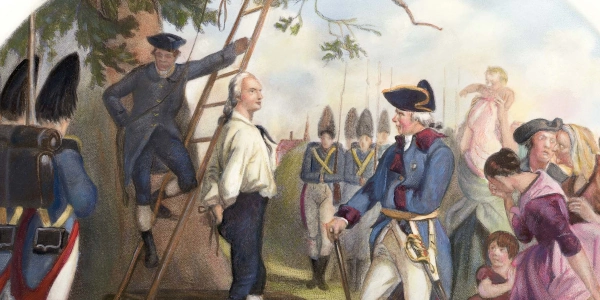
In the annals of the American Revolution, there are two men that stand out, for opposite reasons, about the love of country. And we're not gonna discuss Benedict Arnold here. Nathan Hale was a school teacher in East Haddam and at the Union Grammar School in London, Connecticut, who believed in the cause of colonial rights, and when the American Revolution started, in fighting for the cause. He was a friend of Benjamin Tallmadge, a classmate at Yale and later leader of the Culper Spy Ring, would get to know General George Washington, and joined the spy ring on Long Island, New York, that would attempt to get the commander information about the British General William Howe and what he was planning to do with his trained soldiers.
However, Nathan Hale was only twenty-one years old with no military or intelligence training. He was enamored of Alice Adams, his friend from childhood with black hair and hazel eyes, but they never married. Some sources state they were engaged. Others state that she had previously married Elijah Ripley and had a child, because Hale's parents did not approve. Others state that Alice only married Ripley after Hale's death. Go figure.
His schooling had originally been to become a minister. Conteporaries at the time thought him nice, brave, and principled, but not suited for the job of a spy. A spy was not thought an honorable profession at the time either. The teacher joined the Continental Army on July 6, 1775; within five months he was a 1st Lieutenant, achieving the high rank due to his schooling. Hale would go to Boston with his men in the 7th Connecticut under Colonel Charles Webb to support Washington on September 28, 1775, but his troops were not used. By January of 1776, he would rise to the rank of captain, and by April 1776, he and his men had left Boston for New York, but still in reserve. However, as well as General Washington had done at Boston, he was faring poorly by August 1776, with the Battle of Brooklyn Heights, as Howe launched a double-pronged attack on New York. Washington had to withdraw from Brooklyn to Manhattan. Knowlton's Rangers, a unit that Hale had just joined, asked Washington about providing volunteers for a special mission. Nathan volunteered.
The Intelligence Gathering Mission
On September 15, 1776, Nathan Hale traveled to Connecticut. He would change his army clothes into that of a school teacher, carry his Yale College diploma, but was still distinct due to scars on his face. Hale had met with General Washington in New York and assigned the task a few days before. On September 16, he traveled by a schooner under Captain Pond to a point known as the Cedars on Long Island near Huntington, meeting at the house of William Johnson. He stayed the night, then headed to Brooklyn. On September 15, 1776, the British forces under General William Howe arrived in New York. Their lines stretched from Red Hook to Flushing Bay with General Howe on one end and General Clinton on the other. Royal cavalry patrolled the area. As you can see, there was a symbiotic nature to the tragic story that would unfold. One such tragedy was that Washington no longer needed much of the information Hale would try to gather. The British were already there. Another was that after Washington had agreed on the mission, there had been no additional training in spy craft such as the knowledge of cyphers and codes.
Hale made inquiries in the city, gathered information, and made friends with a man, Robert Rogers, also a spy, whom he thought a patriot. He was not always a patriot, playing both sides in an unsavory manner. Supposedly, Nathan trusted Rogers enough, he couldn't keep his mouth shut around his friends. They were loyalists. When others in town recognized him, his arrest was soon enacted on September 21, 1776. Hale was taken to New York City, under a great fire that day (four hundred and ninety-three houses were lost), and questioned by General Howe the next day at his headquarters, Beekman House, near the contemporary United Nations. Howe interrogated him in the mansion's greenhouse; Hale did not lie about his mission. This enraged General Howe, although he held back his contempt at first, as he turned the table and asked Nathan Hale to switch sides and work for the British. Hale emphatically stated no, vowing he would not betray his new country.
After Howe's conviction, he was taken to the Royal Artillery Park near Dove Tavern to meet the Provost Marshal, William Cunningham. Lieutenant Cunningham had a reputation for brutality. Hale requested a bible and clergy, per his daughter (most sources do not state that Hale had a daughter, but this may have been from Alice Adam per her marriage) after his death and the play Nathan Hale, written and performed in 1898. Hale was denied both. As he walked to the gallows at eleven o'clock in the morning, Hale appeared calm.
Richard Hull would later state that Hale said the words, "I only regret that I have but one life to lose for my country," which most doubt now due to its similarity to that in an earlier play, but it was possible. Hale could have read the play, or excerpts from it, and noted it as his last words. His body would hang in the gallows for days.
Quotes from the Time
"Whether the education of daughters be not, without any just reason, more neglected than that of sons," Nathan Hale at Yale College debate 1773 about his desire for women's rights.
"I think I owe to my country the accomplishment of an object so important and so much desired by the commander of her armies—and I know no other mode of obtaining the information than by assuming a disguise and passing into the enemy's camp. I am fully sensible of the consequences of discovery and capture in such a situation. But for a year I have been attached to the army and have not rendered any material service, while receiving a compensation for which I make no return. Yet I am not influenced by the expectation of promotion or pecuniary reward. I wish to be useful, and every kind of service for the public good becomes honorable by being necessary. If the exigencies of my country demand a peculiar service its claims to the performance of that service are imperious!" Nathan Hale, September 1776, upon taking spy assignment.
"His (Hale's) nature was too frank and open for deceit and disguise, and he was incapable of acting a part equally foreign to his feelings and habits," Nathan Hale's former classmate.
"He (Hale) thought he owed to his country the accomplishment of an object so important, and so much desired by the commander of the armies, and he knew of no other mode of obtaining the information than by assuming a disguise and passing into the enemy's camp," Richard Hull, friend of Nathan Hale.
"Then you may die for her (his country)," General William Howe after Hale refused to switch sides in the American Revolution.
"I only regret that I have but one life to lose for my country," stated by Richard Hull from eyewitness, the last words of Nathan Hale.
"On the morning of his execution, my station was near the fatal spot, and I requested the Provost Marshal to permit the prisoner to sit in my marquee while he was making the necessary preparations. Captain Hale entered: he was calm, and bore himself with gentle dignity, in the consciousness of rectitude and high intentions. He asked for writing materials, which I furnished him: he wrote two letters, one to his mother and one to a brother officer. He was shortly after summoned to the gallows. But a few persons were around him, yet his characteristic dying words were remembered. He said, 'I only regret, that I have but one life to lose for my country,'" British Captain John Montresor statement under flag of true to Hale's friend Captain Richard Hull.
"Thus while fond Virtue wished in vain to save, Hale, bright and generous, found a hapless grave; With Genius' living flame his bosom glowed, And Science lured him to her sweet abode; In Worth's fairpath his feet adventured far, The pride of Peace, the rising hope of War; In duty firm, in danger calm as even To friends unchanging, and sincere to Heaven. How short his course, the prize how early won, While weeping friendship mourns her favorite gone," poem by President Dwight of Yale College.
However, Nathan Hale was only twenty-one years old with no military or intelligence training. He was enamored of Alice Adams, his friend from childhood with black hair and hazel eyes, but they never married. Some sources state they were engaged. Others state that she had previously married Elijah Ripley and had a child, because Hale's parents did not approve. Others state that Alice only married Ripley after Hale's death. Go figure.
His schooling had originally been to become a minister. Conteporaries at the time thought him nice, brave, and principled, but not suited for the job of a spy. A spy was not thought an honorable profession at the time either. The teacher joined the Continental Army on July 6, 1775; within five months he was a 1st Lieutenant, achieving the high rank due to his schooling. Hale would go to Boston with his men in the 7th Connecticut under Colonel Charles Webb to support Washington on September 28, 1775, but his troops were not used. By January of 1776, he would rise to the rank of captain, and by April 1776, he and his men had left Boston for New York, but still in reserve. However, as well as General Washington had done at Boston, he was faring poorly by August 1776, with the Battle of Brooklyn Heights, as Howe launched a double-pronged attack on New York. Washington had to withdraw from Brooklyn to Manhattan. Knowlton's Rangers, a unit that Hale had just joined, asked Washington about providing volunteers for a special mission. Nathan volunteered.
Hale made inquiries in the city, gathered information, and made friends with a man, Robert Rogers, also a spy, whom he thought a patriot. He was not always a patriot, playing both sides in an unsavory manner. Supposedly, Nathan trusted Rogers enough, he couldn't keep his mouth shut around his friends. They were loyalists. When others in town recognized him, his arrest was soon enacted on September 21, 1776. Hale was taken to New York City, under a great fire that day (four hundred and ninety-three houses were lost), and questioned by General Howe the next day at his headquarters, Beekman House, near the contemporary United Nations. Howe interrogated him in the mansion's greenhouse; Hale did not lie about his mission. This enraged General Howe, although he held back his contempt at first, as he turned the table and asked Nathan Hale to switch sides and work for the British. Hale emphatically stated no, vowing he would not betray his new country.
After Howe's conviction, he was taken to the Royal Artillery Park near Dove Tavern to meet the Provost Marshal, William Cunningham. Lieutenant Cunningham had a reputation for brutality. Hale requested a bible and clergy, per his daughter (most sources do not state that Hale had a daughter, but this may have been from Alice Adam per her marriage) after his death and the play Nathan Hale, written and performed in 1898. Hale was denied both. As he walked to the gallows at eleven o'clock in the morning, Hale appeared calm.
Richard Hull would later state that Hale said the words, "I only regret that I have but one life to lose for my country," which most doubt now due to its similarity to that in an earlier play, but it was possible. Hale could have read the play, or excerpts from it, and noted it as his last words. His body would hang in the gallows for days.
Quotes from the Time
"Whether the education of daughters be not, without any just reason, more neglected than that of sons," Nathan Hale at Yale College debate 1773 about his desire for women's rights.
"I think I owe to my country the accomplishment of an object so important and so much desired by the commander of her armies—and I know no other mode of obtaining the information than by assuming a disguise and passing into the enemy's camp. I am fully sensible of the consequences of discovery and capture in such a situation. But for a year I have been attached to the army and have not rendered any material service, while receiving a compensation for which I make no return. Yet I am not influenced by the expectation of promotion or pecuniary reward. I wish to be useful, and every kind of service for the public good becomes honorable by being necessary. If the exigencies of my country demand a peculiar service its claims to the performance of that service are imperious!" Nathan Hale, September 1776, upon taking spy assignment.
"His (Hale's) nature was too frank and open for deceit and disguise, and he was incapable of acting a part equally foreign to his feelings and habits," Nathan Hale's former classmate.
"He (Hale) thought he owed to his country the accomplishment of an object so important, and so much desired by the commander of the armies, and he knew of no other mode of obtaining the information than by assuming a disguise and passing into the enemy's camp," Richard Hull, friend of Nathan Hale.
"Then you may die for her (his country)," General William Howe after Hale refused to switch sides in the American Revolution.
"I only regret that I have but one life to lose for my country," stated by Richard Hull from eyewitness, the last words of Nathan Hale.
"On the morning of his execution, my station was near the fatal spot, and I requested the Provost Marshal to permit the prisoner to sit in my marquee while he was making the necessary preparations. Captain Hale entered: he was calm, and bore himself with gentle dignity, in the consciousness of rectitude and high intentions. He asked for writing materials, which I furnished him: he wrote two letters, one to his mother and one to a brother officer. He was shortly after summoned to the gallows. But a few persons were around him, yet his characteristic dying words were remembered. He said, 'I only regret, that I have but one life to lose for my country,'" British Captain John Montresor statement under flag of true to Hale's friend Captain Richard Hull.
"Thus while fond Virtue wished in vain to save, Hale, bright and generous, found a hapless grave; With Genius' living flame his bosom glowed, And Science lured him to her sweet abode; In Worth's fairpath his feet adventured far, The pride of Peace, the rising hope of War; In duty firm, in danger calm as even To friends unchanging, and sincere to Heaven. How short his course, the prize how early won, While weeping friendship mourns her favorite gone," poem by President Dwight of Yale College.
What Happened to the Legacy?
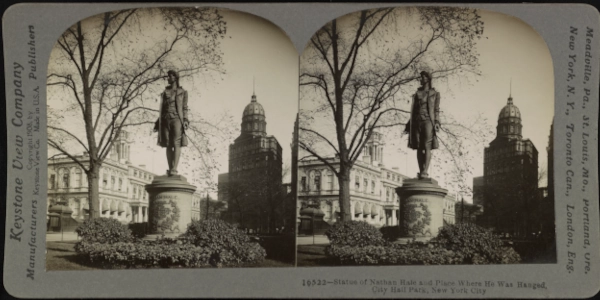
During most of the war, Hale was little recognized by the Continental Army as a hero, or by the British Army as nothing but an unnamed spy. There were a few news reports in colonial papers, but only a year and more later were they published. The legend grew after the war. Today, there are numerous statues dedicated to him; one at the Central Intelligence Agency, another in City Hall Park, the purposed site of his hanging, and others in New Haven, Coventry, and Hartford.
Image above: Drawing of Nathan Hale prior to hanging by the British, 1900, F.O.C. Darley. Courtesy Library of Congress, colorized via Bettmann Archive. Image below: Statue of Nathan Hale in City Hall Park, New York City near where he was hanged," 1908, Keystone View Company. Courtesy Library of Congress. Info Source: "Nathan Hale: The Life and Death of America's First Spy," M. William Phelps; "Nathan Hale: American Patriot. Army Ranger. Spy," 2022, cia.gov; "The Diary of Nathan Hale," Nathan Hale, University of Connecticut Library; Library of Congress; "Nathan Hale, the Doomed Patriot Spy, Probably Never Said 'I Only Regret That I Have but One Life to Lose for My Country' Before His Execution," 2025, Meilan Solly, Smithsonian Magazine; "Nathan Hale The Martyr-hero of the Revolution; with a Hale Genealogy and Hale's Diary," 1899, Charlotte Molyneux Holloway; "Remembering Patriot Known for Famous Last Words," 2026, Jason Brooke and staff, morrowcountysentinel.com.
History Photo Bomb
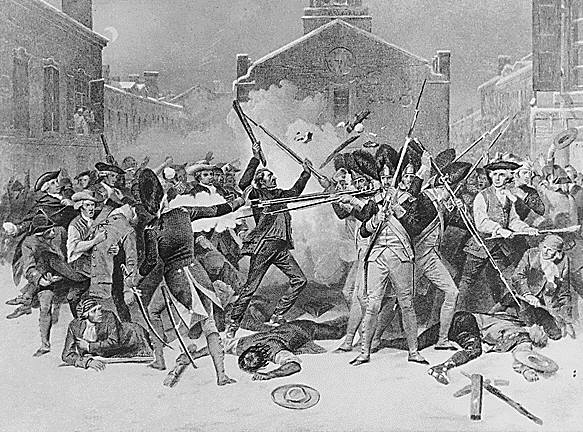
Drawing of the Boston Massacre, March 5, 1770.
ABH Travel Tip
The bargains at the National Park Service continue, despite some recent increases in park fees. The National Park Pass is now called the America the Beautiful Pass, which admits all vehicle and family visitors for one year, and costs $80 for one twelve month period. The pass covers most Federal fee areas, including National Parks, Historic Sites, and National Forests. For those of 62 years of age or older, buy the America the Beautiful Senior Pass. For only $20 per year or $80 for a lifetime pass, you gain free
entrance for the rest of your life to all National Parks, National Historic Sites, and National Forests, and other federal fee sites for you, your spouse, and your children, plus discounts of 50% on some use fees, such as camping. Must be purchased in person at a National Fee location, which are the one hundred or so National Park Service sites that charge for entry. Prices for foreign visitor are expected to rise in 2026.

Paul Revere on his ride to Concord to warn the patriots that
the British were coming. Courtesy National Archives.
Timeline Book


George Washington talking to his men outside the log huts at
his encampment in Valley Forge. Courtesy National Archives.
Military History
Check Out This Interesting
Website suggested by students at Green Mountain
Central School District in Vermont, Understanding Our Military Branches