-
Pre-Revolution Timeline - The 1770s
The people were getting tired of the overarching rules, regulations, and taxes of the British Crown, perhaps no more so than in Boston where a massacre would occur. So a Tea Party would be held, declarations and Congresses made, then a war with shots ringing out from Princeton to Saratoga to Yorktown. But it would take much longer than this one decade to win that war and to form a true government. The American Revolution would seep into the next decade and the first President not in office til after that.
More 1700s
American Revolution Historic Sites

What's going on to protect and interpret American Revolution historic sites. Great news on two interesting fronts.
Sponsor this page. Your banner or text ad can fill the space above.
Click here to Sponsor the page and how to reserve your ad.
-
Timeline
1777 Detail
August 3, 1777 - American held Fort Stanwix is besieged by British and Indian troops under the command of General Barry St. Leger. The British are forced to withdraw after three weeks under the duress of the fort's defenders, led by Colonel Peter Gansevoort.
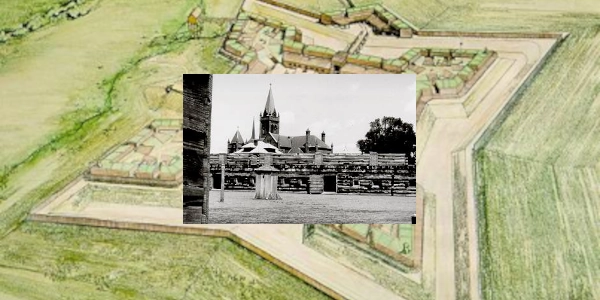
Known by many as the fort (known as Fort Schuyler after 1776) that never surrendered, Colonel Peter Gansevoort and his seven hundred and fifty men of the Third New York Regiment withstood the three week siege and from the beginning refused to surrender. On August 2, 1777, under the orders of British General John Burgoyne, Brigadier General St. Leger traversed the three-hundred and fifty miles from Montreal, and arrived with fifteen hundred and fifty British soldiers (other estimates put the total at nearer nineteen hundred), militia, and Native Allies from the Iroquois Six Nations, led by Mohawk chief Joseph Brant or Thayendanegea, John Butler, and Sayenqueraghta plus Cornplater from the Seneca. Burgoyne thought that St. Leger could easily defeat Fort Schuyler, allowing him to remain in the Hudson River Valley and battle there. St. Leger ordered Gansevoort to surrender. The answer was no.
"... determined to defend [the fort] to the last extremity, against all enemies whatsoever, without any concern for the consequences of doing his duty," Colonel Peter Gansevoort.
For weeks, the Americans in the fort faced cannnon fire and the shutoff of their water supply by St. Leger. However, Gansevoort would await a relief column led by General Nickolas Herkimer, but the first never came. Six miles away, the British attacked in the Battle of Oriskany, winning a tactical battle of hand to hand combat and the elimination of most of the Patriot militia, including eight hundred men and Oneida warriors. But Gansevoort was prescient; he sent two hundred fifty troops from the fort to the British camp, looting it while they were away.
Another relief column was approaching by August 12, led by still respected, awaiting time to be a traitor, American General Benedict Arnold. He had seven hundred men, but convinced St. Leger that his forces numbered four times that, around three thousand. Arnold's trick was to allow a captured loyalist, Hon Yost Schuyler, to go to the British and state that Arnold's force was very large in exchange for his freedom if the plan worked. He also shot holes in his clothes to signify that he barely escaped the Americans, plus told St. Leger that Burgoyne had been defeated. With his native allies restless, expecting a short battle and not a siege, and the thought of battling the lying sob Arnold and his expanded forces, St. Leger abandoned the siege on August 22, 1777 and his goal of occupying the Mohawk Valley. There were few casualties in the battle; 34 for the Americans and 66 for the British troops.
However, those losses were not the main part of the story. By the time St. Leger arrived back to Saratoga to help General Burgoyne and his five thousand eight hundred men, the Battle of Saratoga was over, October 17, 1777. The British forces there were captured, and then were expelled from the colony of New York as well as most of New England, thus leading to the French and Netherlands eventually joining the American Continental Army's effort in their quest for a new nation.
Minute Walk in History
Siege of Fort Stanwix
The battles at Lexington and Concord were over, the American Revolution was on with a Declaration of Independence already cried out to the land. Loyalists still tied to the British Crown, as well as Regulators and Native Allies of Great Britain were attempting to take control of the whole of the former colony of New York, and lay siege to the American at Fort Stanwix for three weeks in August 1777. It would become known as the fort that never surrendered.
Correspondence of Colonel Peter Gansevoort, Revolutionary War 1777 Prior to Battle
To Abraham Ten Broeck
Sir. I must once more apologize to the Convention for not sending a Return of my Regiment agreeable to their Order Their dispersion of my Officers upon the recruiting Service has prevented me but as I am now under marching Orders for Fort Schuyler with that part of my Regiment which is here I have ordered all the Officers in with their Recruits I shall Soon be able to transmit you the Return Requested -
It gives me great Pain that part of my Regiment is separated from me and wish for nothing more than to have them Joined it give me little concern what department I Serve in, but when Corps are so divided they can do little Honor to themselves or the State they belong to, and believe me that my utmost Exertions would not be wanting to make them usefull - permit them to be your Interposition with his Excellency General Washington that may be joined and as I said before I am indifferent where we Join, but conceive it would contribute to the Credit of the State if all the Regiments could be together.
I am most respectfully Sir Your very Hum Servant
The Honble Abraham Ten Broeck Esqr President, March 17, 1777.
To Marinus Willett
Albany 29th March 1777
Sir. As the Season for opening the Campaign is near at hand, the General Commanding the Northern Department has desir'd in General Orders that all Soldiers now on Furlough do immediately Join their respective Regiments and that no more furloughs be granted which you'll please to See executed.
You will have a Force run from Swamp (Casp) Stefanus the Frenchman's House formerly stood to the River and another from the Crippelbush at the lower End of Brodshacks Field to the River with the Swinging Gate in Each these two Fences will be enclosure sufficent to supply with Grass and Hay and secure the Garden - as there is too much Work to be done at present to have the fences made as they formerly were.
As Soon as the Season will permit you will have the Garden put in Seed, that the Garrison may not be without Vegetables in their Season -
Cole Gouvion the Engineer who is with you at present the Marquis de Lafayette informs me will be ordered to the Southward Soon, you will therefore receive from him every necessary Instruction to compleat the Fort for a Seige -
You will constantly make returns to me of every Necessary wanting at the Fort, that I may procure them -
I am Yours, etc.
You will order the Quarter to send Down the Account of Rations and parts of Rations which may be due to the Regt.
Synopsis of Future Letters from and to Peter Gansevoort Closer to the Battle
Fort Schuyler, New York July 28, 1777. Peter Gansevoort to The Council of Safety reporting that about three o'clock on the afternoon of the 27th the garrison was alarmed by the firing of four guns. The troops upon turning out found three girls who had been picking raspberries about 500 yards from the fort, shot. Two of the girls had been tomahawked and scalped; one of which was dead and the other dying about a half an hour after she was brought home. The third girl, who sustained two musket balls through her shoulder was able to escape. This crime was said to have been committed by four Indians. Gansevoort states he has received word from an Oneida Chief, who been had sent to Canada by the order of Major General Schuyler, that Colonel John Butler was at Oswego with 500 Indians and that Sir John Johnson was just on the other side of Oswego with 1,000 troops which consisted of Regulars, Canadians, and Loyalists. Peter states the Chief states Sir John has ordered Butler to take 130 Indians from Oswego and cutoff the communication with Fort Schuyler; Sir John is said to be planning an attack on Fort Schuyler in eight days. [Ensign William Colbreath's Journal reports that on July 27th -- Three girls belonging to the inhabitants being about two hundred yards from our out-sentinels were fired on by a party of Indians, two of whom were killed and scalped, the other wounded in two places, neither of them dangerous].
Oneida, New York July 29, 1777. Thomas Spencer to Colonel Peter Gansevoort stating that at a meeting of the [Oneida] Chiefs it was said that there were but four days remaining before the King's Troops would fall on Fort Schuyler. The Chiefs are said to be desirous of Colonel Gansevoort to not make a Ticonderago of it and express hope General Schuyler will send up a strong reinforcement. Thomas suspects the road is stopped to inhabitants and states this may be his last warning as the British are already past the place where they were to hold a treaty. He requests the Militia rise up and come to Fort Schuyler. Spencer states he will leave Oneida tomorrow for the treaty, but he expects they will be treated with indifference when they announce their intentions for peace. Thomas states that between 80 and 100 Indians are below Fort Schuyler blocking the road. Spencer also states he has heard the British are bringing cannon up the Fish Creek. The Chiefs send Gansevoort a belt of eight rows in testimony of their honesty. Thomas believes a strong blow by the rebels will insure the friendship of the Six Nations and free the frontier of British.
[Albany, New York] July 31, 1777. Miss Catherine Van Schaick (34) to Colonel Peter Gansevoort stating she has received his letter of the 26th and is glad to hear Peter is in good health. Catherine states a courier from Fort Schuyler had stated 3,000 British Regulars,.Canadians, and Indians from Oswego were expected to attack Peter's post. Catharine advises Peter to avoid trusting the Indians and fears that Peter will find it necessary to surrender his post. Miss Van Schaick informs Peter her family is traveling to Esopus and that her brother, Gerrit, is to proceed them and seek a place for them. Catherine states Gerrit says the people of Esopus have express a great fear of the Indians should the British take Albany and that she finds great in hearing the Rebel Army is at Stillwater. Catharine's sister also sends her greetings to Peter. [On page 158, it is noted] "The carrier of this letter was killed in the Battle of Oriskany and the letter was later recovered in Lieutenant Colonel Willett's Raid on the Indian Camps near Fort Stanwix on August 6, 1777."
German Flatts, New York August 22, 1777. Benedict Arnold to Peter Gansevoort stating that since his writing to Gansevoort on the 19th stating that he would be arriving at Fort Schuyler in a few days he has received an express advising no immediate fears for the loss of Fort Schuyler. Arnold reports he is delayed by poor roads and the militia's failure to turn out as expected. Arnold also forwards news of General Stark's victory at Bennington. Benedict states the remanents of Lord Howe's Army is aboard ship and that Burgoyne's Army is thought to be retreating towards Ticonderago. The General states the Rebel Army is reported to be near fifteen thousand strong.
[Fort Schuyler, New York] August 22, [1777]. (37) Peter Gansevoort to [The Council of Safety] stating that about eleven o'clock in the morning he began a heavy cannonade on the British works from Fort Schuyler which is being returned by their artillery. Gansevoort states that about three o'clock in the P. M., seven deserters from British Camp came into the fort and reported that Saint [Barry] Leger was retreating. Peter states he then sent sixty men into the British Camp and found the intelligence to be accurate. Peter states that about seven P. M. Hans Jost Schuyler (38) arrived at Fort Schuyler with news that General Arnold was on his march to Fort Schuyler with upwards of 2,000 men.
Fort Stanwix Today
Fort Stanwix National Monument is located in Rome, New York at 100 North James Street. It is open daily for self-guided or ranger guided tours of the reconstructed fort. The site is closed from December 16 to April 6. Other seasons of the year it is open Tuesday through Saturday. The Marinus Willett Visitor Center is open on similar, but not exact days, and includes exhibits, restrooms, orientation, and more. The Tomb of the Unknown Soldiers of the American Revolution, Rome Historical Society, and Gansevoort Park are located nearby. Gansevoort Park is dedicated to the memory of American fort commander during the 1777 siege, Peter Gansevoort. The Rome Historical Society is known its exhibits surrounding the fort, the local community, and the Erie Canal. Eight soldier graves are interred at the Tom of the Unknown Soldiers of the American Revolution.
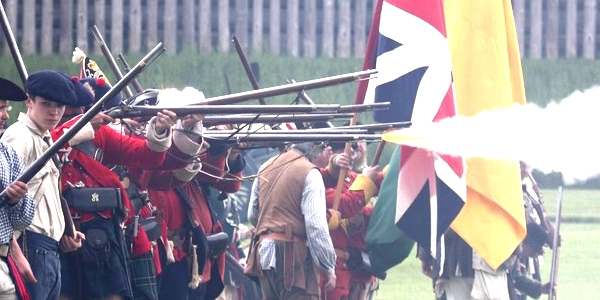
Image above: Montage (left) Sketch of reconstructed fort, rebuilt for the 1976 Sequi-Centennial, National Park Service. (right) Interior of reconstructed fort, circa 1776, National Park Service. Image below: Reemactors emgaged in British Drill Practice. The fort housed British troops in the 1750's during the French and Indian War period. Courtesy National Park Service. Info Source: National Park Service; Library of Congress; Wikipedia Commons; battlefields.org; "Battle of Oriskany and the Siege of Fort Stanwix," 2021, Harry Shenawolf, revolutionarywarjournal.com; Hero of Fort Schuyler: "Selected Revolutionary War Correspondence of Brigadier General Peter Gansevoort, Jr.," 2014, McFarland Books; "This Day in History: Benedict Arnold Saves the Day," 2022, Tara Ross, taraross.com; "The Boodied Mohawk," Calendar of the Military Papers of Peter Gansevoort, Senior, July 4, 1754 through December 31, 1780, New York State Archives Series AO131."
Back to Index
History Photo Bomb
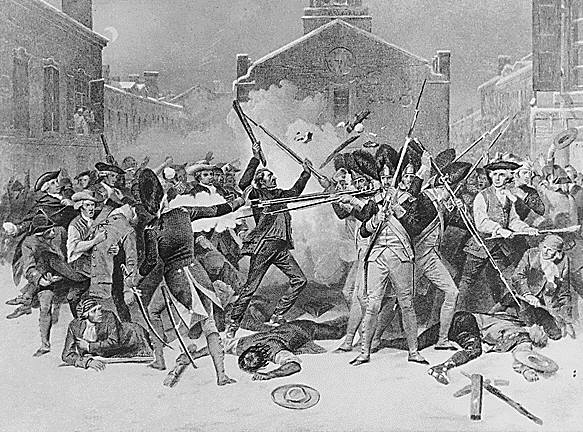
Drawing of the Boston Massacre, March 5, 1770.
ABH Travel Tip
The bargains at the National Park Service continue, despite some recent increases in park fees. The National Park Pass is now called the America the Beautiful Pass, which admits all vehicle and family visitors for one year, and costs $80 for one twelve month period. The pass covers most Federal fee areas, including National Parks, Historic Sites, and National Forests. For those of 62 years of age or older, buy the America the Beautiful Senior Pass. For only $20 per year or $80 for a lifetime pass, you gain free
entrance for the rest of your life to all National Parks, National Historic Sites, and National Forests, and other federal fee sites for you, your spouse, and your children, plus discounts of 50% on some use fees, such as camping. Must be purchased in person at a National Fee location, which are the one hundred or so National Park Service sites that charge for entry. Prices for foreign visitor are expected to rise in 2026.

Paul Revere on his ride to Concord to warn the patriots that
the British were coming. Courtesy National Archives.
Timeline Book


George Washington talking to his men outside the log huts at
his encampment in Valley Forge. Courtesy National Archives.
Military History
Check Out This Interesting
Website suggested by students at Green Mountain
Central School District in Vermont, Understanding Our Military Branches
For weeks, the Americans in the fort faced cannnon fire and the shutoff of their water supply by St. Leger. However, Gansevoort would await a relief column led by General Nickolas Herkimer, but the first never came. Six miles away, the British attacked in the Battle of Oriskany, winning a tactical battle of hand to hand combat and the elimination of most of the Patriot militia, including eight hundred men and Oneida warriors. But Gansevoort was prescient; he sent two hundred fifty troops from the fort to the British camp, looting it while they were away.
Another relief column was approaching by August 12, led by still respected, awaiting time to be a traitor, American General Benedict Arnold. He had seven hundred men, but convinced St. Leger that his forces numbered four times that, around three thousand. Arnold's trick was to allow a captured loyalist, Hon Yost Schuyler, to go to the British and state that Arnold's force was very large in exchange for his freedom if the plan worked. He also shot holes in his clothes to signify that he barely escaped the Americans, plus told St. Leger that Burgoyne had been defeated. With his native allies restless, expecting a short battle and not a siege, and the thought of battling the lying sob Arnold and his expanded forces, St. Leger abandoned the siege on August 22, 1777 and his goal of occupying the Mohawk Valley. There were few casualties in the battle; 34 for the Americans and 66 for the British troops.
However, those losses were not the main part of the story. By the time St. Leger arrived back to Saratoga to help General Burgoyne and his five thousand eight hundred men, the Battle of Saratoga was over, October 17, 1777. The British forces there were captured, and then were expelled from the colony of New York as well as most of New England, thus leading to the French and Netherlands eventually joining the American Continental Army's effort in their quest for a new nation.
Minute Walk in History
Siege of Fort Stanwix
Sir. I must once more apologize to the Convention for not sending a Return of my Regiment agreeable to their Order Their dispersion of my Officers upon the recruiting Service has prevented me but as I am now under marching Orders for Fort Schuyler with that part of my Regiment which is here I have ordered all the Officers in with their Recruits I shall Soon be able to transmit you the Return Requested -
It gives me great Pain that part of my Regiment is separated from me and wish for nothing more than to have them Joined it give me little concern what department I Serve in, but when Corps are so divided they can do little Honor to themselves or the State they belong to, and believe me that my utmost Exertions would not be wanting to make them usefull - permit them to be your Interposition with his Excellency General Washington that may be joined and as I said before I am indifferent where we Join, but conceive it would contribute to the Credit of the State if all the Regiments could be together.
I am most respectfully Sir Your very Hum Servant
The Honble Abraham Ten Broeck Esqr President, March 17, 1777.
To Marinus Willett
Albany 29th March 1777
Sir. As the Season for opening the Campaign is near at hand, the General Commanding the Northern Department has desir'd in General Orders that all Soldiers now on Furlough do immediately Join their respective Regiments and that no more furloughs be granted which you'll please to See executed.
You will have a Force run from Swamp (Casp) Stefanus the Frenchman's House formerly stood to the River and another from the Crippelbush at the lower End of Brodshacks Field to the River with the Swinging Gate in Each these two Fences will be enclosure sufficent to supply with Grass and Hay and secure the Garden - as there is too much Work to be done at present to have the fences made as they formerly were.
As Soon as the Season will permit you will have the Garden put in Seed, that the Garrison may not be without Vegetables in their Season -
Cole Gouvion the Engineer who is with you at present the Marquis de Lafayette informs me will be ordered to the Southward Soon, you will therefore receive from him every necessary Instruction to compleat the Fort for a Seige -
You will constantly make returns to me of every Necessary wanting at the Fort, that I may procure them -
I am Yours, etc.
You will order the Quarter to send Down the Account of Rations and parts of Rations which may be due to the Regt.
Synopsis of Future Letters from and to Peter Gansevoort Closer to the Battle
Fort Schuyler, New York July 28, 1777. Peter Gansevoort to The Council of Safety reporting that about three o'clock on the afternoon of the 27th the garrison was alarmed by the firing of four guns. The troops upon turning out found three girls who had been picking raspberries about 500 yards from the fort, shot. Two of the girls had been tomahawked and scalped; one of which was dead and the other dying about a half an hour after she was brought home. The third girl, who sustained two musket balls through her shoulder was able to escape. This crime was said to have been committed by four Indians. Gansevoort states he has received word from an Oneida Chief, who been had sent to Canada by the order of Major General Schuyler, that Colonel John Butler was at Oswego with 500 Indians and that Sir John Johnson was just on the other side of Oswego with 1,000 troops which consisted of Regulars, Canadians, and Loyalists. Peter states the Chief states Sir John has ordered Butler to take 130 Indians from Oswego and cutoff the communication with Fort Schuyler; Sir John is said to be planning an attack on Fort Schuyler in eight days. [Ensign William Colbreath's Journal reports that on July 27th -- Three girls belonging to the inhabitants being about two hundred yards from our out-sentinels were fired on by a party of Indians, two of whom were killed and scalped, the other wounded in two places, neither of them dangerous].
Oneida, New York July 29, 1777. Thomas Spencer to Colonel Peter Gansevoort stating that at a meeting of the [Oneida] Chiefs it was said that there were but four days remaining before the King's Troops would fall on Fort Schuyler. The Chiefs are said to be desirous of Colonel Gansevoort to not make a Ticonderago of it and express hope General Schuyler will send up a strong reinforcement. Thomas suspects the road is stopped to inhabitants and states this may be his last warning as the British are already past the place where they were to hold a treaty. He requests the Militia rise up and come to Fort Schuyler. Spencer states he will leave Oneida tomorrow for the treaty, but he expects they will be treated with indifference when they announce their intentions for peace. Thomas states that between 80 and 100 Indians are below Fort Schuyler blocking the road. Spencer also states he has heard the British are bringing cannon up the Fish Creek. The Chiefs send Gansevoort a belt of eight rows in testimony of their honesty. Thomas believes a strong blow by the rebels will insure the friendship of the Six Nations and free the frontier of British.
[Albany, New York] July 31, 1777. Miss Catherine Van Schaick (34) to Colonel Peter Gansevoort stating she has received his letter of the 26th and is glad to hear Peter is in good health. Catherine states a courier from Fort Schuyler had stated 3,000 British Regulars,.Canadians, and Indians from Oswego were expected to attack Peter's post. Catharine advises Peter to avoid trusting the Indians and fears that Peter will find it necessary to surrender his post. Miss Van Schaick informs Peter her family is traveling to Esopus and that her brother, Gerrit, is to proceed them and seek a place for them. Catherine states Gerrit says the people of Esopus have express a great fear of the Indians should the British take Albany and that she finds great in hearing the Rebel Army is at Stillwater. Catharine's sister also sends her greetings to Peter. [On page 158, it is noted] "The carrier of this letter was killed in the Battle of Oriskany and the letter was later recovered in Lieutenant Colonel Willett's Raid on the Indian Camps near Fort Stanwix on August 6, 1777."
German Flatts, New York August 22, 1777. Benedict Arnold to Peter Gansevoort stating that since his writing to Gansevoort on the 19th stating that he would be arriving at Fort Schuyler in a few days he has received an express advising no immediate fears for the loss of Fort Schuyler. Arnold reports he is delayed by poor roads and the militia's failure to turn out as expected. Arnold also forwards news of General Stark's victory at Bennington. Benedict states the remanents of Lord Howe's Army is aboard ship and that Burgoyne's Army is thought to be retreating towards Ticonderago. The General states the Rebel Army is reported to be near fifteen thousand strong.
[Fort Schuyler, New York] August 22, [1777]. (37) Peter Gansevoort to [The Council of Safety] stating that about eleven o'clock in the morning he began a heavy cannonade on the British works from Fort Schuyler which is being returned by their artillery. Gansevoort states that about three o'clock in the P. M., seven deserters from British Camp came into the fort and reported that Saint [Barry] Leger was retreating. Peter states he then sent sixty men into the British Camp and found the intelligence to be accurate. Peter states that about seven P. M. Hans Jost Schuyler (38) arrived at Fort Schuyler with news that General Arnold was on his march to Fort Schuyler with upwards of 2,000 men.
Image above: Montage (left) Sketch of reconstructed fort, rebuilt for the 1976 Sequi-Centennial, National Park Service. (right) Interior of reconstructed fort, circa 1776, National Park Service. Image below: Reemactors emgaged in British Drill Practice. The fort housed British troops in the 1750's during the French and Indian War period. Courtesy National Park Service. Info Source: National Park Service; Library of Congress; Wikipedia Commons; battlefields.org; "Battle of Oriskany and the Siege of Fort Stanwix," 2021, Harry Shenawolf, revolutionarywarjournal.com; Hero of Fort Schuyler: "Selected Revolutionary War Correspondence of Brigadier General Peter Gansevoort, Jr.," 2014, McFarland Books; "This Day in History: Benedict Arnold Saves the Day," 2022, Tara Ross, taraross.com; "The Boodied Mohawk," Calendar of the Military Papers of Peter Gansevoort, Senior, July 4, 1754 through December 31, 1780, New York State Archives Series AO131."
History Photo Bomb
Drawing of the Boston Massacre, March 5, 1770.
ABH Travel Tip
The bargains at the National Park Service continue, despite some recent increases in park fees. The National Park Pass is now called the America the Beautiful Pass, which admits all vehicle and family visitors for one year, and costs $80 for one twelve month period. The pass covers most Federal fee areas, including National Parks, Historic Sites, and National Forests. For those of 62 years of age or older, buy the America the Beautiful Senior Pass. For only $20 per year or $80 for a lifetime pass, you gain free
entrance for the rest of your life to all National Parks, National Historic Sites, and National Forests, and other federal fee sites for you, your spouse, and your children, plus discounts of 50% on some use fees, such as camping. Must be purchased in person at a National Fee location, which are the one hundred or so National Park Service sites that charge for entry. Prices for foreign visitor are expected to rise in 2026.
Paul Revere on his ride to Concord to warn the patriots that
the British were coming. Courtesy National Archives.
Timeline Book
George Washington talking to his men outside the log huts at
his encampment in Valley Forge. Courtesy National Archives.
Military History
Check Out This Interesting
Website suggested by students at Green Mountain
Central School District in Vermont, Understanding Our Military Branches