Sponsor this page. Your banner or text ad can fill the space above.
Click here to Sponsor the page and how to reserve your ad.
-
Timeline
1885 - Detail
September 2, 1885 - The Rock Spring, Wyoming mining incident occurs when one hundred and fifty white miners attack Chinese coworkers, killing twenty-eight and forcing several hundred more to leave Rock Springs.
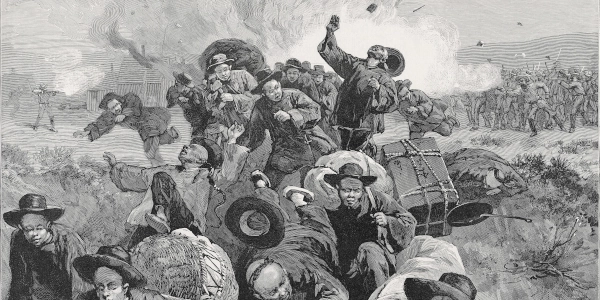
Article by Jason Donovan.
In the history of the United States there has always been a struggle between the wealthy upper class and the lower working classes. From the start, three main conflicts were baked into the foundations. These three conflicts are primarily caused by the imbalance that results from the foundations of the capitalist economic system and that system's historical ups and downs. The second conflict is that of racism and the many times throughout history when a daily spilling of blood soaked into the land itself. The last of the three is an offshoot of the above mentioned racist conflict, nativism.
As a result of using a capitalist system, greed often drives the industrial juggernaughts of the day. This was most certainly true during the post Civil War years. The corporate drive for expanding its monopolistic free reign of the economic machine’s thirst for profits at all costs, cost many lives of nameless forgotten souls.
In the United States of the 19th century, industry was the engine that drove the nation’s economy. The engine needed to be fueled and in order to do that, coal must be mined and sent to market. A large portion of these businesses were not that of a stand alone company; on the contrary monopolies were the flavor of the day. As a result, many companies were part of a closed economic loop where one main corporate body owned each step in the supply chain of a given resource.
The coal mine at Rock Springs was owned by the Union Pacific Railroad (UP). The UP was one of the monopolies mentioned above. There are varying accounts of how the incident kicked off. One is that the Chinese workers refused to strike alongside the white workers. Another account states the spark was a deadly fight that happened in Rock Springs that primed the area like a volcano whose eruption is often preceded by tremors. That pressure was raised by the actions of the UP.
One incident that is a near perfect example of the fiery death that from time to time broke out in the land between the two shining seas. The setting of the tragedy that is about to unfold was a mining town in the Wyoming territory. On 2 September 1885 the dark shadow of the pale rider would descend and extinguish the bright light of 28 souls whose only crime was being seen as the other as not worthy of life.
How The Incident Started
One wonders what caused the ruthless acts of the white men of the town. Well their are two versions of what started the ball rolling. One account states that their was a fight in mine number six between the Chinese and white miners. One Chinese miner was murdered when he received "blows of a pick to the skull." A second Chinese miner was badly beaten.
After this murder the white miners went home in order to arm themselves. They grabbed clubs, hatchets, and guns. The men convened on the railroad tracks close to the No. 6 mine north of Chinatown. There were some within the murderous band that tried to still the volcano that was building with no success. Then the group moved to the Knights of Labor hall and had a meeting. They then moved to the saloons in town. As more miners came into the saloons, the owners read the room and shut down early.
The day of the tragedy was a Chinese holiday so the Chinese workers were in their quarter of town with their families. As the celebrations were going on, a group of between 100 to 150 men were joined by woman and children. The group gathered once again on the railroad tracks near mine No. 6. By 2 o’clock they had divided their forces in half. One half of the mob made their way to Chinatown via the a plank bridge that transversed Bitter Creek. The others crossed the railroad bridge. As they moved along they left small detachments of men to guard the bridges. The Chinese residents of Rock Springs fate was set. These men then descended on the Chinese quarter like a band of Viking invaders raiding an undefended coastline.
The mob’s blood letting started as some Chinese miners at No. 3 mine were shot to death. The horde fell upon the innocents in three different groups. The fear and screams filled the air as the well armed horde went through the streets of the quarter. The defenseless people had the men ripped from their homes, and those that came onto the street to investigate were greeted with a bullet. Many were able to escape out of town by "dashing through the creek, along the tracks or up the steep bluffs and out into the hills beyond." Even after escaping, many would still meet death either by dehydration, exposure, or the wounds they had received. There were some who did not run away, but ran into the invaders and met their fates as a result.
Driving the people from the quarter was not enough. The horde went back through and plundered all the things not nailed down. They then lit the building on fire erasing all that was left. The fire also served the horde’s bloodlust by driving those left from their hiding places and even worse many were burned alive in their basements.
With their bloodlust satiated, they turned their attention toward their company bosses, telling them to get on the next train out of town. The bosses took their advice. As the day wore on the news of the massacre traveled to the sheriff in Greenville. The sheriff received the news only an hour after it started. He took a special train, but could find no one willing to assist him in his duty. He was quoted after the incident that, "there was nothing he could do." The only thing he did was to protect company property. The news continued to travel.
Minute Walk in History
Rock Springs Massacre
On September 2, 1885, the Rock Spring, Wyoming mining incident occurs when one hundred and fifty white miners attacked Chinese coworkers, killing twenty-eight and forcing several hundred more to leave Rock Springs. Watch this sad but moving photos of the workers, camp, and more with a sad Oriental song beneath.
News Travels Fast and Far
The news of the tragedy reached territorial governor Francis E Warren near evening of the same day. It also reached Union Pacific headquarters in Omaha. Company men took a special train and were in Rock Springs by early morning on the following day. The governor also came to see things for himself. As a result, he would sent to Washington D.C. and the Army asking for federal troops in order to restore order.
Trying to find a way to bring things to a peaceful end, the governor met with both company officials and the white miners. The miners took this meeting as a time not for peace, but as a moment to threaten the governor. The miners presented their demands which included the no Chinese would ever live in their town again. They also demanded that no one be arrested for their role in anything that happened that day. The miners drove their strong arm tactics home by informing Warren that if he was unhappy with these demands, the answer to his protests would be death.
Warren was not going to be intimidated by the miner's threats. He left his train many times and made sure the miners saw this. The miners took no action. Word of the massacre spread even further and the governor was not the only official in the area that was keeping a nervous eye on the situation.
One hundred miles away in Evanston, Wyoming Territory, the sheriff of Uinta County, J.J. LeCain, took notice. He was on guard as Evanston had its own Chinese quarter whose population was in the hundreds. A large group of miners came to town, and even though there was no violence the tension in the air was thick. LeCain was informed by Warren that there were no reinforcements on their way; he was on his own. He then deputized 20 men. Only through hard work and vigilance were the sheriff and his men able to keep order. The most twisted part of the events that transpired as a result of the bloodletting in Rock Springs was still to take place.
It took two days for a small detachment of troops to enter Rock Springs. Two days later, the sixth, in Almy, the Chinese miners were warned that if they returned to work in the mines they would not leave those miners alive. Evanston’s Chinatown would soon receive an influx of their fellow countrymen from Almy. After Almy’s Chinese population was evacuated, their white neighbors pillaged their property.
After all they have been through the Chinese realized that the white people of the Wyoming Territory did not want them there. As such they asked their employer for train tickets out of the territory as well as the back pay they were owed, roughly 60 days worth, but they were refused with all demands. The white citizens of Evanston asked Governor Warren to honor the demands so the Chinese could leave town, but the governor refused their petition saying "it was none of his business." The worst was yet to come.
The twisted episode of all that happened occurred a week after the Rock Springs massacre. The company’s men assembled the 600 Chinese in Evanston and loaded them into boxcars under an armed guard of 250 soldiers. The men were told they were going west to San Francisco. Instead they were taken east back to Rock Springs. The train was unable to stop at the train station due to an angry mob that greeted them. The train moved further on, stopping near where the Chinese quarter once stood. Then the doors opened.
The white townspeople made sure each man was made very aware that they were not wanted. The towns people, their neighbors, yelled, tauting them. The white miners blocked the mine entrances. Again, they asked for tickets to California and for their back pay. Again they were refused. More pressure was placed on the victims of the barbaric racist actions when the company store refused to sell anything to men who were not working. Roughly 60 men refused to work and found a way out of town.
The Union Pacific put the word out that any miner no matter their race who were not back at work by Monday morning, September 21, would be fired. Not only would they be fired, but they would also be blacklisted from working for any part of Union Pacific’s wide ranging monopoly.
In the aftermath of the bloodbath, 16 men were arrested, but received bail. A grand jury was convened, but no one could be found that would testify in court, even though the only darkness in that days light was to be found in the townspeople hearts and minds. Justice would not be found for those whose lives were taken from them on that day no matter if they fell in death or if they lived caring the physical and mental scars of those days for the rest of their lives.
In the end a total of 28 Chinese were carried off by death’s cold hands and 15 were left wounded. Every one of the shacks and houses in Rock Springs Chinatown was pillaged and burned. The Chinese diplomats in New York and San Francisco accumulated accounts of the things lost by their countrymen. The president pushed Congress to pay the total of $150,000. The racism against the Chinese would continue via the Chinese Exclusion Act. The act limited the amount of Chinese that were allowed to enter the United States. The following decades would see the Chinese leaving the Wyoming Territory for better lives.
The actions of governor Warren stopped more lives being taken, but also was used to extend the pain and misery of not only the Chinese minersk, but the white ones as well. His actions made sure the Chinese were trapped in the hard work of the mines. By doing this he also helped the Union Pacific keep the white miners wages low, not only for their mines but by extension the wages of miners throughout the country.
The history of the battle between capital and labor in the United States is more times than not soaked in blood and pain. The labor privileges enjoyed today have been built on the bones of those who have fallen in one way or another throughout the course of that history. As the hard won victories that were paid for in blood, and the laws and legislation that gave today's workers the rights they have, are being rolled back by monopolies of the twenty-first century, the voices of the past still ring out if one is willing to listen. Know your history so that you can defend the rights that workers of the past died to give you.
Good Luck and Good Night.
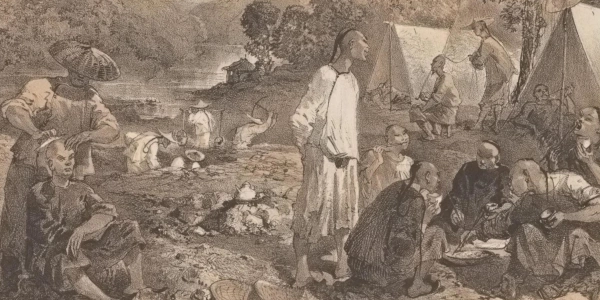
Image above: Illustration of the Rock Spring Massacre of Chinese Workers by White Miners, 1885, Harper's Weekly. Courtesy Wikipedia Commons. Below: Illustration of Chinatown in the Rock Springs Mining Camp," 1885, J.D. Borthwick. Courtesy Library of Congress via Wikipedia Commons. Info Source: "The Rock Springs Massacre," 2014. Rea, Tom. WyoHistory.org; "Sept. 2, 1885: Rock Springs Massacre," Zinn Education Project; "Gilded Age, Definition, History, & Mark Twain," 2019, Encyclopædia Britannica; "When an American Town Massacred Its Chinese Immigrants," 2025, Michael Luo, The New Yorker; "Research Guides: Rock Springs Massacre: Topics in Chronicling America: Introduction," 2025, Mike Saelee, Guides.loc.gov; "“History of the Union Pacific Coal Mines, 1868 to 1940 ...," 2025, HathiTrust.
History Photo Bomb

Oklahoma Land Rush. Courtesy Library of Congress.
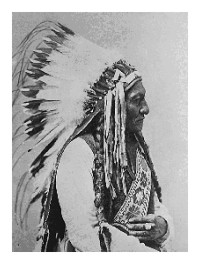
Chief Sitting Bull, (Tatonka-I-Yatanka) Hunkpapa Sioux, circa
1885. Courtesy National Archives.
Timeline Book


Thomas Edison and his phonograph. Courtesy Library of Congress.
ABH Travel Tip
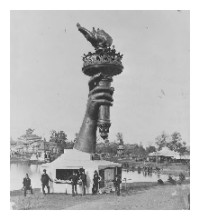
The Statue of Liberty and Ellis Island can be visited from two locations; Liberty State Park in New Jersey and from New York City. Ferry service takes visitors on a round trip to both locations. Tours of the Statue may be reserved in advance or tickets picked up when buying tickets for the ferry service on a first come, first served basis.
Photo above: Torch and Arm of the Statue of Liberty on display at the Philadelphia Centennial Exhibition in 1876. Photo: Centennial Photographic Co., 1876.

World's Fair History, 1880's
Louisville 1883
New Orleans 1884-5
Cincinnati 1888
For the history of baseball, check out our friends at Stat
Geek Baseball with unique stats from 1871 to today you can get nowhere else.