Sponsor this page. Your banner or text ad can fill the space above.
Click here to Sponsor the page and how to reserve your ad.
-
Timeline
1925 Detail
November 28, 1925 - The Grand Ole Opry transmits its first radio broadcast.
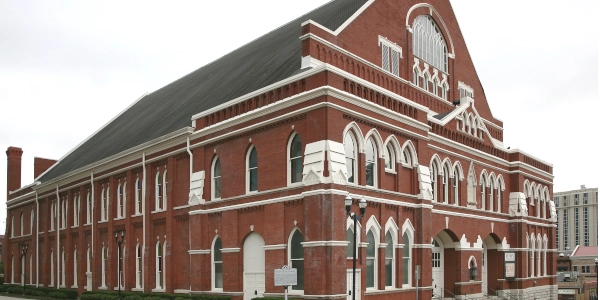
For most country music fans, the Grand Ole Opry is synonymous with the entire genre. After radio was born and began to take most people into a new world of entertainment, the Grand Ole Opry radio program began. It was known as the WSM Barn Dance after the radio station that broadcast it, WSM AM.
So how did it start and who were the originators? The son of one of the founders of the National Life and Insurance Company, Edward W. Craig, loved the radio and had a studio placed inside their headquarters on the fifth floor, which had begun to broadcast its signal on October 5, 1925. WSM was looking for programming and understood the taste of its listeners within the WSM signal area. The slogan of the insurance company was "We Save Millions," thus the WSM moniker. The slogan "Music City USA," would be coined by them and still retains that name for the city of Nashville.
However while Craig was instrumental in convincing the company to build the studio and station, it would be George D. Hay, a Chicago announcer known for their National Barn Dance, only twenty-nine years but known as the "Old Solemn Judge," and Uncle Jimmy Thompson, an old time fiddle player at seventy-seven years old, who as the first guest brought the Grand Ole Opry program to life under the WSM Barn Dance name, with its first show on November 28, 1925. It was broadcast from the small studio at the insurance company, then a larger one until 1934. There was no audience. The studio was too small.
Original acts during those first days were the Crook Brothers, Uncle Jimmy Thompson, Young DeFord Bailey, and the Fruit Jar Drinkers, vibrant fiddle players that always closed the show in the George D. Hay days. The first real star, however, was a banjo player, Uncle Dave Macon, in 1926.
It would take only two years for the show's name to change. On December 10, 1927, when George D. Hay stated, after their programming for the NBC Walter Damrosch's Music Appreciation Hour ...
"For the past hour we have been listening to the music taken largely from the Grand Opera, but from now on we will present the Grand Ole Opry."
Yes, the name stuck. And the crowds keep coming, sold-out Saturday nights with long lines for entry.
Minute Walk in History
Grand Ole Opry Through the Years
It's the bastion of country music, the program that made country music go from the back hills of Kentucky to the entire nation via Nashville. The Grand Ole Opry radio program began in 1925 and still goes today every Friday and Saturday. Watch a short montage of some of its stars of the past and present. Don't read this if you want to guess who they are. Answers at the bottom of the Youtube video.
By 1932, their upgraded signal, 50,000 watts, could be heard at night in Canada and two-thirds of the United States. Their first true national broadcast was broadcast on NBC Radio in 1939. By 1943, the Grand Ole Opry moved into the Ryman Auditorium, its home from 1943 to 1974, and now used for part of the year. However, the Ryman, known as the Union Gospel Tabernacle when built in 1892, actually predates the Grand Ole Opry program itself. Thomas Ryman would coax it into existence, and eventually get the venue named for him in 1904. Surprisingly, WSM Radio would only become a full time country music station in 1980.
As of January 2026, two hundred and thirty-five acts have been inducted; the first was Jimmy Thompson in 1925. Other early inductees include Humphrey Bate, Henry Bandy, the McGee Brothers, Mazy Todd, Uncle Dave Macon, the Pickard Family, DeFord Bailey, the Crook Brothers, Sid Harkreader, Binkley Borthers' Dixie Clodhoppers, and Theron Hale and his Daughters in 1926. Some of the more famous members known to today's fans; Roy Acuff and the Smoky Mountain Boys (1938), Minnie Pearl (1940), Eddie Arnold and Earnest Tubbs (1943), Hank Williams and the Drifting Cowboys (1949), Lester Flatt and Earl Scruggs (1955), Johnny Cash (1956), Loretta Lynn (1962), Willie Nelson (1964), Dolly Parton (1969), and Barbara Mandel (1972). In the new Grand Ole Opry era, inducted members count Reba McEntire, Roy Clark, and Randy Travis (1986), Garth Brooks (1990), Charley Pride (1993), Brad Paisley (2001), Charlie Daniels and Carrie Underwood (2008), Darius Rucker (2012), Kelsea Ballerini (2019), and Kathy Mattea (2025).

How Did Newspapers Cover the First Broadcast?
They did not. Radio was still considered an experiment, and the first show, with no live audience, did not rise to their attention. It has, however, caught the attention of country music lovers and the performers who have been inducted since ...
"Carnegie Hall is real fabulous but it ain't as big as The Grand Ole Opry," Patsy Cline.
"I've said it for a record a thousand times. I'll state it again a thousand times. This is the pinnacle of what I do. Nothing has ever touched being a member of the Grand Ole Opry," Garth Brooks.
"I came out of the back of the building and I was hollering, 'I've sung on the Grand Ole Opry! I've sung on the Grand Ole Opry!," Loretta Lynn about her first performance.
"It was always my dream to be on the Opry. I actually got to sing on the Grand Ole Opry when I was about 10 years old. I became a member in the late '60s. They call it the 'Mother Church,' because the old Ryman was a church, but it's sacred to me, wherever it goes - the church of my heart. For me, the Opry is like the song New York, New York - if you can make it there, you can make it anywhere," Dolly Parton.
"The induction award they gave me says, 'Hey, you're a part of the family.' It means a lot to me because it's the heart of country music, the church, the sacred place, the super-elite club that says you love this music," Carrie Underwood.
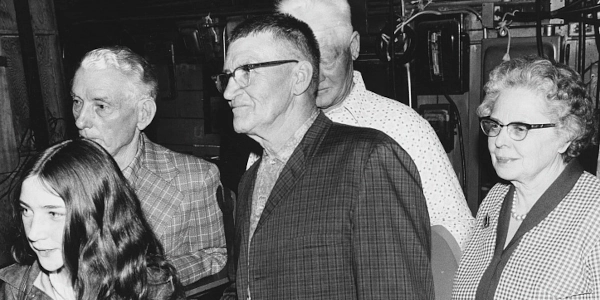
Photo above: Ryman Auditorium, 2007, Daniel Schwen. Courtesy Wikipedia Commons C.C. 4.0. Photo below: Crowd at last performance at Ryman Auditorium, March 15, 1974, before move to new Grand Ole Opry House, 1974, JD Sloan. Courtesy Library of Congress. Info source: "The Show That Made Country Music Famous," opry.com; "History of WSM Radio," georgedhaysociety.org; "100 Years of Bringing Country Music to the World," wsmradio.com; "First Grand Ole Opry Performance," Mystic Stamp Learning Center; "Phantoms of the Opry: Five Stars from the Opry's First 100 Years," 2025, Joseph Dreisenga. Tennessee State Museum; "Grand Ole Opry, A Complete List of Members, 2026, Lydia Farthing, Holler.com; "Ten Quotes About the Grand Ole Opry from Opry Members," 2016, Parade.com; Library of Congress; Nashville Public Library; Wikipedia Commons.
History Photo Bomb

Out of work workers during the Great Depression. Courtesy National Archives.
Timeline Book


The Appalachian Trail, first proposed in 1921 and completed seventeen years later. Scene from trail in the Shenandoah Mountains. Courtesy Library of Congress.
ABH Travel Tip

Be your own history detective. Across the United States,
national, state, and local historical socieites have placed roadside markers telling their historical stories. While some of these markers are in out of the way places, their import to the fabric of the U.S. tale are no less important.
"I've said it for a record a thousand times. I'll state it again a thousand times. This is the pinnacle of what I do. Nothing has ever touched being a member of the Grand Ole Opry," Garth Brooks.
"I came out of the back of the building and I was hollering, 'I've sung on the Grand Ole Opry! I've sung on the Grand Ole Opry!," Loretta Lynn about her first performance.
"It was always my dream to be on the Opry. I actually got to sing on the Grand Ole Opry when I was about 10 years old. I became a member in the late '60s. They call it the 'Mother Church,' because the old Ryman was a church, but it's sacred to me, wherever it goes - the church of my heart. For me, the Opry is like the song New York, New York - if you can make it there, you can make it anywhere," Dolly Parton.
"The induction award they gave me says, 'Hey, you're a part of the family.' It means a lot to me because it's the heart of country music, the church, the sacred place, the super-elite club that says you love this music," Carrie Underwood.
History Photo Bomb
Out of work workers during the Great Depression. Courtesy National Archives.
Timeline Book
The Appalachian Trail, first proposed in 1921 and completed seventeen years later. Scene from trail in the Shenandoah Mountains. Courtesy Library of Congress.
ABH Travel Tip
Be your own history detective. Across the United States,
national, state, and local historical socieites have placed roadside markers telling their historical stories. While some of these markers are in out of the way places, their import to the fabric of the U.S. tale are no less important.