-
Timeline - The 1940s
The world was at war as the decade began, all within the confines of a great depression that was affecting the lives of all Americans, but when Pearl Harbor was attacked, the United States could no longer be on the sidelines. Through the courage and dedication of the soldiers who fought in the European or South Pacfic theaters, they spent much of this decade in a battle for a way of life that the country and western powers had spent two centuries building. By the end of the decade, that war would be won and the build back on the front burner.
More 1900s
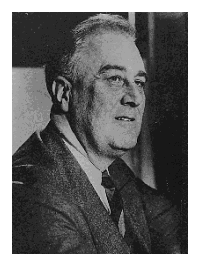
President Franklin D. Roosevelt, circa 1940. Courtesy National Archives.
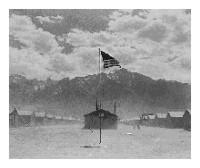
Manzanar War Relocation camp of Japanese detainees during World War II. Photo: Department of the Interior, July 1942. Courtesy National Archives.
Sponsor this page. Your banner or text ad can fill the space above.
Click here to Sponsor the page and how to reserve your ad.
-
Timeline
1945 Detail
February 4-11, 1945 - President Roosevelt, Prime Minister Churchill, and Premier Josef Stalin hold the Yalta Conference in the Soviet Union.
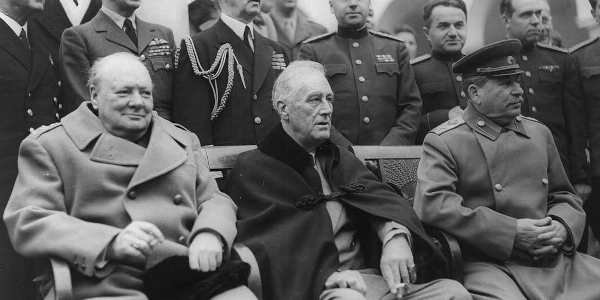
After the invasion at Normandy, D-Day, and the subsequent victories of the Allies through France and Continental Europe, the leaders of the Allied Forces, nations of the United States, Great Britain, and the Soviet Union, began to consider the possibility that World War II, in Europe, could be over soon. But the next question arose, what would Europe look like after the war? What would be its boundaries? How would Germany, the agressor in the entire conflict, be managed after the Third Reich and evil dictator Adolf Hitler were gone?
A lesser known goal of Winston Churchill and President Roosevelt was the fate of the war in the Pacific Theater against Japan. They wanted, and probably needed, the Soviet Union to join them in a subsequent defeat. For that participation, of course, the communist Russian state, would want something in return. What about Manchuria?
As for the future of Europe, there were many items on the agenda. Who would pay for war damage reparation ... mostly Germany. Who would be involved in the governing of Germany after Hitler was defeated ... the United States, Great Britain, France, and the Soviet Union. Would communism be allowed in Poland ... they agreed yes, but that would prove a mistake. How would veto power in the United Nations security council be distributed ... the United States, Great Britain, the Soviet Union, France, and China. This was alot to accomplish during a seven day conference held in the Russian controlled territory of Crimea, in the Palace of Livadia.
Yes, the devil was in the details. And the details that allowed an agreement to be made were important. The German territory would be governed in four zones, as stated above, with the capitol of Berlin, inside the Soviet zone by one hundred miles, would also be divided in four sectors. In the Declaration on Liberated Europe, it would be agreed that the nations controlled by Germany in the war would hold free democratic elections, with the caveat that Eastern European countries near the Soviet Union, could include Communist ideals. Yes, a mistake again as the Cold War would prove for over forty years. The United Nations would be formed under the structure discussed, and the Soviet Union would join the conflict in the Pacific Theater. Suspected German war criminals would also be put on trial.
And a final message was sent to Adolf Hitler, "Germany is doomed," and that he should surrender now to avoid more bloodshed and the invevitable.
President Roosevelt's Log, February 3-12, 1945
Saturday, February 3rd:
1210: The President's plane (#1), escorted by five fighters, arrived at Saki [in the Crimea]. The fighters had joined the flight at Athens. A sixth P-38 had to turn back to Athens because of engine trouble.
At the airport to meet the President were the Honorable V. M. Molotov, Soviet Commissar for Foreign Affairs, Secretary of State Stettinius and Ambassador Harriman. It was explained that Marshal Stalin had not yet arrived in the Crimea.
The President did not leave his plane at once but remained embarked until the Prime Minister arrived from Malta some twenty minutes later.
Distance traveled, Malta to Saki, 1375 miles.
We were met at Saki by Agents Rowley, Peterson, Deckard, Campion, Savage and Griffith, members of our advance party.
1230: The Prime Minister and his party arrived at Saki in his special aircraft escorted by six fighters. The Prime Minister disembarked and came over to the President's plane. The President then left his plane and entered a jeep. As the President and the Prime Minister approached the guard of honor, honors were rendered for them. The honors consisted of the guard presenting arms and the band playing the Star Spangled Banner, God Save the King, and the Third Internationale. Then, while in the jeep, the President drove down the ranks of the guard and made an inspection of them. Afterwards the guard of honor passed in review before the President and the Prime Minister. The President took the review while seated in the jeep.
1306: The ceremonies at the airport over, the President and members of his party left Saki by automobile for Livadia Palace, near Yalta, some 80 miles distant. Mrs. Boettiger rode with the President. All automobiles used in our caravan were furnished by the Soviet Government and were operated by Russian drivers.
The first stretch of our drive, from Saki to Simferopol, was over rolling, snow-covered country somewhat like that of our Middle-West. [Page 550]We saw few, if any, trees and many reminders of the recent fighting there-gutted-out buildings, burned out tanks and destroyed German railroad rolling stock that had been abandoned and burned by them in their flight.
From Simferopol, the capital city of the Crimea, we went on to Alushta, a small town on the east coast of the Crimean Peninsula. From Alushta we followed the "Route Romanoff" to Yalta. This is a high and very winding road that passes around the west side of the Roman Kosh (the highest mountain in the Crimea-5,055 feet) and ascends to the Red Crag (4,760 feet). The entire distance from Saki to Yalta was guarded by Soviet troops. It was noted that a considerable number of them were young girls.
1750: We passed through the city of Yalta.
1800: We arrived at Livadia Palace, two miles south of Yalta. This was our headquarters during the Crimea Conference. Miss Kathleen Harriman (daughter of Ambassador Harriman) was at Livadia to greet the President and Mrs. Boettiger.
We were all very tired, so it was a case of bathing, dining and to bed for us this evening.
The Prime Minister's party proceeded separately from the President's and went from Saki to Vorontsov Villa (located about 12.5 miles south of Livadia), where they made their headquarters during the conference.
Commander Tyree, Major Putnam and Mr. Cornelius had arrived at Livadia several hours before us and had our map room and communications center set up and in operation when the President arrived. Commander Smith had been at Livadia for several days. He had come to the Crimea in the Catoctin.
2100: Lieutenant Bogue, who had remained behind at Malta to handle any last minute communications for our party and had left Malta on one of the last planes of our flight, arrived at Livadia, completing the arrival of our party.
The U. S. minesweepers Pinnacle and Implicit were moored in the harbor at Yalta. The naval auxiliary Catoctin, the liberty ship William Blount and the minesweepers Incessant and Incredible were moored in the harbor at Sevastopol, 80 miles to the southwest. The Soviet authorities had declined to permit the Catoctin or the William Blount to continue on to Yalta because of the presence of mines in that area of the Black Sea. This task group had been sailed from the Mediterranean Area some ten days previously in order to be on hand to furnish miscellaneous services to the American Delegation at Yalta. These ships were the first Allied vessels to pass through the Dardanelles since the beginning of the present war and they opened communications with Sevastopol and Yalta.
Because the Catoctin could not come to Yalta, or closer than Sevastopol, it was necessary for us to communicate by landline (teletype) with the Catoctin which vessel served as communications relay ship for our party during the conference. For the first few days we experienced "wire trouble" between Livadia and Sevastopol. Our communication engineers eventually laid an entirely new line from Livadia to Sevastopol and thereafter no further wire trouble was experienced.
Yalta
Yalta before the war was the center of the health resorts on the south coast of the Crimea. In 1928 it had a normal population of 29,000. It is picturesquely situated in the valley of the river Utchan-Su and is surrounded on three sides by mountains. The mountain range to the north thwarts the cold blasts headed that way and permits the warm sun to exert its full effect in and around Yalta. The mean annual temperature there is 56.65. The thermometer hovered around 40 during our visit but it was not at all uncomfortable.
Livadia Palace
The buildings used by the American Delegation during the Crimea Conference are the former summer palace of the Czars. The main building is called the Livadia and the two auxiliary buildings the Svitski Korpus.
After the Revolution Livadia was used by the Soviet Government as a rest home for tubercular patients. During the German occupation of the Crimea it was used by their high command, who did a very thorough job of looting when they were forced to leave. The buildings were left in complete disrepair and the grounds in equally bad condition. The only original furnishings in the building (Livadia) at the time we resided there were the two pictures in the President's bedroom.
The Soviet Government had performed an amazing job, however, in completely renovating the place during the three weeks period immediately preceding the conference; amazing because of the critical shortage of materials and the very limited time available. This was because it was not until about 15 January that it was definitely decided to hold the conference at Yalta. Hotel staffs were brought in from Moscow and furniture and furnishings were obtained from Moscow and other Soviet cities or from local sanitoria and rest homes. It should be added here that in addition to everything that the Soviets did, Lieutenant Commander L. H. Backus, MC-V(S), U. S. N. R., and Lieutenant T. W. Sullivan, MC-V(S), U. S. N. R., (both from the U. S. S. Catoctin) did an outstanding job in transforming Livadia, an infested building since the German occupation and pillage, to a place that was completely habitable and comfortable, and prevented what might have been a most serious threat to the health of the entire party.
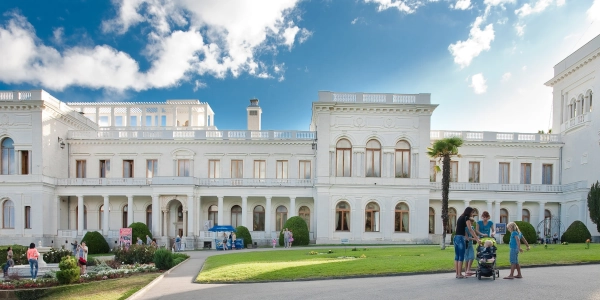
The New Palace (Livadia) was built from white Inkerman granite in 1911, in the style of the Italian renaissance, from plans by the architect Krasnov. It stands on the site of the former palace which, except for the church, had been entirely demolished. Situated more than 150 feet above the sea, it commands a striking panorama of the mountains and the sea to the east and north. Wings extend from the rear of the main building to form two courts, one modeled after the Convent Court of St. Mark (Florence, Italy), and the other is of Moorish design.
The first floor of the 50-room palace was used by Nicholas and his son, Alexi, for living quarters. The left wing, facing the sea, contained the Czar's study and bedroom. The room used as the President's private dining room was formerly a billiard room. The large room used as the main conference room was the ballroom-banquet hall.
The second floor was used principally by the Czarina and her four daughters. The room occupied by General Marshall was formerly the Imperial bedroom and that used by Admiral King was the Czarina's boudoir. The second floor conference hall was formerly a private reception room of the Czarina. The second floor dining room was a private sitting room used only by the Czar's family.
The parks and gardens, which stretch down to the seaside, contain fifteen miles of paths and lanes lined with cypress, cedar, yew and bay trees. There are many rare and beautiful plants and trees in the parks, brought there from all over the world by Count Potocki and the Romanov family during the Nineteenth and early part of the Twentieth Centuries.
Sunday, February 4th:
Marshal Stalin and his party arrived early this morning. They came down from Moscow by rail to a point in the Crimea and from there motored to Koreiz Villa, about 6 miles south of Livadia, where they made their headquarters during the Crimea Conference.
1100: The President conferred with Mr. Stettinius, Mr. Harriman, Admiral Leahy, General Marshall, Admiral King, General Kuter, General McFarland, Mr. Matthews (H. Freeman Matthews, Director of Office of European Affairs, State Department), Mr. Hiss (Alger Hiss, Special Assistant to the Secretary of State) and Mr. Bohlen (Charles E. Bohlen, Special Assistant to the Secretary of State). The conference was held in the grand ballroom of Livadia.
1615: Marshal Stalin and Mr. Molotov called at Livadia and conferred with the President in his study. Mr. Bohlen and Mr. Pavlov were also present.
1630: The President conferred with Mr. Hopkins, Mr. Matthews and Mr. Bohlen in his study.
1710: The First Formal Meeting of the Crimea Conference was convened in the grand ballroom of Livadia.
This meeting adjourned at 1950.
2030: The President was host at dinner at Livadia to the Prime Minister, Marshal Stalin, Mr. Stettinius, Mr. Eden, Mr. Molotov, Mr. Harriman, Mr. Clark Kerr, Mr. Gromyko, Mr. Vyshinski, Justice Byrnes, Major Birse, Mr. Bohlen and Mr. Pavlov. The menu included: Vodka, five different kinds of wine, fresh caviar, bread, butter, consommé, sturgeon with tomatoes, beef and macaroni, sweet cake, tea, coffee and fruit.
Monday, February 5th:
0730: A Joint Chiefs of Staff courier arrived at Livadia with White House mail. This mail had been dispatched from Washington on January 31st.
0800: A Joint Chiefs of Staff courier departed Livadia with mail for the White House.
1300: The President had lunch at Livadia with the members of his Mess.
1430: The President conferred with Mr. Hopkins, Mr. Matthews, and Mr. Bohlen in his study. This conference lasted until 1600.
1600: The second Formal Meeting of the Crimea Conference was convened at Livadia.
The meeting adjourned at 1945.
2030: Dinner at Livadia. - The President, General Marshall, Admiral King, Mr. Harriman, Miss Harriman, Mr. Stettinius, Admiral Leahy, Admiral McIntire, Justice Byrnes, Mrs. Boettiger, Admiral Brown and Mr. Early.
Tuesday, February 6th:
0800: A Joint Chiefs of Staff courier departed Livadia for Washington with White House mail.
1300: Luncheon at Livadia.-The President, the Prime Minister, Mr. Cadogan, Justice Byrnes, Mr. Hopkins and Mr. Harriman. Discussions continued after lunch until 3 p. m. The Prime Minister did not return to Vorontsov, as he was due back at Livadia at 4 p. m. (1600) for another conference. Instead, he accepted the loan of the room occupied by Admiral Brown and General Watson and took a short nap at Livadia.
1615: The Third Formal Meeting of the Crimea Conference was convened at Livadia.
The following preliminary statement concerning the conference was agreed on at today's meeting for release at 1630 tomorrow (Washington time).
Mrs. Boettiger, Mrs. Oliver, Miss Harriman and Mr. Spaman made a motor trip to Sevastopol today.
1900: A Joint Chiefs of Staff courier arrived from Washington with White House mail.
2030: Dinner at Livadia. - The President, Mrs. Boettiger, Justice Byrnes, Admiral Leahy, Mr. Harriman, Miss Harriman, Mr. Early and Mr. Flynn.
This afternoon Commander Tyree, Mr. Reilly, Major Greer, Mr. Long, Mr. Holmes and Mr. O'Driscoll left Livadia by automobile for Saki. At Saki they enplaned for Cairo to complete the advance arrangements incident to the President's forthcoming visit to Egypt.
Wednesday, February 7th:
1300: Lunch at Livadia.-The President, Mrs. Boettiger, Mr. Flynn and General Watson.
1610: The Fourth Formal Meeting of the Crimea Conference was convened at Livadia. This meeting adjourned at 2000.
2030: Dinner at Livadia.-The President, Mrs. Boettiger, Mr. Harriman, Miss Harriman, Justice Byrnes, Admiral Leahy and Mr. Stettinius.
Thursday, February 8th:
1200: The President conferred with Mr. Hopkins, Mr. Harriman, Justice Byrnes, and Mr. Bohlen. The conference was held in the President's study.
The British and American Combined Chiefs of Staff met in the grand ballroom at Livadia. Neither the President nor the Prime Minister attended this meeting.
1330: The President and Mrs. Boettiger had lunch in his study from a tray.
1500: The President signed an Executive Order authorizing the Secretary of War to take over and operate the plants and facilities of the Detroit Edison Company of Detroit, Michigan.
1545: Marshal Stalin, Mr. Molotov, Mr. Harriman, Mr. Bohlen and Mr. Pavlov conferred with the President in the President's study.
1615: The Fifth Formal Meeting of the Crimea Conference was convened in the grand ballroom of Livadia. The meeting adjourned at 1940.
2030: The President and certain members of his party left Livadia by motor for Koreiz Villa to dine as guests of Marshal Stalin.
Friday, February 9th:
1230: The President attended a plenary meeting of the Combined Chiefs of Staff at Livadia.
1330: Lunch at Livadia.-The President, the Prime Minister, Mrs. Boettiger, Mrs. Oliver, Mr. Harriman, Miss Harriman, Admiral Leahy and Justice Byrnes.
1600: The President, the Prime Minister and Marshal Stalin and members of the American, British and Soviet Delegations met in the courtyard of Livadia where they sat for still and motion pictures.
1615: The Sixth Formal Meeting of the Crimea Conference was convened in the grand ballroom of Livadia. The meeting adjourned at 1950.
1930: Lieutenant (j. g.) W. K. Kloock, U. S. N. R., White House courier, arrived at Livadia with mail from Washington. He made the journey from Washington in three days.
2030: Dinner at Livadia.-The President, Mrs. Boettiger, Major General John E. Hull, Major General Kuter, Fleet Admiral Leahy and Vice Admiral C. M. Cooke.
Saturday, February 10th:
0800: White House mail was dispatched to Washington via a Joint Chiefs of Staff courier who left Livadia this morning.
1300: Lunch at Livadia.-The President, Mrs. Boettiger, Miss Harriman, Admiral Leahy, Justice Byrnes and Admiral Brown.
1500: Justice Byrnes left Livadia to return to Washington. He traveled by air in company with the Joint Chiefs of Staff party.
1600: The President presented specially engraved Fourth-Term Inaugural Medallions to the Prime Minister, Marshal Stalin, Mr. Eden and Mr. Molotov, and a book entitled "Target Germany" to Marshal Stalin. This book had been prepared by General Arnold and contained photographs showing damage wrought in Germany as the result of bombings by our strategical air forces.
1630: Marshal Stalin and Mr. Harriman conferred with the President. The conference was held in the President's study. Mr. Bohlen was also present.
1650: The Seventh Formal Meeting of the Crimea Conference was convened at Livadia. The meeting adjourned at 2000.
2030: The President, Mr. Stettinius and Mr. Bohlen left Livadia for the British Headquarters (Vorontsov Villa) where they dined with the Prime Minister, Mr. Eden, Major Birse, Marshal Stalin, Mr. Molotov and Mr. Pavlov as the guests of the Prime Minister.
Sunday, February 11th:
1130: The President, accompanied by Mrs. Boettiger, took a jeep ride through the grounds and gardens of Livadia. Before he returned to his quarters he also inspected the U. S. Naval seaman guard which was drawn up outside the palace at the time.
1200: The Eighth Formal Meeting of the Crimea Conference was convened in the grand ballroom of Livadia. The conference recessed at 1250.
1300: The President was host at luncheon at Livadia to the Prime Minister, Marshal Stalin, Mr. Stettinius, Mr. Eden, Mr. Molotov, Mr. Harriman, Mr. Clark Kerr, Mr. Cadogan, Major Birse, Mr. Bohlen and Mr. Pavlov.
Conference discussions continued at the lunch table under 1545, at which time the Crimea Conference formally adjourned.
1555: Marshal Stalin, after having bade the President and members of his party goodbye, left Livadia by motor for Koreiz Villa. Before the Marshal left Livadia the President presented to him for further delivery the following decorations that had been awarded by the United States to officers of the Soviet Forces:
Legion of Merit (Degree of Chief Commander) for Marshal Vasilevsky, Chief of Staff of the Red Army; Legion of Merit (Degree of Chief Commander) for Marshal Novikov, Commanding General of the Red Air Force; Legion of Merit (Degree of Commander) for Colonel General Repin; Legion of Merit (Degree of Commander) for Lieutenant General Grendall; Legion of Merit (Degree of Commander) for Lieutenant General Krolenko; Legion of Merit (Degree of Commander) for Major General Levandovich; Legion of Merit (Degree of Commander) for Major General Slavin; and Legion of Merit (Degree of Commander) for Colonel Byaz.
As we were leaving Livadia the President was presented numerous gift packages by the Soviet Authorities at the palace, as also were various other members of the party. These packages contained vodka, several kinds of wine, champagne, caviar, butter, oranges and tangerines.
General Comment
The weather at Livadia was most pleasant during our visit. The average temperature was 40. The Russians accredited the good weather to the President and called it "Roosevelt weather." For [Page 559]several days preceding our arrival the weather had been anything but favorable. At exactly the "right time", however, it cleared and remained so generally throughout our stay at Yalta.
During the period 4-11 February, daily meetings of the three Foreign Secretaries were held in addition to their attendance at the major conferences. Livadia, Vorontsov and Koreiz shared these Foreign Secretary meetings.
Our mail was brought to Yalta by Joint Chief of Staff couriers who used the regular Air Transport Command facilities from Washington to Cairo and the shuttle service from Cairo to Saki. The average time employed for the journey from Washington to Conference Headquarters was four days.
The British party had daily mail service. Their mail was flown directly from London to Saki in "Mosquito" type aircraft, the flights following a direct course between the two points involved.
Our radio communications were handled by a two-way high speed circuit set up between Radio Washington and the Catoctin (at Sevastopol), using Navy Radio Oran as an intermediate relay station. The messages were broadcast over the Washington "FOX" schedules and when necessary rebroadcast by Radio Oran. Communication between the Catoctin and Livadia was by a land line or by telephone.
A number of U. S. Naval personnel who speak Russian were assembled by Admiral Hewitt and sent to Yalta in the Catoctin. This team proved most helpful in working with the Soviets to complete the preparations for our visit and they were also very helpful to us as interpreters during our eight days at Livadia. They were: Lieut. George Scherbatoff, U. S. N. R., Lieut. Dimitri P. Keusseff, U. S. N. R., Lieut. C. Norris Houghton, U. S. N. R., Lieut. Michael Kimack, U. S. N. R., Lt (jg) John Cheplick, U. S. N. R., Lt (jg) John P. Romanov, U. S. N., Andrew M. Bacha, Chief Yeoman, U. S. N. R., Andrew Sawchuck, Yeoman 2/c, U. S. N. R., Harry Sklenar, Yeoman 2/c, U. S. N. R.,
Alexis Nestoruk, Yeoman 2/c, U. S. N. R., Nickolas Korniloff, Yeoman 3/c, U. S. N. R., Russel Koval, Yeoman 3/c, U. S. N. R.
1600: The President and members of his party left Livadia by motor for Sevastopol. Mr. Harriman and Miss Harriman accompanied the President. Mr. Early remained behind at Livadia to iron out several details concerning the joint communiqué that had been agreed to by the President, the Prime Minister and Marshal Stalin at the final meeting of the Crimea Conference. Mr. Hopkins, Sergeant Hopkins, Mr. Bohlen, Colonel Park, Major Putnam, Lieutenant Kloock, Chief Warrant Officer Stoner, Agents Deckard, Hastings and Wood left Livadia by motor for Simferopol where they [Page 560]spent the night on a special sleeper-train that had been parked there by the Soviets for our convenience.
The drive to Sevastopol was over high and winding mountain roads along the Black Sea coast. It took us over the battlefield, nearly a century old, where the historic Light Brigade made its famous charge in the Crimean War of 1854-1856, and for many miles led through territory bitterly contested by the Russians and Germans in the recent Crimean campaign.
1840: The President and his party arrived in Sevastopol and proceeded to the U. S. S. Catoctin, a naval auxiliary moored at the Soviet naval base.
It was dusk when we arrived in Sevastopol but the President saw scenes of stark destruction there wrought by the Germans. The city was virtually leveled to the ground except for the walls of homes and other buildings which the mines, bombs and shells in recent battles left standing like billboards-mute testimony of the horrorful wanton Nazi vengeance. Of thousands of buildings in the city, the President was told that only six were left in useful condition when the Germans fled.
Distance traveled, Livadia to Sevastopol, 80 miles.
1855: The President and his party went on board the Catoctin where they spent the night. The Catoctin manned the rail and accorded the President full honors as he went on board.
The Catoctin served a delicious steak dinner to us, which was a real treat for us after eight days of Russian fare.
After dinner Admiral McIntire, Admiral Brown, Mrs. Boettiger and Miss Harriman attended a concert given in Sevastopol by the members of the band of the Black Sea Naval Base.
2130: Mr. Early arrived on board the Catoctin from Livadia and the encoding and radio transmission of the Conference communiqué was started. The communiqué was to be released simultaneously in Washington, London, and Moscow at 1630 tomorrow, February 12th. Lieutenant Bogue and Mr. Cornelius and the communication force of the Catoctin are to be commended for the expeditious manner in which this communiqué was encoded and transmitted to Washington. See Annex A for complete text of the communiqué.
Captain C. O. Comp, U. S. N., commanded the Catoctin. Her Executive Officer was Lieutenant Commander W. S. Dufton, U. S. N., and her Supply Officer Lieutenant Commander E. C. Laflen, (SC), U. S. N.
Monday, February 12th:
0655: After a very comfortable night, the President and members of his party left the Catoctin and proceeded by automobile to the airfield at Saki. Vice Admiral Batistii [Basisty], U. S. S. R. Navy, was on the dock to see the President off. He was second in command at the Soviet Naval Base, Sevastopol. The Admiral commanding was on the sick list at the time and unable to appear. The night aboard the Catoctin had enabled our party to avoid tiring mountain driving on the same day as the long plane flight to Egypt, as most of the road from Sevastopol to Simferopol was over rolling country.
News Coverage, Central Queensland Herald, March 8, 1945
YALTA CONFERENCE, CHURCHILL'S STATEMENT, POLAND'S FUTURE, LONDON, February 27.
Resuming his speech in the House of Commons after lunch, Mr Churchill dealt with what Jie described as "a great deal of misunderstanding in large sections of the American Press on the joint, occupation of Italy, and British
policy there."
He said: "During our recent talks, I repeatedly asked both President Roosevelt and Mr Stettinfus to state whether there were any complaints and, if so, what were the complaints by the United States Government against Britain
for ally steps we have taken, or net taken, in Italy. I received a categorical assurauce that there were none."
Referring to his rapturous welcome in Athens as one of his most vivid, most impressive, and most agreeable experience, Mr Churchill said: "There is no subject in my recollection upon which British policy has received more complete vindication than Greece, nor has there been any on which greater prejudice and misrepresentation have poured out against the British Government than in the United States. I am sure that we rescued Athens from a horrible fate. I feel that the Greek people will long acclaim our actions, both military and political. Peace without vengeance has been achieved. A great mass of arms has been surrendered, prisoners and hostages have been restored and the great work of bringing in food supplies has been resumed and public order established. The Greeks must not expect that the whole process of their restoration can be accomplished by British labour or
American assistance."
PRAISE FOR EDEN.
Referring to the invaluable, efficient and indispeusible work of the three Foreign Secretaries at Yalta, Mr Churchill continued: "Here is the moment when the House should pay tribute to Mr Eden's work. I cannot describe the aid and comfort he has been to me in all our difficulties. He was second to none among the Foreign Secretaries of the Grand Alliance. I suppose that in the last three years the human race has undergone more physical agony and misery
than at any other period. Iu all this war I have never felt so gravely the sense of responsibility as I did on Malta in 1940 aud in 1941. When this island was all alone, the actual steps we ought to take seemed plain and simple."
Mr Churchill said: "It would be a mistake to look too far ahead. Only one link in the chain of destiny can be handled at a time. I trust the House will fed that hope has been powerfully strengthened by our meeting, in Crimea. The United States has entered deeply and constructively into the life and salvation of Europe. We all three set our hands to far-reaching engagements, at once practical and solemn. United, we have the unchallengeable power to
lead the world to prosperity and freedom. The great Powers must seek to serve. I am sure that a fairer choice is open to mankind than it lies known in the recorded ages. The lights burn brighter than before. Let us walk forward together."
Mr Churchill sat down amid prolonged applause, after speaking for 110 minutes.
"MASTERLY SPEECH"
Following Mr Churchill, Mr A. Greenwood (Lab.) said the speech was one of the most masterly he had ever heard Mr Churchill make. The Prime Minister might take it from all members of the House of Commons that when he was
right the House would always unanimously support him; therefore if his conscience was dear lie bud no need to call for perpetual votes of confident. Mr Greenwood welcomed the ftutenicut?? that the destruction of foul ideas did not necessarily involve the destruction of a people, or crippling Germany's peace time capacity for peace-time production; but it must be made clear to the Germans that after the war the United Nations would not permit her, in any circumstances, to develop her capacity or resources for war purposes. He thought it foreign to the principles of British justice that Poland's fate should have been decided in her absence. He did not think the Polish Government had been too well treated by the British Government. Mr Churchill interposed: "The whole object is to create a Polish Government which can unitedly deride on the future."
Mr Greenwood: We all want a united Government, but the Poles have been allowed little say how the coat is going to be cut. When Mr Greenwood again contended that the Poles were not being consulted, Mr Churchill interposed: "They are being consulted now. It was impossible to invite the Polish Government to Yalta, because one great Power recognised one government and others recognised another. It was absolutely necessary for them to adjust their view on that great division before any invitation could be sent, and before we knew which government it should be sent to. What is happening now is that a government, recognised by all the Powers, should be brought into being, representative of the broad elements of Polish national life, and that Government will settle the future course of the affairs of Poland and have recognition from all the United Governments, until such time as its situation can be placed on an unchallengeable footing for a free, unfettered and universal suffrage."
"BRITAIN-THIRD POWER:"
Mr Greenwood, after saying that lie stuck to his point, welcomed the proposal for the San Francisco Conference, but said that of the three great Powers, Britain seemed to be the third. World conferences were held everywhere except in Britain. This was a matter of pride, in view of the part that Britain had taken in the war. He appealed for the establishment of a world economic organisation, as well as a political organisation, as without it they could not prevent world resources not being made available to all without political considerations. He believed that unless unity was preserved in peace-time, Hitler would have won the war. The debate was adjourned.
OVERWHELMING VOTE OF CONFIDENCE LONDON, February 28.
Sir Lambert Ward (Conservative), resuming the debate on the Crimea Conference in the House of Commons, praised Mr Churchill's outline of Allied post-war policy, but said it was belated. An earlier announcement of Allied policy might have avoided trouble in Greece. He described as puisillanimous the statement in regard to Syria, where it was rather inconsistent for Britain to grant independence to a country, then decline to take steps to see that the independence was respected by other countries. He urged a declaration of the policy toward Italy and suggested the creation in Libya of a "second Palestine" for hundreds of thousands of refugee Jews. Mr M. Petherick (Con.), moving the amendment, said be regretted that Government's failure to ensure to those natious which were liberated from German oppression the full right to choose their own government, free from the influence of auy other Power. He hoped the moderation of his words would be taken as an understatement, for he wished his remarks would not be taken up abroad and used against his own country. There was a feeling throughout the country that there was too much of going to a conference with the savour of the cap-in-hand to other countries. 'The Prime Minister is a great juun-u-war, a well-found and stout battlecruiser, but nobody is a superman; anybody may make mistakes," Mr Petherick nai(}.
LOSS OF TEBBITORY
Mr Petherick said that if the Yalta agreement went through, Poland would lose nearly half her territory, 85 per cent of her oil and natural gas, half of her chemical industry, 40 per cent of her water power, and in addition the
ancient city of Lwow, if not all the Pripefc Marshes. He asked whether all of this could be made up by a post-dated cheque, by the cession of territory now belonging to Germany. This was contrary to the Atlautic Charter and in defiance of Polish-Russian treaties and the British-Polish Treaty of mutual assistance in 1839 to which a secret protocal was attached. Mr Petherick continued: "The Atlautic Charter has been ingenuously sprinkled throughout the
Yalta agreement. This Atlantic Charter is always brought out with a pontifical ballyhoo of its 39 articles, the ten commandments, President Wilson's 14 points and the Beveridge report. (Laughter). The Poles, perhaps, are difficult people, but they were not conquered and still fought alongside us when their country was beaten.
"The House could argue about the enthnological layout east of the Curzon Line, but this is not the point. The point is the prewar territory Poland was guaranteed by treaty, freely entered into between Poland and Russia and reaffirmed three times in succeeding treaties. There will be no peace in Europe for 100 years unless the sanctity of treaties forming boundaries, as a result of free discussion, is recognised and then honoured. One of the principles of the Atlantic Charter is the right of people to choose their own form of government , but this government is being chosen for Poland."
"GIVE AND TAKE."
Mr Petherick concluded: "We should continue to work with Russia, but in cooperation not lie" a one-way street. There must be give aud take in these matters. The House is waiting for the Russian case to be stated, but has not yet
heard it. A case must exist, because apparently it is strong enough to override former treaties and the Atlantic Charter, I am afraid the Russian case is a sad one. "If the Prime Minister had returned to the House and said, 'I
have done my best and argued with them. I cannot admit their case, but, after all, they are in possession of the country and are a strong ally on whom we have to depend in the future', I could have understood; but the Prime Minister said he regarded the Yalta Agreement as a just and fair settlement. Sir Archibald Soutliby (Con.) said the treatment of Poland would be a touchstone with regard to Britain's post-war relations. He asked whether the Yalta Agreement was the writing on the wall which would be read to Britain's disadvantage to the Arab world. Sir Archibald Soutby continued: "Russia, in order to safeguard her lines of communication while occupying Germany, must continue to occupy Poland, but information from Poland has made it clear the interna] economy of Poland, under the Lublin Government, has been irrevocably organised on Communist lines. There must be greater safeguards if Poland is to hold really free and unfettered elections."
Sir Archibald urgued the creation of an international commission to govern Poland until free elections were held. He concluded: "The following is essential if Poland is to receive justice: Firstly, deportations from
Poland should cease; secondly, deported Poles should be able to return, and those in concentration camps should be released; thirdly, decrees preventing the free exercise of political riots should be rescinded; fourthly, no exercise of Russian influence; firthly, freedom of the Press and speech restored; sixthly, only persons of Polish nationality can be candidates or vote at elections; seventhly, elections should be under the supervision of a neutral or inter-Allied commission; eighthly, order should be maintained by mixed garrisons of inter-Allied forces and Polish troops; ninthly, members of the Polish forces outside Poland should be entitled to vote; tenthly,
foreign Press correspondents should be admitted to Poland without delay and without the imposition of any political restrictions." (Cheers).
"CONFERENCE A TRIUMPH"
Dr L. Haden Guest (Lab.) said he regarded the Crimea Conference as a triumph of world statesmanship The amendment dwelt in a muddle of obscurity, anti-Soviet prejudice and almost abysmal ignorance in international affairs.
The Yalta Agreement was wise and fair and would establish a free and independent Poland on a sound foundation. Maicr E. R. Lloyd (Con.) declared the Talta plan to be down right annexation. Polish territory, without the consent of the Poles or the Government or the Atlantic Charter, had been whittled down to a meaningless symbol. Mr G. Thorney (Con.) said that though he disagreed with the supporters of the amendment, he appreciated that they were actuated by a desire to face the issues of foreign policy now. They each had an interest to see that no one Power should dominate Europe. But the first British interest was that the war should be finished off at the earliest. They ought to watch that no words of theirs should encourage Russia not to cooperate with Britain. He added: "The greatest cooperation we could ask for is that of Russia in the Pacific war.' Lord Wilioughby le Gresby
(Con.) said that any attempt to marry this solution with the Atlantic Charter was nothing more than a sham. It was unlikely to prove a lasting settlement for peace.
EDEN REPLIES.
Mr Eden, replying to the debate on the amendment, said that at every stage decisions had been taken by the War Cabinet and the responsibility was its. He added: "We worked at Crimea as a united War Cabinet and, be our treatment
of the subject right or wrong, these decisions are those of the united Government, which took them with the facts before them." Dealing with British relations with the present Polish Government he said: "We have not had personal contact, but I frequently have seen the ambassador who represented that Government." Referring to frontiers, he said that it was completely unrealistic to decide the subject at treaty talks. It was true that the Soviet
Government ultimately accepted the treaty, but nobody could say that Russia was content with that solution. Britain had urged the Polish Government at that time not to extend its frontiers east of the Curzon Line. Two years after the treaty Britain withheld recognition of those arrangements. East of the chosen line there was no part where the Poles were in a majority, except the two big cities of Vilna and Lwow, which were surrounded by large non-Polish areas. When the Soviet Government said that it would accept the Curzon Line with minor adjustments, all in favour of Poland, he could not say that he regarded that as a gross injustice to Poland.
TWO WEAKNESSES.
There were two weaknesses in the Polish State before the war. One was a considerable minority element and the other was the corridor. Which Poland would be the stronger? Poland with Vilna and the corridor or Poland without
them? He had not the slightest doubt. He believed that Poland, when reconstituted, would be as strong as or stronger than the Poland which existed in 1939, It would have been a cardinal sin on Britain's part to perpetrate the
problem of the corridor. There were two alternatives-either Poland must be deprived of her outlet to the sea, or East Prussia must cease to be German and the corridor must ??. He commended the latter alternative. He added that the Russians said that they must have some authority on their lines of communication and whether Britain liked or disliked the Lublin committee personally he disliked it - it was for the moment the authority functioning there. Those Polish statesmen who had the most following were the Poles in Poland and the Poles in London, who were members of neither the Lublin Government nor the present London Government. Members had said that it was better to have left things alone. That would have been a policy of despair. Dealing with the freedom of Poland, Mr Eden said: "It is our desire that Poland shall be really and truly free. It will be for us and our allies to decide whether the Government in Poland is really and truly, so far as we can judge, representative of the Polish people and our recognition must depend upon that. We will not recognise the Polish Government, which we do not believe to be truly representative. It must be representative of the Polish parties as they are known and include representatives of national Polish tlgureB. We would ask that tbe new Government should enter into a treaty of friendship and alliance with Russia. I do not think that any one would-regard that as unreasonable. At the same time it would have treaties of friendship and alliance with ourselves and France."
Mr Eden said it might be that the new Polish Government, when formed, would ask for international supervision of elections. He hoped so. If tbey did Britain should certainly be prepared to do that. Britain could not agree to any inter-Allied supervision to which she was not a party, but the final decision could not be taken until the formation of the Government, which must have a say about its nature and conditions. "We should like people from
Britain to have an opportunity of seeing for themselves the conditions inside Poland," said Mr Eden. "We have reason to believe that our Russian ally would/not object to that. We must make plain exactly what is our position about recognition. "I hope, but hold out no pledges, that the discussions in Moscow will be attended by representative Poles from inside and outside Poland and that, as the result of their conversations, a truly representative
Government will come into being. If it does and if it is properly constituted, we and our allies will recognise it as a provisional Government until the elections, if it does not come into being, the position will be as it is today, Britain recognising the Government in London and Russia presumably recognising Lublin. That would not be a happy state of affairs."
The amendment suggested, Mr Eden said, that the recommendation of the three great Powers was contrary to a treaty. That was not so. Britain had at no time guaranteed Poland her pre-war frontiers. Nor could he accept that to
agree to recommend a line worked out as going as near as ought be to an ethnographical boundary was to run counter, to the Atlantic Charter.
YALTA CONFERENCE
Dealing with criticism of the results of the Yalta conference, Mr Eden said: "I cannot tell tbe House how these matters will work out. I know how difficult the problem will be. It may be that we shall not succeed, but I think it would be wiser to reserve judgement until a later stage. "There is no such thing as a perfect solution to this problem, but surely it is a step forward when the three great Powers meet and agree how to handle it. If we are
to restore a purely independent Poland, she will need tbe help of all the three great Powers, She will not get that if there is not agreement between them.
"WORK TOGETHER"
"To continue to recognise the London Government while Russia recognised the Lublin Committee was no advantage to Poland, though it might give us a great moral position until we had not stepped down from our impeccable throne. If any right is to be restored in Europe after six years of war and she is to be saved from anarchy and chaos, that can be done only by the three great Powers working together. "The foreign policy of Britain has been based for centuries on the determination that no one country should dominate Europe. We believe in Europe. I myself am confident that no one country is going to dominate Europe. It is too big for one nation to succeed in doing it. Some members apparently fear that Russia, flush with the magnificent triumphs of her armies, is also dreaming of European domination. That is, of course, the constant - and increasing theme of the German propaganda. It is poured out day by day and night by night without end and comes to us in all sorts of unexpected forms and guises. It was there before the war. It was the Bolshevik bogey and how well tried and used it was. Can anyone doubt that that
theme before the war was a constant element in making it difficult for us to establish any form of understanding with Soviet Russia? Can anyone doubt that, if we had had in 1931 the unity between Russia, this country, and
the United States that we have cemented at Yalta, there would not have been the present war? Can anyone doubt that, so long as we hold that unity there will "not be another war." The amendment was defeated by 386 votes to 25.
The Yalta Conference Agreement
February, 1945
Washington, March 24 - The text of the agreements reached at the Crimea (Yalta) Conference between President Roosevelt, Prime Minister Churchill and Generalissimo Stalin, as released by the State Department today, follows:
PROTOCOL OF PROCEEDINGS OF CRIMEA CONFERENCE
The Crimea Conference of the heads of the Governments of the United States of America, the United Kingdom, and the Union of Soviet Socialist Republics, which took place from Feb. 4 to 11, came to the following conclusions:
I. WORLD ORGANIZATION
It was decided:
1. That a United Nations conference on the proposed world organization should be summoned for Wednesday, 25 April, 1945, and should be held in the United States of America.
2. The nations to be invited to this conference should be:
(a) the United Nations as they existed on 8 Feb., 1945; and
(b) Such of the Associated Nations as have declared war on the common enemy by 1 March, 1945. (For this purpose, by the term "Associated Nations" was meant the eight Associated Nations and Turkey.) When the conference on world organization is held, the delegates of the United Kingdom and United State of America will support a proposal to admit to original membership two Soviet Socialist Republics, i.e., the Ukraine and White Russia.
3. That the United States Government, on behalf of the three powers, should consult the Government of China and the French Provisional Government in regard to decisions taken at the present conference concerning the proposed world organization.
4. That the text of the invitation to be issued to all the nations which would take part in the United Nations conference should be as follows:
"The Government of the United States of America, on behalf of itself and of the Governments of the United Kingdom, the Union of Soviet Socialistic Republics and the Republic of China and of the Provisional Government of the French Republic invite the Government of -------- to send representatives to a conference to be held on 25 April, 1945, or soon thereafter , at San Francisco, in the United States of America, to prepare a charter for a general international organization for the maintenance of international peace and security.
"The above-named Governments suggest that the conference consider as affording a basis for such a Charter the proposals for the establishment of a general international organization which were made public last October as a result of the Dumbarton Oaks conference and which have now been supplemented by the following provisions for Section C of Chapter VI:
C. Voting
"1. Each member of the Security Council should have one vote.
"2. Decisions of the Security Council on procedural matters should be made by an affirmative vote of seven members.
"3. Decisions of the Security Council on all matters should be made by an affirmative vote of seven members, including the concurring votes of the permanent members; provided that, in decisions under Chapter VIII, Section A and under the second sentence of Paragraph 1 of Chapter VIII, Section C, a party to a dispute should abstain from voting.'
"Further information as to arrangements will be transmitted subsequently.
"In the event that the Government of -------- desires in advance of the conference to present views or comments concerning the proposals, the Government of the United States of America will be pleased to transmit such views and comments to the other participating Governments."
Territorial trusteeship:
It was agreed that the five nations which will have permanent seats on the Security Council should consult each other prior to the United Nations conference on the question of territorial trusteeship.
The acceptance of this recommendation is subject to its being made clear that territorial trusteeship will only apply to
(a) existing mandates of the League of Nations;
(b) territories detached from the enemy as a result of the present war;
(c) any other territory which might voluntarily be placed under trusteeship; and
(d) no discussion of actual territories is contemplated at the forthcoming United Nations conference or in the preliminary consultations, and it will be a matter for subsequent agreement which territories within the above categories will be place under trusteeship.
[Begin first section published Feb., 13, 1945.]
II. DECLARATION OF LIBERATED EUROPE
The following declaration has been approved:
The Premier of the Union of Soviet Socialist Republics, the Prime Minister of the United Kingdom and the President of the United States of America have consulted with each other in the common interests of the people of their countries and those of liberated Europe. They jointly declare their mutual agreement to concert during the temporary period of instability in liberated Europe the policies of their three Governments in assisting the peoples liberated from the domination of Nazi Germany and the peoples of the former Axis satellite states of Europe to solve by democratic means their pressing political and economic problems.
The establishment of order in Europe and the rebuilding of national economic life must be achieved by processes which will enable the liberated peoples to destroy the last vestiges of nazism and fascism and to create democratic institutions of their own choice. This is a principle of the Atlantic Charter - the right of all people to choose the form of government under which they will live - the restoration of sovereign rights and self-government to those peoples who have been forcibly deprived to them by the aggressor nations.
To foster the conditions in which the liberated people may exercise these rights, the three governments will jointly assist the people in any European liberated state or former Axis state in Europe where, in their judgment conditions require,
(a) to establish conditions of internal peace;
(b) to carry out emergency relief measures for the relief of distressed peoples;
(c) to form interim governmental authorities broadly representative of all democratic elements in the population and pledged to the earliest possible establishment through free elections of Governments responsive to the will of the people; and
(d) to facilitate where necessary the holding of such elections.
The three Governments will consult the other United Nations and provisional authorities or other Governments in Europe when matters of direct interest to them are under consideration.
When, in the opinion of the three Governments, conditions in any European liberated state or former Axis satellite in Europe make such action necessary, they will immediately consult together on the measure necessary to discharge the joint responsibilities set forth in this declaration.
By this declaration we reaffirm our faith in the principles of the Atlantic Charter, our pledge in the Declaration by the United Nations and our determination to build in cooperation with other peace-loving nations world order, under law, dedicated to peace, security, freedom and general well-being of all mankind.
In issuing this declaration, the three powers express the hope that the Provisional Government of the French Republic may be associated with them in the procedure suggested.
[End first section published Feb., 13, 1945.]
III. DISMEMBERMENT OF GERMANY
It was agreed that Article 12 (a) of the Surrender terms for Germany should be amended to read as follows:
"The United Kingdom, the United States of America and the Union of Soviet Socialist Republics shall possess supreme authority with respect to Germany. In the exercise of such authority they will take such steps, including the complete dismemberment of Germany as they deem requisite for future peace and security."
The study of the procedure of the dismemberment of Germany was referred to a committee consisting of Mr. Anthony Eden, Mr. John Winant, and Mr. Fedor T. Gusev. This body would consider the desirability of associating with it a French representative.
IV. ZONE OF OCCUPATION FOR THE FRENCH AND CONTROL COUNCIL FOR GERMANY.
It was agreed that a zone in Germany, to be occupied by the French forces, should be allocated France. This zone would be formed out of the British and American zones and its extent would be settled by the British and Americans in consultation with the French Provisional Government.
It was also agreed that the French Provisional Government should be invited to become a member of the Allied Control Council for Germany.
V. REPARATION
The following protocol has been approved:
Protocol
On the Talks Between the Heads of Three Governments at the Crimean Conference on the Question of the German Reparations in Kind
1. Germany must pay in kind for the losses caused by her to the Allied nations in the course of the war. Reparations are to be received in the first instance by those countries which have borne the main burden of the war, have suffered the heaviest losses and have organized victory over the enemy.
2. Reparation in kind is to be exacted from Germany in three following forms:
(a) Removals within two years from the surrender of Germany or the cessation of organized resistance from the national wealth of Germany located on the territory of Germany herself as well as outside her territory (equipment, machine tools, ships, rolling stock, German investments abroad, shares of industrial, transport and other enterprises in Germany, etc.), these removals to be carried out chiefly for the purpose of destroying the war potential of Germany.
(b) Annual deliveries of goods from current production for a period to be fixed.
(c) Use of German labor.
3. For the working out on the above principles of a detailed plan for exaction of reparation from Germany an Allied reparation commission will be set up in Moscow. It will consist of three representatives - one from the Union of Soviet Socialist Republics, one from the United Kingdom and one from the United States of America.
4. With regard to the fixing of the total sum of the reparation as well as the distribution of it among the countries which suffered from the German aggression, the Soviet and American delegations agreed as follows:
"The Moscow reparation commission should take in its initial studies as a basis for discussion the suggestion of the Soviet Government that the total sum of the reparation in accordance with the points (a) and (b) of the Paragraph 2 should be 22 billion dollars and that 50 per cent should go to the Union of Soviet Socialist Republics."
The British delegation was of the opinion that, pending consideration of the reparation question by the Moscow reparation commission, no figures of reparation should be mentioned.
The above Soviet-American proposal has been passed to the Moscow reparation commission as one of the proposals to be considered by the commission.
VI. MAJOR WAR CRIMINALS
The conference agreed that the question of the major war criminals should be the subject of inquiry by the three Foreign Secretaries for report in due course after the close of the conference.
[Begin second section published Feb. 13, 1945.]
VII. POLAND
The following declaration on Poland was agreed by the conference:
"A new situation has been created in Poland as a result of her complete liberation by the Red Army. This calls for the establishment of a Polish Provisional Government which can be more broadly based than was possible before the recent liberation of the western part of Poland. The Provisional Government which is now functioning in Poland should therefore be reorganized on a broader democratic basis with the inclusion of democratic leaders from Poland itself and from Poles abroad. This new Government should then be called the Polish Provisional Government of National Unity.
"M. Molotov, Mr. Harriman and Sir A. Clark Kerr are authorized as a commission to consult in the first instance in Moscow with members of the present Provisional Government and with other Polish democratic leaders from within Poland and from abroad, with a view to the reorganization of the present Government along the above lines. This Polish Provisional Government of National Unity shall be pledged to the holding of free and unfettered elections as soon as possible on the basis of universal suffrage and secret ballot. In these elections all democratic and anti-Nazi parties shall have the right to take part and to put forward candidates.
"When a Polish Provisional of Government National Unity has been properly formed in conformity with the above, the Government of the U.S.S.R., which now maintains diplomatic relations with the present Provisional Government of Poland, and the Government of the United Kingdom and the Government of the United States of America will establish diplomatic relations with the new Polish Provisional Government National Unity, and will exchange Ambassadors by whose reports the respective Governments will be kept informed about the situation in Poland.
"The three heads of Government consider that the eastern frontier of Poland should follow the Curzon Line with digressions from it in some regions of five to eight kilometers in favor of Poland. They recognize that Poland must receive substantial accessions in territory in the north and west. They feel that the opinion of the new Polish Provisional Government of National Unity should be sought in due course of the extent of these accessions and that the final delimitation of the western frontier of Poland should thereafter await the peace conference."
VIII. YUGOSLAVIA
It was agreed to recommend to Marshal Tito and to Dr. Ivan Subasitch:
(a) That the Tito-Subasitch agreement should immediately be put into effect and a new government formed on the basis of the agreement.
(b) That as soon as the new Government has been formed it should declare:
(I) That the Anti-Fascist Assembly of the National Liberation (AVNOJ) will be extended to include members of the last Yugoslav Skupstina who have not compromised themselves by collaboration with the enemy, thus forming a body to be known as a temporary Parliament and
(II) That legislative acts passed by the Anti-Fascist Assembly of the National Liberation (AVNOJ) will be subject to subsequent ratification by a Constituent Assembly; and that this statement should be published in the communiqué of the conference.
IX. ITALO-YOGOSLAV FRONTIER - ITALO-AUSTRIAN FRONTIER
Notes on these subjects were put in by the British delegation and the American and Soviet delegations agreed to consider them and give their views later.
X. YUGOSLAV-BULGARIAN RELATIONS
There was an exchange of views between the Foreign Secretaries on the question of the desirability of a Yugoslav-Bulgarian pact of alliance. The question at issue was whether a state still under an armistice regime could be allowed to enter into a treaty with another state. Mr. Eden suggested that the Bulgarian and Yugoslav Governments should be informed that this could not be approved. Mr. Stettinius suggested that the British and American Ambassadors should discuss the matter further with Mr. Molotov in Moscow. Mr. Molotov agreed with the proposal of Mr. Stettinius.
XI. SOUTHEASTERN EUROPE
The British delegation put in notes for the consideration of their colleagues on the following subjects:
(a) The Control Commission in Bulgaria.
(b) Greek claims upon Bulgaria, more particularly with reference to reparations.
(c) Oil equipment in Rumania.
XII. IRAN
Mr. Eden, Mr. Stettinius and Mr. Molotov exchanged views on the situation in Iran. It was agreed that this matter should be pursued through the diplomatic channel.
[Begin third section published Feb. 13, 1945.]
XIII. MEETINGS OF THE THREE FOREIGN SECRETARIES
The conference agreed that permanent machinery should be set up for consultation between the three Foreign Secretaries; they should meet as often as necessary, probably about every three or four months.
These meetings will be held in rotation in the three capitals, the first meeting being held in London.
[End third section published Feb. 13, 1945.]
XIV. THE MONTREAUX CONVENTION AND THE STRAITS
It was agreed that at the next meeting of the three Foreign Secretaries to be held in London, they should consider proposals which it was understood the Soviet Government would put forward in relation to the Montreaux Convention, and report to their Governments. The Turkish Government should be informed at the appropriate moment.
The forgoing protocol was approved and signed by the three Foreign Secretaries at the Crimean Conference Feb. 11, 1945.
E. R. Stettinius Jr.
M. Molotov
Anthony Eden
AGREEMENT REGARDING JAPAN
The leaders of the three great powers - the Soviet Union, the United States of America and Great Britain - have agreed that in two or three months after Germany has surrendered and the war in Europe is terminated, the Soviet Union shall enter into war against Japan on the side of the Allies on condition that;
1. The status quo in Outer Mongolia (the Mongolian People's Republic) shall be preserved.
2. The former rights of Russia violated by the treacherous attack of Japan in 1904 shall be restored, viz.:
(a) The southern part of Sakhalin as well as the islands adjacent to it shall be returned to the Soviet Union;
(b) The commercial port of Dairen shall be internationalized, the pre-eminent interests of the Soviet Union in this port being safeguarded, and the lease of Port Arthur as a naval base of the U.S.S.R. restored;
(c) The Chinese-Eastern Railroad and the South Manchurian Railroad, which provide an outlet to Dairen, shall be jointly operated by the establishment of a joint Soviet-Chinese company, it being understood that the pre-eminent interests of the Soviet Union shall be safeguarded and that China shall retain sovereignty in Manchuria;
3. The Kurile Islands shall be handed over to the Soviet Union.
It is understood that the agreement concerning Outer Mongolia and the ports and railroads referred to above will require concurrence of Generalissimo Chiang Kai-shek. The President will take measures in order to maintain this concurrence on advice from Marshal Stalin.
The heads of the three great powers have agreed that these claims of the Soviet Union shall be unquestionably fulfilled after Japan has been defeated.
For its part, the Soviet Union expresses it readiness to conclude with the National Government of China a pact of friendship and alliance between the U.S.S.R. and China in order to render assistance to China with its armed forces for the purpose of liberating China from the Japanese yoke.
Joseph Stalin
Franklin D. Roosevelt
Winston S. Churchill
February 11, 1945.
Photo above: President Roosevelt, Prime Minister of Great Britain Winston Churchill, and Russian Leader Joseph Stalin at the Yalta Conference, 1945, Federal Government Employee. Courtesy Library of Congress and National Archives. Below: Livadia Palace, site of Yalta Conference, today, 2012, Derevyagin Igor. Courtesy Wikipedia Commons C.C. 3.0.. Source: "The Yalta Conference 1945," U.S. Department of State, Office of the Historian; "The Yalta Conference 1945," bbc.co.uk; Avalon Project, Documents in Law, History and Diplomacy, Yale Law School; "World War II 80: Highlights from the Truman Library, the Yalta Conference 1945," 2025, Truman Library Institute; Library of Congress; Wikipedia.
More World War II Timeline
History Photo Bomb
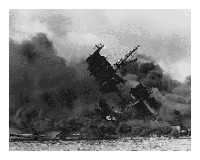
Japan bombs the U.S. Pacific Fleet at Pearl Harbor, Hawaii, on December 7, 1941.
ABH Travel Tip

Take your time and enjoy the view. There are so many beautiful vistas in our national parks, like the one in the Great Smokies above, pull off the side of the road, and take it all in. Those photos will remind you of the great times you have had discovering our beauty and history.
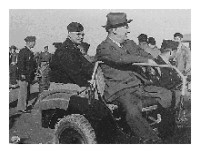
President Franklin D. Roosevelt, General Eisenhower, and
General Patton in Castelvetrano, Sicily, December 8, 1943.
Timeline Book

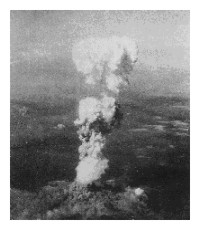
The decision of new President Harry Truman in Washington to curtail the war by sending in the atomic bomb. Photo of the billow of smoke from Hiroshima atomic bomb on August 6, 1945. Photo: Department of the Air Force.