-
Timeline - The 1950s
It was a time for chickens in every pot, two cars in every garage, color television, another war, and a space race to the stars.
More 1900s
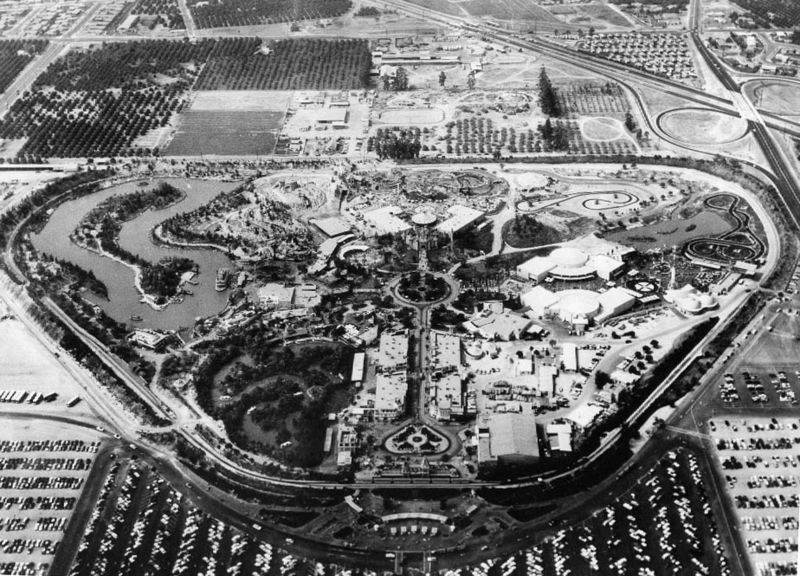
View of Disneyland in 1956.

Rosa Parks transit bus now on display at the Henry Ford Museum, a National Historic Site, in Dearborn, Michigan.
Sponsor this page. Your banner or text ad can fill the space above.
Click here to Sponsor the page and how to reserve your ad.
-
Timeline
Detail - 1951
September 4, 1951 - The inauguration of trans-continental television occurs with the broadcast of President Truman's speech at the Japanese Peace Treaty Conference in San Francisco. The treaty would be signed on September 8 by the U.S., Japan, and forty-seven other nations.
While today we might consider the advent of trans-continental television as equally important, with our copious amount of channels broadcasting around the world, the second part of this blurb was certainly more imperative to the security of the world. Finally, after years of war, World War II, in the Pacific Theater, was about to close with peace treaty negotiations. President Truman's address may have set the tone for the negotiations and treaty that would come of this meeting in San Francisco; seen across the nation by millions of families who had sacrificed their soldiers, or had played their parts in the war efforts in a different manner for six years.
However, it is not that the first time inauguration of President Truman's speech over a trans-continental network was not a feat. AT&T had constructed the network one year earlier, completing it is September, after most networks had postponed their plans for expanding television since World War II had broken out in 1939. It would be a microwave signal that needed many repeater towers constructed at a distance of thirty miles apart; in the east it would be coaxle cable. The code name for the project was CD2; its first application applied to a shorter route from Boston to New York City. Once the coast to coast network was completed, its first official broadcast would be of President Harry Truman opening the Japanese Peace Treaty in California. How many people tuned in? Try forty milllion over eighty-seven television stations. How much did it cost for AT&T to complete the network? Try $40 million dollars. What network carried the speech? How about NBC.
Japanese Peace Treaty Conference
After President Truman opened the conference at the San Francisco War Memorial Opera House, the delegates from the over fifty nations began to negotiate. Much of what was discussed had already had the ground laid by the two main negotiators; John Foster Dulles of the United States, and Prime Minister Shigeru Yoshida of Japan. The main focus was to officially end the war with Japan, as well as curtail any Japanese imperialism efforts in the future. Territorial disputes would also be addressed. There were other problems from the start. The Korean War had started, and even though all of Korea had been significantly affected by the Japanese during the war, they did not take part in order to keep the negotiations smooth with Japan. The South Korean government was initially invited, but John Foster Dulles thought their attendance could provide a negative vibe and hinder any chance of a good agreeement.
The Soviet Union, with Andrei Gromyko as its delegate, voiced their displeasure over the draft agreement, which they had not been consulted on, from the beginning, and did not vote for its passage. They could not agree with a United States base in Okinawa, Japan, as this meant the two nations would be militarily intwined against them. They also contended that the agreement was in conflict with the Yalta Conference on their remaining in control of several islands.
Signing of the Japanese Peace Treaty occurred in the morning of September 8, 1951. The peace treaty would go into force on April 28, 1952. Japanese occupation by the United States would end in 1952, but leave the USA with a continued presence in Okinawa at their base there, both to quell internal quarrels if they arose in Japan, and to defend Japan if they were attacked. There would be limits on the Japanese; only allowed as a defensive force, very small in number.
Formal Statement - Delegate from the United States, John Foster Dulles
Chapter I ends the state of war, with consequent recognition of the full sovereignty of the Japanese people. Let us note that the sovereignty recognized is the "sovereignty of the Japanese people."
What is the territory of Japanese sovereignty? Chapter II deals with that. Japan formally ratifies the territorial provisions of the Potsdam Surrender Terms, provisions which, so far as Japan is concerned, were actually carried into effect six years ago.
The Potsdam Surrender Terms constitute the only definition of peace terms to which, and by which, Japan and the Allied Powers as a whole are bound. There have been some private understandings between some Allied Governments; but by these Japan was not bound, nor were other Allies bound. Therefore, the treaty embodies article 8 of the Surrender Terms which provided that Japanese sovereignty should be limited to Honshu, Hokkaido, Kyushu, Shikoku and some minor islands. The renunciations contained in article 2 of chapter II strictly and scrupulously conform to that surrender term.
Some question has been raised as to whether the geographical name "Kurile Islands" mentioned in article 2 (c) includes the Habomai Islands. It is the view of the United States that it does not.
Formal Statement - Delegate from Japan, Prime Minister Shigeru Yoshida
The peace treaty before the Conference contains no punitive or retaliatory clauses; nor does it impose upon Japan any permanent restrictions or disabilities. It will restore the Japanese people to full sovereignty, equality, and freedom, and reinstate us as a free and equal member in the community of nations. It is not a treaty of vengeance, but an instrument of reconciliation. The Japanese Delegation gladly accepts this fair and generous treaty.
On the other hand, during these past few days in this very conference hall, criticisms and complaints have been voiced by some delegations against this treaty. It is impossible that anyone can be completely satisfied with a multilateral peace settlement of this kind. Even we Japanese, who are happy to accept the treaty, find in it certain points which cause us pain and anxiety. I speak of this with diffidence, bearing in mind the treaty's fairness and magnanimity unparalleled in history and the position of Japan. But I would be remiss in my obligation to my own people if I failed to call your attention to these points.
In the first place, there is the matter of territorial disposition.
... With respect to the Kuriles and South Sakhalin, I cannot yield to the claim of the Soviet Delegate that Japan had grabbed them by aggression.
At the time of the opening of Japan, her ownership of two islands of Etorofu and Kunashiri of the South Kuriles was not questioned at all by the Czarist government. But the North Kuriles north of Urruppu and the southern half of Sakhalin were areas open to both Japanese and Russian settlers. On May 7, 1875 the Japanese and Russian Governments effected through peaceful negotiations an arrangement under which South Sakhalin was made Russian territory, and the North Kuriles were in exchange made Japanese territory. But really, under the name of "exchange" Japan simply ceded South Sakhalin to Russia in order to settle the territorial dispute. It was under the Treaty of Portsmouth of September 5, 1905 concluded through the intermediary of President Theodore Roosevelt of the United States that South Sakhalin became also Japanese territory.
Both the Kuriles and South Sakhalin were taken unilaterally by the Soviet Union as of September 20, 1945, shortly after Japan's surrender.
Even the islands of Habomai and Shikotan, constituting part of Hokkaido, one of Japan's four main islands, are still being occupied by Soviet forces simply because they happened to be garrisoned by Japanese troops at the time when the war ended.
COMING SOON. Minute Walk in History
Japan Peace Conference
World War II had been over for more than five years, but there had not been an official Peace Treaty with Japan. So in 1951, held in San Francisco's famous War Memorial Opera House, delegates from circa fifty nations came to hammer out that document. Watch newsreels of Truman as he gave the first transcontinental televised program over a new nation wide network, plus photos and archival footage of the Battle of Iwo Jima, one of the reasons that a peace treaty was now needed.
Text of Japan Peace Treaty, San Francisco 1951
No. 1832. TREATY 1 OF PEACE WITH JAPAN. SIGNED AT SAN FRANCISCO, ON 8 SEPTEMBER 1951
Whereas the Allied Powers and Japan are resolved that henceforth their
relations shall be those of nations which, as sovereign equals, cooperate in friendly
association to promote their common welfare and to maintain international peace
and security, and are therefore desirous of concluding a Treaty of Peace which
will settle questions still outstanding as a result of the existence of a state of war
between them;
Whereas Japan for its part declares its intention to apply for membership in the United Nations and in all circumstances to conform to the principles of the
Charter of the United Nations; to strive to realize the objectives of the Universal Declaration of Human Rights; to seek to create within Japan conditions of
stability and well-being as defined in Articles 55 and 56 of the Charter of the United Nations and already initiated by post-surrender Japanese legislation;/and in
"public and private trade and commerce to conform to internationally accepted fair practices;
Whereas the Allied Powers welcome the intentions of Japan set out in the
foregoing paragraph;
The Allied Powers and Japan have therefore determined to conclude the
present Treaty of Peace, and have accordingly appointed the undersigned Pleni
potentiaries, who, after presentation of their full powers, found in good and due
form, have agreed on the following provisions:
CHAPTER I - PEACE
Article 1
(a) The state of war between Japan and each of the Allied Powers is terminated
as from the date on which the present Treaty comes into force between Japan and
the Allied Power concerned as provided for in Article 23.
(b) The Allied Powers recognize the full sovereignty of the Japanese people
over Japan and its territorial waters.
CHAPTER II - TERRITORY
Article 2
(a) Japan, recognizing the independence of Korea, renounces all right, title
and claim to Korea, including the islands of Quelpart, Port Hamilton and Dagelet.
(b) Japan renounces all right, title and claim to Formosa and the Pescadores.
(c) Japan renounces all right, title and claim to the Kurile Islands, and to
that portion of Sakhalin and the islands adjacent to it over which Japan acquired
sovereignty as a consequence of the Treaty of Portsmouth of September 5, 1905.
(d) Japan renounces all right, title and claim in connection with the League
of Nations Mandate System, and accepts the action of the United Nations Security Council of April 2, 1947, extending the trusteeship system to the Pacific Islands
formerly under mandate to Japan.
(e) Japan renounces all claim to any right or title to or interest in connection
with any part of the Antarctic area, whether deriving from the activities of Japanese
nationals or otherwise.
(/) Japan renounces all right, title and claim to the Spratly Islands and to
the Paracel Islands.
Article 3
Japan will concur in any proposal of the United States to the United Nations
to place under its trusteeship system, with the United States as the sole ad
ministering authority, Nansei Shoto south of 29 north latitude (including the
Ryukyu Islands and the Daito Islands), Nanpo Shoto south of Sofu Gan (including
the Bonin Islands, Rosario Island and the Volcano Islands) and Parece Vela and
Marcus Island. Pending the making of such a proposal and affirmative action
thereon, the United States will have the right to exercise all and any powers of
administration, legislation and jurisdiction over the territory and inhabitants of
these islands, including their territorial waters.
Article 4
(a) Subject to the provisions of paragraph (V) of this Article, the disposition
of property of Japan and of its nationals in the areas referred to in Article 2, and
their claims, including debts, against the authorities presently administering
such areas and the residents (including juridical persons) thereof, and the disposi
tion in Japan of property of such authorities and residents, and of claims, including
; debts, of such authorities and residents against. Japan and its nationals, shall be
| the subject of special arrangements between Japan and such authorities. The
property of any of the Allied Powers or its nationals in the areas referred to in
Article 2 shall, in so far as this has not already been done, be returned by the ad
ministering authority in the condition in which it now exists. (The term nationals
whenever used in the present Treaty includes juridical persons.)
(b) Japan recognizes the validity of dispositions of property of Japan and
Japanese nationals made by or pursuant to directives of the United States Military
Government in any of the areas referred to in Articles 2 and 3.
(c) Japanese-owned submarine cables connecting Japan with territory
removed from Japanese control pursuant to the present Treaty shall be equally divided, Japan retaining the Japanese terminal and adjoining half of the cable,
and the detached territory the remainder of the cable and connecting terminal lacilities.
CHAPTER III - SECURITY
Article 5
(a) Japan accepts the obligations set forth in Article 2 of the Charter of the
United Nations, and in particular the obligations
(i) to settle its international disputes by peaceful means in such a manner
that international peace and security, and justice, are not endangered;
(ii) to refrain in its international relations from the threat or use of force
against the territorial integrity or political independence of any State or in any
other manner inconsistent with the Purposes of the United Nations;
(iii) to give the United Nations every assistance in any action it takes in
accordance with the Charter and to refrain from giving assistance to any State
against which the United Nations may take preventive or enforcement action.
(b) The Allied Powers confirm that they will be guided by the principles of
Article 2 of the Charter of the United Nations in their relations with Japan.
(c) The Allied Powers for their part recognize that Japan as as overeign
nation possesses the inherent right of individual or collective self-defense referred
to in Article 51 of the Charter of the United Nations and that Japan may voluntar
ily enter into collective security arrangements.
Article 6
(a) All occupation forces of the Allied Powers shall be withdrawn from Japan
as soon as possible after the coming into force of the present Treaty, and in any
case not later than 90 days thereafter. Nothing in this provision shall, however,
prevent the stationing or retention of foreign armed forces in Japanese territory
under or in consequence of any bilateral or multilateral agreements which have
been or may be made between one or more of the Allied Powers, on the one hand,
and Japan on the other.
(b) The provisions of Article 9 of the Potsdam Proclamation of July 26, 1945,
dealing with the return of Japanese military forces to their homes, to the extent
not already completed, will be carried out.
(c) All Japanese property for which compensation has not already been paid,
which was supplied for the use of the occupation forces and which remains in the possession of those forces at the time of the coming into force of the present Treaty,
shall be returned to the Japanese Government within the same 90 days unless
other arrangements are made by mutual agreement.
CHAPTER IV - POLITICAL AND ECONOMIC CLAUSES
Article 7
(a) Each of the Allied Powers, within one year after the present Treaty has
come into force between it and Japan, will notify Japan which of its prewar
bilateral treaties or conventions with Japan it wishes to continue in force or
revive, and any treaties or conventions so notified shall continue in force or be
revived subject only to such amendments as may be necessary to ensure conform
ity with the present Treaty. The treaties and conventions so notified shall be
considered as having been continued in force or revived three months after the
date of notification and shall be registered with the Secretariat of the United
Nations. All such treaties and conventions as to which Japan is not so notified
shall be regarded as abrogated.
(b) Any notification made under paragraph (a) of this Article may except
from the operation or revival of a treaty or convention any territory for the inter
national relations of which the notifying Power is responsible, until three months
after the date on which notice is given to Japan that such exception shall cease
to apply.
Article 8
(a) Japan will recognize the full force of all treaties now or hereafter con
cluded by the Allied Powers for terminating the state of war initiated on Septem
ber 1, 1939, as well as any other arrangements by the Allied Powers for or in
connection with the restoration of peace. Japan also accepts the arrangements
made for terminating the former League of Nations and Permanent Court of
International Justice.
(b) Japan renounces all such rights and interests as it may derive from being
a signatory power of the Conventions of St. Germain-en-Laye of September 10,
1919, and the Straits Agreement of Montreux of July 20, 1936, and from Article 16 of the Treaty of Peace with Turkey signed at Lausanne on July 24,
1923.
(c) Japan renounces all rights, titles and interests acquired under, and is
discharged from all obligations resulting from, the Agreement between Germany
and the Creditor Powers of January 20, 1930, 2 and its Annexes, including the
Trust Agreement, dated May 17, 1930; 3 the Convention of January 20, 1930, respecting the Bank for International Settlements ; and the Statutes of the Bank
for International Settlements. Japan will notify to the Ministry of Foreign
Affairs in Paris within six months of the first coming into force of the present
Treaty its renunciation of the rights, title and interests referred to in this paragraph.
Article 9
Japan will enter promptly into negotiations with the Allied Powers so desiring
for the conclusion of bilateral and multilateral agreements providing for the
regulation or limitation of fishing and the conservation and development of
fisheries on the high seas.
Article 10
Japan renounces all special rights and interests in China, including all benefits
and privileges resulting from the provisions of the final Protocol signed at Peking
on September 7, 1901, 5 and all annexes, notes and documents supplementary
thereto, and agrees to the abrogation in respect to Japan of the said protocol,
annexes, notes and documents.
Article 11
Japan accepts the judgments of the International Military Tribunal for the
Far East and of other Allied War Crimes Courts both within and outside Japan,
and will carry out the sentences imposed thereby upon Japanese nationals im
prisoned in Japan. The power to grant clemency, to reduce sentences and to parole
with respect to such prisoners may not be exercised except on the decision of the
Government or Governments which imposed the sentence in each instance, and
on the recommendation of Japan. In the case of persons sentenced by the Inter
national Military Tribunal for the Far East, such power may not be exercised
except on the decision of a majority of the Governments represented on the
Tribunal, and on the recommendation of Japan.
Article 12
(a) Japan declares its readiness promptly to enter into negotiations for the
conclusion with each of the Allied Powers of treaties or agreements to place their
trading, maritime and other commercial relations on a stable and friendly basis.
(6) Pending the conclusion of the relevant treaty or agreement, Japan will,
during a period of four years from the first coming into force of the present Treaty
(1) accord to each of the Allied Powers, its nationals, products and vessels
(i) most-favored-nation treatment with respect to customs duties,
charges, restrictions and other regulations on or in connection with
the importation and exportation of goods ;
(ii) national treatment with respect to shipping, navigation and imported
goods, and with respect to natural and juridical persons and their
interests such treatment to include all matters pertaining to the
levying and collection of taxes, access to the courts, the making and
performance of contracts, rights to property (tangible and intangible),
participation in juridical entities constituted under Japanese law,
and generally the conduct of all kinds of business and professional
activities;
(2) ensure that external purchases and sales of Japanese state trading enter
prises shall be based solely on commercial considerations.
(c) In respect to any matter, however, Japan shall be obliged to accord to an
Allied Power national treatment, or most-favored-nation treatment, only to the
extent that the Allied Power concerned accords Japan national treatment or mostfavored-nation treatment, as the case may be, in respect of the same matter.
The reciprocity envisaged in the foregoing sentence shall be determined, in the
case of products, vessels and juridical entities of, and persons domiciled in, any
non-metropolitan territory of an Allied Power, and in the case of juridical entities
of, and persons domiciled in, any state or province of an Allied Power having
a federal government, by reference to the treatment accorded to Japan in such
territory, state or province.
(d) In the application of this Article, a discriminatory measure shall not be
considered to derogate from the grant of national or most-favored-nation treat
ment, as the case may be, if such measure is based on an exception customarily
provided for in the commercial treaties of the party applying it, or on the need
to safeguard that party's external financial position or balance of payments (except in respect to shipping and navigation), or on the need to maintain its
essential security interests, and provided such measure is proportionate to the
circumstances and not applied in an arbitrary or unreasonable manner.
(e) Japan's obligations under this Article shall not be affected by the exercise
of any Allied rights under Article 14 of the present Treaty ; nor shall the provisions
of this Article be understood as limiting the undertakings assumed by Japan
by virtue of Article 15 of the Treaty.
Article 13
(a) Japan will enter into negotiations with any of the Allied Powers, promptly
upon the request of such Power or Powers, for the conclusion of bilateral or multi
lateral agreements relating to international civil air transport.
(V) Pending the conclusion of such agreement or agreements, Japan will,
during a period of four years from the first coming into force of the present Treaty,
extend to such Power treatment not less favorable with respect to air-traffic
rights and privileges than those exercised by any such Powers at the date of such
coming into force, and will accord complete equality of opportunity in respect
to the operation and development of air services.
(c) Pending its becoming a party to the Convention on International Civil
Aviation 1 in accordance with Article 93 thereof, Japan will give effect to the pro
visions of that Convention applicable to the international navigation of aircraft, and
will give effect to the standards, practices and procedures adopted as annexes to
the Convention in accordance with the terms of the Convention.
CHAPTER V - CLAIMS AND PROPERTY
Article l4
(a) It is recognized that Japan should pay reparations to the Allied Powers
for the damage and suffering caused by it during the war. Nevertheless it is
also recognized that the resources of Japan are not presently sufficient, if it is to maintain a viable economy, to make complete reparation for all such damage and
suffering and at the same time meet its other obligations.
Therefore,
1. Japan will promptly enter into negotiations with Allied Powers so desiring,
whose present territories were occupied by Japanese forces and damaged by Japan,
with a view to assisting to compensate those countries for the cost of repairing the
damage done, by making available the services of the Japanese people in produc
tion, salvaging and other work for the Allied Powers in question. Such arrange
ments shall avoid the imposition of additional liabilities on other Allied Powers,
and, where the manufacturing of raw materials is called for, they shall be supplied
by the Allied Powers in question, so as not to throw any foreign exchange burden
upon Japan.
2. (I) Subject to the provisions of sub-paragraph (II) below, each of the
Allied Powers shall have the right to seize, retain, liquidate or otherwise dispose
of all property, rights and interests of
(a) Japan and Japanese nationals,
(b) persons acting for or on behalf of Japan or Japanese nationals, and
(c) entities owned or controlled by Japan or Japanese nationals,
which on the first coming into force of the present Treaty were subject to its
jurisdiction. The property, rights and interests specified in this sub-paragraph
shall include those now blocked, vested or in the possession or under the control of
enemy property authorities of Allied Powers, which belonged to, or were held or
managed on behalf of, any of the persons or entities mentioned in (a), (b) or (c)
above at the time such assets came under the controls of such authorities.
(II) The following shall be excepted from the right specified in sub-para
graph (I) above:
(i) property of Japanese natural persons who during the war resided with
the permission of the Government concerned in the territory of one of
the Allied Powers, other than territory occupied by Japan, except proper
ty subjected to restrictions during the war and not released from such
restrictions as of the date of the first coming into force of the present
Treaty;
(ii) all real property, furniture and fixtures owned by the Government of
Japan and used for diplomatic or consular purposes, and all personal
furniture and furnishings and other private property not of an investment
nature which was normally necessary for the carrying out of diplomatic
and consular functions, owned by Japanese diplomatic and consular
personnel;
(iii) property belonging to religious bodies or private charitable institutions
and used exclusively for religious or charitable purposes;
(iv) property, rights and interests which have come within its jurisdiction
in consequence of the resumption of trade and financial relations sub
sequent to September 2, 1945, between the country concerned and Japan,
except such as have resulted from transactions contrary to the laws of
the Allied Power concerned;
(v) obligations of Japan or Japanese nationals, any right, title or interest in
tangible property located in Japan, interests in enterprises organized
under the laws of Japan, or any paper evidence thereof ; provided that
this exception shall only apply to obligations of Japan and its nationals
expressed in Japanese currency.
(Ill) Property referred to in exceptions (i) through (v) above shall be returned
subject to reasonable expenses for its preservation and administration. If any
such property has been liquidated the proceeds shall be returned instead.
(IV) The right to seize, retain, liquidate or otherwise dispose of property
as provided in sub-paragraph (I) above shall be exercised in accordance with the
laws of the Allied Power concerned, and the owner shall have only such rights as
may be given him by those laws.
(V) The Allied Powers agree to deal with Japanese trademarks and literary
and artistic property rights on a basis as favorable to Japan as circumstances
ruling in each country will permit.
(b) Except as otherwise provided in the present Treaty, the Allied Powers
waive all reparations claims of the Allied Powers, other claims of the Allied Powers
and their nationals arising out of any actions taken by Japan and its nationals
in the course of the prosecution of the war, and claims of the Allied Powers for
direct military costs of occupation.
Article 15
(a) Upon application made within nine months of the coming into force of
the present Treaty between Japan and the Allied Power concerned, Japan will,
within six months of the date of such application, return the property, tangible and
intangible, and all rights or interests of any kind in Japan of each Allied Power
and its nationals which was within Japan at any time between December 7, 1941,
and September 2, 1945, unless the owner has freely disposed thereof without
duress or fraud. Such property shall be returned free of all encumbrances and
charges to which it may have become subject because of the war, and without
any charges for its return. Property whose return is not applied for by or on
behalf of the owner or by his Government within the prescribed period may be
disposed of by the Japanese Government as it may determine. In cases where such
property was within Japan on December 7, 1941, and cannot be returned or has
suffered injury or damage as a result of the war, compensation will be made on
terms not less favorable than the terms provided in the draft Allied Powers Property
Compensation Law approved by the Japanese Cabinet on July 13, 1951.
(b) With respect to industrial property rights impaired during the war, Japan
will continue to accord to the Allied Powers and their nationals benefits no less
than those heretofore accorded by Cabinet Orders No. 309 effective September 1,
1949, No. 12 effective January 28, 1950, and No. 9 effective February 1, 1950,
all as now amended, provided such nationals have applied for such benefits within
the time limits prescribed therein.
(c) (i) Japan acknowledges that the literary and artistic property rights
which existed in Japan on December 6, 1941, in respect to the published and un
published works of the Allied Powers and their nationals have continued in force
since that date, and recognizes those rights which have arisen, or but for the
war would have arisen, in Japan since that date, by the operation of any conven
tions and agreements to which Japan was a party on that date, irrespective of
whether or not such conventions or agreements were abrogated or suspended upon
or since the outbreak of war by the domestic law of Japan or of the Allied Power
concerned.
(ii) Without the need for application by the proprietor of the right and
without the payment of any fee or compliance with any other formality, the period
from December 7, 1941, until the coming into force of the present Treaty between
Japan and the Allied Power concerned shall be excluded from the running of the normal term of such rights ; and such period, with an additional period of six
months, shall be excluded from the time within which a literary work must be
translated into Japanese in order to obtain translating rights in Japan.
Article 16
As an expression of its desire to indemnify those members of the armed forces
of the Allied Powers who suffered undue hardships while prisoners of war of Japan,
Japan will transfer its assets and those of its nationals in countries which were
neutral during the war, or which were at war with any of the Allied Powers, or,
at its option, the equivalent of such assets, to the International Committee of
the Red Cross which shall liquidate such assets and distribute the resultant fund
to appropriate national agencies, for the benefit of former prisoners of war and
their families on such basis as it may determine to be equitable. The categories
of assets described in Article 14 (a) 2(11) (ii) through (v) of the present Treaty
shall be excepted from transfer, as well as assets of Japanese natural persons not
residents of Japan on the first coming into force of the Treaty. It is equally
understood that the transfer provision of this Article has no application to the
19,770 shares in the Bank for International Settlements presently owned by
Japanese financial institutions.
Article 17
(a) Upon the request of any of the Allied Powers, the Japanese Government
shall review and revise in conformity with international law any decision or order
of the Japanese Prize Courts in cases involving ownership rights of nationals of that
Allied Power and shall supply copies of all documents comprising the records of
these cases, including the decisions taken and orders issued. In any case in which
such review or revision shows that restoration is due, the provisions of Article 15
shall apply to the property concerned.
(b) The Japanese Government shall take the necessary measures to enable
nationals of any of the Allied Powers at any time within one year from the coming
into force of the present Treaty between Japan and the Allied Power concerned
to submit to the appropriate Japanese authorities for review any judgment given
by a Japanese court between December 7, 1941, and such coming into force, in any
proceedings in which any such national was unable to make adequate presentation
of his case either as plaintiff or defendant. The Japanese Government shall
provide that, where the national has suffered injury by reason of any such judgment,
he shall be restored in the position in which he was before the judgment was given
or shall be afforded such relief as may be just and equitable in the circumstances.
Article 18
(a) It is recognized that the intervention of the state of war has not affected
the obligation to pay pecuniary debts arising out of obligations and contracts (including those in respect of bonds) which existed and rights which were acquired
before the existence of a state of war, and which are due by the Government or
nationals of Japan to the Government or nationals of one of the Allied Powers,
or are due by the Government or nationals of one of the Allied Powers to the
Government or nationals of Japan. The intervention of a state of war shall
equally not be regarded as affecting the obligation to consider on their merits
claims for loss or damage to property or for personal injury or death which arose
before the existence of a state of war, and which may be presented or re-presented
by the Government of one of the Allied Powers to the Government of Japan, or
by the Government of Japan to any of the Governments of the Allied Powers.
The provisions of this paragraph are without prejudice to the rights conferred
by Article 14.
(b) Japan affirms its liability for the prewar external debt of the Japanese
State and for debts of corporate bodies subsequently declared to be liabilities of
the Japanese State, and expresses its intention to enter into negotiations at an
early date with its creditors with respect to the resumption of payments on those
debts ; to encourage negotiations in respect to other prewar claims and obligations ;
and to facilitate the transfer of sums accordingly.
Article 19
(a) Japan waives all claims of Japan and its nationals against the Allied
Powers and their nationals arising out of the war or out of actions taken because
of the existence of a state of war, and waives all claims arising from the presence,
operations or actions of forces or authorities of any of the Allied Powers in Japanese
territory prior to the coming into force of the present Treaty.
(b) The foregoing waiver includes any claims arising out of actions taken by
any of the Allied Powers with respect to Japanese ships between September 1,
1939, and the coming into force of the present Treaty, as well as any claims and
debts arising in respect to Japanese prisoners of war and civilian internees in the
hands of the Allied Powers, but does not include Japanese claims specifically
recognized in the laws of any Allied Power enacted since September 2, 1945.
(c) Subject to reciprocal renunciation, the Japanese Government also re
nounces all claims (including debts) against Germany and German nationals on
behalf of the Japanese Government and Japanese nationals, including inter
governmental claims and claims for loss or damage sustained during the war, but
excepting (a) claims in respect of contracts entered into and rights acquired before
September 1, 1939, and (b) claims arising out of trade and financial relations between Japan and Germany after September 2, 1945. Such renunciation shall
not prejudice actions taken in accordance with Articles 16 and 20 of the present
Treaty.
(d) Japan recognizes the validity of all acts and omissions done during the
period of occupation under or in consequence of directives of the occupation
authorities or authorized by Japanese law at that time, and will take no action
subjecting Allied nationals to civil or criminal liability arising out of such acts or
omissions.
Article 20
Japan will take all necessary measures to ensure such disposition of German
assets in Japan as has been or may be determined by those powers entitled under
the Protocol of the proceedings of the Berlin Conference of 1945 to dispose of those
assets, and pending the final disposition of such assets will be responsible for the
conservation and administration thereof.
Article 21
Notwithstanding the provisions of Article 25 of the present Treaty, China
shall be entitled to the benefits of Articles 10 and 14(a)2 ; and Korea to the benefits
of Articles 2, 4, 9 and 12 of the present Treaty.
CHAPTER VI - SETTLEMENT OF DISPUTES
Article 22
If in the opinion of any Party to the present Treaty there has arisen a dispute
concerning the interpretation or execution of the Treaty, which is not settled by
reference to a special claims tribunal or by other agreed means, the dispute shall,
at the request of any party thereto, be referred for decision to the International
Court of Justice. Japan and those Allied Powers which are not already parties
to the Statute of the International Court of Justice 1 will deposit with the Registrar
of the Court, at the time of their respective ratifications of the present Treaty,
and in conformity with the resolution of the United Nations Security Council,
dated October 15, 1946, 2 a general declaration accepting the jurisdiction, without
special agreement, of the Court generally in respect to all disputes of the character
referred to in this Article.
CHAPTER VII
FINAL CLAUSES
Article 23
(a) The present Treaty shall be ratified by the States which sign it, including
Japan, and will come into force for all the States which have then ratified it, when
instruments of ratification have been deposited by Japan and by a majority,
including the United States of America as the principal occupying Power, of the
following States, namely Australia, Canada, Ceylon, France, Indonesia, the
Kingdom of the Netherlands, New Zealand, Pakistan, the Republic of the Philip
pines, the United Kingdom of Great Britain and Northern Ireland, and the United
States of America. The present Treaty shall come into force for each State which
subsequently ratifies it, on the date of the deposit of its instrument of ratification.
(&) If the Treaty has not come into force within nine months after the date of
the deposit of Japan's ratification, any State which has ratified it may bring the
Treaty into force between itself and Japan by a notification to that effect given
to the Governments of Japan and the United States of America not later than
three years after the date of deposit of Japan's ratification.
Article 24
All instruments of ratification shall be deposited with the Government of the
United States of America which will notify all the signatory States of each such
deposit, of the date of the coming into force of the Treaty under paragraph (a) of
Article 23, and of any notifications made under paragraph (b) of Article 23.
Article 25
For the purposes of the present Treaty the Allied Powers shall be the States
at war with Japan, or any State which previously formed a part of the territory of a
State named in Article 23, provided that in each case the State concerned has
signed and ratified the Treaty. Subject to the provisions of Article 21, the present
Treaty shall not confer any rights, titles or benefits on any State which is not an
Allied Power as herein defined ; nor shall any right, title or interest of Japan be
deemed to be diminished or prejudiced by any provision of the Treaty in favor of a
State which is not an Allied Power as so defined.
Article 26
Japan will be prepared to conclude with any State which signed or adhered
to the United Nations Declaration of January 1, 1942, 1 and which is at war with
Japan, or with any State which previously formed a part of the territory of a
State named in Article 23, which is not a signatory of the present Treaty, a bilateral
Treaty of Peace on the same or substantially the same terms as are provided for
in the present Treaty, but this obligation on the part of Japan will expire three
years after the first coming into force of the present Treaty. Should Japan make
a peace settlement or war claims settlement with any State granting that State
greater advantages than those provided by the present Treaty, those same advan
tages shall be extended to the parties to the present Treaty.
Article 27
The present Treaty shall be deposited in the archives of the Government of
the United States of America which shall furnish each signatory State with a
certified copy thereof.
IN FAITH WHEREOF the undersigned Plenipotentiaries have signed the present
Treaty.
DONE at the city of San Francisco this eighth day of September 1951, in the
English, French, and Spanish languages, all being equally authentic, and in the
Japanese language.
DECLARATION
With respect to the Treaty of Peace l signed this day, the Government of Japan
makes the following Declaration:
1. Except as otherwise provided in the said Treaty of Peace, Japan recognizes
the full force of all presently effective multilateral international instruments to
which Japan was a party, on September 1, 1939, and declares that it will, on the
first coming into force of the said Treaty, resume all its rights and obligations
under those instruments. Where, however, participation in any instrument involves
membership in an international organization of which Japan ceased to be a member
on or after September 1, 1939, the provisions of the present paragraph shall be
dependent on Japan's readmission to membership in the organization concerned.
2. It is the intention of the Japanese Government formally to accede to the
following international instruments within the shortest practicable time, not to
exceed one year from the first coming into force of the Treaty of Peace:
(1) Protocol opened for signature at Lake Success on December 11, 1946, amending the agreements, conventions and protocols on narcotic drugs
of January 23, 1912, February 11, 1925, February 19, 1925, July 13, 1931, November 27, 1931, and June 26, 1936;
(2) Protocol 3 opened for signature at Paris on November 19, 1948, bringing
under international control drugs outside the scope of the convention
of July 13, 1931, for limiting the manufacture and regulating the dis
tribution of narcotic drugs, as amended by the protocol signed at Lake
Success on December 11, 1946;
(3) International Convention on the Execution of Foreign Arbitral Awards
signed at Geneva on September 26, 1927;
(4) International Convention relating to Economic Statistics with protocol
signed at Geneva on December 14, 1928, and Protocol 2 amending the
International Convention of 1928 relating to Economic Statistics signed
Paris on December 9, 1948;
(5) International Convention relating to the Simplification of Customs
Formalities, with protocol of signature, signed at Geneva on November 3,
1923;
(6) Agreement of Madrid of April 14, 1891, for the Prevention of False In
dications of Origin of Goods, as revised at Washington on June 2, 1911,
at The Hague on November 6, 1925, and at London on June 2, 1934;
(7) Convention for the Unification of Certain Rules relating to International
Transportation by Air, and additional protocol, signed at Warsaw on October 12, 1929;
(8) Convention on Safety of Life at Sea opened for signature at London on
June 10, 1948;
(9) Geneva conventions of August 12, 1949, for the protection of war victims.
3. It is equally the intention of the Japanese Government, within six months
of the first coming into force of the Treaty of Peace, to apply for Japan's admission to participation in (a) the Convention 1 on International Civil Aviation opened
for signature at Chicago on December 7, 1944, and, as soon as Japan is itself a
party to that Convention, to accept the International Air Services Transit Agree
ment 2 also opened for signature at Chicago on December 7, 1944; and (b) the
Convention 3 of the World Meteorological Organization opened for signature at
Washington on October 11, 1947.
DECLARATION
With respect to the Treaty of Peace 1 signed this day, the Government of
Japan makes the following Declaration:
Japan will recognize any Commission, Delegation or other Organization
authorized by any of the Allied Powers to identify, list, maintain or regulate its
war graves, cemeteries and memorials in Japanese territory; will facilitate the
work of such Organizations; and will, in respect of the abovementioned war
graves, cemeteries and memorials, enter into negotiations for the conclusion of
such agreements as may prove necessary with the Allied Power concerned, or
with any Commission, Delegation or other Organization authorized by it.
Japan trusts that the Allied Powers will enter into discussions with the
Japanese Government with a view to arrangements being made for the maintenance
of any Japanese war graves or cemeteries which may exist in the territories of the
Allied Powers and which it is desired to preserve.

Nations That Signed the Peace Treaty
Forty-nine nations signed the treaty; Argentina, Australia, Belgium, Bolivia, Brazil, Cambodia, Canada, Ceylon (currently Sri Lanka), Chile, Colombia, Costa Rica, Cuba, the Dominican Republic, Ecuador, Egypt, El Salvador, Ethiopia, France, Greece, Guatemala, Haiti, Honduras, Indonesia, Iran, Iraq, Laos, Lebanon, Liberia, Luxembourg, Mexico, the Netherlands, New Zealand, Nicaragua, Norway, Pakistan, Panama, Paraguay, Peru, the Philippines, Saudi Arabia, South Africa, South Vietnam, Syria, Turkey, the United Kingdom, the United States, Uruguay, Venezuela and Japan.
Three nations did not; the Soviet Union, Poland, and Czechoslavakia. China, Portugal, and Italy had not been invited, and Afghanistan, Burma, India, Nepal, Yemen and Yugoslavia did not come after receiving invitations. Other notable exceptions included the nation of India, who would sign a separated peace treaty with Japan.
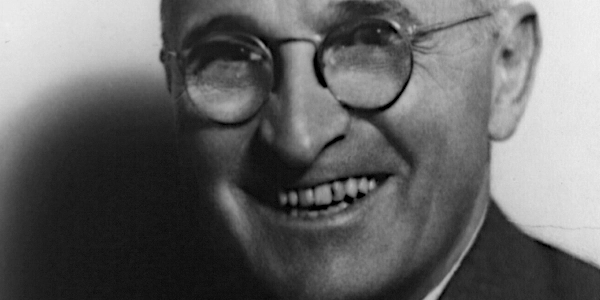
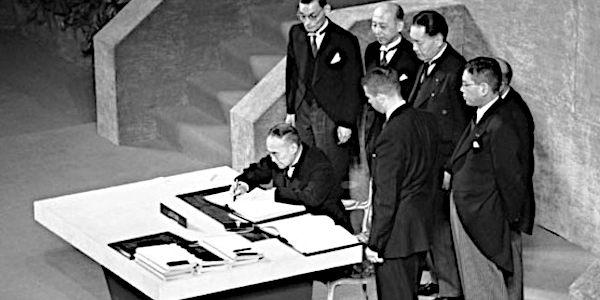
Image above: President Harry Truman photo, 1945. Seattle Walters. Courtesy Library of Congress. Image below: U.S. Secretary of State Dean Acheson signing the Treaty of Peace with Japan, September 8, 1951, 1951, U.S. Department of State. Courtesy Wikipedia Commons. Source Info: "Treaty of Peace With Japan," U.S. Department of State; "Trans-Continental Television Network, US," ethw.org; "Boston Receives First Transcontinental TV Broadcast," massmoments.com; historysnacks.io; "Japanese Peace Conference Documents, August 8 to September 9, 1951," hathitrust.org; "Conference for the Conclusion and Signature of the Treaty of Peace with Japan San Francisco, California," 1952, Department of State, Government Printing Office; Wikipedia Commons; "San Francisco Peace Treaty," mofa.go.jp; "What Was San Francisco Peace Treaty," sfpeacetreaty.org; Office of the Historian, Department of State; "Address in San Francisco at the Opening of the Conference on the Japanese Peace Treaty," Harry S. Truman Library and Museum.
History Photo Bomb
President Franklin D. Roosevelt, General Eisenhower, and
General Patton in Castelvetrano, Sicily, December 8, 1943. By 1952, Eisenhower would become president. Courtesy National Archives.
Timeline Book

Now in easy to search digital format for your Kindle, Nook,
or pdf format. Also comes in paperback, too.
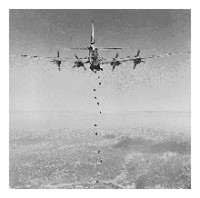
Korean War bombing raid. Courtesy National Archives.
ABH Travel Tip

A visit to Eisenhower National Historic Site should not be missed if you are visiting Gettysburg. Its home and farm evoke the time of the general and his wife, with period furnishings and tales of not only his presidency and the meetings with world and national leaders at the farm, but his life in Gettysburg and prior to that, in World War II. The farm was the only home Eisenhower owned in his lifetime.

Astronaut John Glenn and others around capsule, October 1958.
Courtesy NASA.
COMING SOON. Minute Walk in History
Japan Peace Conference
Whereas the Allied Powers and Japan are resolved that henceforth their relations shall be those of nations which, as sovereign equals, cooperate in friendly association to promote their common welfare and to maintain international peace and security, and are therefore desirous of concluding a Treaty of Peace which will settle questions still outstanding as a result of the existence of a state of war between them;
Whereas Japan for its part declares its intention to apply for membership in the United Nations and in all circumstances to conform to the principles of the Charter of the United Nations; to strive to realize the objectives of the Universal Declaration of Human Rights; to seek to create within Japan conditions of stability and well-being as defined in Articles 55 and 56 of the Charter of the United Nations and already initiated by post-surrender Japanese legislation;/and in "public and private trade and commerce to conform to internationally accepted fair practices;
Whereas the Allied Powers welcome the intentions of Japan set out in the foregoing paragraph;
The Allied Powers and Japan have therefore determined to conclude the present Treaty of Peace, and have accordingly appointed the undersigned Pleni potentiaries, who, after presentation of their full powers, found in good and due form, have agreed on the following provisions:
CHAPTER I - PEACE
Article 1
(a) The state of war between Japan and each of the Allied Powers is terminated as from the date on which the present Treaty comes into force between Japan and the Allied Power concerned as provided for in Article 23.
(b) The Allied Powers recognize the full sovereignty of the Japanese people over Japan and its territorial waters.
CHAPTER II - TERRITORY
Article 2
(a) Japan, recognizing the independence of Korea, renounces all right, title and claim to Korea, including the islands of Quelpart, Port Hamilton and Dagelet.
(b) Japan renounces all right, title and claim to Formosa and the Pescadores.
(c) Japan renounces all right, title and claim to the Kurile Islands, and to that portion of Sakhalin and the islands adjacent to it over which Japan acquired sovereignty as a consequence of the Treaty of Portsmouth of September 5, 1905.
(d) Japan renounces all right, title and claim in connection with the League of Nations Mandate System, and accepts the action of the United Nations Security Council of April 2, 1947, extending the trusteeship system to the Pacific Islands formerly under mandate to Japan.
(e) Japan renounces all claim to any right or title to or interest in connection with any part of the Antarctic area, whether deriving from the activities of Japanese nationals or otherwise.
(/) Japan renounces all right, title and claim to the Spratly Islands and to the Paracel Islands.
Article 3
Japan will concur in any proposal of the United States to the United Nations to place under its trusteeship system, with the United States as the sole ad ministering authority, Nansei Shoto south of 29 north latitude (including the Ryukyu Islands and the Daito Islands), Nanpo Shoto south of Sofu Gan (including the Bonin Islands, Rosario Island and the Volcano Islands) and Parece Vela and Marcus Island. Pending the making of such a proposal and affirmative action thereon, the United States will have the right to exercise all and any powers of administration, legislation and jurisdiction over the territory and inhabitants of these islands, including their territorial waters.
Article 4
(a) Subject to the provisions of paragraph (V) of this Article, the disposition of property of Japan and of its nationals in the areas referred to in Article 2, and their claims, including debts, against the authorities presently administering such areas and the residents (including juridical persons) thereof, and the disposi tion in Japan of property of such authorities and residents, and of claims, including ; debts, of such authorities and residents against. Japan and its nationals, shall be | the subject of special arrangements between Japan and such authorities. The property of any of the Allied Powers or its nationals in the areas referred to in Article 2 shall, in so far as this has not already been done, be returned by the ad ministering authority in the condition in which it now exists. (The term nationals whenever used in the present Treaty includes juridical persons.)
(b) Japan recognizes the validity of dispositions of property of Japan and Japanese nationals made by or pursuant to directives of the United States Military Government in any of the areas referred to in Articles 2 and 3.
(c) Japanese-owned submarine cables connecting Japan with territory removed from Japanese control pursuant to the present Treaty shall be equally divided, Japan retaining the Japanese terminal and adjoining half of the cable, and the detached territory the remainder of the cable and connecting terminal lacilities.
CHAPTER III - SECURITY
Article 5
(a) Japan accepts the obligations set forth in Article 2 of the Charter of the United Nations, and in particular the obligations
(i) to settle its international disputes by peaceful means in such a manner that international peace and security, and justice, are not endangered;
(ii) to refrain in its international relations from the threat or use of force against the territorial integrity or political independence of any State or in any other manner inconsistent with the Purposes of the United Nations;
(iii) to give the United Nations every assistance in any action it takes in accordance with the Charter and to refrain from giving assistance to any State against which the United Nations may take preventive or enforcement action.
(b) The Allied Powers confirm that they will be guided by the principles of Article 2 of the Charter of the United Nations in their relations with Japan.
(c) The Allied Powers for their part recognize that Japan as as overeign nation possesses the inherent right of individual or collective self-defense referred to in Article 51 of the Charter of the United Nations and that Japan may voluntar ily enter into collective security arrangements.
Article 6
(a) All occupation forces of the Allied Powers shall be withdrawn from Japan as soon as possible after the coming into force of the present Treaty, and in any case not later than 90 days thereafter. Nothing in this provision shall, however, prevent the stationing or retention of foreign armed forces in Japanese territory under or in consequence of any bilateral or multilateral agreements which have been or may be made between one or more of the Allied Powers, on the one hand, and Japan on the other.
(b) The provisions of Article 9 of the Potsdam Proclamation of July 26, 1945, dealing with the return of Japanese military forces to their homes, to the extent not already completed, will be carried out.
(c) All Japanese property for which compensation has not already been paid, which was supplied for the use of the occupation forces and which remains in the possession of those forces at the time of the coming into force of the present Treaty, shall be returned to the Japanese Government within the same 90 days unless other arrangements are made by mutual agreement.
CHAPTER IV - POLITICAL AND ECONOMIC CLAUSES
Article 7
(a) Each of the Allied Powers, within one year after the present Treaty has come into force between it and Japan, will notify Japan which of its prewar bilateral treaties or conventions with Japan it wishes to continue in force or revive, and any treaties or conventions so notified shall continue in force or be revived subject only to such amendments as may be necessary to ensure conform ity with the present Treaty. The treaties and conventions so notified shall be considered as having been continued in force or revived three months after the date of notification and shall be registered with the Secretariat of the United Nations. All such treaties and conventions as to which Japan is not so notified shall be regarded as abrogated.
(b) Any notification made under paragraph (a) of this Article may except from the operation or revival of a treaty or convention any territory for the inter national relations of which the notifying Power is responsible, until three months after the date on which notice is given to Japan that such exception shall cease to apply.
Article 8
(a) Japan will recognize the full force of all treaties now or hereafter con cluded by the Allied Powers for terminating the state of war initiated on Septem ber 1, 1939, as well as any other arrangements by the Allied Powers for or in connection with the restoration of peace. Japan also accepts the arrangements made for terminating the former League of Nations and Permanent Court of International Justice.
(b) Japan renounces all such rights and interests as it may derive from being a signatory power of the Conventions of St. Germain-en-Laye of September 10, 1919, and the Straits Agreement of Montreux of July 20, 1936, and from Article 16 of the Treaty of Peace with Turkey signed at Lausanne on July 24, 1923.
(c) Japan renounces all rights, titles and interests acquired under, and is discharged from all obligations resulting from, the Agreement between Germany and the Creditor Powers of January 20, 1930, 2 and its Annexes, including the Trust Agreement, dated May 17, 1930; 3 the Convention of January 20, 1930, respecting the Bank for International Settlements ; and the Statutes of the Bank for International Settlements. Japan will notify to the Ministry of Foreign Affairs in Paris within six months of the first coming into force of the present Treaty its renunciation of the rights, title and interests referred to in this paragraph.
Article 9
Japan will enter promptly into negotiations with the Allied Powers so desiring for the conclusion of bilateral and multilateral agreements providing for the regulation or limitation of fishing and the conservation and development of fisheries on the high seas.
Article 10
Japan renounces all special rights and interests in China, including all benefits and privileges resulting from the provisions of the final Protocol signed at Peking on September 7, 1901, 5 and all annexes, notes and documents supplementary thereto, and agrees to the abrogation in respect to Japan of the said protocol, annexes, notes and documents.
Article 11
Japan accepts the judgments of the International Military Tribunal for the Far East and of other Allied War Crimes Courts both within and outside Japan, and will carry out the sentences imposed thereby upon Japanese nationals im prisoned in Japan. The power to grant clemency, to reduce sentences and to parole with respect to such prisoners may not be exercised except on the decision of the Government or Governments which imposed the sentence in each instance, and on the recommendation of Japan. In the case of persons sentenced by the Inter national Military Tribunal for the Far East, such power may not be exercised except on the decision of a majority of the Governments represented on the Tribunal, and on the recommendation of Japan.
Article 12
(a) Japan declares its readiness promptly to enter into negotiations for the conclusion with each of the Allied Powers of treaties or agreements to place their trading, maritime and other commercial relations on a stable and friendly basis.
(6) Pending the conclusion of the relevant treaty or agreement, Japan will, during a period of four years from the first coming into force of the present Treaty (1) accord to each of the Allied Powers, its nationals, products and vessels (i) most-favored-nation treatment with respect to customs duties, charges, restrictions and other regulations on or in connection with the importation and exportation of goods ; (ii) national treatment with respect to shipping, navigation and imported goods, and with respect to natural and juridical persons and their interests such treatment to include all matters pertaining to the levying and collection of taxes, access to the courts, the making and performance of contracts, rights to property (tangible and intangible), participation in juridical entities constituted under Japanese law, and generally the conduct of all kinds of business and professional activities;
(2) ensure that external purchases and sales of Japanese state trading enter prises shall be based solely on commercial considerations.
(c) In respect to any matter, however, Japan shall be obliged to accord to an Allied Power national treatment, or most-favored-nation treatment, only to the extent that the Allied Power concerned accords Japan national treatment or mostfavored-nation treatment, as the case may be, in respect of the same matter. The reciprocity envisaged in the foregoing sentence shall be determined, in the case of products, vessels and juridical entities of, and persons domiciled in, any non-metropolitan territory of an Allied Power, and in the case of juridical entities of, and persons domiciled in, any state or province of an Allied Power having a federal government, by reference to the treatment accorded to Japan in such territory, state or province.
(d) In the application of this Article, a discriminatory measure shall not be considered to derogate from the grant of national or most-favored-nation treat ment, as the case may be, if such measure is based on an exception customarily provided for in the commercial treaties of the party applying it, or on the need to safeguard that party's external financial position or balance of payments (except in respect to shipping and navigation), or on the need to maintain its essential security interests, and provided such measure is proportionate to the circumstances and not applied in an arbitrary or unreasonable manner.
(e) Japan's obligations under this Article shall not be affected by the exercise of any Allied rights under Article 14 of the present Treaty ; nor shall the provisions of this Article be understood as limiting the undertakings assumed by Japan by virtue of Article 15 of the Treaty.
Article 13
(a) Japan will enter into negotiations with any of the Allied Powers, promptly upon the request of such Power or Powers, for the conclusion of bilateral or multi lateral agreements relating to international civil air transport.
(V) Pending the conclusion of such agreement or agreements, Japan will, during a period of four years from the first coming into force of the present Treaty, extend to such Power treatment not less favorable with respect to air-traffic rights and privileges than those exercised by any such Powers at the date of such coming into force, and will accord complete equality of opportunity in respect to the operation and development of air services.
(c) Pending its becoming a party to the Convention on International Civil Aviation 1 in accordance with Article 93 thereof, Japan will give effect to the pro visions of that Convention applicable to the international navigation of aircraft, and will give effect to the standards, practices and procedures adopted as annexes to the Convention in accordance with the terms of the Convention.
CHAPTER V - CLAIMS AND PROPERTY
Article l4
(a) It is recognized that Japan should pay reparations to the Allied Powers for the damage and suffering caused by it during the war. Nevertheless it is also recognized that the resources of Japan are not presently sufficient, if it is to maintain a viable economy, to make complete reparation for all such damage and suffering and at the same time meet its other obligations. Therefore,
1. Japan will promptly enter into negotiations with Allied Powers so desiring, whose present territories were occupied by Japanese forces and damaged by Japan, with a view to assisting to compensate those countries for the cost of repairing the damage done, by making available the services of the Japanese people in produc tion, salvaging and other work for the Allied Powers in question. Such arrange ments shall avoid the imposition of additional liabilities on other Allied Powers, and, where the manufacturing of raw materials is called for, they shall be supplied by the Allied Powers in question, so as not to throw any foreign exchange burden upon Japan.
2. (I) Subject to the provisions of sub-paragraph (II) below, each of the Allied Powers shall have the right to seize, retain, liquidate or otherwise dispose of all property, rights and interests of
(a) Japan and Japanese nationals,
(b) persons acting for or on behalf of Japan or Japanese nationals, and (c) entities owned or controlled by Japan or Japanese nationals, which on the first coming into force of the present Treaty were subject to its jurisdiction. The property, rights and interests specified in this sub-paragraph shall include those now blocked, vested or in the possession or under the control of enemy property authorities of Allied Powers, which belonged to, or were held or managed on behalf of, any of the persons or entities mentioned in (a), (b) or (c) above at the time such assets came under the controls of such authorities.
(II) The following shall be excepted from the right specified in sub-para graph (I) above:
(i) property of Japanese natural persons who during the war resided with the permission of the Government concerned in the territory of one of the Allied Powers, other than territory occupied by Japan, except proper ty subjected to restrictions during the war and not released from such restrictions as of the date of the first coming into force of the present Treaty;
(ii) all real property, furniture and fixtures owned by the Government of Japan and used for diplomatic or consular purposes, and all personal furniture and furnishings and other private property not of an investment nature which was normally necessary for the carrying out of diplomatic and consular functions, owned by Japanese diplomatic and consular personnel;
(iii) property belonging to religious bodies or private charitable institutions and used exclusively for religious or charitable purposes;
(iv) property, rights and interests which have come within its jurisdiction in consequence of the resumption of trade and financial relations sub sequent to September 2, 1945, between the country concerned and Japan, except such as have resulted from transactions contrary to the laws of the Allied Power concerned;
(v) obligations of Japan or Japanese nationals, any right, title or interest in tangible property located in Japan, interests in enterprises organized under the laws of Japan, or any paper evidence thereof ; provided that this exception shall only apply to obligations of Japan and its nationals expressed in Japanese currency.
(Ill) Property referred to in exceptions (i) through (v) above shall be returned subject to reasonable expenses for its preservation and administration. If any such property has been liquidated the proceeds shall be returned instead.
(IV) The right to seize, retain, liquidate or otherwise dispose of property as provided in sub-paragraph (I) above shall be exercised in accordance with the laws of the Allied Power concerned, and the owner shall have only such rights as may be given him by those laws.
(V) The Allied Powers agree to deal with Japanese trademarks and literary and artistic property rights on a basis as favorable to Japan as circumstances ruling in each country will permit.
(b) Except as otherwise provided in the present Treaty, the Allied Powers waive all reparations claims of the Allied Powers, other claims of the Allied Powers and their nationals arising out of any actions taken by Japan and its nationals in the course of the prosecution of the war, and claims of the Allied Powers for direct military costs of occupation.
Article 15
(a) Upon application made within nine months of the coming into force of the present Treaty between Japan and the Allied Power concerned, Japan will, within six months of the date of such application, return the property, tangible and intangible, and all rights or interests of any kind in Japan of each Allied Power and its nationals which was within Japan at any time between December 7, 1941, and September 2, 1945, unless the owner has freely disposed thereof without duress or fraud. Such property shall be returned free of all encumbrances and charges to which it may have become subject because of the war, and without any charges for its return. Property whose return is not applied for by or on behalf of the owner or by his Government within the prescribed period may be disposed of by the Japanese Government as it may determine. In cases where such property was within Japan on December 7, 1941, and cannot be returned or has suffered injury or damage as a result of the war, compensation will be made on terms not less favorable than the terms provided in the draft Allied Powers Property Compensation Law approved by the Japanese Cabinet on July 13, 1951.
(b) With respect to industrial property rights impaired during the war, Japan will continue to accord to the Allied Powers and their nationals benefits no less than those heretofore accorded by Cabinet Orders No. 309 effective September 1, 1949, No. 12 effective January 28, 1950, and No. 9 effective February 1, 1950, all as now amended, provided such nationals have applied for such benefits within the time limits prescribed therein.
(c) (i) Japan acknowledges that the literary and artistic property rights which existed in Japan on December 6, 1941, in respect to the published and un published works of the Allied Powers and their nationals have continued in force since that date, and recognizes those rights which have arisen, or but for the war would have arisen, in Japan since that date, by the operation of any conven tions and agreements to which Japan was a party on that date, irrespective of whether or not such conventions or agreements were abrogated or suspended upon or since the outbreak of war by the domestic law of Japan or of the Allied Power concerned.
(ii) Without the need for application by the proprietor of the right and without the payment of any fee or compliance with any other formality, the period from December 7, 1941, until the coming into force of the present Treaty between Japan and the Allied Power concerned shall be excluded from the running of the normal term of such rights ; and such period, with an additional period of six months, shall be excluded from the time within which a literary work must be translated into Japanese in order to obtain translating rights in Japan.
Article 16 As an expression of its desire to indemnify those members of the armed forces of the Allied Powers who suffered undue hardships while prisoners of war of Japan, Japan will transfer its assets and those of its nationals in countries which were neutral during the war, or which were at war with any of the Allied Powers, or, at its option, the equivalent of such assets, to the International Committee of the Red Cross which shall liquidate such assets and distribute the resultant fund to appropriate national agencies, for the benefit of former prisoners of war and their families on such basis as it may determine to be equitable. The categories of assets described in Article 14 (a) 2(11) (ii) through (v) of the present Treaty shall be excepted from transfer, as well as assets of Japanese natural persons not residents of Japan on the first coming into force of the Treaty. It is equally understood that the transfer provision of this Article has no application to the 19,770 shares in the Bank for International Settlements presently owned by Japanese financial institutions.
Article 17
(a) Upon the request of any of the Allied Powers, the Japanese Government shall review and revise in conformity with international law any decision or order of the Japanese Prize Courts in cases involving ownership rights of nationals of that Allied Power and shall supply copies of all documents comprising the records of these cases, including the decisions taken and orders issued. In any case in which such review or revision shows that restoration is due, the provisions of Article 15 shall apply to the property concerned.
(b) The Japanese Government shall take the necessary measures to enable nationals of any of the Allied Powers at any time within one year from the coming into force of the present Treaty between Japan and the Allied Power concerned to submit to the appropriate Japanese authorities for review any judgment given by a Japanese court between December 7, 1941, and such coming into force, in any proceedings in which any such national was unable to make adequate presentation of his case either as plaintiff or defendant. The Japanese Government shall provide that, where the national has suffered injury by reason of any such judgment, he shall be restored in the position in which he was before the judgment was given or shall be afforded such relief as may be just and equitable in the circumstances.
Article 18
(a) It is recognized that the intervention of the state of war has not affected the obligation to pay pecuniary debts arising out of obligations and contracts (including those in respect of bonds) which existed and rights which were acquired before the existence of a state of war, and which are due by the Government or nationals of Japan to the Government or nationals of one of the Allied Powers, or are due by the Government or nationals of one of the Allied Powers to the Government or nationals of Japan. The intervention of a state of war shall equally not be regarded as affecting the obligation to consider on their merits claims for loss or damage to property or for personal injury or death which arose before the existence of a state of war, and which may be presented or re-presented by the Government of one of the Allied Powers to the Government of Japan, or by the Government of Japan to any of the Governments of the Allied Powers. The provisions of this paragraph are without prejudice to the rights conferred by Article 14.
(b) Japan affirms its liability for the prewar external debt of the Japanese State and for debts of corporate bodies subsequently declared to be liabilities of the Japanese State, and expresses its intention to enter into negotiations at an early date with its creditors with respect to the resumption of payments on those debts ; to encourage negotiations in respect to other prewar claims and obligations ; and to facilitate the transfer of sums accordingly.
Article 19
(a) Japan waives all claims of Japan and its nationals against the Allied Powers and their nationals arising out of the war or out of actions taken because of the existence of a state of war, and waives all claims arising from the presence, operations or actions of forces or authorities of any of the Allied Powers in Japanese territory prior to the coming into force of the present Treaty. (b) The foregoing waiver includes any claims arising out of actions taken by any of the Allied Powers with respect to Japanese ships between September 1, 1939, and the coming into force of the present Treaty, as well as any claims and debts arising in respect to Japanese prisoners of war and civilian internees in the hands of the Allied Powers, but does not include Japanese claims specifically recognized in the laws of any Allied Power enacted since September 2, 1945.
(c) Subject to reciprocal renunciation, the Japanese Government also re nounces all claims (including debts) against Germany and German nationals on behalf of the Japanese Government and Japanese nationals, including inter governmental claims and claims for loss or damage sustained during the war, but excepting (a) claims in respect of contracts entered into and rights acquired before September 1, 1939, and (b) claims arising out of trade and financial relations between Japan and Germany after September 2, 1945. Such renunciation shall not prejudice actions taken in accordance with Articles 16 and 20 of the present Treaty.
(d) Japan recognizes the validity of all acts and omissions done during the period of occupation under or in consequence of directives of the occupation authorities or authorized by Japanese law at that time, and will take no action subjecting Allied nationals to civil or criminal liability arising out of such acts or omissions.
Article 20
Japan will take all necessary measures to ensure such disposition of German assets in Japan as has been or may be determined by those powers entitled under the Protocol of the proceedings of the Berlin Conference of 1945 to dispose of those assets, and pending the final disposition of such assets will be responsible for the conservation and administration thereof.
Article 21
Notwithstanding the provisions of Article 25 of the present Treaty, China shall be entitled to the benefits of Articles 10 and 14(a)2 ; and Korea to the benefits of Articles 2, 4, 9 and 12 of the present Treaty.
CHAPTER VI - SETTLEMENT OF DISPUTES
Article 22
If in the opinion of any Party to the present Treaty there has arisen a dispute concerning the interpretation or execution of the Treaty, which is not settled by reference to a special claims tribunal or by other agreed means, the dispute shall, at the request of any party thereto, be referred for decision to the International Court of Justice. Japan and those Allied Powers which are not already parties to the Statute of the International Court of Justice 1 will deposit with the Registrar of the Court, at the time of their respective ratifications of the present Treaty, and in conformity with the resolution of the United Nations Security Council, dated October 15, 1946, 2 a general declaration accepting the jurisdiction, without special agreement, of the Court generally in respect to all disputes of the character referred to in this Article.
CHAPTER VII FINAL CLAUSES Article 23 (a) The present Treaty shall be ratified by the States which sign it, including Japan, and will come into force for all the States which have then ratified it, when instruments of ratification have been deposited by Japan and by a majority, including the United States of America as the principal occupying Power, of the following States, namely Australia, Canada, Ceylon, France, Indonesia, the Kingdom of the Netherlands, New Zealand, Pakistan, the Republic of the Philip pines, the United Kingdom of Great Britain and Northern Ireland, and the United States of America. The present Treaty shall come into force for each State which subsequently ratifies it, on the date of the deposit of its instrument of ratification.
(&) If the Treaty has not come into force within nine months after the date of the deposit of Japan's ratification, any State which has ratified it may bring the Treaty into force between itself and Japan by a notification to that effect given to the Governments of Japan and the United States of America not later than three years after the date of deposit of Japan's ratification.
Article 24
All instruments of ratification shall be deposited with the Government of the United States of America which will notify all the signatory States of each such deposit, of the date of the coming into force of the Treaty under paragraph (a) of Article 23, and of any notifications made under paragraph (b) of Article 23. Article 25
For the purposes of the present Treaty the Allied Powers shall be the States at war with Japan, or any State which previously formed a part of the territory of a State named in Article 23, provided that in each case the State concerned has signed and ratified the Treaty. Subject to the provisions of Article 21, the present Treaty shall not confer any rights, titles or benefits on any State which is not an Allied Power as herein defined ; nor shall any right, title or interest of Japan be deemed to be diminished or prejudiced by any provision of the Treaty in favor of a State which is not an Allied Power as so defined.
Article 26
Japan will be prepared to conclude with any State which signed or adhered to the United Nations Declaration of January 1, 1942, 1 and which is at war with Japan, or with any State which previously formed a part of the territory of a State named in Article 23, which is not a signatory of the present Treaty, a bilateral Treaty of Peace on the same or substantially the same terms as are provided for in the present Treaty, but this obligation on the part of Japan will expire three years after the first coming into force of the present Treaty. Should Japan make a peace settlement or war claims settlement with any State granting that State greater advantages than those provided by the present Treaty, those same advan tages shall be extended to the parties to the present Treaty.
Article 27
The present Treaty shall be deposited in the archives of the Government of the United States of America which shall furnish each signatory State with a certified copy thereof.
IN FAITH WHEREOF the undersigned Plenipotentiaries have signed the present Treaty.
DONE at the city of San Francisco this eighth day of September 1951, in the English, French, and Spanish languages, all being equally authentic, and in the Japanese language.
DECLARATION
With respect to the Treaty of Peace l signed this day, the Government of Japan makes the following Declaration:
1. Except as otherwise provided in the said Treaty of Peace, Japan recognizes the full force of all presently effective multilateral international instruments to which Japan was a party, on September 1, 1939, and declares that it will, on the first coming into force of the said Treaty, resume all its rights and obligations under those instruments. Where, however, participation in any instrument involves membership in an international organization of which Japan ceased to be a member on or after September 1, 1939, the provisions of the present paragraph shall be dependent on Japan's readmission to membership in the organization concerned.
2. It is the intention of the Japanese Government formally to accede to the following international instruments within the shortest practicable time, not to exceed one year from the first coming into force of the Treaty of Peace:
(1) Protocol opened for signature at Lake Success on December 11, 1946, amending the agreements, conventions and protocols on narcotic drugs of January 23, 1912, February 11, 1925, February 19, 1925, July 13, 1931, November 27, 1931, and June 26, 1936;
(2) Protocol 3 opened for signature at Paris on November 19, 1948, bringing under international control drugs outside the scope of the convention of July 13, 1931, for limiting the manufacture and regulating the dis tribution of narcotic drugs, as amended by the protocol signed at Lake Success on December 11, 1946;
(3) International Convention on the Execution of Foreign Arbitral Awards signed at Geneva on September 26, 1927;
(4) International Convention relating to Economic Statistics with protocol signed at Geneva on December 14, 1928, and Protocol 2 amending the International Convention of 1928 relating to Economic Statistics signed Paris on December 9, 1948;
(5) International Convention relating to the Simplification of Customs Formalities, with protocol of signature, signed at Geneva on November 3, 1923;
(6) Agreement of Madrid of April 14, 1891, for the Prevention of False In dications of Origin of Goods, as revised at Washington on June 2, 1911, at The Hague on November 6, 1925, and at London on June 2, 1934;
(7) Convention for the Unification of Certain Rules relating to International Transportation by Air, and additional protocol, signed at Warsaw on October 12, 1929;
(8) Convention on Safety of Life at Sea opened for signature at London on June 10, 1948;
(9) Geneva conventions of August 12, 1949, for the protection of war victims.
3. It is equally the intention of the Japanese Government, within six months of the first coming into force of the Treaty of Peace, to apply for Japan's admission to participation in (a) the Convention 1 on International Civil Aviation opened for signature at Chicago on December 7, 1944, and, as soon as Japan is itself a party to that Convention, to accept the International Air Services Transit Agree ment 2 also opened for signature at Chicago on December 7, 1944; and (b) the Convention 3 of the World Meteorological Organization opened for signature at Washington on October 11, 1947.
DECLARATION
With respect to the Treaty of Peace 1 signed this day, the Government of Japan makes the following Declaration:
Japan will recognize any Commission, Delegation or other Organization authorized by any of the Allied Powers to identify, list, maintain or regulate its war graves, cemeteries and memorials in Japanese territory; will facilitate the work of such Organizations; and will, in respect of the abovementioned war graves, cemeteries and memorials, enter into negotiations for the conclusion of such agreements as may prove necessary with the Allied Power concerned, or with any Commission, Delegation or other Organization authorized by it. Japan trusts that the Allied Powers will enter into discussions with the Japanese Government with a view to arrangements being made for the maintenance of any Japanese war graves or cemeteries which may exist in the territories of the Allied Powers and which it is desired to preserve.
Three nations did not; the Soviet Union, Poland, and Czechoslavakia. China, Portugal, and Italy had not been invited, and Afghanistan, Burma, India, Nepal, Yemen and Yugoslavia did not come after receiving invitations. Other notable exceptions included the nation of India, who would sign a separated peace treaty with Japan.
Image above: President Harry Truman photo, 1945. Seattle Walters. Courtesy Library of Congress. Image below: U.S. Secretary of State Dean Acheson signing the Treaty of Peace with Japan, September 8, 1951, 1951, U.S. Department of State. Courtesy Wikipedia Commons. Source Info: "Treaty of Peace With Japan," U.S. Department of State; "Trans-Continental Television Network, US," ethw.org; "Boston Receives First Transcontinental TV Broadcast," massmoments.com; historysnacks.io; "Japanese Peace Conference Documents, August 8 to September 9, 1951," hathitrust.org; "Conference for the Conclusion and Signature of the Treaty of Peace with Japan San Francisco, California," 1952, Department of State, Government Printing Office; Wikipedia Commons; "San Francisco Peace Treaty," mofa.go.jp; "What Was San Francisco Peace Treaty," sfpeacetreaty.org; Office of the Historian, Department of State; "Address in San Francisco at the Opening of the Conference on the Japanese Peace Treaty," Harry S. Truman Library and Museum.
History Photo Bomb
President Franklin D. Roosevelt, General Eisenhower, and
General Patton in Castelvetrano, Sicily, December 8, 1943. By 1952, Eisenhower would become president. Courtesy National Archives.
Timeline Book
Now in easy to search digital format for your Kindle, Nook,
or pdf format. Also comes in paperback, too.
Korean War bombing raid. Courtesy National Archives.
ABH Travel Tip
A visit to Eisenhower National Historic Site should not be missed if you are visiting Gettysburg. Its home and farm evoke the time of the general and his wife, with period furnishings and tales of not only his presidency and the meetings with world and national leaders at the farm, but his life in Gettysburg and prior to that, in World War II. The farm was the only home Eisenhower owned in his lifetime.
Astronaut John Glenn and others around capsule, October 1958.
Courtesy NASA.