-
Timeline - The 1990s
A presidential scandal amidst prosperity and a world that is beginning to show signs of the conflicts to come with the first Gulf War and attacks in New York City.
More 1900s

President Clinton and Boris Yeltsin. Courtesy National Archives.
Sponsor this page. Your banner or text ad can fill the space above.
Click here to Sponsor the page and how to reserve your ad.
-
Timeline
1990 - Detail
February 7, 1990 - The Central Committee of the Soviet Communist Party gives up its monopoly of power, continuing the trend, since the beginning of the Berlin Wall coming down, that the Cold War was about to end. The ending of the Cold War was completed, in many ways, by the strong policies of U.S. President Ronald Reagan toward the Soviet block. Six days later, a plan to reunite Germany was announced.
President Ronald Reagan had been a thorn in the side of the Soviet Union and the Communist Block since his inauguration. His speech at the Berlin Wall is renowned as one of the best in American or European history. It would lead, amongst other geopolitical activities in that eventual tearing down of the wall, its opening on November 9, 1989, and the pouring of two thousand people from East to West Germany when the opportunity arose. The considerations in Moscow under Premier Mikhail Gorbachev revealed that the power of the Soviet Union was waning. Their economy was in shambles, they were having problems controlling its vast territory from the Eastern European and northern Arabian countries through mother Russia and to the Pacific Oceans. A change was approaching.
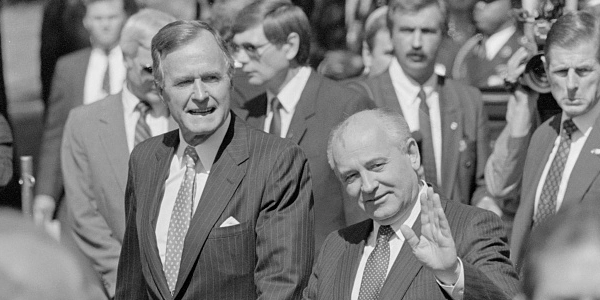
Now, his successor and former Vice President, George W. Bush, was taking up the mantel as President, and as the former head of the CIA, his stance was similiar to Reagan's; strong military, pressure on the Soviet Block, and negotiations with Gorbachev. The Soviet leader had been pushing their international relations in a conciliatory direction since 1985 when he became the youngest man to rise to General Secretary of the Communist Party through perestroika (restructuring economy) and glasnost (openness). There were a number of arms control agreements, including the 1987 treaty to cut nuclear arsenals, removing troops from Afghanistan, and, as we would learn over time, getting closer to China. That would not be a good thing. However, in 1990, the world thought China could be turned into a democracy by adding capitalism into the equation. Many state department officials thought that to be inevitable. Well, it has not happened yet.
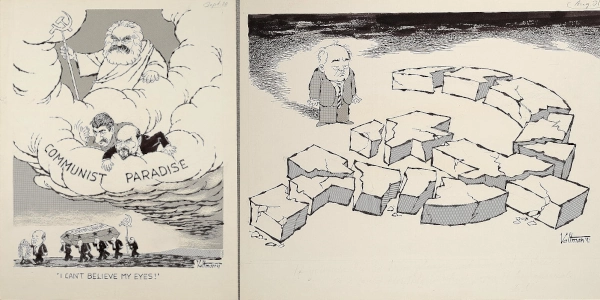
Despite Gorbachev's effort, by 1991, the Soviet economy continued to collapse and the Republics wanted independence.
Central Committee Gives Up Power
It had been seventy-two years, January 1918, since the Communist Party in the Soviet Union had come to power. Now they were ready to give it all up, after a three day plenum when more than fifty speakers within the party spoke ... for awhile. On Feburary 4, Mikhail Gorbachev asked the party to allow competition. One hundred thousand protesters crowded the street around the Kremlin demanding the change on February 5, leading up and during the plenum. On Feburary 7, 1990, the two hundred and forty-nine members of the Central Committee and seven hundred other political leaders from around the country, agreed to vie for office, including the Presidency, through a multi-party system. The only dissenting vote, Boris Yeltsin, who thought it was not radical enough. He would later become one of the Presidents, in June 1991. Article 6 of their Constitution would be changed from a guaranteed Communist Rule. It would be put up to a vote of the 28th Party Congress, Parliament, and the Congress of People's Deputies. In the end, it would be the most drastic of reforms by President Mikhail Gorbechev in his perestroika and glasnost programs.
"In any case, the president would be responsible before the people and would be elected by the people. ... The Communist Party of the Soviet Union like other social and political organizations and mass movements participates in running the country and its social affairs ... In nominating its candidates, the party does not assume full government authority. Its role is to be a political leader with no claim to any particular position in society encoded in the constitution," Vice President Anatoly Lukyanov.
"Article 6 will no longer be; there will be a multi-party system. There will be a normal democracy, ... fantastic," Svyatoslav Fyodorov.
Germany Reunites
On February 2, 1990, Prime Minister of East Germany, Hans Modrow, presented his plan for reuniting Germany, expressing interest in a neutral agreement. Eleven days later, with input from the two Germanys, the Soviet Union, The United States, France, and Great Britain, the preliminary document was completed. There was some consternation in the international press that a reunited Germany could become another world superpower, and that when they had been in the past, two World Wars had happened because of them. The remainder of Europe, as well as the United States and NATO, would be challenged with the task of keeping that in check. It is part of the reason why there is so much military presence in Germany of the United States military. The agreement would be followed by a democratic election in March 1990 in East Germany that brought about Lothar de Maiziére from the Christian Democratic Union as victor, along with a new People's Chamber. The socialists suffered a huge defeat. Lothar de Maiziére and West Germany's Helmut Kohl began negotations for a final agreement swiftly. In May 1990, the two plus four forum was held in Bonn. By July, there was a monetary union, with both nations to use the currency of the West German Federal Republic. A second meeting was held on June 22; a third on July 17. Gorbechev was involved in all phases, meeting with Kohl on July 14-17. On September 12, the fourth meeting of the two plus four occurred in Moscow. A concluding document was initialed. The final agreement would not only bring reunification of the two nations, but also serve as the final peace treaty of World War II, and ban Germany from holding nuclear weapons. A combined German Army could not exceed three hundred and seventy thousand soldiers.
Reunification would occur on October 3, 1990. By December, free elections of the all German state, the first since the Nazi takeover, would occur. It expanded Chancellor Kohl's majority. Later, Mikhail Gorbachev would win the Nobel Peace Prize.
Treaty on the Final Settlement with Respect to Germany (English)
Treaty on the Final Settlement with Respect to Germany, September 12, 1990
The Federal Republic of Germany, the German Democratic Republic, the French Republic, the Union of Soviet Socialist Republics, the United Kingdom of Great Britain
and Northern Ireland and the United States of America,
Conscious of the fact that their peoples have been living together in peace since 1945;
Mindful of the recent historic changes in Europe which make it possible to overcome the
division of the continent;
Having regard to the rights and responsibilities of the Four Powers relating to Berlin and
to Germany as a whole, and the corresponding wartime and post-war agreements and
decisions of the Four Powers;
Resolved, in accordance with their obligations under the Charter of the United Nations to
develop friendly relations among nations based on respect for the principle of equal rights
and self-determination of peoples, and to take other appropriate measures to strengthen
universal peace;
Recalling the principles of the Final Act of the Conference on Security and Cooperation
in Europe, signed in Helsinki;
Recognizing that those principles have laid firm foundations for the establishment of a
just and lasting peaceful order in Europe;
Determined to take account of everyone's security interests;
Convinced of the need finally to overcome antagonism and to develop cooperation in
Europe;
Confirming their readiness to reinforce security, in particular by adopting effective arms
control, disarmament and confidence-building measures; their willingness not to regard
each other as adversaries but to work for a relationship of trust and cooperation; and
accordingly their readiness to consider positively setting up appropriate institutional
arrangements within the framework of the Conference on Security and Cooperation in
Europe;
Welcoming the fact that the German people, freely exercising their right of selfdetermination, have expressed their will to bring about the unity of Germany as a state so
that they will be able to serve the peace of the world as an equal and sovereign partner in
a united Europe;
Convinced that the unification of Germany as a state with definitive borders is a
significant contribution to peace and stability in Europe;
Intending to conclude the final settlement with respect to Germany;
Recognizing that thereby, and with the unification of Germany as a democratic and
peaceful state, the rights and responsibilities of the Four Powers relating to Berlin and to
Germany as a whole lose their function;
Represented by their Ministers for Foreign Affairs who, in accordance with the Ottawa
Declaration of 13 February 1990, met in Bonn on 5 May 1990, in Berlin on 22 June 1990,
in Paris on 17 July 1990 with the participation of the Minister for Foreign Affairs of the
Republic of Poland, and in Moscow on 12 September 1990;
Have agreed as follows:
ARTICLE 1
(1) The united Germany shall comprise the territory of the Federal Republic of Germany,
the German Democratic Republic and the whole of Berlin. Its external borders shall be
the borders of the Federal Republic of Germany and the German Democratic Republic
and shall be definitive from the date on which the present Treaty comes into force. The
confirmation of the definitive nature of the borders of the united Germany is an essential
element of the peaceful order in Europe.
(2) The united Germany and the Republic of Poland shall confirm the existing border
between them in a treaty that is binding under international law.
(3) The united Germany has no territorial claims whatsoever against other states and shall
not assert any in the future.
(4) The Governments of the Federal Republic of Germany and the German Democratic
Republic shall ensure that the constitution of the united Germany does not contain any
provision incompatible with these principles. This applies accordingly to the provisions
laid down in the preamble, the second sentence of Article 23, and Article 146 of the Basic
Law for the Federal Republic of Germany.
(5) The Governments of the French Republic, the Union of Soviet Socialist Republics,
the United Kindgom of Great Britain and Northern Ireland and the United States of
America take formal note of the corresponding commitments and declarations by the
Governments of the Federal Republic of Germany and the German Democratic Republic
and declare that their implementation will confirm the definitive nature of the united
Germany's borders.
ARTICLE 2
The Governments of the Federal Republic of Germany and the German Democratic
Republic reaffirm their declarations that only peace will emanate from German soil.
According to the constitution of the united Germany, acts tending to and undertaken with
the intent to disturb the peaceful relations between nations, especially to prepare for
aggressive war, are unconstitutional and a punishable offence. The Governments of the
Federal Republic of Germany and the German Democratic Republic declare that the
united Germany will never employ any of its weapons except in accordance with its
constitution and the Charter of the United Nations.
ARTICLE 3
(1) The Governments of the Federal Republic of Germany and the German Democratic
Republic reaffirm their renunciation of the manufacture and possession of and control
over nuclear, biological and chemical weapons. They declare that the united Germany,
too, will abide by these commitments. In particular, rights and obligations arising from
the Treaty on the Non-Proliferation of Nuclear Weapons of 1 July 1968 will continue to
apply to the united Germany.
(2) The Government of the Federal Republic of Germany, acting in full agreement with
the Government of the German Democratic Republic, made the following statement on
30 August 1990 in Vienna at the Negotiations on Conventional Armed Forces in Europe:
The Government of the Federal Republic of Germany undertakes to reduce the personnel
strength of the armed forces of the united Germany to 370,000 (ground, air and naval
forces) within three to four years. This reduction will commence on the entry into force
of the first CFE agreement. Within the scope of this overall ceiling no more than 345,000
will belong to the ground and air forces which, pursuant to the agreed mandate, alone are
the subject to the Negotations on Conventional Armed Forces in Europe. The Federal
Government regards its commitment to reduce ground and air forces as a signficant
German contribution to the reduction of conventional armed forces in Europe. It assumes
that in follow-on negotiations the other participants in the negotiations, too, will render
their contribution to enhancing security and stability in Europe, including measures to
limit personnel strengths.
The Government of the German Democratic Republic has expressly associated itself with
this statement.
(3) The Governments of the French Republic, the Union of Soviet Socialist Republics,
the United Kingdom of Great Britain and Northern Ireland and the United States of
America take note of these statements by the Governments of the Federal Republic of
Germany and the German Democratic Republic.
ARTICLE 4
(1) The Governments of the Federal Republic of Germany, the German Democratic
Republic and the Union of Soviet Socialist Republics state that the united Germany and the Union of Soviet Socialist Republics will settle by treaty the conditions for and the
duration of the presence of Soviet armed forces on the territory of the present German
Democratic Republic and of Berlin, as well as the conduct of the withdrawal of these
armed forces which will be completed by the end of 1994, in connection with the
implementation of the undertaking of the Federal Republic of Germany and the German
Democratic Republic referred to in paragraph 2 of Article 3 of the present Treaty.
(2) The Governments of the French Republic, the United Kingdom of Great Britain and
Northern Ireland and the United States of America take note of this statement.
ARTICLE 5
(1) Until the completion of the withdrawal of the Soviet armed forces for the territory of
the present German Democratic Republic and of Berlin in accordance with Article 4 of
the present Treaty, only German territorial defence units which are not integrated into the
alliance structures to which German armed forces in the rest of German territory are
assigned will be stationed in that territory as armed forces of the united Germany. During
that period and subject to the provisions of paragraph 2 of this Article, armed forces of
other states will not be stationed in that territory or carry out any other military activity
there.
(2) For the duration of the presence of Soviet armed forces in the territory of the present
German Democratic Republic and of Berlin, armed forces of the French Republic, the
United Kingdom of Great Britain and Northern Ireland and the United States of America
will, upon German request, remain stationed in Berlin by agreement to this effect
between the Government of the united Germany and the Govenments of the states
concerned. The number of troops and the amount of equipment of all non-German armed
forces stationed in Berlin will not be greater than at the time of signature of the present
Treaty. New categories of weapons will not be introduced there by non-German armed
forces. The Government of the united Germany will conclude with the Governments of
those states which have armed forces stationed in Berlin treaties with conditions which
are fair taking account of the relations existing with the states concerned.
(3) Following the completion of the withdrawal of the Soviet armed forces from the
territory of the present German Democratic Republic and of Berlin, units of German
armed forces assigned to military alliance structures in the same way as those in the rest
of German territory may also be stationed in that part of Germany, but without nuclear
weapon carriers. This does not apply to conventional weapon systems which may have
other capabilities in addition to conventional ones but which in that part of Germany are
equipped for a conventional role and designated only for such. Foreign armed forces and
nuclear weapons or their carriers will not be stationed in that part of Germany or
deployed there.
ARTICLE 6
The right of the united Germany to belong to alliances, with all the rights and
responsibilities arising therefrom, shall not be affected by the present Treaty.
ARTICLE 7
(1) The French Republic, the Union of Soviet Socialist Republics, the United Kingdom of
Great Britain and Northern Ireland and the United States of America hereby terminate
their rights and responsibilities relating to Berlin and to Germany as a whole. As a result,
the corresponding, related quadripartite agreements, decisions and practices are
terminated and all related Four Power institutions are dissolved.
(2) The United Germany shall have accordingly full sovereignty over its internal and
external affairs.
ARTICLE 8
(1) The present Treaty is subject to ratification or acceptance as soon as possible. On the
German side it will be ratified by the united Germany. The Treaty will therefore apply to
the united Germany.
(2) The instruments of ratification or acceptance shall be deposited with the Government
of the united Germany. That Government shall inform the Governments of the other
Contracting Parties of the deposit of each instrument of ratification or acceptance.
ARTICLE 9
The present Treaty shall enter into force for the united Germany, the French Republic, the
Union of Soviet Socialist Republics, the United Kingdom of Great Britain and Northern
Ireland and the United States of America on the date of deposit of the last instrument of
ratification or acceptance by these states.
ARTICLE 10
The original of the present Treaty, of which the English, French, German and Russian
texts are equally authentic, shall be deposited with the Government of the Federal
Republic of Germany, which shall transmit certified true copies to the Governments of
the other Contracting Parties.
Photo above: Soviet Union and United States summit arrival ceremony with President H.W. Bush and Mikhail Gorbachev, May 31, 1990, Michael R. Jenkins. Courtesy Library of Congress. Below: Montage (left) Cartoon drawing about the collapse of the Soviet Union named, "I can't believe my eyes, with Lenin, Stalin, and Carl Marx looking down in disdain as Gorbachev led the funeral march for communism, September 20, 1991, Edmund S. Valtman. (Right) Cartoon drawing of Gorbachev staring at a shattered hammer and sickle, August 31, 1991, Edmund S. Valtman. Courtesy Library of Congress. Source: "Communists Drop Monopoly, Propose "Landmark" Presidential System," 1990, James Rosen, UPI; "Upheaval in the East," February 5, 1990, New York Times; "Gorbachev to Ask Party to Give Up Power, February 4, 1990, Los Angeles Times; "Soviets End 1 Party Monopoly," February 7, 1990, Deseret News; "Mikhael Gorbachev: Timeline of the Soviet Leaders Era and the Collapse of the USSR," 2022, Aisha Rimi, independent.co.uk; "German Reunification Case Study," Foothills College; Library of Congress; United Nations; Congress.gov; "American Foreign Policy Current Documents 1990. Department of State, Washington 1991; "Upheaval in the East: East Berlin Chief Presents His Plan to Unite Germany," 1990, New York Times; "February 13, 1990: Agreement is Reached on a Plan to Reunify Germany," 2015, Richard Kreitner and the Almanac, the Nation; Britannica.com; Wikipedia Commons.
History
Photo Bomb
President George H.W. Bush, Vice President Dan Quayle and
school children in conversation with astronauts at NASA. January 24, 1992. Photo: Photographic Office.
Official Souvenirs
America's Best History


Towers of the World Trade Center. Courtesy National Archives.
Timeline History

Want a copy of the Timeline. Now available in easy to search
digital format for your Kindle, Nook, or pdf format. Also comes in paperback, too.

Christopher Columbus, by Ridalfo Ghirlandaio, 1520. New U.S.
preserve, Salt River Bay, on land Columbus actually visited dedicated in the Virgin Islands. Courtesy Wikipedia Commons.
ABH Travel Tip

If you've never been there, or it's been awhile since you've taken a trip to Washington, D.C., the nation's capitol is a treat for anyone interested in the USA and its history. From the spectacular museums of the Smithsonian, to the recent addition of the Holocaust museum and the Newseum, too, there's so much to see and do. One of the best new attractions is the World War II Memorial. It will make you wonder what took them so long and just why there was any controversy about adding this museum to the space between the Washington Memorial and the Lincoln Memorial.
Now, his successor and former Vice President, George W. Bush, was taking up the mantel as President, and as the former head of the CIA, his stance was similiar to Reagan's; strong military, pressure on the Soviet Block, and negotiations with Gorbachev. The Soviet leader had been pushing their international relations in a conciliatory direction since 1985 when he became the youngest man to rise to General Secretary of the Communist Party through perestroika (restructuring economy) and glasnost (openness). There were a number of arms control agreements, including the 1987 treaty to cut nuclear arsenals, removing troops from Afghanistan, and, as we would learn over time, getting closer to China. That would not be a good thing. However, in 1990, the world thought China could be turned into a democracy by adding capitalism into the equation. Many state department officials thought that to be inevitable. Well, it has not happened yet.
Despite Gorbachev's effort, by 1991, the Soviet economy continued to collapse and the Republics wanted independence.
"Article 6 will no longer be; there will be a multi-party system. There will be a normal democracy, ... fantastic," Svyatoslav Fyodorov.
Reunification would occur on October 3, 1990. By December, free elections of the all German state, the first since the Nazi takeover, would occur. It expanded Chancellor Kohl's majority. Later, Mikhail Gorbachev would win the Nobel Peace Prize.
Treaty on the Final Settlement with Respect to Germany, September 12, 1990
The Federal Republic of Germany, the German Democratic Republic, the French Republic, the Union of Soviet Socialist Republics, the United Kingdom of Great Britain
and Northern Ireland and the United States of America,
Conscious of the fact that their peoples have been living together in peace since 1945;
Mindful of the recent historic changes in Europe which make it possible to overcome the
division of the continent;
Having regard to the rights and responsibilities of the Four Powers relating to Berlin and
to Germany as a whole, and the corresponding wartime and post-war agreements and
decisions of the Four Powers;
Resolved, in accordance with their obligations under the Charter of the United Nations to
develop friendly relations among nations based on respect for the principle of equal rights
and self-determination of peoples, and to take other appropriate measures to strengthen
universal peace;
Recalling the principles of the Final Act of the Conference on Security and Cooperation
in Europe, signed in Helsinki;
Recognizing that those principles have laid firm foundations for the establishment of a
just and lasting peaceful order in Europe;
Determined to take account of everyone's security interests;
Convinced of the need finally to overcome antagonism and to develop cooperation in
Europe;
Confirming their readiness to reinforce security, in particular by adopting effective arms
control, disarmament and confidence-building measures; their willingness not to regard
each other as adversaries but to work for a relationship of trust and cooperation; and
accordingly their readiness to consider positively setting up appropriate institutional
arrangements within the framework of the Conference on Security and Cooperation in
Europe;
Welcoming the fact that the German people, freely exercising their right of selfdetermination, have expressed their will to bring about the unity of Germany as a state so
that they will be able to serve the peace of the world as an equal and sovereign partner in
a united Europe;
Convinced that the unification of Germany as a state with definitive borders is a
significant contribution to peace and stability in Europe;
Intending to conclude the final settlement with respect to Germany;
Recognizing that thereby, and with the unification of Germany as a democratic and
peaceful state, the rights and responsibilities of the Four Powers relating to Berlin and to
Germany as a whole lose their function;
Represented by their Ministers for Foreign Affairs who, in accordance with the Ottawa
Declaration of 13 February 1990, met in Bonn on 5 May 1990, in Berlin on 22 June 1990,
in Paris on 17 July 1990 with the participation of the Minister for Foreign Affairs of the
Republic of Poland, and in Moscow on 12 September 1990;
Have agreed as follows:
ARTICLE 1
(1) The united Germany shall comprise the territory of the Federal Republic of Germany,
the German Democratic Republic and the whole of Berlin. Its external borders shall be
the borders of the Federal Republic of Germany and the German Democratic Republic
and shall be definitive from the date on which the present Treaty comes into force. The
confirmation of the definitive nature of the borders of the united Germany is an essential
element of the peaceful order in Europe.
(2) The united Germany and the Republic of Poland shall confirm the existing border
between them in a treaty that is binding under international law.
(3) The united Germany has no territorial claims whatsoever against other states and shall
not assert any in the future.
(4) The Governments of the Federal Republic of Germany and the German Democratic
Republic shall ensure that the constitution of the united Germany does not contain any
provision incompatible with these principles. This applies accordingly to the provisions
laid down in the preamble, the second sentence of Article 23, and Article 146 of the Basic
Law for the Federal Republic of Germany.
(5) The Governments of the French Republic, the Union of Soviet Socialist Republics,
the United Kindgom of Great Britain and Northern Ireland and the United States of
America take formal note of the corresponding commitments and declarations by the
Governments of the Federal Republic of Germany and the German Democratic Republic
and declare that their implementation will confirm the definitive nature of the united
Germany's borders.
ARTICLE 2
The Governments of the Federal Republic of Germany and the German Democratic
Republic reaffirm their declarations that only peace will emanate from German soil.
According to the constitution of the united Germany, acts tending to and undertaken with
the intent to disturb the peaceful relations between nations, especially to prepare for
aggressive war, are unconstitutional and a punishable offence. The Governments of the
Federal Republic of Germany and the German Democratic Republic declare that the
united Germany will never employ any of its weapons except in accordance with its
constitution and the Charter of the United Nations.
ARTICLE 3
(1) The Governments of the Federal Republic of Germany and the German Democratic
Republic reaffirm their renunciation of the manufacture and possession of and control
over nuclear, biological and chemical weapons. They declare that the united Germany,
too, will abide by these commitments. In particular, rights and obligations arising from
the Treaty on the Non-Proliferation of Nuclear Weapons of 1 July 1968 will continue to
apply to the united Germany.
(2) The Government of the Federal Republic of Germany, acting in full agreement with
the Government of the German Democratic Republic, made the following statement on
30 August 1990 in Vienna at the Negotiations on Conventional Armed Forces in Europe:
The Government of the Federal Republic of Germany undertakes to reduce the personnel
strength of the armed forces of the united Germany to 370,000 (ground, air and naval
forces) within three to four years. This reduction will commence on the entry into force
of the first CFE agreement. Within the scope of this overall ceiling no more than 345,000
will belong to the ground and air forces which, pursuant to the agreed mandate, alone are
the subject to the Negotations on Conventional Armed Forces in Europe. The Federal
Government regards its commitment to reduce ground and air forces as a signficant
German contribution to the reduction of conventional armed forces in Europe. It assumes
that in follow-on negotiations the other participants in the negotiations, too, will render
their contribution to enhancing security and stability in Europe, including measures to
limit personnel strengths.
The Government of the German Democratic Republic has expressly associated itself with
this statement.
(3) The Governments of the French Republic, the Union of Soviet Socialist Republics,
the United Kingdom of Great Britain and Northern Ireland and the United States of
America take note of these statements by the Governments of the Federal Republic of
Germany and the German Democratic Republic.
ARTICLE 4
(1) The Governments of the Federal Republic of Germany, the German Democratic
Republic and the Union of Soviet Socialist Republics state that the united Germany and the Union of Soviet Socialist Republics will settle by treaty the conditions for and the
duration of the presence of Soviet armed forces on the territory of the present German
Democratic Republic and of Berlin, as well as the conduct of the withdrawal of these
armed forces which will be completed by the end of 1994, in connection with the
implementation of the undertaking of the Federal Republic of Germany and the German
Democratic Republic referred to in paragraph 2 of Article 3 of the present Treaty.
(2) The Governments of the French Republic, the United Kingdom of Great Britain and
Northern Ireland and the United States of America take note of this statement.
ARTICLE 5
(1) Until the completion of the withdrawal of the Soviet armed forces for the territory of
the present German Democratic Republic and of Berlin in accordance with Article 4 of
the present Treaty, only German territorial defence units which are not integrated into the
alliance structures to which German armed forces in the rest of German territory are
assigned will be stationed in that territory as armed forces of the united Germany. During
that period and subject to the provisions of paragraph 2 of this Article, armed forces of
other states will not be stationed in that territory or carry out any other military activity
there.
(2) For the duration of the presence of Soviet armed forces in the territory of the present
German Democratic Republic and of Berlin, armed forces of the French Republic, the
United Kingdom of Great Britain and Northern Ireland and the United States of America
will, upon German request, remain stationed in Berlin by agreement to this effect
between the Government of the united Germany and the Govenments of the states
concerned. The number of troops and the amount of equipment of all non-German armed
forces stationed in Berlin will not be greater than at the time of signature of the present
Treaty. New categories of weapons will not be introduced there by non-German armed
forces. The Government of the united Germany will conclude with the Governments of
those states which have armed forces stationed in Berlin treaties with conditions which
are fair taking account of the relations existing with the states concerned.
(3) Following the completion of the withdrawal of the Soviet armed forces from the
territory of the present German Democratic Republic and of Berlin, units of German
armed forces assigned to military alliance structures in the same way as those in the rest
of German territory may also be stationed in that part of Germany, but without nuclear
weapon carriers. This does not apply to conventional weapon systems which may have
other capabilities in addition to conventional ones but which in that part of Germany are
equipped for a conventional role and designated only for such. Foreign armed forces and
nuclear weapons or their carriers will not be stationed in that part of Germany or
deployed there.
ARTICLE 6
The right of the united Germany to belong to alliances, with all the rights and
responsibilities arising therefrom, shall not be affected by the present Treaty.
ARTICLE 7
(1) The French Republic, the Union of Soviet Socialist Republics, the United Kingdom of
Great Britain and Northern Ireland and the United States of America hereby terminate
their rights and responsibilities relating to Berlin and to Germany as a whole. As a result,
the corresponding, related quadripartite agreements, decisions and practices are
terminated and all related Four Power institutions are dissolved.
(2) The United Germany shall have accordingly full sovereignty over its internal and
external affairs.
ARTICLE 8
(1) The present Treaty is subject to ratification or acceptance as soon as possible. On the
German side it will be ratified by the united Germany. The Treaty will therefore apply to
the united Germany.
(2) The instruments of ratification or acceptance shall be deposited with the Government
of the united Germany. That Government shall inform the Governments of the other
Contracting Parties of the deposit of each instrument of ratification or acceptance.
ARTICLE 9
The present Treaty shall enter into force for the united Germany, the French Republic, the
Union of Soviet Socialist Republics, the United Kingdom of Great Britain and Northern
Ireland and the United States of America on the date of deposit of the last instrument of
ratification or acceptance by these states.
ARTICLE 10
The original of the present Treaty, of which the English, French, German and Russian
texts are equally authentic, shall be deposited with the Government of the Federal
Republic of Germany, which shall transmit certified true copies to the Governments of
the other Contracting Parties.
Photo above: Soviet Union and United States summit arrival ceremony with President H.W. Bush and Mikhail Gorbachev, May 31, 1990, Michael R. Jenkins. Courtesy Library of Congress. Below: Montage (left) Cartoon drawing about the collapse of the Soviet Union named, "I can't believe my eyes, with Lenin, Stalin, and Carl Marx looking down in disdain as Gorbachev led the funeral march for communism, September 20, 1991, Edmund S. Valtman. (Right) Cartoon drawing of Gorbachev staring at a shattered hammer and sickle, August 31, 1991, Edmund S. Valtman. Courtesy Library of Congress. Source: "Communists Drop Monopoly, Propose "Landmark" Presidential System," 1990, James Rosen, UPI; "Upheaval in the East," February 5, 1990, New York Times; "Gorbachev to Ask Party to Give Up Power, February 4, 1990, Los Angeles Times; "Soviets End 1 Party Monopoly," February 7, 1990, Deseret News; "Mikhael Gorbachev: Timeline of the Soviet Leaders Era and the Collapse of the USSR," 2022, Aisha Rimi, independent.co.uk; "German Reunification Case Study," Foothills College; Library of Congress; United Nations; Congress.gov; "American Foreign Policy Current Documents 1990. Department of State, Washington 1991; "Upheaval in the East: East Berlin Chief Presents His Plan to Unite Germany," 1990, New York Times; "February 13, 1990: Agreement is Reached on a Plan to Reunify Germany," 2015, Richard Kreitner and the Almanac, the Nation; Britannica.com; Wikipedia Commons.
History Photo Bomb
President George H.W. Bush, Vice President Dan Quayle and
school children in conversation with astronauts at NASA. January 24, 1992. Photo: Photographic Office.
Official Souvenirs
America's Best History
Towers of the World Trade Center. Courtesy National Archives.
Timeline History
Want a copy of the Timeline. Now available in easy to search
digital format for your Kindle, Nook, or pdf format. Also comes in paperback, too.
Christopher Columbus, by Ridalfo Ghirlandaio, 1520. New U.S.
preserve, Salt River Bay, on land Columbus actually visited dedicated in the Virgin Islands. Courtesy Wikipedia Commons.
ABH Travel Tip
If you've never been there, or it's been awhile since you've taken a trip to Washington, D.C., the nation's capitol is a treat for anyone interested in the USA and its history. From the spectacular museums of the Smithsonian, to the recent addition of the Holocaust museum and the Newseum, too, there's so much to see and do. One of the best new attractions is the World War II Memorial. It will make you wonder what took them so long and just why there was any controversy about adding this museum to the space between the Washington Memorial and the Lincoln Memorial.