-
Timeline - The 1990s
A presidential scandal amidst prosperity and a world that is beginning to show signs of the conflicts to come with the first Gulf War and attacks in New York City.
More 1900s

President Clinton and Boris Yeltsin. Courtesy National Archives.
Sponsor this page. Your banner or text ad can fill the space above.
Click here to Sponsor the page and how to reserve your ad.
-
Timeline
1990 - Detail
August 2, 1990 - Iraq invades its neighbor, Kuwait, setting into motion the beginning of U.S. involvement in the Gulf War. Four days later, the United Nations begins a global trade embargo against Iraq. On November 29, the United Nations passes a resolution, #678, stating that Iraq must withdraw its forces from Kuwait by January 15, 1991 or face military intervention.
On the second day of August, Saddam Hussein sent his troops across the border into Kuwait and quickly took over the nation. They had not been prepared, somewhat because hussein and the Iraqi leadership had toned down their saberrattling in the month before, stating that they would not invade. However, this belied their anger in previous months accusing Kuwait of undercutting their oil prices with increased production deals, and that Iraq had always believed that Kuwait was not a real country, and should be back under the Persian, now Iraqi, state as a province. This stemmed from the 1961 dispute when Great Britain gave Kuwait its soverienty; Iraq thought it should have control as it had been part of the Ottoman province of Al-Basrah. Hussein intended to control Kuwait one way of the other, using that rationale, take their oil resources, and make himself richer and safer. However, he had miscalculated the anger that the remainder of the world community would have, almost complete unanimity between the United States and other U.N. Security Council members, including Russia. President George H.W. Bush, father Bush, with his experience in diplomacy, war, and the CIA, would lead the charge of putting the coalition together.
During the years before the invasion, 1980 to 1988, Iraq had been in a costly war with Iran. Their debts were mounting and unsustainable after the war ended and they were looking for quick ways to make up the deficit. One, of course, in this country of abundant oil riches, was the pump their way out, keeping the prices high. They also wanted their $37 billion dollars in loans to make war, held mainly by the United Arab Emirates and Kuwait, to be cancelled. Why per their rationale? Iraq had saved those countries from Iranian expansion. Both said no. The other Arab nations also had other plans for oil prices. Hussein accused them of overproducing the OPEC quotas.
Iraq saw advantage in their military prowess versus Kuwait's inferior forces. The dispute over the Warbah and Bubiyan Islands was a good excuse; Kuwait held them with their importance to the ports on the Khawr 'Abd Allah waterway. Iraq wanted them back. They also stated that Kuwait had been siphoning off oil with slant drilling into their Rumayla oil field. The Bush administration prior to the invasion had been attempting diplomacy, attempting to mollify Iraq that they had good relations and that staying out of a conflict was better economically for them. Iraq agreed, but they had lied.
At first, after the invasion, Bush and his allies would put in place sanctions, with the thought that they might or might not work. He chided Hussein, and told him in later speeches that if he did not leave Kuwait, there would be a war that Iraq could not win. American forces arrived in Saudi Arabia to protect the kingdom. The United Nations gave Hussein until January 15, 1991, to comply, leave Iraq, and recognize the border, or there would be war. On January 16, 1991, Operation Desert Storm began. Six hundred ninety-seven thousand United States troops overwhelmed the region with air power and ground troops. President George Herbert Walker Bush had been right. Iraq was no match for the United States and its forty coalition partners might. There were eighteen thousand air missions, one hundred and sixteen thousand air sorties, and more than eighty-eight thousand bombs dropped. The air attacks lasted six weeks; the ground assualt one hundred days. By February 28, 1991, the war was over.
Newspaper Report of the Invasion
Los Angeles Times, Diary of Victor Mallet
Present During Invasion August 2, 1990
Aug. 15, 1990 12 AM PT
FINANCIAL TIMES
Victor Mallett, a correspondent for the Financial Times in London, was in Kuwait city at the time of the Iraqi invasion Aug. 2 and kept a diary. He escaped Monday and filed this personal account.
Aug. 2--Iraq invades Kuwait before dawn, taking the population completely by surprise despite the collapse of negotiations between the two countries in Jidda the day before. People are still commuting to work in the city center hours after Iraq forces had crossed the border and taken the capital. I am among thousands of civilians caught in the fighting, and I am kept under guard out in the open by Iraq soldiers before being released. At first it seems that Kuwaiti troops have only fought back in the city center, particularly at the royal palaces of the ousted Sabah family, but the burned-out tanks and armored cars I saw later in Jahra area to the west show that there were battles outside the capital as well.
Kuwaitis are shocked and can hardly believe that their country has been overrun. Some of them assume that President Saddam Hussein of Iraq is simply making a show of force to extort money from Kuwait. Thousands of foreign workers from the Arab world, Asia and the West are also caught unawares and trapped in Kuwait. "It's chaos," said one British diplomat during the morning fighting. Later in the day a radio broadcast on an unfamiliar wavelength claims that the free provisional government has overthrown Sheik Jabbar, the emir, and invited the Iraqis. No one believes it, and those suspicions are later confirmed by Iraq’s annexation of Kuwait. Meanwhile, the Kuwaiti television airwaves are still in the hands of the old regime, and the television broadcasts an appeal for resistance by Sheik Saad, the crown prince. "They have come to kill the sons of Kuwait and its women," he says. "Our patriotic army is repelling the aggression. Kuwaitis should stand behind them." In fact, the army has all but fled, and the television is apparently broadcasting from a secret location, although isolated pockets of resistance will continue to trouble the Iraqis for several days to come.
Senior members of the ruling family have escaped to Saudi Arabia.
Aug. 3--Iraqi troops consolidate their hold on the country, but resistance continues and there is further fighting both at the emir’s Dasman Palace and at the military barracks near Shuwaikh. Near the conference center for the Gulf Cooperation Council, we see three shot-up Iraqi pickups which have evidently just been ambushed. Four corpses lie by the roadside. The Iraqis appear to have chosen the Sheraton Hotel as their headquarters, and they position tanks along the sea front next to Arabian Gulf Street. Residential areas are largely left alone. Baghdad Radio announces that the new government, declaring the Sabahs to be corrupt, has confiscated all their wealth, but there is still no indication as to who is in the new leadership. They later turn out to be Iraqis. Some shops, including the Sultan Centre supermarket, are open by the afternoon, and only milk and bread are in short supply. Queues form at petrol stations, and muezzin call the faithful to Friday prayers from the mosque minarets. Kuwaitis are still stunned by the Iraqi attack. "They cannot just do this, even if they oppose the Kuwaiti government," says one civil servant. "A country has its dignity." International telecommunications are cut in the evening, although telex lines to Saudi Arabia function intermittently until Saturday.
Aug. 4--The fiasco of the Iraqi-imposed government becomes more pronounced. Kuwaitis scoff at the fact that their supposed new leaders have not shown their faces and that the announcers of the new Iraqi-controlled TV station speak in Iraqi accents and do not know how to wear the ghutra-- the traditional Kuwaiti headdress. Even Kuwaitis with grievances against the royal family are now completely alienated by Iraq’s crude propaganda. "I think this is nonsense," says one Kuwaiti newspaper publisher. The first reports of looting--later to be confirmed--surface in Kuwait. Residents say the gold souk (market) has been ransacked, although it is not clear who did it. Civilians mount a resistance campaign in the Keifan district of the capital. The Iraqis, meanwhile, have opened prison gates, apparently taking away a group of Kuwaiti Shiite Muslims convicted of bombing Western embassies. For the first time there is an eyewitness report of Westerners being driven away in buses by the Iraqis. Frenzied shoppers continue to empty the shelves of the Sultan Centre. Tinned foods--except for quail's eggs--are running out, but cherries from the U.S. and cabbages from Holland are still available. I am astonished when the cashier accepts my credit card and gives me tickets for a lucky draw. Such is the unreality of war. The prize for the draw, a car, was later stolen. In the afternoon a helicopter circles around the Holiday Inn hotel where guests with nothing to do and nowhere to go sunbathe by the pool. Even after the fighting began, the hotel’s telex machine cheerfully and automatically answers back to desperate callers: "Welcome to a new age of elegance."
Aug. 5--Resistance continues. I and some colleagues have to stop our car and dive for cover as gunfire is exchanged across the main road. From where we lie in the dust, it seems that resistance forces are attacking a passing Iraqi convoy. Such ambushes seem to be common. Just beyond the shooting, an Iraqi soldier flags us down and asks, over-optimistically, for whiskey. Anti-Iraq graffiti is now widespread. Kuwaiti flags and pictures of Sheiks Jabbar and Saad are plastered over road signs and hung from bridges. The Holiday Inn, however, decides that discretion is the better part of valor and finally takes down the pictures of the two sheiks in the lobby.
Aug. 6-- Confusion reigns. Embassies--sometimes without telephones--are struggling to find out how many of their citizens are in the country during the summer holidays. Some embassies are having problems with their short-wave transmitters, which they use to keep in contact with their capitals. A 7 p.m. to 7 a.m. curfew has been declared, but many Kuwaitis ignore it.
Aug. 7--Refugees continue to head for the border with Saudi Arabia, but it is closed. We encounter a washing machine which has fallen off a vehicle in the middle lane of the highway to Al Salmy in the west. We are turned back by an Iraqi roadblock. More looting is reported in the city center, and there are reports that ration cards are being issued in some areas. The days are becoming quieter, but resistance fighters continue to snipe at the Iraqis by night. Soldiers at roadblocks are friendly. At least one reported rape is confirmed by diplomats. A resistance leaflet appears calling Saddam Hussein "The Hitler of the gulf."
Aug. 8--During the night, Kuwaitis have assembled on rooftops and shouted defiance at the Iraqis together with cries of "God is great!" They are encouraged by the belief that their demonstration will be seen by American spy satellites. I meet a resistance leader, a younger member of the Sabah family, who says: "We have a political and military undercover structure now. We are in contact with our leadership outside." He says the Iraqi soldiers have been fed lies about a supposed Israeli attack on Kuwait which they have come to beat back. The 38-year-old man, part of an amateurish but courageous anti-Iraqi network, says: :My place is in Kuwait. Saddam Hussein will leave, whether by force or voluntarily. It may be today, tomorrow or in a month's time, but he will leave." The resistance is urging people not to report to work and to ignore the Iraqi-controlled media. "We are not taking too many prisoners," says the resistance leader I meet.
Aug. 9--The Iraqis force shopkeepers to accept that one Iraqi dinar offered by a soldier is equivalent to one Kuwaiti dinar, although before the invasion one Kuwaiti dinar was worth 10 Iraqi dinars on the free market. The Iraqis are buying everything from cans of Pepsi to tea cups to take home to Iraq. The Iraqi army is beginning to dig in to defensive positions in Kuwait. The soldiers are filling sandbags or sitting under beach umbrellas and makeshift shelters in the heat of the day at their seaside bivouacs. Most of Kuwait's Egyptian population has come down firmly on the side of the West and the former Kuwaiti regime, but Palestinians are divided. Many of them resented the arrogance of Kuwaitis and their refusal to grant citizenship to Palestinians who had lived in the country all their lives. Palestinians also see Saddam Hussein as a strong leader who stands up for their rights against Israel and the rest of the world.
Aug. 10--Iraq has ordered embassies to move to Baghdad, further raising fears among foreigners about their protection. Travelers see large missiles--possibly Scud-Bs or upgraded Scuds--on the road to the south. Some residents have also seen face-masks and mobile equipment which appears to be for decontamination after a chemical attack. Foreigners are increasingly afraid of the possibility of chemical war, although the immediate horizon is clouded by the possibility that they may be used as hostages.
Aug. 11--Women demonstrate outside the Rumasiya Mosque. Four resistance fighters are said to have been killed in an attack upon Iraqi positions. Iraqi soldiers are becoming increasingly nervous and no longer sit relaxed by the roadside or in their vehicles.
Aug. 12--A Briton is reported to have been shot while trying to escape over the Saudi border. There are increasing reports of desertions and mutiny among the Iraqi troops. Most Iraqi tanks and heavy equipment have now left the city center and seem to be concentrated at Jahra, which gives easy access in all directions. A diplomat sees a group of Iraqi civilians being bused in for a pro-Iraqi demonstration which will later be shown on Iraqi television. The city is looking increasingly shabby, even if the damage from the fighting is not extensive. Damaged vehicles and garbage litter the once-immaculate streets.
Aug. 13--I escape with friends.
Minute Walk in History
President Bush Reaction To Invasion
Watch the response of President George H.W. Bush after the Iraqi invasion of Kuwait in Press Conferences and Speeches as he prepares for war to oust Saddam Hussein from Kuwait.
United Nations Security Council Resolution 678
Resolution 678 (1990) of 29 November 1990.
The Security Council, Recalling and reaffirming its resolutions 660 ( 1990) of
2 August 1990, 661 (1990) of 6 August 1990, 662 (1990)
of 9 August 1990, 664 (1990) of 18 August 1990, 665
(1990) of 25 August 1990, 666 (1990) of 13 September
1990, 667 (1990) of 16 September 1990, 669 (1990) of24
September 1990, 670 (1990) of 25 September 1990, 674
(1990) of29 October 1990 and 677 (1990) of 28 November
1990,
Noting that, despite all efforts by the United Nations,
Iraq refuses to comply with its obligation to implement
resolution 660 (1990) and the above-mentioned sub-
sequent relevant resolutions, in flagrant contempt of the
Security Council,
Mindful of its duties and responsibilities under the Char-
ter of the United Nations for the maintenance and preser-
vation of international peace and security,
Determined to secure full compliance with its decisions,
Acting under Chapter VII of the Charter,
1. Demands that Iraq comply fully with resolution 660
( 1990) and all subsequent relevant resolutions, and de-
cides, while maintaining all its decisions, to allow Iraq one
final opportunity, as a pause of goodwill, to do so;
2. Authorizes Member States co-operating with the
Government of Kuwait, unless Iraq on or before 15 January
1991 fully implements, as set forth in paragraph l above,
the above-mentioned resolutions, to use all necessary means to uphold and implement resolution 660 (1990) and
all subsequent relevant resolutions and to restore Interna-
tional peace and security in the area;
3. Requests all States to provide appropriate support
for the actions undertaken in pursuance of paragraph 2
above;
4. Requests the States concerned to keep the Security
Council regularly Informed on the progress of actions
undertaken pursuant to paragraphs 2 and 3 above;
S. Decides to remain seized of the matter.
Adopted at the 2963rd meeting by
12 votes to 2 (Cuba and Yemen),
with I abstention (China).
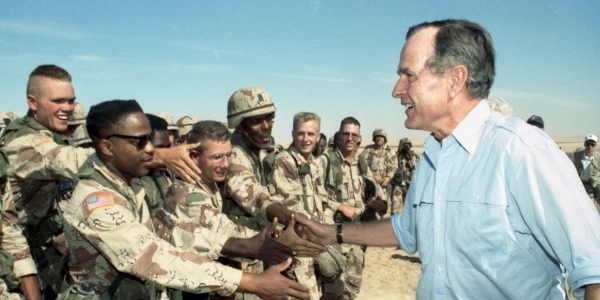
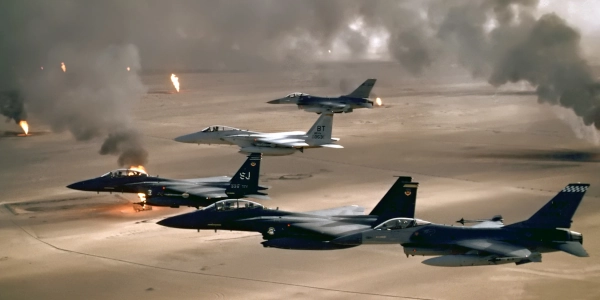
Photo above: President George H.W. Bush greets soldiers in Kuwait at beginning of Operation Desert Storm, 1990, U.S. Federal Government. Courtesy Bush Library via Wikipedia Commons. Below: Fighter jets fly over the burning oilfields of Kuwait, USAF F-16A F-15C F-15E, 1991, U.S. Air Force. Courtesy Wikipedia Commons. Source: "Where Duty Required Us to Stand," George H.W. Bush Presidential Library and Museum; "The Gulf War," U.S. Department of State, Office of the Historian; "Desert Storm, a Look Back," 2026, Shannon Collins, U.S. Department War; United Nations Digital Library; Los Angeles Times; Financial Times of London; Wikipedia Commons.
History
Photo Bomb
President George H.W. Bush, Vice President Dan Quayle and
school children in conversation with astronauts at NASA. January 24, 1992. Photo: Photographic Office.
Official Souvenirs
America's Best History


Towers of the World Trade Center. Courtesy National Archives.
Timeline History

Want a copy of the Timeline. Now available in easy to search
digital format for your Kindle, Nook, or pdf format. Also comes in paperback, too.

Christopher Columbus, by Ridalfo Ghirlandaio, 1520. New U.S.
preserve, Salt River Bay, on land Columbus actually visited dedicated in the Virgin Islands. Courtesy Wikipedia Commons.
ABH Travel Tip

If you've never been there, or it's been awhile since you've taken a trip to Washington, D.C., the nation's capitol is a treat for anyone interested in the USA and its history. From the spectacular museums of the Smithsonian, to the recent addition of the Holocaust museum and the Newseum, too, there's so much to see and do. One of the best new attractions is the World War II Memorial. It will make you wonder what took them so long and just why there was any controversy about adding this museum to the space between the Washington Memorial and the Lincoln Memorial.
During the years before the invasion, 1980 to 1988, Iraq had been in a costly war with Iran. Their debts were mounting and unsustainable after the war ended and they were looking for quick ways to make up the deficit. One, of course, in this country of abundant oil riches, was the pump their way out, keeping the prices high. They also wanted their $37 billion dollars in loans to make war, held mainly by the United Arab Emirates and Kuwait, to be cancelled. Why per their rationale? Iraq had saved those countries from Iranian expansion. Both said no. The other Arab nations also had other plans for oil prices. Hussein accused them of overproducing the OPEC quotas.
Iraq saw advantage in their military prowess versus Kuwait's inferior forces. The dispute over the Warbah and Bubiyan Islands was a good excuse; Kuwait held them with their importance to the ports on the Khawr 'Abd Allah waterway. Iraq wanted them back. They also stated that Kuwait had been siphoning off oil with slant drilling into their Rumayla oil field. The Bush administration prior to the invasion had been attempting diplomacy, attempting to mollify Iraq that they had good relations and that staying out of a conflict was better economically for them. Iraq agreed, but they had lied.
At first, after the invasion, Bush and his allies would put in place sanctions, with the thought that they might or might not work. He chided Hussein, and told him in later speeches that if he did not leave Kuwait, there would be a war that Iraq could not win. American forces arrived in Saudi Arabia to protect the kingdom. The United Nations gave Hussein until January 15, 1991, to comply, leave Iraq, and recognize the border, or there would be war. On January 16, 1991, Operation Desert Storm began. Six hundred ninety-seven thousand United States troops overwhelmed the region with air power and ground troops. President George Herbert Walker Bush had been right. Iraq was no match for the United States and its forty coalition partners might. There were eighteen thousand air missions, one hundred and sixteen thousand air sorties, and more than eighty-eight thousand bombs dropped. The air attacks lasted six weeks; the ground assualt one hundred days. By February 28, 1991, the war was over.
Los Angeles Times, Diary of Victor Mallet
Present During Invasion August 2, 1990
FINANCIAL TIMES
Victor Mallett, a correspondent for the Financial Times in London, was in Kuwait city at the time of the Iraqi invasion Aug. 2 and kept a diary. He escaped Monday and filed this personal account.
Aug. 2--Iraq invades Kuwait before dawn, taking the population completely by surprise despite the collapse of negotiations between the two countries in Jidda the day before. People are still commuting to work in the city center hours after Iraq forces had crossed the border and taken the capital. I am among thousands of civilians caught in the fighting, and I am kept under guard out in the open by Iraq soldiers before being released. At first it seems that Kuwaiti troops have only fought back in the city center, particularly at the royal palaces of the ousted Sabah family, but the burned-out tanks and armored cars I saw later in Jahra area to the west show that there were battles outside the capital as well.
Kuwaitis are shocked and can hardly believe that their country has been overrun. Some of them assume that President Saddam Hussein of Iraq is simply making a show of force to extort money from Kuwait. Thousands of foreign workers from the Arab world, Asia and the West are also caught unawares and trapped in Kuwait. "It's chaos," said one British diplomat during the morning fighting. Later in the day a radio broadcast on an unfamiliar wavelength claims that the free provisional government has overthrown Sheik Jabbar, the emir, and invited the Iraqis. No one believes it, and those suspicions are later confirmed by Iraq’s annexation of Kuwait. Meanwhile, the Kuwaiti television airwaves are still in the hands of the old regime, and the television broadcasts an appeal for resistance by Sheik Saad, the crown prince. "They have come to kill the sons of Kuwait and its women," he says. "Our patriotic army is repelling the aggression. Kuwaitis should stand behind them." In fact, the army has all but fled, and the television is apparently broadcasting from a secret location, although isolated pockets of resistance will continue to trouble the Iraqis for several days to come.
Senior members of the ruling family have escaped to Saudi Arabia.
Aug. 3--Iraqi troops consolidate their hold on the country, but resistance continues and there is further fighting both at the emir’s Dasman Palace and at the military barracks near Shuwaikh. Near the conference center for the Gulf Cooperation Council, we see three shot-up Iraqi pickups which have evidently just been ambushed. Four corpses lie by the roadside. The Iraqis appear to have chosen the Sheraton Hotel as their headquarters, and they position tanks along the sea front next to Arabian Gulf Street. Residential areas are largely left alone. Baghdad Radio announces that the new government, declaring the Sabahs to be corrupt, has confiscated all their wealth, but there is still no indication as to who is in the new leadership. They later turn out to be Iraqis. Some shops, including the Sultan Centre supermarket, are open by the afternoon, and only milk and bread are in short supply. Queues form at petrol stations, and muezzin call the faithful to Friday prayers from the mosque minarets. Kuwaitis are still stunned by the Iraqi attack. "They cannot just do this, even if they oppose the Kuwaiti government," says one civil servant. "A country has its dignity." International telecommunications are cut in the evening, although telex lines to Saudi Arabia function intermittently until Saturday.
Aug. 4--The fiasco of the Iraqi-imposed government becomes more pronounced. Kuwaitis scoff at the fact that their supposed new leaders have not shown their faces and that the announcers of the new Iraqi-controlled TV station speak in Iraqi accents and do not know how to wear the ghutra-- the traditional Kuwaiti headdress. Even Kuwaitis with grievances against the royal family are now completely alienated by Iraq’s crude propaganda. "I think this is nonsense," says one Kuwaiti newspaper publisher. The first reports of looting--later to be confirmed--surface in Kuwait. Residents say the gold souk (market) has been ransacked, although it is not clear who did it. Civilians mount a resistance campaign in the Keifan district of the capital. The Iraqis, meanwhile, have opened prison gates, apparently taking away a group of Kuwaiti Shiite Muslims convicted of bombing Western embassies. For the first time there is an eyewitness report of Westerners being driven away in buses by the Iraqis. Frenzied shoppers continue to empty the shelves of the Sultan Centre. Tinned foods--except for quail's eggs--are running out, but cherries from the U.S. and cabbages from Holland are still available. I am astonished when the cashier accepts my credit card and gives me tickets for a lucky draw. Such is the unreality of war. The prize for the draw, a car, was later stolen. In the afternoon a helicopter circles around the Holiday Inn hotel where guests with nothing to do and nowhere to go sunbathe by the pool. Even after the fighting began, the hotel’s telex machine cheerfully and automatically answers back to desperate callers: "Welcome to a new age of elegance."
Aug. 5--Resistance continues. I and some colleagues have to stop our car and dive for cover as gunfire is exchanged across the main road. From where we lie in the dust, it seems that resistance forces are attacking a passing Iraqi convoy. Such ambushes seem to be common. Just beyond the shooting, an Iraqi soldier flags us down and asks, over-optimistically, for whiskey. Anti-Iraq graffiti is now widespread. Kuwaiti flags and pictures of Sheiks Jabbar and Saad are plastered over road signs and hung from bridges. The Holiday Inn, however, decides that discretion is the better part of valor and finally takes down the pictures of the two sheiks in the lobby.
Aug. 6-- Confusion reigns. Embassies--sometimes without telephones--are struggling to find out how many of their citizens are in the country during the summer holidays. Some embassies are having problems with their short-wave transmitters, which they use to keep in contact with their capitals. A 7 p.m. to 7 a.m. curfew has been declared, but many Kuwaitis ignore it.
Aug. 7--Refugees continue to head for the border with Saudi Arabia, but it is closed. We encounter a washing machine which has fallen off a vehicle in the middle lane of the highway to Al Salmy in the west. We are turned back by an Iraqi roadblock. More looting is reported in the city center, and there are reports that ration cards are being issued in some areas. The days are becoming quieter, but resistance fighters continue to snipe at the Iraqis by night. Soldiers at roadblocks are friendly. At least one reported rape is confirmed by diplomats. A resistance leaflet appears calling Saddam Hussein "The Hitler of the gulf."
Aug. 8--During the night, Kuwaitis have assembled on rooftops and shouted defiance at the Iraqis together with cries of "God is great!" They are encouraged by the belief that their demonstration will be seen by American spy satellites. I meet a resistance leader, a younger member of the Sabah family, who says: "We have a political and military undercover structure now. We are in contact with our leadership outside." He says the Iraqi soldiers have been fed lies about a supposed Israeli attack on Kuwait which they have come to beat back. The 38-year-old man, part of an amateurish but courageous anti-Iraqi network, says: :My place is in Kuwait. Saddam Hussein will leave, whether by force or voluntarily. It may be today, tomorrow or in a month's time, but he will leave." The resistance is urging people not to report to work and to ignore the Iraqi-controlled media. "We are not taking too many prisoners," says the resistance leader I meet.
Aug. 9--The Iraqis force shopkeepers to accept that one Iraqi dinar offered by a soldier is equivalent to one Kuwaiti dinar, although before the invasion one Kuwaiti dinar was worth 10 Iraqi dinars on the free market. The Iraqis are buying everything from cans of Pepsi to tea cups to take home to Iraq. The Iraqi army is beginning to dig in to defensive positions in Kuwait. The soldiers are filling sandbags or sitting under beach umbrellas and makeshift shelters in the heat of the day at their seaside bivouacs. Most of Kuwait's Egyptian population has come down firmly on the side of the West and the former Kuwaiti regime, but Palestinians are divided. Many of them resented the arrogance of Kuwaitis and their refusal to grant citizenship to Palestinians who had lived in the country all their lives. Palestinians also see Saddam Hussein as a strong leader who stands up for their rights against Israel and the rest of the world.
Aug. 10--Iraq has ordered embassies to move to Baghdad, further raising fears among foreigners about their protection. Travelers see large missiles--possibly Scud-Bs or upgraded Scuds--on the road to the south. Some residents have also seen face-masks and mobile equipment which appears to be for decontamination after a chemical attack. Foreigners are increasingly afraid of the possibility of chemical war, although the immediate horizon is clouded by the possibility that they may be used as hostages.
Aug. 11--Women demonstrate outside the Rumasiya Mosque. Four resistance fighters are said to have been killed in an attack upon Iraqi positions. Iraqi soldiers are becoming increasingly nervous and no longer sit relaxed by the roadside or in their vehicles.
Aug. 12--A Briton is reported to have been shot while trying to escape over the Saudi border. There are increasing reports of desertions and mutiny among the Iraqi troops. Most Iraqi tanks and heavy equipment have now left the city center and seem to be concentrated at Jahra, which gives easy access in all directions. A diplomat sees a group of Iraqi civilians being bused in for a pro-Iraqi demonstration which will later be shown on Iraqi television. The city is looking increasingly shabby, even if the damage from the fighting is not extensive. Damaged vehicles and garbage litter the once-immaculate streets.
Aug. 13--I escape with friends.
Minute Walk in History
President Bush Reaction To Invasion
The Security Council, Recalling and reaffirming its resolutions 660 ( 1990) of 2 August 1990, 661 (1990) of 6 August 1990, 662 (1990) of 9 August 1990, 664 (1990) of 18 August 1990, 665 (1990) of 25 August 1990, 666 (1990) of 13 September 1990, 667 (1990) of 16 September 1990, 669 (1990) of24 September 1990, 670 (1990) of 25 September 1990, 674 (1990) of29 October 1990 and 677 (1990) of 28 November 1990,
Noting that, despite all efforts by the United Nations, Iraq refuses to comply with its obligation to implement resolution 660 (1990) and the above-mentioned sub- sequent relevant resolutions, in flagrant contempt of the Security Council,
Mindful of its duties and responsibilities under the Char- ter of the United Nations for the maintenance and preser- vation of international peace and security, Determined to secure full compliance with its decisions, Acting under Chapter VII of the Charter,
1. Demands that Iraq comply fully with resolution 660 ( 1990) and all subsequent relevant resolutions, and de- cides, while maintaining all its decisions, to allow Iraq one final opportunity, as a pause of goodwill, to do so;
2. Authorizes Member States co-operating with the Government of Kuwait, unless Iraq on or before 15 January 1991 fully implements, as set forth in paragraph l above, the above-mentioned resolutions, to use all necessary means to uphold and implement resolution 660 (1990) and all subsequent relevant resolutions and to restore Interna- tional peace and security in the area;
3. Requests all States to provide appropriate support for the actions undertaken in pursuance of paragraph 2 above;
4. Requests the States concerned to keep the Security Council regularly Informed on the progress of actions undertaken pursuant to paragraphs 2 and 3 above; S. Decides to remain seized of the matter.
Adopted at the 2963rd meeting by 12 votes to 2 (Cuba and Yemen), with I abstention (China).
Photo above: President George H.W. Bush greets soldiers in Kuwait at beginning of Operation Desert Storm, 1990, U.S. Federal Government. Courtesy Bush Library via Wikipedia Commons. Below: Fighter jets fly over the burning oilfields of Kuwait, USAF F-16A F-15C F-15E, 1991, U.S. Air Force. Courtesy Wikipedia Commons. Source: "Where Duty Required Us to Stand," George H.W. Bush Presidential Library and Museum; "The Gulf War," U.S. Department of State, Office of the Historian; "Desert Storm, a Look Back," 2026, Shannon Collins, U.S. Department War; United Nations Digital Library; Los Angeles Times; Financial Times of London; Wikipedia Commons.
History Photo Bomb
President George H.W. Bush, Vice President Dan Quayle and
school children in conversation with astronauts at NASA. January 24, 1992. Photo: Photographic Office.
Official Souvenirs
America's Best History
Towers of the World Trade Center. Courtesy National Archives.
Timeline History
Want a copy of the Timeline. Now available in easy to search
digital format for your Kindle, Nook, or pdf format. Also comes in paperback, too.
Christopher Columbus, by Ridalfo Ghirlandaio, 1520. New U.S.
preserve, Salt River Bay, on land Columbus actually visited dedicated in the Virgin Islands. Courtesy Wikipedia Commons.
ABH Travel Tip
If you've never been there, or it's been awhile since you've taken a trip to Washington, D.C., the nation's capitol is a treat for anyone interested in the USA and its history. From the spectacular museums of the Smithsonian, to the recent addition of the Holocaust museum and the Newseum, too, there's so much to see and do. One of the best new attractions is the World War II Memorial. It will make you wonder what took them so long and just why there was any controversy about adding this museum to the space between the Washington Memorial and the Lincoln Memorial.