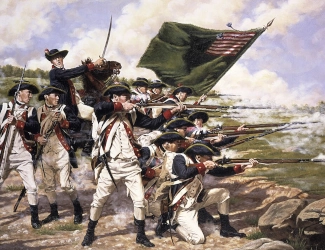
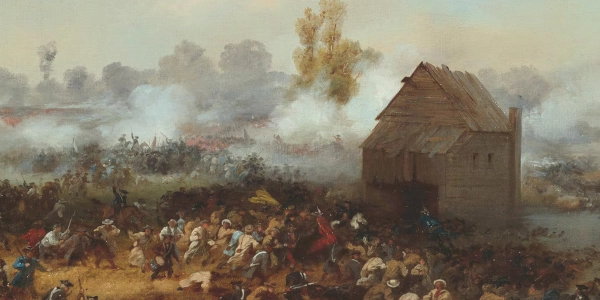
Image above: Painting of the Delaware Regiment at the Battle of Long Island, 2004, Domenick D'Andrea, National Guide Bureau. Courtesy Wikipedia Commons.
Spotlight on Lesser Known History
Battle of Long Island, New York
America's Best History Spotlight
On this page we're going to Spotlight the lesser known historic sites and attractions that dot the history landscape across the USA and are worth a visit if you're in their area. And while they may be lesser known, some are very unique, and will be that rare find. You'll be, at times, on the ground floor, or maybe even know something others don't. It'll be fun. Visit them.
Battle of Long Island, New York
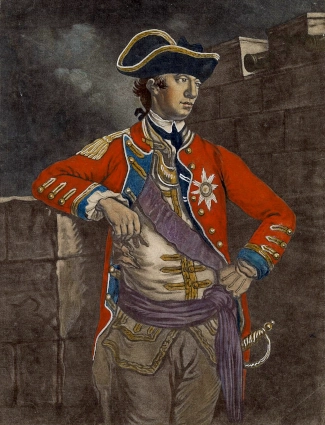
The Revolutionary War was in its second year, and there had been few victories for Washington's Continental Army after success around Boston. This New York battle on Long Island, and sometimes known as the Battle of Brooklyn, would not turn his fortunes. General Washington had guessed right that the next target of the British would be New York. So in March 1776, he began marching the nineteen thousand Continental soldiers into Gotham City. Washington fortified defenses there, including the construction of new forts in Brooklyn Heights and north Manhattan. The British appeared in late June and early July with four hundred ships and thirty-two thousand men off Staten Island. They were commanded by British General William Howe. Once Washington made it clear that he would not surrender, even with pardons offered, he made prepartions for the attack, thinking it possible the attack could come in Manhattan or Brooklyn. The subsequent battle would be the first major engagement after the signing of the Declaration of Independence.
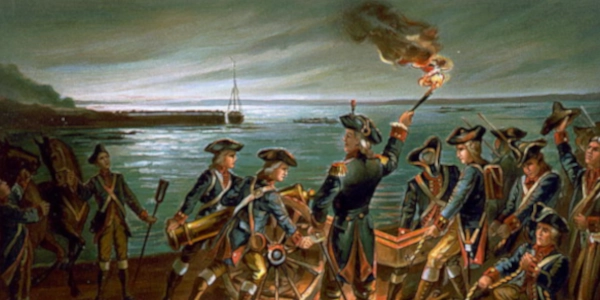
Image above: Continental Army retreat from Long Island, 1899, Werner Company. Courtesy Library of Congress.
Sponsor this page. Your banner or text ad can fill the space above.
Click here to Sponsor the page and how to reserve your ad.
Info, What's There Now, History Nearby
Battle of Long Island, New York
In preparation, Washington had positioned General Lord Stirling southwest on the hills of Guan, General John Sullivan to the south, and General Israel Putnam in Brooklyn Heights. This positioning led to his first mistake, the passage from the east at Jamaica was unguarded. On August 26, the British sent ten thousand men through it, with intent to attack Brooklyn Heights from the rear. Washington had expected an attack from the water, like had been done at Bunker Hill. British General Leopold Philip Von Heister would attack Sullivan's troops with his Hessians (the bloodiest fighting would occur against them on Battle Hill); against Stirling would be the troops of General James Grant. Essentially, the Continental Army had two lines; on Guan Hill to the south and at Brooklyn Heights to the north. Early the next morning, Continental Army pickets were fired upon at Red Lion Tavern in Brooklyn. The battle had begun.
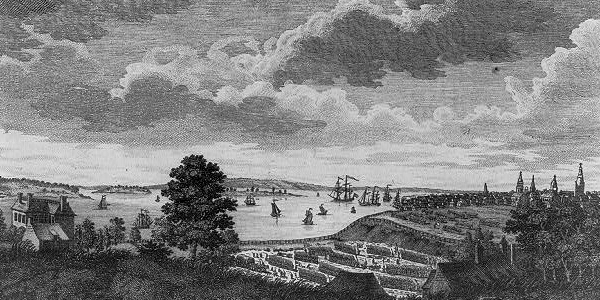
Image above: Panoramic view of the Battle of Long Island with New York, Governors Island, and River, 1768, engraving by P. Canot, 1776, illustration, A. Hamilton, Jr. Courtesy Library of Congress. Below: General Stirling and Maryland troops (known as the Marland 400, of which 250 were killed) in the Battle of Long Island at Brouwer's Mill, 1858, Alonzo Chappel. Courtesy Wikipedia Commons.
Where Is It
The various sites that you can still visit are located throughout Brooklyn and Long Island. See the websites of the sites below for addresses and directions.
What is There Now
Battle of Long Island, New York
Unfortunately not much, as the borough of Brooklyn grew over many of the fields of battle. However, some places remain with vistas and signs. A driving tour to the remaining sites is a must for any true New York history or American Revolution history fan. The Old Stone House, Prospect Park (designed by Frederick Law Olmstead and Calvert Vaux of Central Park fame) with the Dongan Oak Monument, Green-Wood Cemetary then known as Battle Hill with the statue of Minerva, and Fort Greene Park, site of the Prison Ship Martyrs Monument honoring those who died after capture in the battle on British ships in the harbor. Eleven thousand five hundred men and women from the Revolutionary War are buried beneath the monument.
When Open and How Much
Variety of sites open at different times. Most sites do not require a fee.
Fees and hours are subject to change.
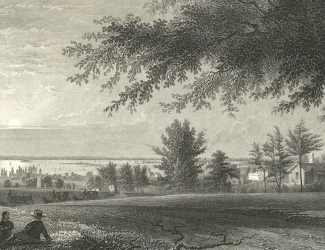
Photo above: View from Battle Hill, one of few Continental Army's successful attacks at the Battle of Long Island, date unknown, James Smillie. Courtesy Wikipedia Commons.
Websites
Old Stone House
Prospect Park
Fort Greene Park
Green-Wood Cemetary
History Nearby
The history nearby in New York City and Brooklyn includes sites of the American Revolution, the Harbor, and other interesting historic sites.
Photos, History, and More Spotlights
The Battle Itself
At the moment of the first shots, General Washington was still in Manhattan. He crossed the East River and watched the action from Cobble Hill. The sight was aweful. Sullivan's troops fought hard, but the Redcoats coming through Jamaica Pass caused him to retreat to Brooklyn Heights. General William Alexander, i.e. Lord Stirling and his forces fought for several hours at the Old Stone House against the troops of General Charles Cornwallis before he ordered their retreat; he himself was captured however. It had been an impossible situation after Washington's initial mistake; they were fighting with their backs to the East River against a foe twice their size.
By early afternoon, British General Howe ordered the fighting to stop and his men to dig trenches surrounding the Continentals. Washington ordered a complete withdrawal to Manhattan through August 29 before Howe could attack again. They were penned in at Brooklyn Heights, the river still behind them. Nine thousand soldiers crossed the East River in the retreat; Washington went last, and they were lucky to make it due to the fog. No lives were lost during the retreat. Approximately ten thousand Americans had been engaged versus twenty thousand troops from Great Britain. Casualties (killed, wounded, and missing) numbered two thousand Continentals; three hundred and eighty-eight British and allies.
Other battles sites include Gravesend Bay and Fulton Ferry Landing.
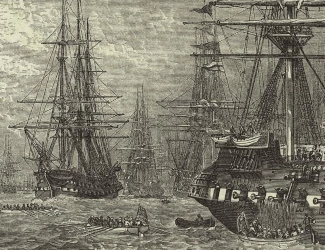
Photo above: Drawing of British warships assembling off Staten Island for the Battle of Long Island, 1876, Harper's Weekly. Courtesy Wikipedia Commons.
T-Shirts and Souvenirs

America's Best History T-Shirts, Sweatshirts, Backpacks, and other Souvenirs from the official gear of americasbesthistory.com.
General Washington Quotes About the Battle
"I am determined to defend this city as long as I can," prior to the Battle of Long Island.
"Those who have committed no fault want no pardon," April/May 1776 when British General Howe asked for their surrender.
"The time is now near at hand which must probably determine whether Americans are to be freemen or slaves; whether they are to have any property they can call their own; whether their houses and farms are to be pillaged and destroyed, and themselves consigned to a state of wretchedness from which no human efforts will deliver them. The fate of unborn millions will now depend under God, on the courage and conduct of this army. Our cruel and unrelenting enemy leaves us only the choice of brave resistance, or the most abject submission. We have, therefore, to resolve to conquer or die," July 2, 1776, on the same day the British landed their troops on Staten Island.
"Sir: Since closing the letter which I had the honor to write you this Morning, two deserters have come in, who left the Solebay Man of War last Evening. ー one of them is a Native of New York. Their Account is that they were in the Engagement with Col. Moultrie at Sullivan's Island on the 9th. July [sic]; the particulars they give nearly correspond with the narrative sent by General Lee; that they left Carolina 3 Weeks ago as a Convoy to 45 transports, having on board General Clinton, Lord [Charles] Cornwallis and the whole Southern Army, consisting of about 3000 Men, all of whom were landed last week on Staten Island, in tolerable Health.
That on Sunday 13 Transports part of [Richard; Note: Brother of William] Howe's fleet and having on board Hessians and Highlanders, came to Staten Island: that the remainder of the Fleet which was reported to have in the whole 12000 Men; had parted with these Troops off the Banks of Newfoundland and were expected to come in every moment; that they were getting their heavy Carriages and Cannon on board; had launched 8 Gondolas with flat Bottoms, and 2 Rafts on Stages to carry Cannon. These men understand that the attack will soon be made, if the other Troops arrive; That they give out they will lay the Jerseys waste with Fire and Sword. The computed Strength of their Army will be 30,000 Men. They further add, that when they left Carolina one Transport got on Shore, so that they were not able to give her relief, upon which she surrendered with 5 Companies of Highlanders to General Lee, who after taking every thing valuable out of her brunt her, That the Admiral turned General Clinton out of his Ship after the Engagement, with a great deal of abuse; great differences between the Principal Naval and Military Gentlemen; that, the Ships left in Carolina, are now in such a Weakly distressed condition they would fall an easy Prey. I am, etc.
P.S: The Ships are changing their position, and the Men of War forming into a Line but I still think they will wait the arrival of the remaining Hessians before any general attack will be made. Monday's return will shew our strength here," August 7, 1776.
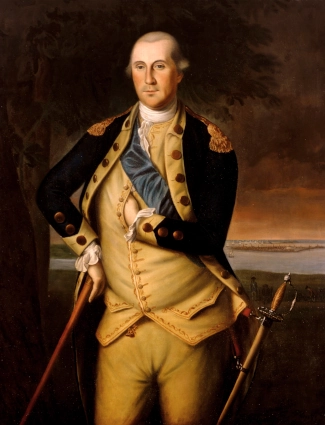
Image above: General George Washington, 1776, Charles Willson Peale, White House Historical Association. Courtesy Wikipedia Commons.
More Quotes
"Good God, what brave fellows I must lose," August 27, 1776, General Washington upon sighting the battle from Cobble Hill.
"It is a melancholy truth that we are not yet prepared for a regular and vigorous prosecution of the war," Washington after the Battle of Long Island.
Images above: British General William Howe, 1777, Richard Purcell aka Charles Corbutt. Courtesy Anne S.K. Brown Military History Collection at Brown University via Wikipedia Commons.
Buy Second Edition
America's Best History Timeline

Great book to keep middle school to college students up to date on their American history.
May Spotlight
Battle of Nashville, Tennessee
April Spotlight
Fort Davis, Texas