-
Barbary Coast/San Francisco
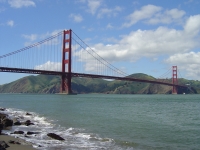
Golden Gate Bridge at the northern entrance across San Francisco Bay.
Associate Pages
-
Visitor Statistics
Golden Gate National Recreation Area
San Francisco National Parks
14,953,882 Visitors
#2 Most Visited National Park Unit
San Francisco Maritime National Historic Park
1,769,467 Visitors
#50 Most Visited
Fort Point National Historic Site
903,685 Visitors - #83 Most Visited
Source: NPS 2023 NPU (National Park Unit). Rankings among 393 National Park Units.
Park Size
Golden Gate National Recreation Area
30,829 acres (Federal Acres); 74,588 (Total)
San Francisco Maritime National Historic Park
28 acres (Federal Acres); 50 (Total)
Fort Point National Historic Site
29 acres (Federal/Total Acres)
Historic Site Fees
Golden Gate National Recreation Area
Alacatraz - $various, depending on tour chosen, from $38.00 adult/junior, $23.25 child 5-11, $35.75 over 62, $114.75 family of four.
Muir Woods National Monument - $10.00 16 years old and up, under Free.
Other Golden Gate NRA Sites - Free.
San Francisco Maritime National Historic Park
Adults (16 plus) - $10 for 7 days.
Children - Free
Fort Point National Historic Site
Free (Open F-Sa-Su)
Fees subject to change without notice.
Weather
Summer - Average high temperatures are cool, typically ranging from 60-75 degrees.
Winter - Temperate high temperatures are typical, from 50-60 degrees, but can fall to freezing at night. Winter is the rainy season in San Francisco.

San Francisco and the Barbary Coast
For some, and for some reason, most people tend to eliminate San Francisco and Northern California from their minds when they think of historic attractions. Oh, it is there somewhere, in the backs of their minds, when the city by the bay comes into focus, but it sits far back, beyond the visions of the city on the hill with cable cars plying the streets and romantic ballads sung about it, with seals on rocks and long ago Treasure Islands in the bay. But it is the history of San Francisco, the Barbary Coast, and the surrounding area that it spawned, from Sutter's Mill to the east and those 49ers looking for gold in the hills and a good time in Barbary Coast establishments where their money would be spent, or islands of world's fair exhibits that mesmerized a nation on the brink of world war, that made this all possible.
Click here to Sponsor the page and how to reserve your ad.

San Francisco Then
From the days of the Barbary Coast and Clipper Ships that had to round the Cape to navigate to California, to the gold rushes that began just east of the city and served as the ribald hub of the trade, the San Francisco Bay area was replete with a history of the western coast of the United States that did not pale in comparison to any other location. It was the gateway for the entire coast, all the way to Washington, and later Alaska. It was the transitional city, in so many ways, from a Spanish culture beget by their arrival in 1769 and the missions that dotted the California coast and inlands. That led to the claim by the United States that it owned the city on January 30, 1847 during the Mexican-American War, which was followed little more than one year later by the wild west of desperate miners trying to cash in on their fortune and to the world that would beat down its doors with immigrants from the Orient and Europe, as well as trade between all ports and diplomats from many lands. It is a history filled with great world events, both spectacular from man and tragic from nature. The Pan-Pacific International Exposition in 1915 is regarded as one of the most elegant world's fairs in the over one hundred and fifty year history of those events, but twenty-one years before, the leaders of the city had already hosted the world in the little known 1894 Midwinter Exposition, and a quarter century later, the Golden Gate International Exposition was held on Treasure Island in the middle of San Francisco Bay to signify the building of those two great bridges as well as to signal the end of the era of depression, and unfortunately, the beginning of World War II.
The war would take a large measure from the city of San Francisco, too, but it is, in most respects, the wars of nature that scarred and steeled the city, first in 1906 when an earthquake and subsequent fire wiped out 28,000 buildings, and later in 1989, October 17, by the Loma Prieta earthquake, with a magnitude of 7.1 on the Richter scale, when a World Series would be interrupted and parts of those bridges brought to the ground in terrifying destruction witnessed by the entire world.
So when you walk around this city on the hill with the fog rolling in on the bay, whether on a resident stroll or San Francisco vacation, perhaps singing that famous "Left My Heart" song, remember where this city came from, its history at every corner, the Barbary saloon girls, the miners looking for their fortune, a city looking to show its wares and that of the nation, to the globe.
The Barbary Coast - Prior to the days of gold, the town of Yerba Buena (later named San Francisco in 1847 after the United States took control) was a sleepy town of eight-hundred and fifty people. That all changed in 1848, when gold brought an influx of quick rich folks, who wanted things fast and loose, whether that meant fortune in the fields of gold, or profit in the gambling houses, or a night in a Chinese bordello. The area teamed with dirty miners, dancehall girls, Chinese rogues, and the fortune seekers from many nations. The Barbary Coast may have been a western U.S. early version of the United Nations, without a charter. When the gold rush stopped ten years later, it was followed by the Comstock silver lode, an even bigger strike. Much of the physical plant of the Barbary Coast plant was lost in 1906, during the great earthquake and fire. For those with a bent toward following the past Barbary Coast tales, the book "Walking San Francisco on the Barbary Coast Trail" may be a good start. It details Portsmouth Square, where some of the most important events of the Barbary Coast days took place.
The Gold Rush - When the gold rush of 1849 began at Sutter's Mill one year earlier on January 24, 1848, it hit the city of San Francisco like a tidal wave. The city grew from less than one thousand residents to twenty-five thousand in less than two years. Forty thousand people passed through the city in 1848 alone. An estimated eighty thousand would pass through in 1849. This influx caused the Barbary Coast to development into a baudy area of notorious activities.
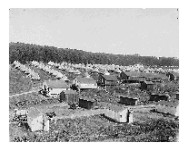
1906 Earthquake - April 18, 1906, the city shook to an earthquake, its estimated moment magnitude 7.8, estimated Richter scale of 8.25. The rupture along the San Andreas fault was followed by fires that burned throughout the city, five hundred city blocks in total. The devestation to the city of San Francisco was enormous, with almost eighty percent of the city destroyed by the earthquake and fire. Although the loss of life was estimated very low at the time due to city father's desire to minimize the loss, it is now thought that three thousand people is a conservative amount for the people that perished in 1906 due to the event. Also, between 50-75% of the population at the time was homeless after the earthquake, with tent cities, and subsequent Army "relief houses" popping up at Fort Point, the Presidio, Golden Gate Park, and other city parks to handle the influx.
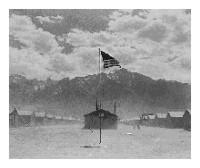
World War II - The implications of World War on the major city in the western United States were many. Its high concentration of Asian immigrants saw the tragedy of internment, whose story is now told at Manzanar National Historic Site east of the city, and the proximity to the coast saw intense efforts to ensure national security, which included use of Treasure Island as what was intended as a temporary Naval Air Station. Thousands of recruits would pass through this navy station on their way to combat. After the surrender of Japan in 1945, the original charter for the United Nations was also signed in San Francisco.
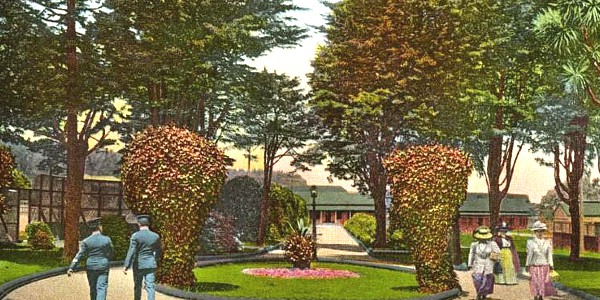
Photo above: Clipper ships in San Francisco, Yerba Buena Cove, during the Gold Rush, circa 1850-1. Courtesy Library of Congress/Wikipedia Commons. Below: Postcard of soldiers and ladies walking through the Presidio Grounds, 1918. Source: National Park Service.
San Francisco Now
Cable Cars - At times, one of the most special and romantic ways to traverse any city in the United States, these cable cars have plied the hills of San Francisco since Andrew Smith Hallidie, an Englishman no less, put the Clay Street line into public service on September 1, 1873. For more on the history of San Francisco's cable cars, go the the Cable Car Museum on Mason Street on Nob Hill.
The National Parks of San Francisco - For many outside California, it might come as some surprise at the variety and popularity of San Francisco's national parks. From Golden Gate National Recreation Area, which includes many different sites, ranging from the notorious prison in the bay, Alcatraz, to the Marin Headwaters, Nike Missile Site and its Cold War remains, the Presidio, and Muir Woods, twelve miles north of the Golden Gate Bridge among its 59 miles of shoreline and 75,000 acres, to Fort Point National Historic Site where the city was guarded from invaders from the Civil War through World War II, and the many ships and maritime displays of San Francisco Maritime National Historic Park on the west end of the wharf of San Francisco Bay. It includes a museum, historic vessels docked at the pier, and a visitor center.
Alacatraz Island - Part of Golden Gate National Recreation Area, Alcatraz Island is accessible through a concessionaire's tour from Pier 41. Ranger tours and audio tours are available once at the prison. The prison was once home to Al Capone, Machine Gun Kelley, and the Birdman. Reservations are advisable.
Remnants from the Pan Pacific International Exposition - The Palace of Fine Arts from the 1915 exhibition still remains, a spectacular site which now houses the Exploratorium, a modern museum of science and perception. The building, designed by architect Bernard R. Maybeck, recounts a Roman ruin and has charmed city residents and visitors since its February 1915 debut.
T-Shirts and Souvenirs
San Francisco T-Shirts and Souvenirs from the official merchandise of America's Best History. Great for your next western vacation or planning session.
San Francisco
Things You Should Not Miss
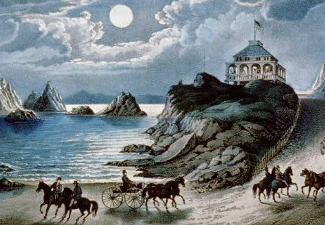
1. The seals, at Seal Rock, as well as the fourth version of Cliff House in the northwest part of San Francisco.
2. Yes, ... a ride on a Cable Car. There's not much like it, but watch your step.
3. Take the trip to Alcatraz, but remember to get your reservations as they can fill up fast during the tourist season.
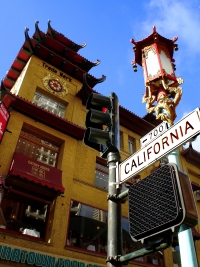
4. Chinatown ... San Francisco's oriental neighborhoods are some of the largest and oldest in the United States of America, and they harken back, in more modern buildings due to the 1906 destruction, the days when the Barbary Coast were in full flourish.
5. Take a walking tour. Some, provided free, are staffed by volunteers.
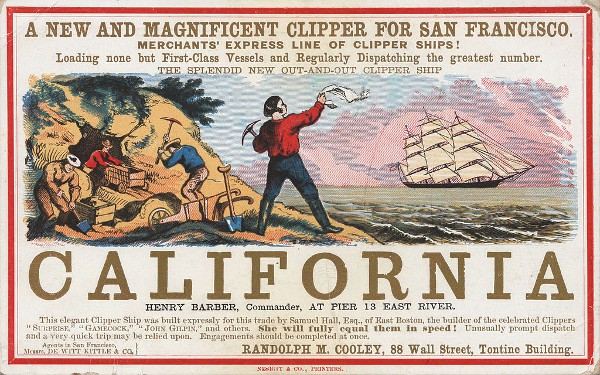
Image above: Sailing card for the Clipper ship California, heading for the California Gold Rush, G.F. Nesbitt and Company, Printer, circa 1850. Courtesy Wikipedia Commons. Below: Golden Gate Bridge looming above Fort Point today. Source: Wikipedia Commons.

San Francisco's World's Fairs
San Francisco began its infatuation with international events by hosting the California Midwinter International Exhibition in 1894, the first national event held in the west. Although small in comparison to subsequent expos, the Midwinter drew over one million people to its 160 acre site and exhibits from thirty-eight nations and colonies. Even before the 1906 earthquake, San Francisco leaders were discussing hosting another fair, but after the devastating impact of that natural disaster, there was even more reason. So the Pan Pacific International Exhibition was spawned. It opened with dual purpose, to celebrate the city's rebirth after the earthquake and to celebrate the opening of the Panama Canal. Held on 625 acres on reclaimed land on the south bank of the bay, it opened with the fanfare of 255,144 visitors and held a captive audience that included Franklin Delano Roosevelt, Herbert Hoover, and John Phillip Sousa's band, which performed, that would visit the exhibits of forty nations and colonies. To this day, it is regarded as one of the most magnificent world gatherings in history, and the Palace of Fine Arts remains as one legacy of its glory. Twenty-five years would pass, but by the time the Golden Gate International Exposition opened for its two seasons, San Francisco had been connected to the east by two large spans, the Golden Gate Bridge and the Oakland Bay Bridge, the later which would lead to the four hundred acre island, known as Treasure, in the middle of the bay and host a world's fair. The island was assisted in construction with WPA money, but despite the fact that the fair was viewed as spectacular by most who visited, if was considered less successful than the 1915 edition, in many ways due to the impending tensions of World War II and competition from the New York World's Fair of 1939-1940.
Get Baseball History and Books at Stat Geek Baseball, including Baseball's Best @ 150, the book that counts down 8,000 of the best batters, pitchers, and fielders of all your favorite teams, including the San Francisco Giants, New York Yankees, and more for the 1st 150 years of Major League Baseball (1871-2020).
Visitor FAQ

What's There Now
Just a Few of the Museums in the City include...
The Exploratorium - Palace of Fine Arts Building from the 1915 Pan Pacific. Seemingly an unlikely tenant for an building styled after a Roman ruin, this science museum explores a variety of subjects, including music and earthquakes, another unlikely pair.
Chinese Historical Society Museum - The museum and learning center documents Chinese American history, including special collections and exhibits on the effect of the earthquake on Chinatown and many other immigrant history tales.
Wells Fargo History Museum - This museum sits on the site where Wells Fargo opened for business during the height of the Barbary Coast and Gold Rush days. Exhibits include stagecoaches and gold dust from the halcium moments of quick riches and gold fever.
Photo above: The Palace of Fine Arts from the 1915 exhibition. Below: Another view of the 1915 San Francisco World's Fair.

San Francisco's World's Fairs
1894 California Midwinter Exposition
- January 27 to July 4, 1894.
- Attendance: 1,315,022 paid
1915 Pan Pacific International Exposition
- February 20 to December 4, 1915
- Attendance: 13,127,103 paid
1939-40 Golden Gate International Exposition
- February 18 to October 29, 1939.
- May 25 to September 29, 1940
- Attendance: 1939: 10,496,203 paid; 1940: 5,135,897 paid.
Image above: Painting of Seal Rock, courtesy Library of Congress.

Lodging and Camping
San Francisco is a cosmopolitan city with a wealth of accommodations. Check out the tourist organization as well as online travel sites for a hotel, motel, bed and breakfast that suits your needs. Be aware that San Francisco is the second most dense city in the U.S.A. (after New York), so expect crowds in the downtown core and on city streets and the interstates, plus the city and its environs.
Photo above: Smoke billows above the city after the San Francisco earthquake on October 18, 1906. Photo below: Refugee camp after the 1906 San Francisco earthquake.