-
Pre-Revolution Timeline - The 1600s
They came, in colonies settled around Jamestown, with the pilgrims at Plymouth Rock in the Massachusetts Bay, and they began what we would term the America of today. There would be treaties with the Indian nations and battles amongst warring tribes. There would be contests of wills between colonies funded and founded by British, Spanish, and French concerns. But this would be the century that began true settlement, for all its wonder and hardship and harbinger of a nation that would come.
More Pre-Revolution

Image of the statue of Jacques Marquette, 1898, Detroit Publishing Co. Courtesy Library of Congress.
Sponsor this page. Your banner or text ad can fill the space above.
Click here to Sponsor the page and how to reserve your ad.
-
Timeline
1690 Detail
December 10, 1690 - First paper money issued in North America by the Massachusetts Bay Colony, bills of credit to pay for their military expeditions in King William's War.

It would not be the first paper money ever issued, the Dynasties of China, try Tang Dynasty of the 7th Century, had beaten us to it, but when King William's War broke out and the conflict stretched all the way to Quebec, Elisha Hutchinson of the Massacusetts Bay Colony approved the use of paper money to pay the soldiers. There is debate to the date, with some sources listing February 3, 1690/1691, when notes had been printed and used in the colony itself, and other December 10, 1690, when the first 7,000 pounds were printed for the war soldiers. However, this was of little consequence. The December 10, 1690 date comes from a note to a soldier, thus proving its date. That seems to be why the February date, as noted in another source, was for a supplemental amount above the 7,000 pounds, and in the next year. Hutchinson noted the desperation and the mistake of fighting in Quebec, "hath run us into debt." There was concern that the soldiers would not accept it, wanting the Pine Tree shilling or the Spanish Milled metal coins. After all, the new Massachusetts Bay Colony paper money had no real backing.
The notes read ... "This indented Bill of _____ Shillings due from the Massachusetts Colony to the Possessor shall be in value equal to money and shall be accordingly accepted by the Treasurer and Receiver Subordinates to him in all Public payments and for any stock at any time in the Treasury - New England, February the third, 1690. By Order of the General Court.
It was Governor William William Phips who had caused the crises. His successful attack on Acadia in April 1690 had boosted his gravitas. If they could take Acadia, the same could happen in Quebec City, and there they could also gain French treasure. Promising half to the soldiers, plus their pay, Phips lead his men to Quebec in August 1690 with over thirty ships and two thousand men, and lost, leaving with no treasure, just loss of life and some of his ships.
Of course, the experiment with paper money would lead to depreciation and strong inflation, so the colony limited the paper money to 40,000 in circulation on March 21, 1691. They put the plates for the paper money in the hands of a committee of three; Mr. John Foster, Captain Joseph Lynde, and Captain Samuel Ruggles. Some sources state the printing presses were destroyed. Ten thousand of that money was paid to the Colony for taxes. By the end of 1691, the treasury retired the rest of the money, with most of it bought up by Governor Phips with gold.
In the end, neither the soldiers or the public were forced to use the paper money. It was not called legal tender, essentially notes of short-term duration.
First Bill of Emission, General Court of Massachusetts, December 10, 1690.
Whereas (for the maintaining and defending of their Majesties interests against the hostile invasions of their French and Indian enemies who have begun and are combined in the prosecution of a Bloody war upon the English of their Majesties Colonys and plantation of New England) this Colony had necessarily contracted sundry considerable debts, which the Court taking into consideration and being desirous to approve themselves Just and honest in the discharge of the same and that every person who hath credit with the country for the use of any of his estate, disbursements, or services done for the Public, and in convenient time receive due and equal satisfaction; withal considering the present poverty and calamities of the country And (through scarcity of money) the want of adequate measure of Commerce whereby they are disadvantaged in making present payment as desired; Yet being willing to settle and adjust the accounts of the said debts, and to make payment thereof, with what speed they can ...
It is ordered by the Court that Major Elisha Hutchinson, Major John Phillips, Captain Penn Townsend, Mr. Adam Winthrop and Mr. Timothy Hutchinson or any three of them, be and are hereby appointed and impowered a Committee for the granting forth of Printed Bills in such form as is agreed upon by this Court (none under five shillings nor exceeding five pounds in one bill) unto all such persons who shall desire the same, to whom the Colony is indebted, for such sum or sums of money as they have debentures from the Committee, or Committees that are or shall be appointed to give out the same, Every of which Bills according to the sums therein expressed shall be of equal Value with money, and the Treasurer and all the receivers subordinate to him shall accept, and receive the same accordingly in all Publick Payments; No more of Said Bills, to be Printed or granted forth than for the Sum of Seven thousand Pounds; And the Colony is hereby engaged to Satisfy the Value of Said Bills as the Treasury shall be enabled, And any person having of said Bills in his Hands, may Accordingly return the same to the Treasurer, and shall receive the full Sum thereof in Money, or other Public Stock at the Money Price as Stated for that time. And if any of the said Bills be worn in any Persons hands, so as they desire to renew them, returning them to the Committee, they shall have new ones of the same numbers and sums given out.
Buy Chronology

Who Was Elisha Hutchinson?
Elisha Hutchinson was an aristocrat in the Massachusetts Bay Colony heirarchy, appointed the Minister of Finance. Several years prior to 1690, the idea had been floated by Captain John Blackwell to issue paper money, but had not gone into place. By the later date, February 3, 1691, the colony had produced forty thousand pounds worth of paper money, to be exchanged in the future for coin, or to pay their taxes.
Elisha came from a long line of Massachusetts Bay settlers, some, like his grandmother Anne, was a religious dissenter who almost created a civil war. Elisha would leave Boston with her family in 1638, but her son Edward would return to Boston. He had a son, Elisha, in 1641, who grew to the, at the time, unnatural height of six feet two inches. He followed his father into the mercantile business and they created a real estate empire. He married, did not own slaves, and had courage, with his father, to disagree with the Colony persecution of Baptists.
In 1680, he became deputy at the General Court, town councilor, judge, and militia captain. He had his enemies, many stemming from the legacy of his grandmother, but continued to rise in the Colony upper class. While in England, the revolt in Boston began, and the Dominion Government overthrown in 1689. Upon his return to Boston, he retook his positions and rose to Militia Major in King William's War.
Loss of Charter and Mint
Part of the monetary policy shortage had been caused when the Massachusetts Colony lost their charter and mint in 1684. It caused them to be creative with their finances.
Note: In 1685, the French had paid their soldiers with playing cards, thus not technically printing notes or paper money.
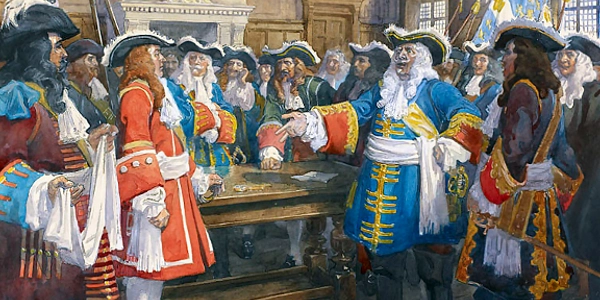
Image Above: Montage of (left) Elisha Hutchinson, 1675-1690, Unknown Artist. Courtesy Harvard University Portrait Gallery; and (right) Copy of first paper money issued October 1690 to Massachusetts Bay soldiers, 1690. Courtesy Massachusetts Bay Colony. Below: Painting of Frontenac and Sir William Phips at surrender of Quebec in 1690 during King William's War, circa 1915, Charles William Jefferys. Courtesy Library and Archives Canada via Wikipedica Commons. Info source: "Massachusetts Issues the First Paper Money in the Western World," 2023, New England Historical Society; "First Paper Currency Authorized in the Colonies," history.com; "America's First Experiment With Paper (Fiat) Money," Lawrence W. Reed, Foundation for Economic Education; "The First Printed Currency, Massachusetts Bay - December 10, 1690, Coincommunity.com; "The Middle Hutchinson, Elisha, 1641-1717," Dror Goldberg, commonplace.online; Wikipedia.
History Photo Bomb

The Treaty of Penn with the Indians, 1771-2, Benjamin West. Courtesy Pennsylvania Academy of Fine Arts via Wikipedia Commons.


Painting titled Portrait of a Man, supposedly of Joseph Dudley, circa late 17th century. Courtesy Wikipedica Commons.
ABH Travel Tip
You can visit much of the Pre-Revolution history of the United States throughout the many trails and historic sites of the nation. And don't miss out on the Native American history throughout Florida or other regions. The history of the nation and North America comes from the culture of the many tribes that made up the mosaic of human culture in each state. They were here before the majority of us, after all, and their history is an amazing collection of wonder, beauty, and dedication to the land that sits beneath us.

Painting of the Signing of the Mayflower Compact, 1899, Jean Leon Gerome Ferris. Courtesy Wikipedia Commons.
Timeline Book
