-
Pre-Revolution Timeline - The 1770s
The people were getting tired of the overarching rules, regulations, and taxes of the British Crown, perhaps no more so than in Boston where a massacre would occur. So a Tea Party would be held, declarations and Congresses made, then a war with shots ringing out from Princeton to Saratoga to Yorktown. But it would take much longer than this one decade to win that war and to form a true government. The American Revolution would seep into the next decade and the first President not in office til after that.
More 1700s
American Revolution Historic Sites

What's going on to protect and interpret American Revolution historic sites. Great news on two interesting fronts.
Sponsor this page. Your banner or text ad can fill the space above.
Click here to Sponsor the page and how to reserve your ad.
-
Timeline
1776 Detail
September 7, 1776 - In the world's first submarine attack, the American submersible ship Turtle attempts to attach a time bomb to the flagship of British Admiral Richard Howe's ship HMS Eagle in New York Harbor.
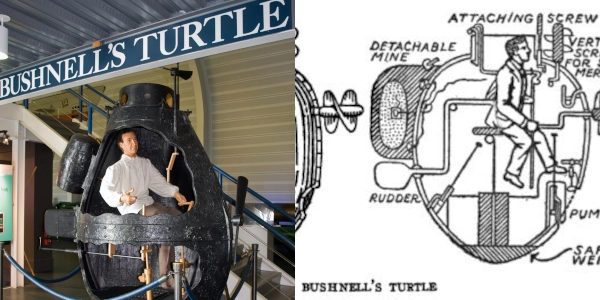
With the British regulars and Royal Navy considered the best military force in the world, it was imperative that the Continental Army and Navy would use ingenuity in tactics and weaponry. One such invention would be a submarine designed by David Bushnell. But Bushnell's story had not started with an engineering or military background; he was the son of a farmer, Nehemiah and wife Sarah, but when his father passed, Bushnell was ready to make a change, selling half of his stake in the family farm to his brother. Then, at age thirty-one, he went to Yale.
At Yale, Bushnell became enamored with the science of invention. In a stunning experiment, he made gunpowder explode under water. When the battles at Lexington and Concord forced the college to close in 1775, David Bushnell went home and perfected using underwater mines. His accomplice was farmer brother Ezra. They worked on the submarine they called Turtle, and figured the mechanics that would turn a standard diving bell into a one-manned moving toward a target submersible. Isaac Doolittle, clockmaker, fashioned the valves, pumps, and hatch. Bushnell built two propellers that were handcranked, the idea to use water to lower and raise the submersible, then turned to making the mine itself. Try a keg mine that could hold one-hundred and fifty pounds of gunpowder with a two and one half by one and one half foot footprint. By 1776, the Turtle was put throught its trials at Ayer's Point on the Connecticutt River with Ezra as its pilot, and was ready to go to its real work against the British in Boston Harbor. But it was not ready by the time the British Navy left Boston and headed to New York.
At first Connecticutt Congressman Silas Deane, then Philadelphia inventor Benjamin Franklin, invited to witness the craft by Bushnell's Yale professor Dr. Benjamin Gale, saw its potential, urging General George Washington and New York Governor Jonathan Trumball to become supporters. When Washington met with Bushnell, he was convinced. The Turtle made its way to New York City as the British amassed their warships in the harbor by June 1776. They had brought along fifty thousand British regulars, seamen, and Hessians.
September Attack in New York Harbor
David Bushnell had the audacity to dream that he could send the Turtle out and take down the HMS Eagle, the pride of General Howe's fleet. He would need another pilot when Ezra got sick, however, with Brigadier General Samuel Holden Parsons suggesting three. Seargeant Ezra Lee from the Connecticutt volunteers, twenty something, was chosen; he was Parsons' brother-in-law. This pushed back the timetable for two months as the pilot trained.
The sun was rising on September 7, 1776 by the time Lee and the Turtle were rowed out by boats into New York Harbor and he got close to the HMS Eagle after two hours of pedaling. He would be attempting the world's first combat attack using a submarine. Ezra Lee attempted to screw the mine to the hull of the Royal Navy flagship, but it would not afix. Losing air (the Turtle could only submerge for thirty minutes) and fearing that daylight would show him to the British crew, Lee drove the Turtle toward shore. However, the British troops stationed at Governor's Island saw the unique submarine and sent out guard boats to investigate. To divert and possibly sink the guard boats, Ezra Lee unloaded the keg mine. It went off, scattering the guard boats, no injury, and allowing the Turtle to make it back to safety.
Quotes from the Participants
"The external shape of the sub-marine vessel bore some resemblence to two upper tortoise shells of equal size, joined together; the place of entrance into the vessel being represented by the opening made by the swell of the shells, at the head of the animal," Davis Bushnell.
"Dear Sir.- Killingworth, 9th Nov., 1775. In your last you requested I would give you an account of the progress of our machine, and whether anything may be expected of it. I now sit down to give you a succinct but imperfect account of its structure, which is so complicated that it is impossible to give a perfect idea of it.
The Body, when standing upright in the position in which it is navigated, has the nearest resemblance to the two upper shells of a Tortoise joined together. In length it doth not exceed 7-1/2 feet from the stem to the higher part of the rudder: the height not exceeding 6 feet. The person who navigates it enters at the top. It has a brass top or cover, which receives the person's head as he sits on a seat, and is fastened on the inside by screws. In this brass head is fixed eight glasses, viz. two before, two on each side, one behind, and one to look out upwards. In the same brass head are fixed two brass tubes, to admit fresh air when requisite, and a ventilator at the side to free the machine from the air rendered unfit for respiration. On the inside is fixed a Barometer, by which he can tell the depth he is under water; a Compass, by which he knows the course he steers. In the barometer and on the needles of the compass is fixed fox-fire, i.e. wood that gives light in the dark. His ballast consists of about 900 wt. of lead which he carried at the bottom and on the outside of the machine, part of which is so fixed as he can let run down to the Bottom, and serves as an anchor, by which he can ride ad libitum. He has a sounding lead fixed at the bow, by which he can take the depth of water under him; and to bring the machine into a perfect equilibrium with the water, he can admit so much water as is necessary, and has a forcing pump by which he can free the machine at pleasure, and can rise above water, and again immerge, as occasion requires.
In the bow, he has a pair of oars fixed like the two opposite arms of a wind mill, with which he can row forward, and turning them the opposite way, row the machine backward; another pair fixed upon the same model, with which he can row the machine round, either to the right or left, and a third, by which he can row the machine either up or down; all which are turn'd by foot, like a spinning wheel. The rudder by which he steers, he manages by hand, within board. All these shafts which pass through the machine are so curiously fix'd as not to admit any water to incommode the machine. The magazine for the powder is carried on the hinder part of the machine, without board, and so contrived, that when he comes under the side of the Ship, he rubs down the side until he comes to the keel, and a hook so fix'd as that when it touches the keel it raises a spring which frees the magazine from the machine and fastens it to the side of the Ship; at the same time, it draws a pin, which sets the watchwork agoing which, at a given time, springs the lock and the explosion ensues.
Three magazines are prepared; the first, the explosion takes place in twelve, - the second in eight, - the third in six hours, after being fixed to the ship. He proposes to fix these three before the first explosion takes place. He has made such a trial of the effects of the explosion of gunpowder under water, since Dr. [Benjamin] Franklin did me the honor to call upon me, as has exceeded his most sanguine expectations, and is now convinced his magazines will contain three times so much powder as is necessary to destroy the largest ship in the navy.
I now write with the greater freedom, as I conclude by the time this reaches you the machine will be in camp. Lately he has conducted matters and his designs with the greatest secrecy, both for the personal safety of the navigator as to produce the greatest astonishment to those against whom it is designed, - if this projection succeeds, of which I make no doubt, as I well know the man and have seen the machine while in embryo, and every addition made to it fills me with fresh astonishment and surprize. And you may call me a visionary, an enthusiast, or what you please, - I do insist upon it, that I believe the inspiration of the Almighty has given him understanding for this very purpose and design. If he succeeds, a stipend for life, and if he fails, a reasonable compensation for time and expense is his due from the public.
What astonishment it will produce and what advantages may be made by those on the spot, if it succeeds, is more easy for you to conceive than for me to describe.
I congratulate you and my country in the begun success of our Arms to the northward, and the prospects of further success. Make my most respectful compliments to Dr. Franklin and our Delegates, your associates; and am, most respectfully Your sincere friend and most humble servt," Dr. Benjamin Gale to Silas Deane.
"Military Journal of James Thacher, October, 1776
October. [1776] - By some gentlemen from head-quarters, near New York, we are amused with an account of a singular machine, invented by a Mr. D. Bushnell of Connecticut, for the purpose of destroying the British shipping by explosion. This novel machine was so ingeniously constructed, that, on examination, Major-General Putnam was decidedly of opinion that its operations might be attended with the desired success; accordingly he encouraged the inventor, and resolved to be himself a spectator of the experiment on the British shipping in New York harbor. Mr. Bushnell gave to his machine the name of American Turtle or Torpedo. It was constructed on the principles of submarine navigation, and on trial it has been ascertained that it might be rowed horizontally, at any given depth under water, and the adventurer, concealed within, might rise or sink, as occasion requires. A magazine of powder was attached to it in such a manner as to be screwed into the bottom of the ship; and being now disengaged from the machine, the operator retires in safety, leaving the internal clock work in motion; and at the distance of half an hour, or an hour, the striking of a gun lock communicates fire to the powder, and the explosion takes place. It was determined to make the experiment with this machine in the night, on the ship Eagle, of sixty-four guns on board of which admiral Lord Howe commanded. General Putnam placed himself on the wharf to witness the result. Mr. Bushnell had instructed his brother in the management of the Torpedo with perfect dexterity; but being taken sick, a sergeant of a Connecticut regiment was selected for the business, who, for want of time, could not be properly instructed. He, however, succeeded so far as to arrive in safety with his apparatus under the bottom of the ship, when the screw, designed to perforate the copper sheathing, unfortunately struck against an iron plate, near the rudder, which, with the strong current and want of skill in the operator, frustrated the enterprise; and, as day-light had begun to appear, the sergeant abandoned his magazine, and returned in the Torpedo to the shore. In less than half an hour a terrible explosion from the magazine took place, and threw into the air a prodigious column of water, resembling a great water-spout, attended with a report like thunder. General Putnam and others, who waited with great anxiety for the result, were exceedingly amused with the astonishment and alarm which this secret explosion occasioned on board of the ship. This failure, it is confidently asserted, is not to be attributed to any defect in the principles of this wonderful machine; as it is allowed to be admirably calculated to execute destruction among the shipping," James Thatcher.
"We set off from the City, the Whale boats towed me as nigh the ships as they dare go, and then they cast me off. I soon found that I was too early in the tide, as it carried me down to the ships. I however, hove about, and rowed for 5 glasses (2.5 hours), by the ship's bells, before the tide slackened so that I could get along side the man of war, which lay above the transports, ... I eyed them, and when they got within 50 or 60 yards of me I let loose the magazine in the hopes that if they should take me they would likewise pick up the magazine, and then we should all be blown up together," Ezra Lee.
"... Bushnel is a man of great Mechanical powers - fertile of invention - and a master in execution - He came to me in 1776 recommended by Governor Trumbull (now dead) and other respectable characters who were proselites to his plan. - Although I wanted faith myself, I furnished him with money, and other aids to carry it into execution. - He laboured for sometime ineffectually, & though the advocates for his scheme continued sanguine he never did succeed - One accident or another was always intervening. - I then thought, and still think, that it was an effort of genius; but that a combination of too many things were requisite, to expect much success from the enterprise against an enemy, who are always upon guard. - That he had a machine which was so contrived as to carry a man under water at any depth he chose, and for a considerable time & distance, with an apparatus charged with Powder which he could fasten to a ships bottom or side & give fire to in any given time (sufft. for him to retire) by means whereof a ship could be blown up, or sunk, are facts which I believe admit of little doubt - but then, where it was to operate against an enemy, it is no easy matter to get a person hardy enough to encounter the variety of dangers to which he must be exposed. 1 from the novelty 2 from the difficulty of conducting the machine, and governing it under water on acct. of the Currents &ca. 3 the consequent uncertainty of hitting the object of destination, without rising frequently above water for fresh observation, wch., when near the Vessel, would expose the adventurer to a discovery, & almost to certain death - To these causes I always ascribed the non-performance of his plan, as he wanted nothing that I could furnish to secure the success of it. - This to the best of my recollection is a true state of the case - But Humphreys, if I mistake not, being one of the proselites, will be able to give you a more perfect acct. of it than I have done ...." George Washington to Thomas Jefferson about the Turtle, September 26, 1785.
"Dr. Sir,
Judge Griswold, & Charles Griswold Esq. both informed me that you wished to have an account of a machine invented by David Bushnell of Say. Brook, at the commencement of our Revolutionary war. In the summer of 1776, he went to New York with it to try the Asia man of war: - his brother being acquainted with the working of the machine, was to try the first experiment with it, but having spent untill the middle of August, he gave out, in consequence of indisposition. - Mr. Bushnell then came to General Parsons (of Lyme) to get some one to go, and learn the ways & mystery of this new machine, and to make a trial of it.
General Parsons, sent for me, & two others, who had given in our names to go in a fire ship if wanted, to see if we would undertake the enterprize: - we agreed to it, but first returned with the machine down Sound, and on our way practised with it in several harbours. - we returned as far back as Say-Brook with Mr Bushnell, where some little alterations were made in it - in the course of which time, (it being 8 or 10 days) the British had got possession of Long Island & Governor's Island - We went back as far as New Rochelle and had it carted over by land to the North River. -
Before I proceed further, I will endeavour to give you some idea of the construction of this machine, turtle or torpedo, as it has since been called. - (1) Its shape was most like a round clam, but longer, and set up on its square side - it was high enough to stand in or sit as you had occasion, with a (2) composition head hanging on hinges. - it had six glasses, inserted in the head, and made water tight, each the size of a half Dollar piece, to admit light - in a clear day, a person might see to read in three fathoms of water - The machine was steered by a rudder having a crooked tiller, which led in by your side, through a water joint. - (3) then sitting on the seat, the navigator rows with one hand, & steers with the other - it had two oars, of about 12 inches in leangth, & 4 or 5 in width, shaped like the arms of a windmill, which led also inside through water joints, in front of the person steering, and were worked by means of a wench (or crank) and with hard labour, the machine might be impelled at the rate of 3 nots an hour for a short time - Seven hundred pounds of lead were fixed on the bottom for ballast, and two hundred weight of it was so contrived, as to let it go in case the pumps choaked, so that you could rise at the surface of the water. - It was sunk by letting in water by a spring near the bottom, by placing your foot against which, the water would rush in and when sinking take off your foot & it would cease to come in & you would sink no further, but if you had sunk too far, pump out water untill you got the necessary depth - these pumps forced the water out at the bottom, one being on each side of you as you rowed - A pocket compass was fixed in the side, with a piece of light (4) wood on the north side, thus +, and another on the east side thus -, to steer by while under water - Three round doors were cut in the head, (each 3 inches diameter) to let in fresh air, untill you wished to sink, and then they were shut down & fastened - There was also a glass tube (5) 12 inches long and 1 inch diamater, with a cork in it, with a peice of light wood, fixed to it, and another peice at the bottom of the tube, to tell the depth of discent, - one inch rise of the cork in the tube gave about one fathom water, - It had a screw, that peirced through the top of the machine, with a water joint, which was so very sharp that it would enter wood, with very little force, and this was turned with a wench, or crank, and when entered fast in the bottom of the ship, the screw is then left, and the machine is disengaged, by unscrewing another one inside that held the other. From the screw now fixed on the bottom of the ship, a line - led to & fastened to the mazagine, to prevent its escape either side of the ship - the magazine was directly behind you on the outside, and that was faced from you by unscrewing a screw inside - Inside the magazine was a clock machinery, which immediately sets a going after it is disengaged & a gun lock is fixed to strike fire to the powder, at the set time after the Clock should rundown - The clock might be set to go longer or shorter - 20 or 30 minutes was the usual time, to let the navigator escape - This magazine was shaped like an egg, & made of oak dug out in two peices, bound together with bands of iron, corked & paid over with tar so as to be perfectly tight, and the clock was bound so as not to run untill this magazine was unscrewed .....
I will now endeavour to give you a short account of my voyage in this machine. - The first night after we got down to New York with it, that was favourable, (for the time for a trial, must be, when it is slack water, & calm, as it is unmanagable in a swell or a strong tide) the British Fleet lay a little above Staten Island We set off from the City - the Whale boats towed me as nigh the ships, as they dared to go, and then cast me off - I soon found that it was too early in the tide, as it carried me down by the ships - I however hove about, and rowed for 5 glasses, by the ships' bells, before the tide slacked so that I, could get along side of the man of war, which lay above the transports - The Moon was about 2 hours high, and the daylight about one - when I rowed under the stern of the ship, could see the men on deck, & hear them talk - I then shut down all the doors, sunk down, and came under the bottom of the ship, up with the screw against the bottom but found that it would not enter - I pulled along to try another place, but deviated a little one side, and immediately rode with great velocity, and come above the surface 2 or 3 feet between the ship and the daylight - then sunk again like a porpoise I hove partly about to try again, but on further thought I gave out, knowing that as soon as it was light the ships boats would be rowing in all directions, and I thought the best generalship, was to retreat, as fast as I could as I had 4 miles to go, before passing Governor's Island. - So I jogg'd on as fast as I could, and my compass being then of no use to me, I was obliged to rise up every few minutes to see that I sailed in the right direction, and for this purpose keeping the machine on the surface of the water, and the doors open - I was much afraid of getting aground on the island as the Tide of the flood set on the north point While on my passage up to the City, my course owing to the above circumstances, was very crooked & zig zag, and the enemy's attention was drawn towards me, from Governors Island - When I was abreast of the fort on the island 3 or 400 men got upon the parapet to observe me, - at leangth a number came down to the shore, shoved off a 12 oar'd barge, with 5 or 6 sitters, and pulled for me - I eyed them, and when they had got within 50 or 60 yards of me, I let loose the magazine, in hopes, that if they should take me, they would likewise pick up the magazine, and then we should all be blown up together, but as kind Providence would have it, they took fright, and returned to the island, to my infinite joy. - I then weathered the Island, and our people seeing me, came off with a whaleboat, and towed me in - The Magazine after getting a little past the Island, went off with a tremendous explosion, throwing up large bodies of water to an immense height.
Before we had another opportunity to try an experiment our army evacuated Newyork, and we retreated up the North River as far as fort Lee - A Frigate came up and anchored off Bloomingdale. I now made another attempt upon a new plan - my intention was to have gone under the ship's stern, and screwed on the magazine close to the water's edge, but I was discovered by the Watch and was obliged to abondon this scheme, then shutting my doors, I dove under her, but my cork in the tube, (by which I ascertained my depth) got obstructed, and deceived me, and I descended too deep & did not track the ship, and I then left her - Soon after the Frigate came up the river, drove our Crane galley on shore, and sunk our Sloop, from which we escaped to the shore -," Ezra Lee, letter to David Humphreys, 1815.
At Yale, Bushnell became enamored with the science of invention. In a stunning experiment, he made gunpowder explode under water. When the battles at Lexington and Concord forced the college to close in 1775, David Bushnell went home and perfected using underwater mines. His accomplice was farmer brother Ezra. They worked on the submarine they called Turtle, and figured the mechanics that would turn a standard diving bell into a one-manned moving toward a target submersible. Isaac Doolittle, clockmaker, fashioned the valves, pumps, and hatch. Bushnell built two propellers that were handcranked, the idea to use water to lower and raise the submersible, then turned to making the mine itself. Try a keg mine that could hold one-hundred and fifty pounds of gunpowder with a two and one half by one and one half foot footprint. By 1776, the Turtle was put throught its trials at Ayer's Point on the Connecticutt River with Ezra as its pilot, and was ready to go to its real work against the British in Boston Harbor. But it was not ready by the time the British Navy left Boston and headed to New York.
At first Connecticutt Congressman Silas Deane, then Philadelphia inventor Benjamin Franklin, invited to witness the craft by Bushnell's Yale professor Dr. Benjamin Gale, saw its potential, urging General George Washington and New York Governor Jonathan Trumball to become supporters. When Washington met with Bushnell, he was convinced. The Turtle made its way to New York City as the British amassed their warships in the harbor by June 1776. They had brought along fifty thousand British regulars, seamen, and Hessians.
The sun was rising on September 7, 1776 by the time Lee and the Turtle were rowed out by boats into New York Harbor and he got close to the HMS Eagle after two hours of pedaling. He would be attempting the world's first combat attack using a submarine. Ezra Lee attempted to screw the mine to the hull of the Royal Navy flagship, but it would not afix. Losing air (the Turtle could only submerge for thirty minutes) and fearing that daylight would show him to the British crew, Lee drove the Turtle toward shore. However, the British troops stationed at Governor's Island saw the unique submarine and sent out guard boats to investigate. To divert and possibly sink the guard boats, Ezra Lee unloaded the keg mine. It went off, scattering the guard boats, no injury, and allowing the Turtle to make it back to safety.
Quotes from the Participants
"The external shape of the sub-marine vessel bore some resemblence to two upper tortoise shells of equal size, joined together; the place of entrance into the vessel being represented by the opening made by the swell of the shells, at the head of the animal," Davis Bushnell.
"Dear Sir.- Killingworth, 9th Nov., 1775. In your last you requested I would give you an account of the progress of our machine, and whether anything may be expected of it. I now sit down to give you a succinct but imperfect account of its structure, which is so complicated that it is impossible to give a perfect idea of it.
The Body, when standing upright in the position in which it is navigated, has the nearest resemblance to the two upper shells of a Tortoise joined together. In length it doth not exceed 7-1/2 feet from the stem to the higher part of the rudder: the height not exceeding 6 feet. The person who navigates it enters at the top. It has a brass top or cover, which receives the person's head as he sits on a seat, and is fastened on the inside by screws. In this brass head is fixed eight glasses, viz. two before, two on each side, one behind, and one to look out upwards. In the same brass head are fixed two brass tubes, to admit fresh air when requisite, and a ventilator at the side to free the machine from the air rendered unfit for respiration. On the inside is fixed a Barometer, by which he can tell the depth he is under water; a Compass, by which he knows the course he steers. In the barometer and on the needles of the compass is fixed fox-fire, i.e. wood that gives light in the dark. His ballast consists of about 900 wt. of lead which he carried at the bottom and on the outside of the machine, part of which is so fixed as he can let run down to the Bottom, and serves as an anchor, by which he can ride ad libitum. He has a sounding lead fixed at the bow, by which he can take the depth of water under him; and to bring the machine into a perfect equilibrium with the water, he can admit so much water as is necessary, and has a forcing pump by which he can free the machine at pleasure, and can rise above water, and again immerge, as occasion requires.
In the bow, he has a pair of oars fixed like the two opposite arms of a wind mill, with which he can row forward, and turning them the opposite way, row the machine backward; another pair fixed upon the same model, with which he can row the machine round, either to the right or left, and a third, by which he can row the machine either up or down; all which are turn'd by foot, like a spinning wheel. The rudder by which he steers, he manages by hand, within board. All these shafts which pass through the machine are so curiously fix'd as not to admit any water to incommode the machine. The magazine for the powder is carried on the hinder part of the machine, without board, and so contrived, that when he comes under the side of the Ship, he rubs down the side until he comes to the keel, and a hook so fix'd as that when it touches the keel it raises a spring which frees the magazine from the machine and fastens it to the side of the Ship; at the same time, it draws a pin, which sets the watchwork agoing which, at a given time, springs the lock and the explosion ensues.
Three magazines are prepared; the first, the explosion takes place in twelve, - the second in eight, - the third in six hours, after being fixed to the ship. He proposes to fix these three before the first explosion takes place. He has made such a trial of the effects of the explosion of gunpowder under water, since Dr. [Benjamin] Franklin did me the honor to call upon me, as has exceeded his most sanguine expectations, and is now convinced his magazines will contain three times so much powder as is necessary to destroy the largest ship in the navy.
I now write with the greater freedom, as I conclude by the time this reaches you the machine will be in camp. Lately he has conducted matters and his designs with the greatest secrecy, both for the personal safety of the navigator as to produce the greatest astonishment to those against whom it is designed, - if this projection succeeds, of which I make no doubt, as I well know the man and have seen the machine while in embryo, and every addition made to it fills me with fresh astonishment and surprize. And you may call me a visionary, an enthusiast, or what you please, - I do insist upon it, that I believe the inspiration of the Almighty has given him understanding for this very purpose and design. If he succeeds, a stipend for life, and if he fails, a reasonable compensation for time and expense is his due from the public.
What astonishment it will produce and what advantages may be made by those on the spot, if it succeeds, is more easy for you to conceive than for me to describe.
I congratulate you and my country in the begun success of our Arms to the northward, and the prospects of further success. Make my most respectful compliments to Dr. Franklin and our Delegates, your associates; and am, most respectfully Your sincere friend and most humble servt," Dr. Benjamin Gale to Silas Deane.
"Military Journal of James Thacher, October, 1776
October. [1776] - By some gentlemen from head-quarters, near New York, we are amused with an account of a singular machine, invented by a Mr. D. Bushnell of Connecticut, for the purpose of destroying the British shipping by explosion. This novel machine was so ingeniously constructed, that, on examination, Major-General Putnam was decidedly of opinion that its operations might be attended with the desired success; accordingly he encouraged the inventor, and resolved to be himself a spectator of the experiment on the British shipping in New York harbor. Mr. Bushnell gave to his machine the name of American Turtle or Torpedo. It was constructed on the principles of submarine navigation, and on trial it has been ascertained that it might be rowed horizontally, at any given depth under water, and the adventurer, concealed within, might rise or sink, as occasion requires. A magazine of powder was attached to it in such a manner as to be screwed into the bottom of the ship; and being now disengaged from the machine, the operator retires in safety, leaving the internal clock work in motion; and at the distance of half an hour, or an hour, the striking of a gun lock communicates fire to the powder, and the explosion takes place. It was determined to make the experiment with this machine in the night, on the ship Eagle, of sixty-four guns on board of which admiral Lord Howe commanded. General Putnam placed himself on the wharf to witness the result. Mr. Bushnell had instructed his brother in the management of the Torpedo with perfect dexterity; but being taken sick, a sergeant of a Connecticut regiment was selected for the business, who, for want of time, could not be properly instructed. He, however, succeeded so far as to arrive in safety with his apparatus under the bottom of the ship, when the screw, designed to perforate the copper sheathing, unfortunately struck against an iron plate, near the rudder, which, with the strong current and want of skill in the operator, frustrated the enterprise; and, as day-light had begun to appear, the sergeant abandoned his magazine, and returned in the Torpedo to the shore. In less than half an hour a terrible explosion from the magazine took place, and threw into the air a prodigious column of water, resembling a great water-spout, attended with a report like thunder. General Putnam and others, who waited with great anxiety for the result, were exceedingly amused with the astonishment and alarm which this secret explosion occasioned on board of the ship. This failure, it is confidently asserted, is not to be attributed to any defect in the principles of this wonderful machine; as it is allowed to be admirably calculated to execute destruction among the shipping," James Thatcher.
"We set off from the City, the Whale boats towed me as nigh the ships as they dare go, and then they cast me off. I soon found that I was too early in the tide, as it carried me down to the ships. I however, hove about, and rowed for 5 glasses (2.5 hours), by the ship's bells, before the tide slackened so that I could get along side the man of war, which lay above the transports, ... I eyed them, and when they got within 50 or 60 yards of me I let loose the magazine in the hopes that if they should take me they would likewise pick up the magazine, and then we should all be blown up together," Ezra Lee.
"... Bushnel is a man of great Mechanical powers - fertile of invention - and a master in execution - He came to me in 1776 recommended by Governor Trumbull (now dead) and other respectable characters who were proselites to his plan. - Although I wanted faith myself, I furnished him with money, and other aids to carry it into execution. - He laboured for sometime ineffectually, & though the advocates for his scheme continued sanguine he never did succeed - One accident or another was always intervening. - I then thought, and still think, that it was an effort of genius; but that a combination of too many things were requisite, to expect much success from the enterprise against an enemy, who are always upon guard. - That he had a machine which was so contrived as to carry a man under water at any depth he chose, and for a considerable time & distance, with an apparatus charged with Powder which he could fasten to a ships bottom or side & give fire to in any given time (sufft. for him to retire) by means whereof a ship could be blown up, or sunk, are facts which I believe admit of little doubt - but then, where it was to operate against an enemy, it is no easy matter to get a person hardy enough to encounter the variety of dangers to which he must be exposed. 1 from the novelty 2 from the difficulty of conducting the machine, and governing it under water on acct. of the Currents &ca. 3 the consequent uncertainty of hitting the object of destination, without rising frequently above water for fresh observation, wch., when near the Vessel, would expose the adventurer to a discovery, & almost to certain death - To these causes I always ascribed the non-performance of his plan, as he wanted nothing that I could furnish to secure the success of it. - This to the best of my recollection is a true state of the case - But Humphreys, if I mistake not, being one of the proselites, will be able to give you a more perfect acct. of it than I have done ...." George Washington to Thomas Jefferson about the Turtle, September 26, 1785.
"Dr. Sir,
Judge Griswold, & Charles Griswold Esq. both informed me that you wished to have an account of a machine invented by David Bushnell of Say. Brook, at the commencement of our Revolutionary war. In the summer of 1776, he went to New York with it to try the Asia man of war: - his brother being acquainted with the working of the machine, was to try the first experiment with it, but having spent untill the middle of August, he gave out, in consequence of indisposition. - Mr. Bushnell then came to General Parsons (of Lyme) to get some one to go, and learn the ways & mystery of this new machine, and to make a trial of it.
General Parsons, sent for me, & two others, who had given in our names to go in a fire ship if wanted, to see if we would undertake the enterprize: - we agreed to it, but first returned with the machine down Sound, and on our way practised with it in several harbours. - we returned as far back as Say-Brook with Mr Bushnell, where some little alterations were made in it - in the course of which time, (it being 8 or 10 days) the British had got possession of Long Island & Governor's Island - We went back as far as New Rochelle and had it carted over by land to the North River. -
Before I proceed further, I will endeavour to give you some idea of the construction of this machine, turtle or torpedo, as it has since been called. - (1) Its shape was most like a round clam, but longer, and set up on its square side - it was high enough to stand in or sit as you had occasion, with a (2) composition head hanging on hinges. - it had six glasses, inserted in the head, and made water tight, each the size of a half Dollar piece, to admit light - in a clear day, a person might see to read in three fathoms of water - The machine was steered by a rudder having a crooked tiller, which led in by your side, through a water joint. - (3) then sitting on the seat, the navigator rows with one hand, & steers with the other - it had two oars, of about 12 inches in leangth, & 4 or 5 in width, shaped like the arms of a windmill, which led also inside through water joints, in front of the person steering, and were worked by means of a wench (or crank) and with hard labour, the machine might be impelled at the rate of 3 nots an hour for a short time - Seven hundred pounds of lead were fixed on the bottom for ballast, and two hundred weight of it was so contrived, as to let it go in case the pumps choaked, so that you could rise at the surface of the water. - It was sunk by letting in water by a spring near the bottom, by placing your foot against which, the water would rush in and when sinking take off your foot & it would cease to come in & you would sink no further, but if you had sunk too far, pump out water untill you got the necessary depth - these pumps forced the water out at the bottom, one being on each side of you as you rowed - A pocket compass was fixed in the side, with a piece of light (4) wood on the north side, thus +, and another on the east side thus -, to steer by while under water - Three round doors were cut in the head, (each 3 inches diameter) to let in fresh air, untill you wished to sink, and then they were shut down & fastened - There was also a glass tube (5) 12 inches long and 1 inch diamater, with a cork in it, with a peice of light wood, fixed to it, and another peice at the bottom of the tube, to tell the depth of discent, - one inch rise of the cork in the tube gave about one fathom water, - It had a screw, that peirced through the top of the machine, with a water joint, which was so very sharp that it would enter wood, with very little force, and this was turned with a wench, or crank, and when entered fast in the bottom of the ship, the screw is then left, and the machine is disengaged, by unscrewing another one inside that held the other. From the screw now fixed on the bottom of the ship, a line - led to & fastened to the mazagine, to prevent its escape either side of the ship - the magazine was directly behind you on the outside, and that was faced from you by unscrewing a screw inside - Inside the magazine was a clock machinery, which immediately sets a going after it is disengaged & a gun lock is fixed to strike fire to the powder, at the set time after the Clock should rundown - The clock might be set to go longer or shorter - 20 or 30 minutes was the usual time, to let the navigator escape - This magazine was shaped like an egg, & made of oak dug out in two peices, bound together with bands of iron, corked & paid over with tar so as to be perfectly tight, and the clock was bound so as not to run untill this magazine was unscrewed .....
I will now endeavour to give you a short account of my voyage in this machine. - The first night after we got down to New York with it, that was favourable, (for the time for a trial, must be, when it is slack water, & calm, as it is unmanagable in a swell or a strong tide) the British Fleet lay a little above Staten Island We set off from the City - the Whale boats towed me as nigh the ships, as they dared to go, and then cast me off - I soon found that it was too early in the tide, as it carried me down by the ships - I however hove about, and rowed for 5 glasses, by the ships' bells, before the tide slacked so that I, could get along side of the man of war, which lay above the transports - The Moon was about 2 hours high, and the daylight about one - when I rowed under the stern of the ship, could see the men on deck, & hear them talk - I then shut down all the doors, sunk down, and came under the bottom of the ship, up with the screw against the bottom but found that it would not enter - I pulled along to try another place, but deviated a little one side, and immediately rode with great velocity, and come above the surface 2 or 3 feet between the ship and the daylight - then sunk again like a porpoise I hove partly about to try again, but on further thought I gave out, knowing that as soon as it was light the ships boats would be rowing in all directions, and I thought the best generalship, was to retreat, as fast as I could as I had 4 miles to go, before passing Governor's Island. - So I jogg'd on as fast as I could, and my compass being then of no use to me, I was obliged to rise up every few minutes to see that I sailed in the right direction, and for this purpose keeping the machine on the surface of the water, and the doors open - I was much afraid of getting aground on the island as the Tide of the flood set on the north point While on my passage up to the City, my course owing to the above circumstances, was very crooked & zig zag, and the enemy's attention was drawn towards me, from Governors Island - When I was abreast of the fort on the island 3 or 400 men got upon the parapet to observe me, - at leangth a number came down to the shore, shoved off a 12 oar'd barge, with 5 or 6 sitters, and pulled for me - I eyed them, and when they had got within 50 or 60 yards of me, I let loose the magazine, in hopes, that if they should take me, they would likewise pick up the magazine, and then we should all be blown up together, but as kind Providence would have it, they took fright, and returned to the island, to my infinite joy. - I then weathered the Island, and our people seeing me, came off with a whaleboat, and towed me in - The Magazine after getting a little past the Island, went off with a tremendous explosion, throwing up large bodies of water to an immense height.
Before we had another opportunity to try an experiment our army evacuated Newyork, and we retreated up the North River as far as fort Lee - A Frigate came up and anchored off Bloomingdale. I now made another attempt upon a new plan - my intention was to have gone under the ship's stern, and screwed on the magazine close to the water's edge, but I was discovered by the Watch and was obliged to abondon this scheme, then shutting my doors, I dove under her, but my cork in the tube, (by which I ascertained my depth) got obstructed, and deceived me, and I descended too deep & did not track the ship, and I then left her - Soon after the Frigate came up the river, drove our Crane galley on shore, and sunk our Sloop, from which we escaped to the shore -," Ezra Lee, letter to David Humphreys, 1815.
What Happened to the Turtle after the Attack
Bushnell and Lee took the Turtle up the Hudson River and attempted to blow up another British ship; it failed again. By this time the British Royal Navy was catching on, warning its mariners of this new weapon. Phineas Pratt, another operator of the submarine, set out for another potential attack, but was discovered before he could succeed. Several days after that attempt, at the Battle of Fort Lee, November 20, 1776, the ship that carried the Turtle submersible was blown to pieces by an English vessel. Some sources state that the Turtle was blown up one month earlier, October 9, 1776. Believe whatever source you want. The Turtle was recovered within the wreckage.
For the remainder of the war, Bushnell abandoned the submarine idea, but developed better mines. Two were used in successful raids at New London Harbor and on the Delaware River above Philadelphia to float down the water and harm British ships in the January 5, 1778 Battle of the Kegs. Reports state that two boys went out to investigate, a keg blew, and possibly killed one of the boys. More than thirty years after the war, Bushnell contacted the government about his development of a torpedo. In 1915 and 1945, the U.S. Navy named submarine tenders after Bushnell. For Ezra Lee, he would serve the remainder of the war, and thought highly by General Washington, was chosen for several additional secret missions.
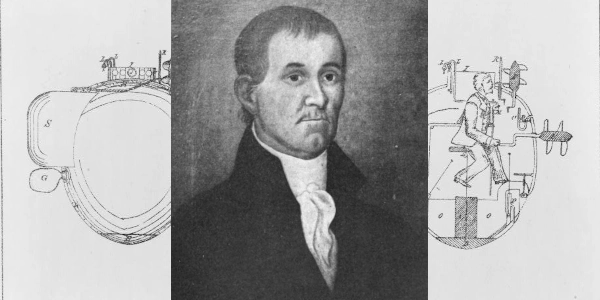
Image above: Montage (right) Photo of the full size replica of Bushnell's Turtle Submarine in the U.S. Navy Submarine Force Museum, used in 1776 by the Continental Navy against the British, 2008, divermasterking2000. Courtesy Flickr via Wikipedia Commons C.C. 2.0. (right) Portion of a drawing of the prototype for the Turtle Submarine, 1920, William Oliver Stevens. Courtesy Wikipedia Commons. Image below: Montage (background) Another diagram of David Bushnell's Turtle Submarine, the one-man submarine used to attach bombs to British warships during the American Revolution, 1881, Henry L. Abbot. Courtesy Library of Congress. (center) Turtle submarine operator Ezra James, 1916, unknown from The Story of the Submarine by Farnham Bishop. Courtesy Wikipedia Commons. Info Source: "A History of Sea Power," 1920, William Oliver Stevens, Allan Westcott, Allan Ferguson Westcott; Submaine Force Library and Museum; Library of Congress; Wikipedia Commons; "The beginning of modern submarine warfare, under Captain-Lieutenant David Bushnell, Sappers and miners, Army of the revolution," 1881, Lieutenant Colonel Henry L. Abbot; "David Bushnell and his Revolutionary Submarine," 2022, Brenda Milkofski, connecticutthistory.org; "Bushnell's Turtle, A Revolutionary Submarine," 2022, battlefields.org; americanrevolution.org; "The Submarine Turtle, Naval Documents of the Revolutionary War," history.navy.mil; "We Should Be Blown Up Together - Under the Sea With Ezra Lee," founderoftheday.com; "Turtle, David Bushnell's Revolutionary Vessel," Roy R. Manstan, Frederic J. Frese.
History Photo Bomb
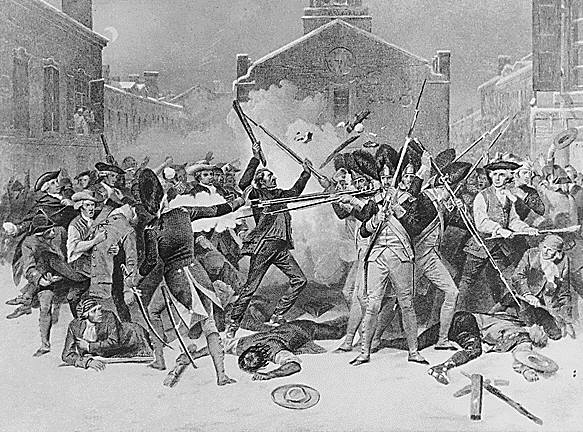
Drawing of the Boston Massacre, March 5, 1770.
ABH Travel Tip
The bargains at the National Park Service continue, despite some recent increases in park fees. The National Park Pass is now called the America the Beautiful Pass, which admits all vehicle and family visitors for one year, and costs $80 for one twelve month period. The pass covers most Federal fee areas, including National Parks, Historic Sites, and National Forests. For those of 62 years of age or older, buy the America the Beautiful Senior Pass. For only $20 per year or $80 for a lifetime pass, you gain free
entrance for the rest of your life to all National Parks, National Historic Sites, and National Forests, and other federal fee sites for you, your spouse, and your children, plus discounts of 50% on some use fees, such as camping. Must be purchased in person at a National Fee location, which are the one hundred or so National Park Service sites that charge for entry. Prices for foreign visitor are expected to rise in 2026.

Paul Revere on his ride to Concord to warn the patriots that
the British were coming. Courtesy National Archives.
Timeline Book


George Washington talking to his men outside the log huts at
his encampment in Valley Forge. Courtesy National Archives.
Military History
Check Out This Interesting
Website suggested by students at Green Mountain
Central School District in Vermont, Understanding Our Military Branches