-
Timeline - The 1970s
Watergate. The end of Vietnam. Normal relations with China. Earth Day. It was a nation in flux, one turning in small measures to a computer age, even if that computer was originally the size of a house.
More 1900s

With the Senate vote in 1978 to return the Panama Canal back to Panama in 1999, the nearly one hundred year history of Washington's involvement in the canal would come to an end. Photo: Panama Canal workers, circa 1906.

Check out the Spotlights on History you may not know about, our monthly feature at America's Best History.
Click here to Sponsor the page and how to reserve your ad.
-
Timeline
1977 - Detail
July 13, 1977 - The New York City blackout results in massive looting and disorderly conduct during its twenty-five hour duration.
Okay, let's get this out of the way right up front. This is not about race, or poverty; it is about being taught what the right thing to do is when nobody can see it. The civil unrest and looting that occurred after the lightning strikes that caused New York City to dim into darkness on July 13, 1977, at first saw people helping people, directing traffic, and staying calm under candlelight. But others saw the opportunity to loot and pillage and to act like they had not been taught better by their moms. And unfortunately, as we've seen by riots over the last several years, another blackout in New York City would likely cause the same reaction. Que lastima.
The culprit during the night had been several lightning strikes to the city's north. It plunged the neighborhoods into darkness, a pitch black scene so different from the usual lights of New York City. By the time the night ended, one thousand six hundred and sixteen stores were ravaged. Store shelves were empty. The police made arrests, three thousand seven hundred and seventy six of them, but they were overwhelmed by the unrest. There was arson, a reported one thousand and thirty-seven, a great number of them in the Bronx, more than a few in Brooklyn itself. The lightning had done less damage except for causing the dark corners of every street. And to add to the desperation, the date of the blackout was also in the time of the Son of Sam serial killer murders.
It had been a minor blackout compared to that of 1965 when the city stayed calm. Nine million people were affected in 1977; twenty-five million in 1965 with a more regional outage. This one was a Consolidate Edision problem in less boroughs, but it was in many of the boroughs under stress from the economy and social disfunction. The lightning strike hit two transmission lines between Buchanon Street and Millwood West in Westchester Country at first. Less than twenty minutes later, another lightning strike blasted another two transmission lines. although one came back on line. There were problems at the Indian Point 3 Generating Unit and trees kept going down into power lines. As an isolated system, Con Edision could not handle it, going completely dark in fifty-nine minutes. The blackout took twenty-six hours for the Con Ed team to fix the damage and get the city back with power.
Newspaper Reports - New York Times, July 14, 1977
A vast power failure plunged New York City and Westchester County into darkness last night, disrupting the lives of nearly nine million people. Thousands of subway riders were trapped in trains that stopped between stations. Homes and apartments went black. Thousands of people were trapped in elevators. Others stumbled and streamed from theaters, restaurants, and late‐closing shops and office buildings. The power failed at 9:34 P.M., apparently when lightning struck a Consolidated Edison electrical transmission line in northern Westchester. Like dominos falling through Westchester and the city, circuit breakers and successively overloaded transmission lines went off automatically.
A Repetition of 1965
The result, for the utility's three million customers, was a repetition of the Nov. 9, 1965 power failure that hit New York City during the early evening rush hour, cutting power to the city, parts of nine northeastern states, and two provinces of Canada. But this time the lights failed at night, with no daylight left to help people get to their homes.
Kennedy International and LaGuardia airports both closed, and flights were diverted to Newark, Boston, and other airfields. Hospitals switched to emergency power sources, but the emergency units failed at Bellevue Hospital. Police Headquarters in downtown Manhattan also used standby power. Civilians with flashlights joined policemen all over the city at major intersections to help direct traffic on highways and streets left without traffic lights. There were reports of widespread looting and vandalism, and police sirens wailed through the dark canyons of city streets. Calls for assistance flooded into the police emergency number, 911, and operators fell far behind in answering them. In addition, the police communications system, operating on emergency power, had difficulty reaching radio patrol cars, especially in outlying areas. Commissioner Michael J. Codd ordered all off‐duty personnel to report to the nearest precinct or command, in effect putting his entire 25,000‐member force to work. About 3,000 uniformed officers were on duty at the time of the blackout.
Mayor Beame, who was at Co‐op City in the Bronx when the blackout struck, hurried back to Gracie Mansion and then to City Hall, where he summoned all of his major commissioners. In a news conference at City Hall, Commissioner Codd and his chief of operations, James F. Hannon, said the police were trying to get buses to transfer units from Staten Island to Manhattan, the Bronx and Brooklyn. Chief Hannon said that units were being dispatched to the most “critically needed areas” in those three boroughs. In addition to the police, all firemen and corrections officers were ordered to report for duty immediately. Off‐duty firemen were told to report to the fire station or police precinct stationhouse nearest their home. While Police Headquarters had emergency power, City Hall did not and planning for the emergency unfolded in candlelight until the Fire Department brought in gasoline generators to supply light at about 11:30 P.M.
Power on Staten Island
Only some sections of Staten Island and buildings with their own emergency generators had power during the blackout. When the lights flickered and then went out, there were some gleeful, spontaneous shouts from knots of people on the streets. Rockefeller Center soon drew Christmaslike crowds, but they came not for a treat, but to stroll through the powerful and somber group of towers. Across the city, candles flickered in homes and apartments. In the darkness the thoroughfares became rivers of lights as cars and buses moved at reduced speed, halting frequently at the waving flashlights of volunteers who were directing traffic. People in the streets and aboard buses spoke to strangers and talked of the great blackout of 1965. Along Fulton Street in Brooklyn, “fairly severe” looting took place immediately after the blackout. Entire storefronts were ripped away and the stores looted. There were so many arrests in Brooklyn that the police said they had lost count. The prisoners were left at the 84th precinct station by police officers who forgot about the paperwork of the arrests and rushed back into the streets.
At the Bronx House of Detention, a disturbance broke out shortly after the blackout occurred, according to Mayor Beame. The police and the Corrections Department rushed reinforcements to the scene. Shortly after midnight, a police spokesman said that inmates at the Bronx jail had taken over the guard house. It was not immediately known if any guards were being held hostage or how many prisoners were involved. Bellevue Hospital's backup emergency power went out shortly after midnight. Doctors and nurses squeezed bags of air with their hands to resuscitate patients when respirators stopped, and emergency generators were brought in. The Red Cross set up emergency medical centers at Pennsylvania Station and Grand Central Terminal, and some armories were reported opened for first aid.
Some Trains Stranded
About a dozen Long Island Rail Road trains were stranded in Queens, according to a spokesman for the line. A Transit Authority spokesman said that auxiliary power had been used to move subway trains into stations and that, as a result, only seven trains, carrying several thousand riders, had been trapped on the system. Two trains were on the Manhattan Bridge. While the subways had emergency power to get trains into the nearest station, the subway system shut down during the power outage, and the auxiliary power was used to light some station platforms. In most instances, people emerging from trains were orderly, but others found it difficult to retain their composure in the pitch darkness of some stations. In lower Manhattan at the IRT Fulton Street station, a train pulled in just after the blackout, and the passengers groped along the station wall in the darkness in search of an exit. In the confusion, some were whimpering, but there was no panic. Looting appeared to be the worst public safety problem. In a stereo store called Tech Hi‐F5 at 112th Street and Broadway, a crowd ripped away a metal grating and smashed the windows with a litter basket.
At the Radio Clinic, 13 blocks south on Broadway, looters took television sets, small appliances, and other items. A policeman said that he had grabbed a young boy and a girl outside but that "the bottles started flying . . . we got back in our cars and we went." The police later came back in force and arrested numerous bottle throwers. Some of those taken into custody were still carrying television and hi‐fi sets and stolen clothing when they were taken into the stationhouses. Looting also was reported on the Grand Concourse in the Bronx and bottle throwing was reported also in Harlem and downtown Brooklyn. At least four police officers were injured and hospitalized.
Fire Alarms Triggered
Fires were set in trash baskets in many parts of the city, and there was a heavy demand for fire equipment as alarm boxes were pulled all over the city. Elsewhere burglar alarms clanged stridently in the darkness. Many people were said to have left restaurants without paying their bills. Massive crowds gathered outside Lincoln Center and along Broadway in the Times Square theater district as people left darkened theaters. The blackout interrupted a Mets baseball game at Shea Stadium in Queens, and 15,000 fans groped their way out.
The police said the worst incidents of looting were in downtown Brooklyn, East Harlem and on the Upper West Side. A police officer said that Third Avenue in East Harlem “is demolished,” and added, "it's like a bomb hit it."
Many Looters Arrested
Along Broadway between 96th and 106th Streets more than a dozen stores were looted, and at least 30 people were arrested and taken to the West 100th Street stationhouse. A police officer at the Alexander Avenue station in the South Bronx said of the looting, "they hit every store in the 40‐block area." By 1 a.m., 70 people were under arrest at the West 100th Street station on looting charges, and the stationhouse began to look like a department store, with looted items—appliances, leather chairs, clothing —stacked up in the muster rooms. The police said that as of 1 a.m. there had been 309 arrests throughout the city, nearly all for looting.
There were islands of serenity amid the confusion. The Statue of Liberty's lights continued to shine over the Upper Bay; people in their homes and apartments dined by candlelight, and no serious problems at all were reported in Westchester County. "All's quiet," said Police Chief Charles G. McLaughlin in Rye. "We have a nice quiet community under any circumstances."
Minute Walk in History
New York City Blackout 1977
Watch videos and photographs of the New York City blackout and looting in 1977 underscored by music. Witness riots and civil unrest while others calmly sat out a night of darkness caused by lightning strikes.
Impact of the Blackout
A report for the Department of Enery enumerated many of the outcomes. Business had a direct economic impact of $34 million dollars and an indirect impact of $154 million. Government assistance programs had to spend $12.5 million more dollars than if the blackout had not happened. For Consolidated Edison itself, the restoration cost $12 million, with new equipment necessary an additional $65 million. There was an indirect impact on the insurance market; $33.5 million dollars. Public health spent $1.5 million more. Public services, including Metropolitan Transportation Authority had direct impacts of $9.1 million and indirect impacts of $17.2 million, which included $4.4 million in police overtime pay.
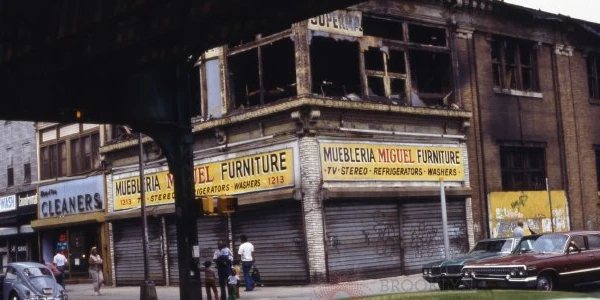
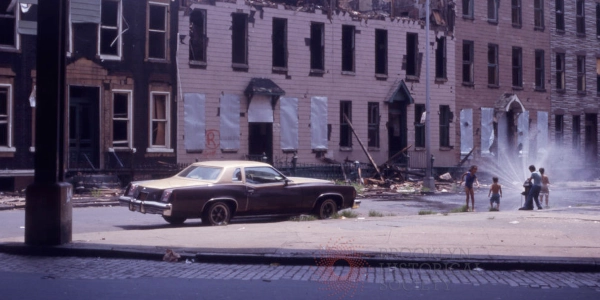
Photo above: A destroyed furniture store in Brooklyn, 1977, Center for Brooklyn History. Photo below: Children in street next to damaged buildings, 1977, Center for Brooklyn History, Brooklyn Historical Society. Source Info: Center for Brooklyn History; Brooklyn Historical Society; "Summer of 1977 in New York City," 2016, Editor Savannah Cox, allthatsinteresting.com; "Why the 1977 Blackout Was One of New York's Darkest Hours," 2015, Jennifer Aston, Time.com; "The Great New York City Blackouts; History of 1965, 1977, and 2003," 2026, Brian Katchejian, classicnewyorkhistory.com; New York Times; "Impact Assessment of the 1977 New York City Blackout," 1978, Jane L. Corwin and William T. Miles, Department of Energy.
History Photo Bomb
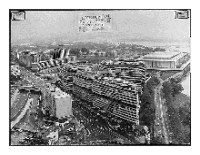
The Watergate Office Complex exhibit photo. Trial of June 17,
1972 burglary of the Democratic National Committee. Source: U.S.
District Court for the District of Columbia.
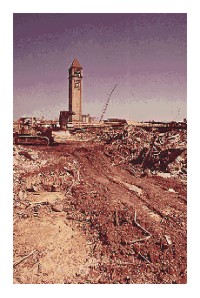
Construction on the site of Expo 74, Spokane, Washington, one
year before opening. Theme to be the Environment. May 1973. Photo: Environmental Protection Agency.
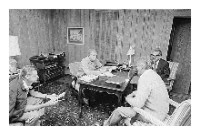
Camp David Peace Accord negotiated at the presidential retreat within Catoctin Mountain Park. Courtesy National Archives.
Official Souvenirs
America's Best History