-
Timeline - The 1990s
A presidential scandal amidst prosperity and a world that is beginning to show signs of the conflicts to come with the first Gulf War and attacks in New York City.
More 1900s

President Clinton and Boris Yeltsin. Courtesy National Archives.
Sponsor this page. Your banner or text ad can fill the space above.
Click here to Sponsor the page and how to reserve your ad.
-
Timeline
1995 - Detail
July 27, 1995 - The Korean War Memorial in Washington, D.C. is dedicated in ceremonies presided by President Bill Clinton and South Korean President Kim Yong-sam.
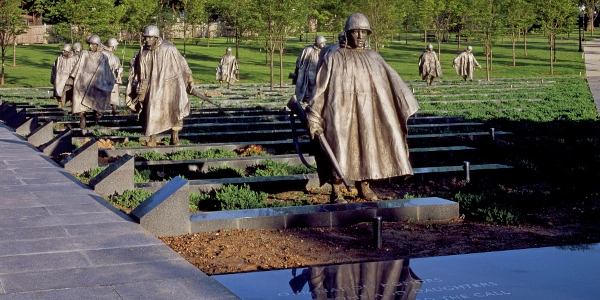
It had taken much too long for a Korean War Memorial to be built. Was that due to the fact that the war was not truly, officially, over? To some degree yes. However, the fact remained, that the sacrifice of the men and women in the Korean War deserved to have a monument to stand alongside the others on the National Mall. However, these efforts take time. Just think about how long it took for the World War II to find its magnificent place among the Memorials there.
Fifty-Four thousand United States soldiers lost their lives in the war that began in June 1950; over one hundred and eighteen thousand total killed, wounded, and missing, with more than 5.7 million Americans serving in that theater over the three years of arduous battle. There are still twenty-eight thousand five hundred United States soldiers anchored on the demilitarized zone at the 38th parallel between the divided nations of democratic South Korea and communist North Korea. The was is still not technically over.
Congress approved the construction of the Memorial in 1986. There had been years of lobbying by Korean War Veterans organizations before that. Original design work had been done by Penn State architects, although that was withdrawn. Eventually the firm of Cooper-Lecky Architects with lead architect Frank Gaylord (main section) and Louis Nelson (industrial designer, granite wall) won the design contest that had nearly five hundred submissions. The site chosen by the advisory committee established by President Reagan in 1988 was across the reflecting pool from the Vietnam Memorial.
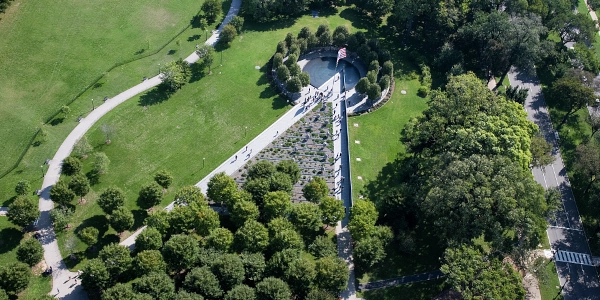
Construction of the project began on June 14, 1992 with President H.W. Bush at the groundbreaking. The sculpture and gardens of the Korean War Memorial located in ash woods of West Potomac Park contains several distinct features. The nineteen steel sculptures of U.S. soldiers, seven foot three inches tall, moving through a rice paddy evoke the difficult terrain which the branches of the service had to endure. A polished granite wall, Academy Black granite from California, one hundred and sixty-four feet long reflects not only those figures a second time, but contains two thousand five hundred images of soldiers, support staff, and equipment as well. There is a pool of reflection and the words, "Freedom Is Not Free," in places throughout the landscape. It certainly is not.
Full Text, Congressional Approval of Memorial
Public Law 99-572, 99th Congress
An Act
To authorize the erection of a memorial on Federal land in the District of Columbia and its environs to honor members of the Armed Forces of the United States who served in the Korean war.
Be it enacted by the Senate and House of Representatives of the United States of America in Congress assembled,
AUTHORIZATION OF MEMORIAL
SECTION 1. The American Battle Monuments Commission is authorized to establish a memorial on Federal land in the District of
Columbia and its environs to honor members of the Armed Forces of the United States who served in the Korean war, particularly those who were killed in action, are still listed as missing in action, or were held as prisoners of war. Such memorial shall be established in accordance with the provisions of H.R. 4378, as approved by the House of Representatives on September 29,1986.
ESTABLISHMENT OF KOREAN WAR VETERANS MEMORIAL ADVISORY BOARD
SEC. 2. (a) There is hereby established a Korean War Veterans Memorial Advisory Board which shall consist of twelve veterans
who served in the Korean war. The members of the Board shall be appointed by the President within one hundred and twenty calendar
days of enactment of this Act.
(b) The Korean War Veterans Memorial Advisory Board shall be responsible for:
(1) recommending the site and selecting the design for the memorial, subject to the approval of the American Battle Monu
ments Commission and in accordance with section 7(a) of H.R. 4378, as approved by the House of Representatives on September 29,1986; and
(2) promoting the establishment of the memorial and encouraging the donation of private funds for the construction
and maintenance of the memorial.
FEDERAL AUTHORIZATION AND PRIVATE FUNDING
SEC. 3. (a) The American Battle Monuments Commission shall establish the memorial with private funds except as provided in
subsection (b) of this section. For the purpose of carrying out this Act, the American Battle Monuments Commission is authorized to solicit and accept private contributions. The Commission is directed to establish an account into which these private funds shall be deposited and to maintain documentation of such contributions.
(b) There are hereby authorized to be appropriated:
(1) $500,000 for site preparation, design, planning, and associated administrative costs for the establishment of the memorial;
and
(2) $500,000 for construction of the memorial, to be available only after a construction permit has been issued for the memorial.
(c) Private funds donated in excess of the cost of construction and maintenance of the memorial shall be deposited in the Treasury as miscellaneous receipts to reimburse the United States for funds appropriated pursuant to subsection (b) of this section.
Approved October 28, 1986.
The Dedication
On July 27, 1995, President Bill Clinton and South Korean President Kim Yong-sam dedicated the Memorial on the 42nd anniversary of the armistice. The President spoke at 3:20 p.m. South Korean President Kim preceeded him.
PRESIDENT KIM: Your Excellency President Clinton, American congressional leaders, delegates from the Korean War, allies, Korean War veterans, ladies and gentlemen:
We are dedicating this Korean War Veterans Memorial in memory of all the veterans who fought heroically in that war so that all succeeding generations will know how great the sacrifices and devotion of those veterans were, and how precious freedom and peace are. On behalf of the people of the Republic of Korea, I pay tribute to all those Korean war veterans who sacrificed their lives, and I pay respect to all those who fought in that war.
I would like to express my profound appreciation to the United States government, Congress, General Davis, and others for sponsoring and supporting the building of this profoundly meaningful memorial.
Korean War veterans and distinguished guests, the sacrifices of the Korean War veterans to defend freedom and peace were not in vain. The blood and sweat shed by the U.S. and the U.N. troops proved to be the prime mover behind the realization of freedom throughout the postwar world. The free world's participation in the Korean War, its first resolute and effective action to stem the expansion of communism, changed the course of history. In this sense, I would say that the Korean War was the war that heralded the collapse of the Berlin Wall and the demise of communism. (Applause.)
We take pride in the progress of history that has turned the Korean War from a forgotten war into a war most worthy of remembrance. Let all succeeding generations remember the truism engraved in this great memorial -- freedom is not free.
Thank you. (Applause.)
PRESIDENT CLINTON: Thank you. Thank you very much, President Kim, for your fine remarks on behalf of all the people of
Korea, and for your leadership and for your defense of democracy in your country, proving that these sacrifices of the Americans and others were not in vain.
Thank you to all the distinguished guests who are here.
I'd like to say also a special word of thanks for those who are responsible for this memorial, for those who designed and built it and conceived it, and those who operate it. It is a magnificent reminder of what is best about the United States. And I thank you all for your contribution. (Applause.)
I also believe that everyone in this crowd, indeed everyone in this country, owes a special debt of gratitude to General Davis and to his predecessor, General Stilwell, for their eight-year dream to make this day a reality. (Applause.) General Davis served our country with great distinction in World War II and went on to win the Congressional Medal of Honor in Korea. But he had eight more long years of combat to make this day happen. And all of us who are here owe it to him to say thank you for all of that service. (Applause.)
Today we are surrounded by monuments to some of the greatest figures in our history, while we gather at this our newest national memorial to remember and honor the Americans who fought for freedom in Korea. In 1950, our nation was weary of war, but 1.5 million Americans left their family and friends and their homes to help to defend freedom for a determined ally halfway around the world -- or, as the monument says, a place they had never been and a people they had never met.
Together with men and women from 20 other nations, all of whom are represented here today, they joined the first mission of the United Nations to preserve peace, by fighting shoulder to shoulder with the brave people of South Korea to defend their independence, to safeguard other Asian nations from attack, and to protect the freedom that remains our greatest gift. The Korean War veterans endured terrible hardships -- deathly cold, weeks and months crammed in foxholes and bunkers, an enemy of overwhelming numbers, the threat of brutal imprisonment and torture, defending the perimeter at Pusan, braving the tides at Inchon, confronting the world's fastest fighter jets in Mig Alley, enduring hand to hand combat on Heartbreak Ridge and Pork Chop Hill, fighting the way back from Chosin Reservoir. They set a standard of courage that may be equal, but will never be surpassed in the annals of American combat. (Applause.)
If I might recount the deeds of just two men, so as to ring to life today, so many years later, the dimensions of this conflict. One from my home state, 26-year-old Lloyd Burke was trying to lead his company to high ground outside of Seoul. Pinned down by enemy fire, he wiped out three enemy bunkers in a lone assault. Hand grenades were thrown at him. So he caught them and threw them back. Later, he knocked out two enemy mortars and a machine gun position. Despite being wounded, he led his men in a final charge and took the hill. For his extraordinary courage and leadership, Lloyd Burke was awarded the Congressional Medal of Honor. (Applause.)
Corporal Ronald Rosser was forward observer in the hills near Ponggilli when his platoon came under fire from two directions. With just a carbine and a grenade, he charged the enemy position and knocked out two bunkers and cleared a trench. Twice he ran out of ammunition and twice he crossed through enemy fire to resume his attack.
Later, even though he was wounded, Ronald Rosser repeatedly dodged enemy fire to bring other injured soldiers to safety. And for his exceptional bravery, he, too, was awarded the Medal of Honor. (Applause.)
These two great Americans, Lloyd Burke and Ronald Rosser, are with us here today. I ask them to stand and be recognized on behalf of all the veterans of the Korean War. (Applause.)
In this impressive monument we can see the figures and faces that recall their heroism. In steel and granite, water and earth, the creators of this memorial have brought to life the courage and sacrifice of those who served in all branches of the Armed Forces from every racial and ethnic group and background in America. They represent, once more, the enduring American truth: From many we are one.
Tens of thousands of Americans died in Korea. Our South Korean allies lost hundreds of thousands of soldiers and civilians. Our other U.N. allies suffered grievous casualties. Thousands of Americans who were lost in Korea to this day have never been accounted for. Today I urge the leaders of North Korea to work with us to resolve those cases. (Applause.)
President Kim and I are working together to open the door to better relations between our nations and North Korea. Clarifying these MIA cases is an important step. We have not forgotten our debt to them or to their families and we will never stop working for the day when they can be brought home. (Applause.)
This memorial also commemorates those who made the ultimate sacrifice so that we might live free. And I ask you on this hot, summer day to pause for a moment of silence in honor of those from the United States, our U.N. allies and from our friends in the Republic of Korea who lost their lives in the Korean War. (A moment of silence is observed.) Amen.
On this day 42 years ago, President Dwight Eisenhower called the end of hostilities an armistice on a single battleground, not peace in the world. It's fair to say that when the guns fell silent then, no one knew for sure what our forces in Korea had done for the future of our nation or the future of world freedom. The larger conflict of the Cold War had only begun. It would take four decades more to win.
In a struggle so long and consuming, perhaps it's not surprising that too many lost sight of the importance of Korea. But now we know with the benefit of history, that those of you who served and the families who stood behind you laid the foundations for one of the greatest triumphs in the history of human freedom. By sending a clear message that America had not defeated fascism to see communism prevail, you put the free world on the road to victory in the Cold War. That is your enduring contribution. And all free people everywhere should recognize it today. (Applause.)
And look what you achieved in Korea. Today, Korea is thriving and prosperous. From the unbelievable poverty and ruin at the aftermath of the war, this brave, industrious, strong country has risen to become the 11th largest economy in the entire world, with a strong democratic leader in President Kim. In Asia, peace and stability are more firmly rooted than at any time since World War II. And all around the world, freedom and democracy are now on the march.
So to all the veterans here today, and to all throughout our land who are watching, let us all say, when darkness threatened you kept the torch of liberty alight. You kept the flame burning so that others all across the world could share it. You showed the truth inscribed on the wall, that freedom is not free.
We honor you today because you did answer the call to defend a country you never knew, and a people you never met. They are good people. It's a good country. And the world is better because of you.
God bless you and God bless America. (Applause.)
Photo above: Steel soldiers in rice patties of Korea, part of Korean War Memorial, circa 1995-2006, Carol M. Highsmith. Courtesy Library of Congress. Below: Aerial view of the Korean War Memorial, 1995, Carol M. Highsmith. Courtesy Library of Congress. Info source: National Park Service; "Korean War Veterans Memorial ... Freedom is Not Free," nationalmall.org; "The Korean War Veterans Memorial," koreanwarvetsmemorial.org; "A War Monument Mystery - An Army Vet Tells Story of Designing Korean War Memorial," 2021, Mac Caltrider, coffeeordie.com; Library of Congress; Wikipedia Commons; koreanwar.org; newsnationnow.com.
History
Photo Bomb
President George H.W. Bush, Vice President Dan Quayle and
school children in conversation with astronauts at NASA. January 24, 1992. Photo: Photographic Office.
Official Souvenirs
America's Best History


Towers of the World Trade Center. Courtesy National Archives.
Timeline History

Want a copy of the Timeline. Now available in easy to search
digital format for your Kindle, Nook, or pdf format. Also comes in paperback, too.

Christopher Columbus, by Ridalfo Ghirlandaio, 1520. New U.S.
preserve, Salt River Bay, on land Columbus actually visited dedicated in the Virgin Islands. Courtesy Wikipedia Commons.
ABH Travel Tip

If you've never been there, or it's been awhile since you've taken a trip to Washington, D.C., the nation's capitol is a treat for anyone interested in the USA and its history. From the spectacular museums of the Smithsonian, to the recent addition of the Holocaust museum and the Newseum, too, there's so much to see and do. One of the best new attractions is the World War II Memorial. It will make you wonder what took them so long and just why there was any controversy about adding this museum to the space between the Washington Memorial and the Lincoln Memorial.
Fifty-Four thousand United States soldiers lost their lives in the war that began in June 1950; over one hundred and eighteen thousand total killed, wounded, and missing, with more than 5.7 million Americans serving in that theater over the three years of arduous battle. There are still twenty-eight thousand five hundred United States soldiers anchored on the demilitarized zone at the 38th parallel between the divided nations of democratic South Korea and communist North Korea. The was is still not technically over.
Congress approved the construction of the Memorial in 1986. There had been years of lobbying by Korean War Veterans organizations before that. Original design work had been done by Penn State architects, although that was withdrawn. Eventually the firm of Cooper-Lecky Architects with lead architect Frank Gaylord (main section) and Louis Nelson (industrial designer, granite wall) won the design contest that had nearly five hundred submissions. The site chosen by the advisory committee established by President Reagan in 1988 was across the reflecting pool from the Vietnam Memorial.
Construction of the project began on June 14, 1992 with President H.W. Bush at the groundbreaking. The sculpture and gardens of the Korean War Memorial located in ash woods of West Potomac Park contains several distinct features. The nineteen steel sculptures of U.S. soldiers, seven foot three inches tall, moving through a rice paddy evoke the difficult terrain which the branches of the service had to endure. A polished granite wall, Academy Black granite from California, one hundred and sixty-four feet long reflects not only those figures a second time, but contains two thousand five hundred images of soldiers, support staff, and equipment as well. There is a pool of reflection and the words, "Freedom Is Not Free," in places throughout the landscape. It certainly is not.
An Act
To authorize the erection of a memorial on Federal land in the District of Columbia and its environs to honor members of the Armed Forces of the United States who served in the Korean war.
Be it enacted by the Senate and House of Representatives of the United States of America in Congress assembled,
AUTHORIZATION OF MEMORIAL
SECTION 1. The American Battle Monuments Commission is authorized to establish a memorial on Federal land in the District of Columbia and its environs to honor members of the Armed Forces of the United States who served in the Korean war, particularly those who were killed in action, are still listed as missing in action, or were held as prisoners of war. Such memorial shall be established in accordance with the provisions of H.R. 4378, as approved by the House of Representatives on September 29,1986.
ESTABLISHMENT OF KOREAN WAR VETERANS MEMORIAL ADVISORY BOARD
SEC. 2. (a) There is hereby established a Korean War Veterans Memorial Advisory Board which shall consist of twelve veterans who served in the Korean war. The members of the Board shall be appointed by the President within one hundred and twenty calendar days of enactment of this Act.
(b) The Korean War Veterans Memorial Advisory Board shall be responsible for:
(1) recommending the site and selecting the design for the memorial, subject to the approval of the American Battle Monu ments Commission and in accordance with section 7(a) of H.R. 4378, as approved by the House of Representatives on September 29,1986; and
(2) promoting the establishment of the memorial and encouraging the donation of private funds for the construction and maintenance of the memorial.
FEDERAL AUTHORIZATION AND PRIVATE FUNDING
SEC. 3. (a) The American Battle Monuments Commission shall establish the memorial with private funds except as provided in subsection (b) of this section. For the purpose of carrying out this Act, the American Battle Monuments Commission is authorized to solicit and accept private contributions. The Commission is directed to establish an account into which these private funds shall be deposited and to maintain documentation of such contributions.
(b) There are hereby authorized to be appropriated:
(1) $500,000 for site preparation, design, planning, and associated administrative costs for the establishment of the memorial; and
(2) $500,000 for construction of the memorial, to be available only after a construction permit has been issued for the memorial.
(c) Private funds donated in excess of the cost of construction and maintenance of the memorial shall be deposited in the Treasury as miscellaneous receipts to reimburse the United States for funds appropriated pursuant to subsection (b) of this section.
Approved October 28, 1986.
PRESIDENT KIM: Your Excellency President Clinton, American congressional leaders, delegates from the Korean War, allies, Korean War veterans, ladies and gentlemen:
We are dedicating this Korean War Veterans Memorial in memory of all the veterans who fought heroically in that war so that all succeeding generations will know how great the sacrifices and devotion of those veterans were, and how precious freedom and peace are. On behalf of the people of the Republic of Korea, I pay tribute to all those Korean war veterans who sacrificed their lives, and I pay respect to all those who fought in that war.
I would like to express my profound appreciation to the United States government, Congress, General Davis, and others for sponsoring and supporting the building of this profoundly meaningful memorial.
Korean War veterans and distinguished guests, the sacrifices of the Korean War veterans to defend freedom and peace were not in vain. The blood and sweat shed by the U.S. and the U.N. troops proved to be the prime mover behind the realization of freedom throughout the postwar world. The free world's participation in the Korean War, its first resolute and effective action to stem the expansion of communism, changed the course of history. In this sense, I would say that the Korean War was the war that heralded the collapse of the Berlin Wall and the demise of communism. (Applause.)
We take pride in the progress of history that has turned the Korean War from a forgotten war into a war most worthy of remembrance. Let all succeeding generations remember the truism engraved in this great memorial -- freedom is not free.
Thank you. (Applause.)
PRESIDENT CLINTON: Thank you. Thank you very much, President Kim, for your fine remarks on behalf of all the people of
Korea, and for your leadership and for your defense of democracy in your country, proving that these sacrifices of the Americans and others were not in vain.
Thank you to all the distinguished guests who are here.
I'd like to say also a special word of thanks for those who are responsible for this memorial, for those who designed and built it and conceived it, and those who operate it. It is a magnificent reminder of what is best about the United States. And I thank you all for your contribution. (Applause.)
I also believe that everyone in this crowd, indeed everyone in this country, owes a special debt of gratitude to General Davis and to his predecessor, General Stilwell, for their eight-year dream to make this day a reality. (Applause.) General Davis served our country with great distinction in World War II and went on to win the Congressional Medal of Honor in Korea. But he had eight more long years of combat to make this day happen. And all of us who are here owe it to him to say thank you for all of that service. (Applause.)
Today we are surrounded by monuments to some of the greatest figures in our history, while we gather at this our newest national memorial to remember and honor the Americans who fought for freedom in Korea. In 1950, our nation was weary of war, but 1.5 million Americans left their family and friends and their homes to help to defend freedom for a determined ally halfway around the world -- or, as the monument says, a place they had never been and a people they had never met.
Together with men and women from 20 other nations, all of whom are represented here today, they joined the first mission of the United Nations to preserve peace, by fighting shoulder to shoulder with the brave people of South Korea to defend their independence, to safeguard other Asian nations from attack, and to protect the freedom that remains our greatest gift. The Korean War veterans endured terrible hardships -- deathly cold, weeks and months crammed in foxholes and bunkers, an enemy of overwhelming numbers, the threat of brutal imprisonment and torture, defending the perimeter at Pusan, braving the tides at Inchon, confronting the world's fastest fighter jets in Mig Alley, enduring hand to hand combat on Heartbreak Ridge and Pork Chop Hill, fighting the way back from Chosin Reservoir. They set a standard of courage that may be equal, but will never be surpassed in the annals of American combat. (Applause.)
If I might recount the deeds of just two men, so as to ring to life today, so many years later, the dimensions of this conflict. One from my home state, 26-year-old Lloyd Burke was trying to lead his company to high ground outside of Seoul. Pinned down by enemy fire, he wiped out three enemy bunkers in a lone assault. Hand grenades were thrown at him. So he caught them and threw them back. Later, he knocked out two enemy mortars and a machine gun position. Despite being wounded, he led his men in a final charge and took the hill. For his extraordinary courage and leadership, Lloyd Burke was awarded the Congressional Medal of Honor. (Applause.)
Corporal Ronald Rosser was forward observer in the hills near Ponggilli when his platoon came under fire from two directions. With just a carbine and a grenade, he charged the enemy position and knocked out two bunkers and cleared a trench. Twice he ran out of ammunition and twice he crossed through enemy fire to resume his attack.
Later, even though he was wounded, Ronald Rosser repeatedly dodged enemy fire to bring other injured soldiers to safety. And for his exceptional bravery, he, too, was awarded the Medal of Honor. (Applause.)
These two great Americans, Lloyd Burke and Ronald Rosser, are with us here today. I ask them to stand and be recognized on behalf of all the veterans of the Korean War. (Applause.)
In this impressive monument we can see the figures and faces that recall their heroism. In steel and granite, water and earth, the creators of this memorial have brought to life the courage and sacrifice of those who served in all branches of the Armed Forces from every racial and ethnic group and background in America. They represent, once more, the enduring American truth: From many we are one.
Tens of thousands of Americans died in Korea. Our South Korean allies lost hundreds of thousands of soldiers and civilians. Our other U.N. allies suffered grievous casualties. Thousands of Americans who were lost in Korea to this day have never been accounted for. Today I urge the leaders of North Korea to work with us to resolve those cases. (Applause.)
President Kim and I are working together to open the door to better relations between our nations and North Korea. Clarifying these MIA cases is an important step. We have not forgotten our debt to them or to their families and we will never stop working for the day when they can be brought home. (Applause.)
This memorial also commemorates those who made the ultimate sacrifice so that we might live free. And I ask you on this hot, summer day to pause for a moment of silence in honor of those from the United States, our U.N. allies and from our friends in the Republic of Korea who lost their lives in the Korean War. (A moment of silence is observed.) Amen.
On this day 42 years ago, President Dwight Eisenhower called the end of hostilities an armistice on a single battleground, not peace in the world. It's fair to say that when the guns fell silent then, no one knew for sure what our forces in Korea had done for the future of our nation or the future of world freedom. The larger conflict of the Cold War had only begun. It would take four decades more to win.
In a struggle so long and consuming, perhaps it's not surprising that too many lost sight of the importance of Korea. But now we know with the benefit of history, that those of you who served and the families who stood behind you laid the foundations for one of the greatest triumphs in the history of human freedom. By sending a clear message that America had not defeated fascism to see communism prevail, you put the free world on the road to victory in the Cold War. That is your enduring contribution. And all free people everywhere should recognize it today. (Applause.)
And look what you achieved in Korea. Today, Korea is thriving and prosperous. From the unbelievable poverty and ruin at the aftermath of the war, this brave, industrious, strong country has risen to become the 11th largest economy in the entire world, with a strong democratic leader in President Kim. In Asia, peace and stability are more firmly rooted than at any time since World War II. And all around the world, freedom and democracy are now on the march.
So to all the veterans here today, and to all throughout our land who are watching, let us all say, when darkness threatened you kept the torch of liberty alight. You kept the flame burning so that others all across the world could share it. You showed the truth inscribed on the wall, that freedom is not free.
We honor you today because you did answer the call to defend a country you never knew, and a people you never met. They are good people. It's a good country. And the world is better because of you.
God bless you and God bless America. (Applause.)
Photo above: Steel soldiers in rice patties of Korea, part of Korean War Memorial, circa 1995-2006, Carol M. Highsmith. Courtesy Library of Congress. Below: Aerial view of the Korean War Memorial, 1995, Carol M. Highsmith. Courtesy Library of Congress. Info source: National Park Service; "Korean War Veterans Memorial ... Freedom is Not Free," nationalmall.org; "The Korean War Veterans Memorial," koreanwarvetsmemorial.org; "A War Monument Mystery - An Army Vet Tells Story of Designing Korean War Memorial," 2021, Mac Caltrider, coffeeordie.com; Library of Congress; Wikipedia Commons; koreanwar.org; newsnationnow.com.
History Photo Bomb
President George H.W. Bush, Vice President Dan Quayle and
school children in conversation with astronauts at NASA. January 24, 1992. Photo: Photographic Office.
Official Souvenirs
America's Best History
Towers of the World Trade Center. Courtesy National Archives.
Timeline History
Want a copy of the Timeline. Now available in easy to search
digital format for your Kindle, Nook, or pdf format. Also comes in paperback, too.
Christopher Columbus, by Ridalfo Ghirlandaio, 1520. New U.S.
preserve, Salt River Bay, on land Columbus actually visited dedicated in the Virgin Islands. Courtesy Wikipedia Commons.
ABH Travel Tip
If you've never been there, or it's been awhile since you've taken a trip to Washington, D.C., the nation's capitol is a treat for anyone interested in the USA and its history. From the spectacular museums of the Smithsonian, to the recent addition of the Holocaust museum and the Newseum, too, there's so much to see and do. One of the best new attractions is the World War II Memorial. It will make you wonder what took them so long and just why there was any controversy about adding this museum to the space between the Washington Memorial and the Lincoln Memorial.