-
Timeline - The 1910s
Conflict comes to the entire world as the United States is drawn into the first World War against a foe that would not go away for thirty years, Germany. One million American soldiers would fight in that war.
More 1900s
More World War I Timeline
Timeline History

Now in easy to search digital format for your Kindle, Nook, or pdf format. Also comes in paperback, too.
Sponsor this page. Your banner or text ad can fill the space above.
Click here to Sponsor the page and how to reserve your ad.
-
Timeline
1914 - Detail
August 3, 1914 - The first ship passes through the completed Panama Canal after the United States finishes construction over ten years.
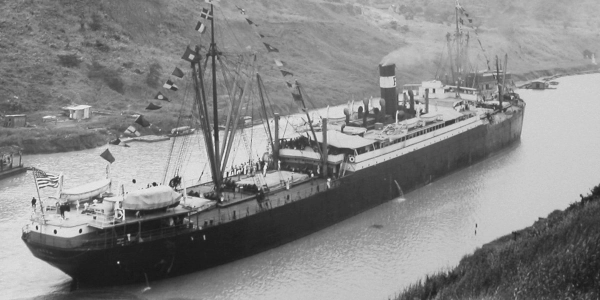
It had taken the United States ten years to complete the canal after purchasing its rights in 1903 in the Hay-Bunau-Varilla Treaty, and restarting construction one year later from the French failure. Of course, it did take the United States urging Panama (think U.S. warships blocking sea lanes for any possible Columbian troops movements) to break away from its mother country Columbia, as well as supporting the effort in many other ways after their failed negotiations with Columbia. But alas, the canal was now U.S. owned, construction underway, then completed with arduous consequences. Over twenty-six thousand people died through the French and United States days, but the U.S. construction deaths were fewer by comparison. Yes, the deaths were both construction related, but most through malaria and other diseases. However, now, after all that harangue and horris, it was time for the Panama Canal to take its place as a shortcut from the Pacific to the Atlantic Ocean.
The S.S. Cristobal, a renaming of the S.S. Tremont, would traverse the canal on August 3, 1914, becoming its first ship customer. She was a cargo and passenger ship built by Maryland steel. There had been a French crane ship of 1,200 tons and three cranes, the Alexander LaValley, to cross prior during construction of the Culebra Cut on January 7, 1914, but we are not counting that. The official opening would be twelve days later, with the S.S. Ancon making its way from one ocean to the other. The Ancon was a sister ship to the S.S. Tremont, both owned at one time by the Boston Steamship Company and now the property of the U.S. Government owned Panama Railroad Company's Panama Railroad Steamship Line since 1909. The Ancon traversed the Canal with several hundred bigwigs aboard. Despite its amazing achievement, war would take precedence in the newspaper headlines. The Panama Canal opening would have to take second place to World War I.
News Reports
Ship Goes Through Canal. First steamer uses waterway between the two oceans. Panama, Jan. 8. - The first vessel to go through the Panama canal under its own steam made the trip yesterday. It was the crane boat Alexander Lavalley, which was brought to Culebra cut early in December and has been working at Culebra since. It was taken through the Pedro Miguel ad Miraflores locks to the Pacific entrance, thus making the first trans-sithmian voyage. The Alexander Lavalley is an old French ship equipped with three cranes. It has a single screw and tonnage of 1,200." Belvedere Republican.
The Panama Canal - A Contrast. The Panama Canal is thrown open to the ships of the whole world today, four and a half months ahead of the schedule set eight years ago.
This is America's contribution to civilization in the year when the contribution of Europe promises to be a continent drenched in blood; here a neutral canal open on equal terms to the merchant fleets and the navies of the whole world, there armies straining at the leash which holds them from each other's throats, and navies maneuvering for a chance to send thousands of men and millions of money in money to the bottom of the ocean.
Today's opening of the Canal has been given the simplest possible official character, because the great celebration had been reserved for next spring, when it was expected that all the navies of the world would take part in the ceremonies. But the needs of commerce are not to be postponed to official glorification. Ships are now on their way from New York and San Francisco to take advantage of this short-cut through the heart of the Western Continent, and before a week has passed the great saving to the world's commerce will begin to be realized.
It will take from eight to twelve hours for a ship to go through the canal. It took the old Oregon sixty-eight days to get from San Francisco to Key West, of which fifty days were used from Callao, far below the Canal and she was hurrying to fight the Spaniards. What the Canal would mean if a like emergency should arise next year can be dimly apprehended, not fully realized. For our commerce, the Canal brings Seattle 7,800 miles nearer to New York, Honolulu 6,600, Guaynquill, in Ecuador, 7,400 and Yokohamo, nearly 6,000 miles nearer than they have been. It puts San Francisco 8,800 miles nearer to New Orleans than by Cape Horn, and Melbourne 1,300 miles nearer to Liverpool than by either Suez or the Cape of Good Hope.
The Panama Canal is thus the most powerful instrument for the preservation of peace and the increase of prosperity which this century has contributed to the world. It could not be opened at a time when its significance would be greater or when its construction and dedication to world service would serve more sharply to distinguish American ideals from those of Europe." Brooklyn Daily Eagle, August 15, 1914.
This is America's contribution to civilization in the year when the contribution of Europe promises to be a continent drenched in blood; here a neutral canal open on equal terms to the merchant fleets and the navies of the whole world, there armies straining at the leash which holds them from each other's throats, and navies maneuvering for a chance to send thousands of men and millions of money in money to the bottom of the ocean.
Today's opening of the Canal has been given the simplest possible official character, because the great celebration had been reserved for next spring, when it was expected that all the navies of the world would take part in the ceremonies. But the needs of commerce are not to be postponed to official glorification. Ships are now on their way from New York and San Francisco to take advantage of this short-cut through the heart of the Western Continent, and before a week has passed the great saving to the world's commerce will begin to be realized.
It will take from eight to twelve hours for a ship to go through the canal. It took the old Oregon sixty-eight days to get from San Francisco to Key West, of which fifty days were used from Callao, far below the Canal and she was hurrying to fight the Spaniards. What the Canal would mean if a like emergency should arise next year can be dimly apprehended, not fully realized. For our commerce, the Canal brings Seattle 7,800 miles nearer to New York, Honolulu 6,600, Guaynquill, in Ecuador, 7,400 and Yokohamo, nearly 6,000 miles nearer than they have been. It puts San Francisco 8,800 miles nearer to New Orleans than by Cape Horn, and Melbourne 1,300 miles nearer to Liverpool than by either Suez or the Cape of Good Hope.
The Panama Canal is thus the most powerful instrument for the preservation of peace and the increase of prosperity which this century has contributed to the world. It could not be opened at a time when its significance would be greater or when its construction and dedication to world service would serve more sharply to distinguish American ideals from those of Europe." Brooklyn Daily Eagle, August 15, 1914.
Presidential Proclamation 1570, July 12, 1920
By the President of the United States of America
A Proclamation
Whereas, Section 4 of the Act of Congress entitled "An Act To provide for the, opening, maintenance, protection and operation of the Panama Canal, and the sanitation and government of the Canal Zone," approved August 24, 1912, (37 Stat. L. 561) and known as the Panama Canal Act, provides that upon the completion of the Panama Canal the President shall cause it to be officially and formally opened for use and operation; and
Whereas, the Canal is completed, and is open for commerce;
Now, Therefore, I, Woodrow Wilson, President of the United States of America, acting under the authority of the Panama Canal Act, do hereby declare and proclaim the official and formal opening of the Panama Canal for use and operation in conformity with the laws of the United States.
In witness whereof, I have hereunto set my hand and caused the seal of the United States to be affixed.
Done in the District of Columbia, this 12th day of July, in the year of our Lord One Thousand Nine Hundred and Twenty, and of the Independence of the United States of America the One Hundred and Forty-fifth.
WOODROW WILSON
By the President:
Norman H. Davis, Acting Secretary of State.

Impact of the Panama Canal
Well, at first blush, and something the authorities did not consider or care about, was that fishing towns along the South America coasts saw limited traffic from ships that no longer had to go around the Cape of Good Hope. This happened almost immediately, well before Woodrow Wilson, yes, busy with World War I, would send out his opening proclamation. Most experts state the obvious; it shortened the distance for trade. This, of course, spurred more trade, and the economic impact of all parties was enhanced. For the nation of Panama, the canal built the new nation. Its econonmic impact today reaches twenty-three percent of Panama's government revenues.
But what about the numbers? In the first year, 1914, approximately one thousand ships traveled the Panama Canal. By 2008, that number had risen to 14,702. The average today is between 13,000 and 14,000 ships per year. To date, the total number is over one million.
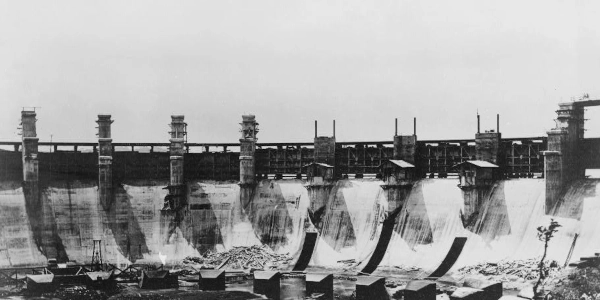
Photo above: Opening of the Panama Canal with the first official ship, S.S. Ancon, 1914, Panama Railroad Company. Courtesy NARA via Wikipedia Commons. Photo below: Gatun Lake spillway, Panama Canal, 1914, Detroit News Company. Courtesy Library of Congress. Info source: Library of Congress; "Opening of the Panama Canal, August 15, 1914," 2014, blog.newspapers.com; "Ship Goes Through Canal," 2014, Belvedere Republican; "The Panama Canal - A Contrast," 1914, Brooklyn Daily Eagle; "Proclamation 1570 - Opening of the Panama Canal," presidency.uscb.edu; "What Was the Greatest Impact of the Panama Canal," 2026, scienceimpacts.org; "Flashback in maritime history: Opening of the Panama Canal 15 Aug 1914," Maritimecyprus.com; "How Many Ships Go Through the Panama Canal Each Year Today," 2026, Mark Anderson; Wikipedia Commons.
History
Photo Bomb

Two man tank manufactured for the United States by Ford for World War I, 1918. Photo: War Department.
ABH Travel Tip
The bargains at the National Park Service continue, despite some recent increases in park fees. The National Park Pass is now called the America the Beautiful Pass, which admits all vehicle and family visitors for one year, and costs $80 for one twelve month period. The pass covers most Federal fee areas, including National Parks, Historic Sites, and National Forests. For those of 62 years of age or older, buy the America the Beautiful Senior Pass.. For only $20 per year or $80 for a lifetime pass, you gain free entrance for the rest of your life to all National Parks, National Historic Sites, and National Forests, and other federal fee sites for you, your spouse, and your children, plus discounts of 50% on some use fees, such as camping. Must be purchased in person at a National Fee location, which are the one hundred or so National Park Service sites that charge for entry.

Panama Pacific International Exposition, held in San Francisco 1915, showing their recovery from the earthquake nine years before. Courtesy Library of Congress.
History Photo Bomb
Two man tank manufactured for the United States by Ford for World War I, 1918. Photo: War Department.
ABH Travel Tip
The bargains at the National Park Service continue, despite some recent increases in park fees. The National Park Pass is now called the America the Beautiful Pass, which admits all vehicle and family visitors for one year, and costs $80 for one twelve month period. The pass covers most Federal fee areas, including National Parks, Historic Sites, and National Forests. For those of 62 years of age or older, buy the America the Beautiful Senior Pass.. For only $20 per year or $80 for a lifetime pass, you gain free entrance for the rest of your life to all National Parks, National Historic Sites, and National Forests, and other federal fee sites for you, your spouse, and your children, plus discounts of 50% on some use fees, such as camping. Must be purchased in person at a National Fee location, which are the one hundred or so National Park Service sites that charge for entry.
Panama Pacific International Exposition, held in San Francisco 1915, showing their recovery from the earthquake nine years before. Courtesy Library of Congress.