Sponsor this page. Your banner or text ad can fill the space above.
Click here to Sponsor the page and how to reserve your ad.
- Timeline
1906 Detail
April 18-19, 1906 - The San Francisco earthquake occurs, estimated at 7.8 on the Richter scale. Its proximity to the epicenter of the San Andreas Fault and the subsequent fire that followed the quake and aftershocks left 478 reported deaths, although estimates in the future peg that figure at nearly 3,000. Between $350-$400 million in damages were sustained. Refugee camps were constructed at twenty-one sites throughout the city, including the Presidio, Fort Point, and Golden Gate Park.
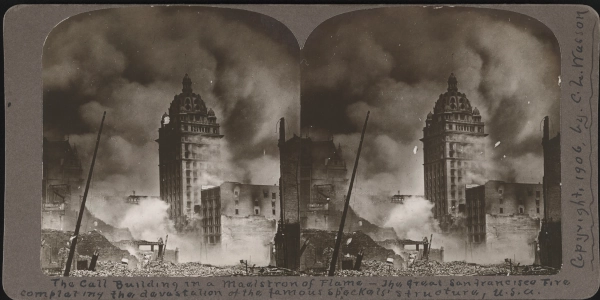
It was a devastating sight to witness, particularly for the residents of San Francisco, the west coast hub of commerce and culture since the Gold Rush of 1849. 342,782 people lived in the city by the census of 1900. There was a vibrant port, an opera, Carmen, performed by famous singer Enrico Caruso on the night before. The San Andreas fault had always been a threat to the growing metropolis, a thirty million years ago phenomenom, even though its discovery had been recent, in 1895, by Professor Andrew Lawson of the University of California - Berkeley. So the emerging city in 1849 until the turn of the century, with the exception of the October 21, 1868 smaller quake, had seen no knowledge of, or planning by the business community and residents for such an event.
A foreshock had been the first warning on April 18, 1906 at 5:12 a.m. The residents, most asleep, had only twenty to twenty-five seconds before the major earthquake shook, rupturing two hundred and ninety-six miles of the fault at its northern end. Its epicenter was near, but not under, San Francisco. The violence lasted for forty-five to sixty seconds. By the time it ended, what was thought to be seven hundred deaths is now considered much higher, half of the buildings were damaged, either by the earthquake itself or the subsequent three day fire. Almost all of the deaths were in San Francisco itself, only one hundred and eighty-nine elsewhere. The quake had been felt from south Oregon to south of Los Angeles and east to central Nevada.
It is estimated that the earthquake had a Richter scale rating of 7.7 to 7.9. Five hundred city blocks had been destroyed. Half of the city population were made homeless. Camps were erected around the hills, including the Presido for them; others made refuge along the streets and crumbling buildings. The U.S. Army cavalry would arrive to assist in the clean up and care. It had been fortuitous that there was a large military presence around the bay; the U.S. Army headquarters for the Pacific, the U.S. Navy and Marines at Mare Island. The forts of the Presidio, Fort Mason, and Alcatraz. Brigadier General Frederick Funston, from Fort Mason, declared that his forces controlled the city. There was no martial law. Congress made appropriations for the immediate situation and the eventual repair or construction of public buildings.
There was a general feeling that the quake destroyed the lives of all classes of the public. Both the rich, poor, Asian, and white were in the streets and in need of help. When help came, the divisions came back. Only Golden Gate Park had water available. The Mint and most banks were destroyed. There was no telephone or telegraph service on land, only the USS Chicago had a working wireless system.
Among the famous in the city that morning was Enrico Caruso, the most celebrated of the opera singers of the day. On the night of April 17, he had sung in the Opera Carmen, at the Mission Opera House. He had made visits to the Palace Hotel, where he stayed on the fifth floor, and the St. Francis Hotel during the night before and morning of the earthquake. The singer would watch the fire burn and eventually be taken to the ferry that headed to Oakland.
Enrico Caruso's Account
You ask me to say what I saw and what I did during the terrible days which witnessed the destruction of San Francisco? Well, there have been many accounts of my so-called adventures published in the American papers, and most of them have not been quite correct. Some of the papers said that I was terribly frightened, that I went half crazy with fear, that I dragged my valise out of the hotel into the square and sat upon it and wept; but all this is untrue. I was frightened, as many others were, but I did not lose my head. I was stopping at the Hotel (Palace), where many of my fellow-artists were staying, and very comfortable it was. I had a room on the fifth floor, and on Tuesday evening, the night before the great catastrophe, I went to bed feeling very contented. I had sung in "Carmen" that night, and the opera had one fine eclat. We were all pleased, and, as I said before, I went to bed that night feeling happy and contented.
But what an awakening! You must know that I am not a very heavy sleeper - I always wake early, and when I feel restless I get up and go for a walk. So on the Wednesday morning early I wake up about 5 o'clock, feeling my bed rocking as though I am in a ship on the ocean, and for a moment I think I am dreaming that I am crossing the water on my way to my beautiful country. And so I take no notice for the moment, and then, as the rocking continues, I get up and go to the window, raise the shade and look out. And what I see makes me tremble with fear. I see the buildings toppling over, big pieces of masonry falling, and from the street below I hear the cries of men and women and children.
I remain speechless, thinking I am in some dreadful nightmare, and for something like forty seconds I stand there, while the buildings fall and my room still rocks like a boat on the sea. And during that forty seconds I think of forty thousand different things. All that I have ever done in my life passes before me, and I remember trivial things and important things. I think of my first appearance in grand opera, and I feel nervous as to my reception, and again I think I am going through last night's "Carmen."
And then I gather my faculties together and call for my valet. He comes rushing in quite cool, and, without any tremor in his voice, says: "It is nothing." But all the same he advises me to dress quickly and go into the open, lest the hotel fall and crush us to powder. By this time the plaster on the ceiling has fallen in a great shower, covering the bed and the carpet and the furniture, and I, to, begin to think it is time to "get busy." My valet gives me some clothes; I know not what the garments are but I get into a pair of trousers and into a coat and draw some socks on and my shoes, and every now and again the room trembles, so that I jump and feel very nervous. I do not deny that I feel nervous, for I still think the building will fall to the ground and crush us. And all the time we hear the sound of crashing masonry and the cries of frightened people.
Then we run down the stairs and into the street, and my valet, brave fellow that he is, goes back and bundles all my things into trunks and drags them down six flights of stairs and out into the open one by one. While he is gone for another and another, I watch those that have already arrived, and presently someone comes and tries to take my trunks saying they are his. I say, "no, they are mine"; but he does not go away. Then a soldier comes up to me; I tell him that this man wants to take my trunks, and that I am Caruso, the artist who sang in "Carmen" the night before. He remembers me and makes the man who takes an interest in my baggage "skidoo" as Americas say.
Minute Walk in History
San Francisco Earthquake
Minute Walk in History
San Francisco Earthquake
The night before the earthquake that devastated San Francisco in 1906, Enrico Caruso had performed the opera Carmen. The streets were bustling, the building tall. The first sections of the video juxtaposes a pre-earthquake drive down Market Street with a carriage ride in the days after as Caruso's voice fills the air. The remainder of the video takes you through photos and videos of the buildings as the fall, the people disposed from their homes, and more.
Then I make my way to Union Square, where I see some of my friends, and one of them tells me he has lost everything except his voice, but he is thankful that he has still got that. And they tell me to come to a house that is still standing; but I say houses are not safe, nothing is safe but the open square, and I prefer to remain in a place where there is no fear of being buried by falling buildings. So I lie down in the square for a little rest, while my valet goes and looks after the luggage, and soon I begin to see the flames and all the city seems to be on fire. All the day I wander about, and I tell my valet we must try and get away, but the soldiers will not let us pass. We can find no vehicle to find our luggage, and this night we are forced to sleep on the hard ground in the open. My limbs act yet from so rough a bed.
Then my valet succeeds in getting a man with a cart, who says he will take us to the Oakland ferry for a certain sum, and we agree to his terms. We pile the luggage into the cart and climb in after it, and the man whips up his horse and we start.
We pass terrible scenes on the way: buildings in ruins, and everywhere there seems to be smoke and dust. The driver seems in no hurry, which makes me impatient at times, for I am longing to return to New York, where I know I shall find a ship to take me to my beautiful Italy and my wife and my little boys.
When we arrive at Oakland we find a train there which is just about to start, and the officials are very polite, take charge of my luggage, and tell me go get on board, which I am very glad to do. The trip to New York seems very long and tedious, and I sleep very little, for I can still feel the terrible rocking which made me sick. Even now I can only sleep an hour at a time, for the experience was a terrible one.

Check out Chronology, A Collection of 50 Short Essays Within the Timeline of American History.
Aftermath and Reconstruction of San Francisco
Resident accounts about the transformation of the city are replete with the changes that occurred. The city officials rebuilt quickly, attempting to restore their economy and tourism. Doris Bepler Sharp, ten years old during the quake, noted that the department stores that had been destroyed suddenly opened in undestroyed mansions along Van Ness Avenue. While commercial and industrial buildings rose, most of the residents remained in the tent camps. While you would think that building codes were strengthened to withstand another quake, that was not true. There was too much need for speed. Permits for one story buildings of wood or iron were not needed. Gas mains and pipes were up and running by the end of the 1906 summer. Some brick buildings that were damaged were able to be repaired and rebuilt quickly. In three years, ninety thousand buildings were erected, including the Merchants Exchange, Fairmount Hotel, and later City Hall (1915).
Within one decade, the city had risen again, enough to celebrate its reconstruction by hosting the 1915 Panama-Pacific International Exposition, a world's fair built over the rubble. It served as a reminder that the city was back in business and that investment could flow freely once again to the largest city on the Pacific Coast. San Francisco even stopped using coins as its basis for money and started using paper.
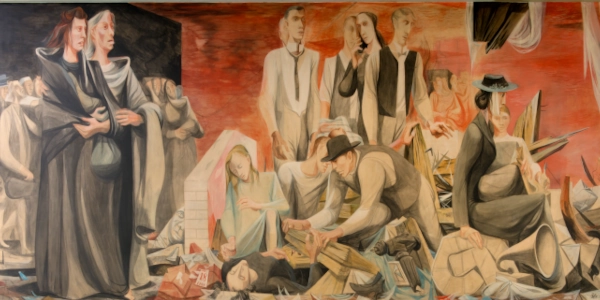
Photo above: Earthquake damage surrounding the Call building in San Francisco, 1906, C.L. Wassan. Courtesy Library of Congress. Below: Mural painting, "Earthquake and Fire of 1906," near Embarcadero, 2012, Carol M. Highsmith. Courtesy Library of Congress. Source: "The Great San Francisco Earthquake of 1906," earthquake.usgs.gov; "San Francisco Earthquake of 1906," archives.gov; "When an American City is Destroyed," 2006, Rebecca Livingston, Prologue Magazine; "Enrico Caruso and the 1906 Earthquake," SFmuseum.org; "Caruso's Account," the Sketch, London; "Rebuilding San Francisco after the 1906 Quake, I Was There" Doris Bepler Sharp, 1986, Eva Knowles, 2024, foundsf.org; "1906 Earthquake and Rebuilding," 2025, Woody LaBounty, sfheritage.org; Library of Congress; Wikipedia Commons.
History Photo Bomb

Washington policy leads to construction by Panama Canal workers, circa 1906. Courtesy Library of Congress.

Ford auto plant. Courtesy Library of Congress.
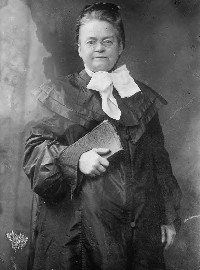
Prohibitionist Carrie Nation. Courtesy Library of Congress.
Official Souvenirs
America's Best History

Get history and national park souvenir t-shirts, mugs, stickers, posters, and other gifts from the official gear of America's Best History, now available on Zazzle, Cafepress, Amazon, and Redbubble.

World's Fair History, 1900's
Buffalo 1901
Charleston 1901-2
St. Louis 1904
Portland 1905
Jamestown 1907
Seattle 1909
For the history of baseball, check out our friends at Stat Geek Baseball with unique stats from 1871 to today you can get nowhere else.
Timeline Book

Now in easy to search ebook, pdf, or paperback.