Sponsor this page. Your banner or text ad can fill the space above.
Click here to Sponsor the page and how to reserve your ad.
-
Timeline
1933 - Detail
March 31, 1933 - The Civilian Conservation Corps is authorized under the Federal Unemployment Relief Act. It would provide work for two and one-half million men during the succeeding nine years and help construct many national park and other projects across the United States.
It was essential to the nation recovering from the Great Depression. Unemployment had reach 13 million souls by the beginning of 1933, and 18 million people were receiving some type of public assistance. There was a twenty-five percent unemployment rate. Food lines were long and stilting. Confidence in the nation that they would see recovery within the next year, or decade, or lifetime was taking a toll on the nation. Remember, at this time, the United States did not see war on the horizon. They had misinterpreted the intentions of Japan and Italy in their attempts with military reduction treaties such as the Naval Reduction Act. They even thought that Germany was toothless.
Once President Franklin D. Roosevelt took office on March 4, 1933, and gave his "We have nothing to fear, but fear itself," speech, he intended to use the bully pulpit to rally the nation, as well as push Congress to pass his campaign agenda. His presidential nomination speech at the Democratic National Campaign Convention had made it clear about the New Deal that was upcoming. Roosevelt was dogged about passing the various New Deal program legislations, and this, authorization of the Civilian Conservation Corps was meant, while mostly to give employment to the many men on those unemployment lines, but also to build much of the infrastructure in need across the United States, including within the newish, 1916, National Park Service. Roosevelt knew that part of this was getting people back to work. And he was diligent in the way he went about it with Congress. On March 21, he spoke to Congress, they passed the legislation ten days later; On April 5, 1933, he issued Executive Order 6101 - Relief of Unemployment Through the Performance of Useful Public Work (see below for both legislation and letters).
When the subsequent Federal Unemployment Relief Act passed Congress on May 12, 1933, the legislation and implimentation became an overwhemling victory. The 73rd Congress passed the May 2, 1933 Federal Unemployment Relief Act 326 to 42 in the House of Representatives and 55 to 17 in the U.S. Senate. And the program was a remarkable success. The Civilian Conservation Corps, CCC for short, built roads, national park buildings, planted nearly two billion trees, and worked on flood control. Three million men were employed, plus eight thousand five hundred women, ages eighteen to twenty-five. They lived in work camps, four thousand five hundred of them with two hundred people per camp, and were paid $30 per month allowance with $22-25 of that sent home to help their families. Their stints would last from several months to two years. Unfortunately not all races worked together on these projects, a stain on the era for certain, but its goal of putting the unemployed back to work did reach the poor population among blacks and Native Americans. 250,000 black Americans and 80,000 Native Americans were part of the program. As they built up the natural resources and land of the United States, this project took on some of the aspects of the Green New Deal, but for a different reason. Whatever that reason, it worked.
Two billion dollars were spent on the program. 1,501,662,800 forest tree seedlings were planted on 1,501,663 acres of bare, barren or unproductive land. 98,444 miles of truck trails and minor roads were constructed and 66,161 miles of telephone lines were strung. 3,459 fire lookout houses and towers were built, along with 41,303 bridges and 45,350 buildings. Construction on national park land, as well as other recreation facilities, including eight hundred new state parks, left a legacy that is still felt today. You can see it at Gettysburg, Mt. Hood, Yosemite, Yellowstone, and the Grand Canyon, just to name a few. By the end of the program, it would be less needed as an employment tool. World War II would take care of that. The CCC would be discontinued after nine years in 1942.
Buy Chronology

President Franklin D. Roosevelt Speech to Congress
March 21, 1933
To the Congress:
It is essential to our recovery program that measures immediately be enacted aimed at unemployment relief. A direct attack in this problem suggests three types of legislation. The first is the enrollment of workers now by the Federal Government for such public employment as can be quickly started and will not interfere with the demand for or the proper standards of normal employment. The second is grants to States for relief work.
The third extends to a broad public works labor-creating program.
With reference to the latter I am now studying the many projects suggested and the financial questions involved. I shall make recommendations to the Congress presently.
In regard to grants to States for relief work, I advise you that the remainder of the appropriation of last year will last until May. Therefore, and because a continuance of Federal aid is still a definite necessity for many States, a further appropriation must be made before the end of this special session.
I find a clear need for some simple Federal machinery to coordinate and check these grants of aid. I am, therefore, asking that you establish the office of Federal Relief Administrator, whose duty it will be to scan requests for grants and to check the efficiency and wisdom of their use.
The first of these measures which I have enumerated, however, can and should be immediately enacted. I propose to create a civilian conservation corps to be used in simple work, not interfering with normal employment, and confining itself to forestry, the prevention of soil erosion, flood control and similar projects. I call your attention to the fact that this type of work is of definite, practical value, not only through the prevention of great present financial loss, but also as a means of creating future national wealth. This is brought home by the news we are receiving today of vast damage caused by floods on the Ohio and other rivers.
Control and direction of such work can be carried on by existing machinery of the departments of Labor, Agriculture, War and Interior.
I estimate that 250,000 men can be given temporary employment by early summer if you give me authority to proceed within the next two weeks.
I ask no new funds at this time. The use of unobligated funds, now appropriated for public works, will be sufficient for several months.
This enterprise is an established part of our national policy. It will conserve our precious natural resources. It will pay dividends to the present and future generations. It will make improvements in national and state domains which have been largely forgotten in the past few years of industrial development.
More important, however, than the material gains will be the moral and spiritual value of such work. The overwhelming majority of unemployed Americans, who are now walking the streets and receiving private or public relief, would infinitely prefer to work. We can take a vast army of these unemployed out into healthful surroundings. We can eliminate to some extent at least the threat that enforced idleness brings to spiritual and moral stability. It is not a panacea for all the unemployment but it is an essential step in this emergency. I ask its adoption.

Act Authorizing the Civilian Conservation Corp
March 31, 1933
AN ACT
For the relief of unemployment through the performance of useful public work,
and for other purposes.
Be it enacted by the Senate and House of Representatives of the
United States of America in Congress assembled That for the purpose of relieving the acute condition of widespread distress and unemployment now existing in the United States, and in order to provide
for the restoration of the country's depleted natural resources and
the advancement of an orderly program of useful public works, the
President is authorized, under such rules and regulations as he
may prescribe and by utilizing such existing departments or agencies as he may designate, to provide for employing citizens of the
United States who are unemployed, in the construction, maintenance and carrying on of works of a public nature in connection
with the forestation of lands belonging to the United States or to
the several States which are suitable for timber production, the
prevention of forest fires, floods and soil erosion, plant pest and
disease control, the construction, maintenance or repair of paths,
trails and fire-lanes in the national parks and national forests, and
such other work on the public domain, national and State, and
Government reservations incidental to or necessary in connection
with any projects of the character enumerated, as the President may
determine to be desirable: Provided^ That the President may in his
discretion extend the provisions of this Act to lands owned by
counties and municipalities and lands in private ownership, but only
for the purpose of doing thereon such kinds of cooperative work as
are now provided for by Acts of Congress in preventing and controlling forest fires and the attacks of forest tree pests and diseases
and such work as is necessary in the public interest to control floods.
The President is further authorized, by regulation, to provide for
housing the persons so employed and for furnishing them with such
subsistence, clothing, medical attendance and hospitalization, and
cash allowance, as may be necessary, during the period they are so
employed, and, in his discretion, to provide for the transportation
of such persons to and from the places of employment. That in
employing citizens for the purposes of this Act no discrimination
shall be made on account of race, color, or creed; and no person
under conviction for crime and serving sentence therefor shall be
employed under the provisions of this Act. The President is further
authorized to allocate funds available for the purposes of this Act,
for forest research, including forest products investigations, by the
Forest Products Laboratory.
Sec. 2. For the purpose of carrying out the provisions of this Act
the President is authorized to enter into such contracts or agreements
with States as may be necessary, including provisions for utilization
of existing State administrative agencies, and the President, or the
head of any department or agency authorized by him to construct
any project or to carry on any such public works, shall be authorized
to acquire real property by purchase, donation, condemnation, or
otherwise, but the provisions of section 355 of the Revised Statutes
shall not apply to any property so acquired.
Sec. 3. Insofar as applicable, the benefits of the Act entitled "An
Act to provide compensation for employees of the United States
suffering injuries while in the performance of their duties, and for
other purposes", approved September 7, 1916, as amended, shall
extend to persons given employment under the provisions of this Act.
Sec. 4. For the purpose of carrying out the provisions of this
Act, there is hereby authorized to be expended, under the direction
of the President, out of any unobligated moneys heretofore appropriated for public works (except for projects on which actual construction has been commenced or may be commenced within ninety
days, and except maintenance funds for river and harbor improvements already allocated), such sums as may be necessary; and an
amount equal to the amount so expended is hereby authorized to be
appropriated for the same purposes for which such moneys were
origina1ly appropriated.
Sec. 5. That the unexpended and unallotted balance of the sum
of $300,000,000 made available under the terms and conditions of
the Act approved July 21. 1932, entitled "An Act to relieve destitution", and so forth, may be made available, or any portion thereof,
to any State or Territory or States or Territories without regard
to the limitation of 15 per centum or other limitations as to per
centum.
Sec. 6. The authority of the President under this Act shall continue for the period of two years next after the date of the passage
hereof and no longer.
Approved March 31st 1933
Minute Walk in History
Civilian Conservation Corps
It was part of Roosevelt's New Deal, to take 18-25 year old out of work in the depression and make them the Civilian Conservation Corps that built roads, bridges, planted trees, and helped construct structures for the National Park Service and State Parks. Watch a montage of videos with original photographs and video about the Corps.
Executive Order 6101 - Relief of Unemployment Through the Performance of Useful Public Work
April 05, 1933
By virtue of the authority vested in me by the Act of Congress entitled "An Act for the relief of unemployment through the performance of useful public work, and for other purposes," approved March 31, 1933 (Public No. 5, 73d Congress), it is hereby ordered that:
(1) For the purpose of carrying out the provisions of said Act Robert Fechner is hereby appointed Director of Emergency Conservation Work at an annual rate of compensation of $12,000, less the reduction prescribed in subparagraph (b), Section 2, Title II, of the Act of Congress entitled "An Act to maintain the credit of the United States Government" (Public No. 2, 73d Congress), approved March 20, 1933.
(2) The Secretary of War, the Secretary of Agriculture, the Secretary of the Interior, and the Secretary of Labor each shall appoint a representative, and said representatives shall constitute an Advisory Council to the Director of Emergency Conservation Work.
(3) There is hereby established in the Treasury a fund of $10,000,000 by the transfer of an equal amount from the unobligated balances of the appropriation for emergency construction of public buildings contained in the act approved July 21, 1932, as authorized by Section 4 of the said Act of March 31, 1933, which fund shall be subject to requisition by the said Robert Fechner, as Director of Emergency Conservation Work, on the approval of the President.
(4) Subject to direction by the President, supplies and materials of the several departments or establishments shall be furnished on the requisition of the Director of Emergency Conservation Work, and the departments and establishments furnishing such supplies and materials shall be reimbursed therefor in accordance with instructions of the President.
(5) Reimbursement, if any, to the departments or establishments for other services rendered shall be made in accordance with instructions of the President.
Signature of Franklin D. Roosevelt
FRANKLIN D ROOSEVELT
The White House, April 5, 1933.
Federal Unemployment Relief Act
The Federal Emergency Relief Act of 1933 Approved, May 12, 1933
AN ACT
To provide for cooperation by the Federal Government with the several States and Territories and the District of Columbia in relieving the hardship and suffering caused by unemployment, and for other purposes.
Be it enacted by the Senate and House of Representatives of the United States of America in Congress assembled, That the Congress hereby declares that the present economic depression has created a serious emergency, due to widespread unemployment and increasing inadequacy of State and local relief funds, resulting in the existing or threatened deprivation of a considerable number of families and individuals of the necessities of life, and making it imperative that the Federal Government cooperate more effectively with the several States and Territories and the District of Columbia in furnishing relief to their needy and distressed people.
Sec. 2. (a) The Reconstruction Finance Corporation is authorized and directed to make available out of the funds of the Corporation not to exceed $500,000,000, in addition to the funds authorized under title I of the Emergency Relief and Construction Act of 1932, for expenditure under the provisions of this Act upon certification by the Federal Emergency Relief Administrative provided for in section 3.
(b) The amount of notes, debentures, bonds, or other such obligations which the Reconstruction Finance Corporation is authorized and empowered under section 9 of the Reconstruction Finance Corporation Act, as amended, to have outstanding at any one time is increased by $500,000,000: Provided, That no such additional notes, debentures, bonds, or other such obligations authorized by this subsection shall be issued except at such times and in such amounts as the President shall approve.
(c) After the expiration of ten days after the date upon which the Federal Emergency Relief Administrator has qualified and has taken office, no application shall be approved by the Reconstruction Finance Corporation under the provisions of title I of the Emergency Relief and Construction Act of 1932, and the Federal Emergency Relief Administrator shall have access to all files and records of the Reconstruction Finance Corporation relating to the administration of funds under title I of such Act. At the expiration of such ten-day period, the unexpended and unobligated balance of the funds authorized under title I of such Act shall be available for the purposes of this Act.
Sec. 3. (a) There is hereby created a Federal Emergency Relief Administration, all the powers of which shall be exercised by a Federal Emergency Relief Administrator (referred to in this Act as the Administrator) to be appointed by the President, by and with the advice and consent of the Senate. The Administrator shall receive a salary to be fixed by the President at not to exceed $10,000, and necessary traveling and subsistence expenses within the limitations prescribed by law for civilian employees in the executive branch of the Government. The Federal Emergency Relief Administration and the office of Federal Emergency Relief Administrator shall case to exist upon the expiration of two years after the date of enactment of this Act, and the unexpended balance on such date of any funds made available under the provisions of this Act shall be disposed of as the Congress may by law provide.
(b) The Administrator may appoint and fix the compensation of such experts and their appointment may be made and compensation fixed without regard to the civil service laws, or the Classification Act of 1923, as amended, and the Administrator may, in the same manner, appoint and fix the compensation of such other officers and employees as are necessary to carry out the provisions of this Act, but such compensation shall not exceed in any case the sum of $8,000; and may make such expenditures (including expenditures for personal services and rent at the seat of government and elsewhere and for printing and binding), not to exceed $350,000, as are necessary to carry out the provisions of this Act, to be paid by the Reconstruction Finance Corporation out of funds made available by this Act upon presentation of vouchers approved by the Administrator or by an officer of the Administration designated by him for that purpose. The Administrator may, under rules and regulations prescribed by the President, assume control of the administration in any State or States where, in his judgment, more effective and efficient cooperation between the State and Federal authorities may thereby be secured in carrying out the purposes of this Act.
(c) In executing any of the provisions of this Act, the Administrator, and any person duly authorized or designated by him, may conduct any investigation pertinent or material to the furtherance of the purposes of this Act and, at the request of the President, shall make such further investigations and studies as the President may deem necessary in dealing with problems of unemployment relief.
(d) The Administrator shall print monthly, and shall submit to the President and to the Senate and the House of Representatives (or to the Secretary of the Senate and the Clerk of the House of Representatives, if those bodies are not in session), a report of his activities and expenditures under this Act. Such reports shall, when submitted, be printed as public documents.
Sec. 4. (a) Out of the funds of the Reconstruction Finance Corporation made available by this Act, the Administrator is authorized to make grants to the several States to aid in meeting the costs of furnishing relief and work relief and in relieving the hardship and suffering caused by unemployment in the form of money, service, materials, and/or commodities to provide the necessities of life to persons in need as a result of the present emergency, and/or to their dependents, whether resident, transient, or homeless.
(b) Of the amounts made available by this Act not to exceed $250,000,000 shall be granted to the several States applying therefor, in the following manner: Each State shall be entitled to receive grants equal to one third of the amount expended by such State, including the civil subdivisions thereof, out of public moneys from all sources for the purposes set forth in subsection (a) of this section; and such grants shall be made quarterly, beginning with the second quarter in the calendar year 1933, and shall be made during any quarter upon the basis of such expenditures certified by the States to have been made during the preceding quarter.
(c) The balance of the amounts made available by this Act, except the amount required for administrative expenditures under section 3, shall be used for grants to be made whenever, from an application presented by a State, the Administrator finds that the combined moneys which can be made available within the State from all sources, supplemented by any moneys, available under subsection (b) of this section, will fall below the estimated needs within the State for the purposes specified in subsection (a) of this section: Provided, That the Administrator may certify out of the funds made available by this subsection additional grants to States applying therefor to aid needy persons who have no legal settlement in any one State or community, and to aid in assisting cooperative and self-help associations for the barter of goods and services.
(d) After October 1, 1933, notwithstanding the provisions of subsection (b), the unexpended balance of the amounts available for the purposes of subsection (b) may, in the discretion of the Administrator and with the approval of the President, be available for grants under subsection (c).
(e) The decision of the Administrator as to the purpose of any expenditure shall be final.
(f) The amount available to any one State under subsections (b) and (c) of this section shall not exceed 15 per centum of the total amount made available by such subsections.
Sec. 5. Any State desiring to obtain funds under this Act shall through its Governor make application therefor from time to time to the Administrator. Each application so made shall present in the manner requested by the Administrator information showing (1) the amounts necessary to meet relief needs in the State during the period covered by such application and the amounts available from public or private sources within the State, its political subdivisions, and private agencies, to meet the relief needs of the State, (2) the provision made to assure adequate administrative supervision, (3) the provision made for suitable standards of relief, and (4) the purposes for which the funds requested will be used.
Sec. 6. The Administrator upon approving a grant to any State shall so certify to the Reconstruction Finance Corporation which shall, except upon revocation of a certificate by the Administrator, make payments without delay to the State in such amounts and at such times as may be prescribed in the certificate. The Governor of each State receiving grants under this Act shall file monthly with the Administrator, and in the form required by him, a report of the disbursements made under such grants.
Sec. 7. As used in the foregoing provisions of this Act, the term State shall include the District of Columbia, Alaska, Hawaii, the Virgin Islands, and Puerto Rico; and the term Governor shall include the Commissioners of the District of Columbia.
Sec. 8. This Act may be cited as the Federal Emergency Relief Act of 1933.
Approved, May 12, 1933
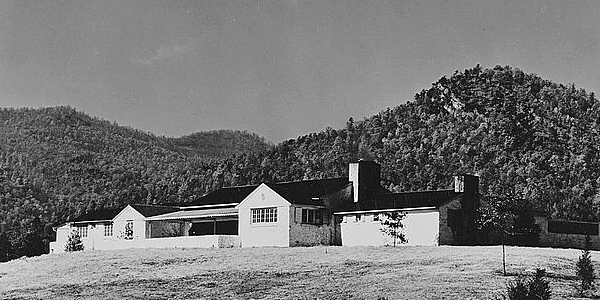
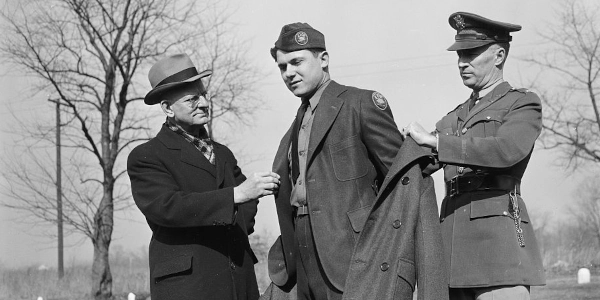
Photo above: Cove Lake Park was built under TVA (Tennessee Valley Authority) direction by the Tennessee State Department of Conservation with the assistance of the CCC (Civilian Conservation Corps) on an arm of Norris Lake, Unknown Date, Tennessee Valley Authority. Courtesy Library of Congress. Below: Robert E. Fechner, left, Director of the Civilian Conservation Corps, inspecting the new uniform issued to members of the Corps for the first time, 1939, Harris and Ewing. Courtesy Library of Congress. Info Source: "The American Presidency Project," https://www.presidency.ucsb.edu/; recordofrights.org; "Civilian Conservation Corps," Catherine A. Paul," and "Civilian Conservation Corps Accomplishments: 1939, My Hopes for the CCC," Robert Fleshner, CCC Director, both socialwelfare.library.vcu.edu/eras/new-deal/; "The Federal Role in the Federal System, The Dynamics of Growth," 1980, Advisory Commission on Intergovernmental Relations, UNC; "New Deal 90, The Civilian Conservation Corps," Roosevelt House, Public Policy Institute at Hunter College; "American Archives Digital Archives Portal; National Park Service; Library of Congress, Wikipedia Commons.
History Photo Bomb
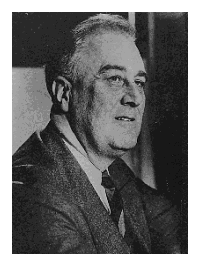
President Franklin D. Roosevelt, who served four terms as
President. Courtesy National Archives.

Out of work workers during the Great Depression. Courtesy National Archives.
Timeline Book


During the decade of the 1930's, World's Fairs of various sizes were held throughout the United States to stimulate the local economies as public works projects to pull the country out of depression. They were also used a public confidence projects to buoy the spirit of a nation in economic turmoil.
Chicago 1933-4
San Diego 1935-6
Cleveland 1936-7
Dallas 1936-7
New York 1939-40
San Francisco 1939-40
ABH Travel Tip

Take the time to listen, not only to the guides at the various historic sites you visit, but also to the ambiance around the sites themselves. Imagine yourself back in time. It's easier to do in the early morning or evening when crowds are low and the bustle lessened, but it can be a wonderful experience to imagine for yourself the past that happened on the ground where you stand. Above photo, the salient at Spotsylvania Battlefield, Virginia.

Night view of the Trylon and Perisphere at the New York World's Fair of 1939-40, 1939, New York Daily News, Courtesy Pinterest. During the first year of the fair, World War II would start.
Official Souvenirs
America's Best History

Buy Chronology
Great Book for the History Fan with Fifty Short Essays Telling the Story of American History.
Once President Franklin D. Roosevelt took office on March 4, 1933, and gave his "We have nothing to fear, but fear itself," speech, he intended to use the bully pulpit to rally the nation, as well as push Congress to pass his campaign agenda. His presidential nomination speech at the Democratic National Campaign Convention had made it clear about the New Deal that was upcoming. Roosevelt was dogged about passing the various New Deal program legislations, and this, authorization of the Civilian Conservation Corps was meant, while mostly to give employment to the many men on those unemployment lines, but also to build much of the infrastructure in need across the United States, including within the newish, 1916, National Park Service. Roosevelt knew that part of this was getting people back to work. And he was diligent in the way he went about it with Congress. On March 21, he spoke to Congress, they passed the legislation ten days later; On April 5, 1933, he issued Executive Order 6101 - Relief of Unemployment Through the Performance of Useful Public Work (see below for both legislation and letters).
When the subsequent Federal Unemployment Relief Act passed Congress on May 12, 1933, the legislation and implimentation became an overwhemling victory. The 73rd Congress passed the May 2, 1933 Federal Unemployment Relief Act 326 to 42 in the House of Representatives and 55 to 17 in the U.S. Senate. And the program was a remarkable success. The Civilian Conservation Corps, CCC for short, built roads, national park buildings, planted nearly two billion trees, and worked on flood control. Three million men were employed, plus eight thousand five hundred women, ages eighteen to twenty-five. They lived in work camps, four thousand five hundred of them with two hundred people per camp, and were paid $30 per month allowance with $22-25 of that sent home to help their families. Their stints would last from several months to two years. Unfortunately not all races worked together on these projects, a stain on the era for certain, but its goal of putting the unemployed back to work did reach the poor population among blacks and Native Americans. 250,000 black Americans and 80,000 Native Americans were part of the program. As they built up the natural resources and land of the United States, this project took on some of the aspects of the Green New Deal, but for a different reason. Whatever that reason, it worked.
Two billion dollars were spent on the program. 1,501,662,800 forest tree seedlings were planted on 1,501,663 acres of bare, barren or unproductive land. 98,444 miles of truck trails and minor roads were constructed and 66,161 miles of telephone lines were strung. 3,459 fire lookout houses and towers were built, along with 41,303 bridges and 45,350 buildings. Construction on national park land, as well as other recreation facilities, including eight hundred new state parks, left a legacy that is still felt today. You can see it at Gettysburg, Mt. Hood, Yosemite, Yellowstone, and the Grand Canyon, just to name a few. By the end of the program, it would be less needed as an employment tool. World War II would take care of that. The CCC would be discontinued after nine years in 1942.
Buy Chronology
To the Congress:
It is essential to our recovery program that measures immediately be enacted aimed at unemployment relief. A direct attack in this problem suggests three types of legislation. The first is the enrollment of workers now by the Federal Government for such public employment as can be quickly started and will not interfere with the demand for or the proper standards of normal employment. The second is grants to States for relief work.
The third extends to a broad public works labor-creating program.
With reference to the latter I am now studying the many projects suggested and the financial questions involved. I shall make recommendations to the Congress presently.
In regard to grants to States for relief work, I advise you that the remainder of the appropriation of last year will last until May. Therefore, and because a continuance of Federal aid is still a definite necessity for many States, a further appropriation must be made before the end of this special session.
I find a clear need for some simple Federal machinery to coordinate and check these grants of aid. I am, therefore, asking that you establish the office of Federal Relief Administrator, whose duty it will be to scan requests for grants and to check the efficiency and wisdom of their use.
The first of these measures which I have enumerated, however, can and should be immediately enacted. I propose to create a civilian conservation corps to be used in simple work, not interfering with normal employment, and confining itself to forestry, the prevention of soil erosion, flood control and similar projects. I call your attention to the fact that this type of work is of definite, practical value, not only through the prevention of great present financial loss, but also as a means of creating future national wealth. This is brought home by the news we are receiving today of vast damage caused by floods on the Ohio and other rivers.
Control and direction of such work can be carried on by existing machinery of the departments of Labor, Agriculture, War and Interior.
I estimate that 250,000 men can be given temporary employment by early summer if you give me authority to proceed within the next two weeks.
I ask no new funds at this time. The use of unobligated funds, now appropriated for public works, will be sufficient for several months.
This enterprise is an established part of our national policy. It will conserve our precious natural resources. It will pay dividends to the present and future generations. It will make improvements in national and state domains which have been largely forgotten in the past few years of industrial development.
More important, however, than the material gains will be the moral and spiritual value of such work. The overwhelming majority of unemployed Americans, who are now walking the streets and receiving private or public relief, would infinitely prefer to work. We can take a vast army of these unemployed out into healthful surroundings. We can eliminate to some extent at least the threat that enforced idleness brings to spiritual and moral stability. It is not a panacea for all the unemployment but it is an essential step in this emergency. I ask its adoption.
AN ACT
For the relief of unemployment through the performance of useful public work, and for other purposes.
Be it enacted by the Senate and House of Representatives of the United States of America in Congress assembled That for the purpose of relieving the acute condition of widespread distress and unemployment now existing in the United States, and in order to provide for the restoration of the country's depleted natural resources and the advancement of an orderly program of useful public works, the President is authorized, under such rules and regulations as he may prescribe and by utilizing such existing departments or agencies as he may designate, to provide for employing citizens of the United States who are unemployed, in the construction, maintenance and carrying on of works of a public nature in connection with the forestation of lands belonging to the United States or to the several States which are suitable for timber production, the prevention of forest fires, floods and soil erosion, plant pest and disease control, the construction, maintenance or repair of paths, trails and fire-lanes in the national parks and national forests, and such other work on the public domain, national and State, and Government reservations incidental to or necessary in connection with any projects of the character enumerated, as the President may determine to be desirable: Provided^ That the President may in his discretion extend the provisions of this Act to lands owned by counties and municipalities and lands in private ownership, but only for the purpose of doing thereon such kinds of cooperative work as are now provided for by Acts of Congress in preventing and controlling forest fires and the attacks of forest tree pests and diseases and such work as is necessary in the public interest to control floods. The President is further authorized, by regulation, to provide for housing the persons so employed and for furnishing them with such subsistence, clothing, medical attendance and hospitalization, and cash allowance, as may be necessary, during the period they are so employed, and, in his discretion, to provide for the transportation of such persons to and from the places of employment. That in employing citizens for the purposes of this Act no discrimination shall be made on account of race, color, or creed; and no person under conviction for crime and serving sentence therefor shall be employed under the provisions of this Act. The President is further authorized to allocate funds available for the purposes of this Act, for forest research, including forest products investigations, by the Forest Products Laboratory.
Sec. 2. For the purpose of carrying out the provisions of this Act the President is authorized to enter into such contracts or agreements with States as may be necessary, including provisions for utilization of existing State administrative agencies, and the President, or the head of any department or agency authorized by him to construct any project or to carry on any such public works, shall be authorized to acquire real property by purchase, donation, condemnation, or otherwise, but the provisions of section 355 of the Revised Statutes shall not apply to any property so acquired.
Sec. 3. Insofar as applicable, the benefits of the Act entitled "An Act to provide compensation for employees of the United States suffering injuries while in the performance of their duties, and for other purposes", approved September 7, 1916, as amended, shall extend to persons given employment under the provisions of this Act.
Sec. 4. For the purpose of carrying out the provisions of this Act, there is hereby authorized to be expended, under the direction of the President, out of any unobligated moneys heretofore appropriated for public works (except for projects on which actual construction has been commenced or may be commenced within ninety days, and except maintenance funds for river and harbor improvements already allocated), such sums as may be necessary; and an amount equal to the amount so expended is hereby authorized to be appropriated for the same purposes for which such moneys were origina1ly appropriated.
Sec. 5. That the unexpended and unallotted balance of the sum of $300,000,000 made available under the terms and conditions of the Act approved July 21. 1932, entitled "An Act to relieve destitution", and so forth, may be made available, or any portion thereof, to any State or Territory or States or Territories without regard to the limitation of 15 per centum or other limitations as to per centum.
Sec. 6. The authority of the President under this Act shall continue for the period of two years next after the date of the passage hereof and no longer.
Approved March 31st 1933
Minute Walk in History
Civilian Conservation Corps
By virtue of the authority vested in me by the Act of Congress entitled "An Act for the relief of unemployment through the performance of useful public work, and for other purposes," approved March 31, 1933 (Public No. 5, 73d Congress), it is hereby ordered that:
(1) For the purpose of carrying out the provisions of said Act Robert Fechner is hereby appointed Director of Emergency Conservation Work at an annual rate of compensation of $12,000, less the reduction prescribed in subparagraph (b), Section 2, Title II, of the Act of Congress entitled "An Act to maintain the credit of the United States Government" (Public No. 2, 73d Congress), approved March 20, 1933.
(2) The Secretary of War, the Secretary of Agriculture, the Secretary of the Interior, and the Secretary of Labor each shall appoint a representative, and said representatives shall constitute an Advisory Council to the Director of Emergency Conservation Work.
(3) There is hereby established in the Treasury a fund of $10,000,000 by the transfer of an equal amount from the unobligated balances of the appropriation for emergency construction of public buildings contained in the act approved July 21, 1932, as authorized by Section 4 of the said Act of March 31, 1933, which fund shall be subject to requisition by the said Robert Fechner, as Director of Emergency Conservation Work, on the approval of the President.
(4) Subject to direction by the President, supplies and materials of the several departments or establishments shall be furnished on the requisition of the Director of Emergency Conservation Work, and the departments and establishments furnishing such supplies and materials shall be reimbursed therefor in accordance with instructions of the President.
(5) Reimbursement, if any, to the departments or establishments for other services rendered shall be made in accordance with instructions of the President.
Signature of Franklin D. Roosevelt
FRANKLIN D ROOSEVELT
The White House, April 5, 1933.
AN ACT
To provide for cooperation by the Federal Government with the several States and Territories and the District of Columbia in relieving the hardship and suffering caused by unemployment, and for other purposes.
Be it enacted by the Senate and House of Representatives of the United States of America in Congress assembled, That the Congress hereby declares that the present economic depression has created a serious emergency, due to widespread unemployment and increasing inadequacy of State and local relief funds, resulting in the existing or threatened deprivation of a considerable number of families and individuals of the necessities of life, and making it imperative that the Federal Government cooperate more effectively with the several States and Territories and the District of Columbia in furnishing relief to their needy and distressed people.
Sec. 2. (a) The Reconstruction Finance Corporation is authorized and directed to make available out of the funds of the Corporation not to exceed $500,000,000, in addition to the funds authorized under title I of the Emergency Relief and Construction Act of 1932, for expenditure under the provisions of this Act upon certification by the Federal Emergency Relief Administrative provided for in section 3.
(b) The amount of notes, debentures, bonds, or other such obligations which the Reconstruction Finance Corporation is authorized and empowered under section 9 of the Reconstruction Finance Corporation Act, as amended, to have outstanding at any one time is increased by $500,000,000: Provided, That no such additional notes, debentures, bonds, or other such obligations authorized by this subsection shall be issued except at such times and in such amounts as the President shall approve.
(c) After the expiration of ten days after the date upon which the Federal Emergency Relief Administrator has qualified and has taken office, no application shall be approved by the Reconstruction Finance Corporation under the provisions of title I of the Emergency Relief and Construction Act of 1932, and the Federal Emergency Relief Administrator shall have access to all files and records of the Reconstruction Finance Corporation relating to the administration of funds under title I of such Act. At the expiration of such ten-day period, the unexpended and unobligated balance of the funds authorized under title I of such Act shall be available for the purposes of this Act.
Sec. 3. (a) There is hereby created a Federal Emergency Relief Administration, all the powers of which shall be exercised by a Federal Emergency Relief Administrator (referred to in this Act as the Administrator) to be appointed by the President, by and with the advice and consent of the Senate. The Administrator shall receive a salary to be fixed by the President at not to exceed $10,000, and necessary traveling and subsistence expenses within the limitations prescribed by law for civilian employees in the executive branch of the Government. The Federal Emergency Relief Administration and the office of Federal Emergency Relief Administrator shall case to exist upon the expiration of two years after the date of enactment of this Act, and the unexpended balance on such date of any funds made available under the provisions of this Act shall be disposed of as the Congress may by law provide.
(b) The Administrator may appoint and fix the compensation of such experts and their appointment may be made and compensation fixed without regard to the civil service laws, or the Classification Act of 1923, as amended, and the Administrator may, in the same manner, appoint and fix the compensation of such other officers and employees as are necessary to carry out the provisions of this Act, but such compensation shall not exceed in any case the sum of $8,000; and may make such expenditures (including expenditures for personal services and rent at the seat of government and elsewhere and for printing and binding), not to exceed $350,000, as are necessary to carry out the provisions of this Act, to be paid by the Reconstruction Finance Corporation out of funds made available by this Act upon presentation of vouchers approved by the Administrator or by an officer of the Administration designated by him for that purpose. The Administrator may, under rules and regulations prescribed by the President, assume control of the administration in any State or States where, in his judgment, more effective and efficient cooperation between the State and Federal authorities may thereby be secured in carrying out the purposes of this Act.
(c) In executing any of the provisions of this Act, the Administrator, and any person duly authorized or designated by him, may conduct any investigation pertinent or material to the furtherance of the purposes of this Act and, at the request of the President, shall make such further investigations and studies as the President may deem necessary in dealing with problems of unemployment relief.
(d) The Administrator shall print monthly, and shall submit to the President and to the Senate and the House of Representatives (or to the Secretary of the Senate and the Clerk of the House of Representatives, if those bodies are not in session), a report of his activities and expenditures under this Act. Such reports shall, when submitted, be printed as public documents.
Sec. 4. (a) Out of the funds of the Reconstruction Finance Corporation made available by this Act, the Administrator is authorized to make grants to the several States to aid in meeting the costs of furnishing relief and work relief and in relieving the hardship and suffering caused by unemployment in the form of money, service, materials, and/or commodities to provide the necessities of life to persons in need as a result of the present emergency, and/or to their dependents, whether resident, transient, or homeless.
(b) Of the amounts made available by this Act not to exceed $250,000,000 shall be granted to the several States applying therefor, in the following manner: Each State shall be entitled to receive grants equal to one third of the amount expended by such State, including the civil subdivisions thereof, out of public moneys from all sources for the purposes set forth in subsection (a) of this section; and such grants shall be made quarterly, beginning with the second quarter in the calendar year 1933, and shall be made during any quarter upon the basis of such expenditures certified by the States to have been made during the preceding quarter.
(c) The balance of the amounts made available by this Act, except the amount required for administrative expenditures under section 3, shall be used for grants to be made whenever, from an application presented by a State, the Administrator finds that the combined moneys which can be made available within the State from all sources, supplemented by any moneys, available under subsection (b) of this section, will fall below the estimated needs within the State for the purposes specified in subsection (a) of this section: Provided, That the Administrator may certify out of the funds made available by this subsection additional grants to States applying therefor to aid needy persons who have no legal settlement in any one State or community, and to aid in assisting cooperative and self-help associations for the barter of goods and services.
(d) After October 1, 1933, notwithstanding the provisions of subsection (b), the unexpended balance of the amounts available for the purposes of subsection (b) may, in the discretion of the Administrator and with the approval of the President, be available for grants under subsection (c).
(e) The decision of the Administrator as to the purpose of any expenditure shall be final.
(f) The amount available to any one State under subsections (b) and (c) of this section shall not exceed 15 per centum of the total amount made available by such subsections.
Sec. 5. Any State desiring to obtain funds under this Act shall through its Governor make application therefor from time to time to the Administrator. Each application so made shall present in the manner requested by the Administrator information showing (1) the amounts necessary to meet relief needs in the State during the period covered by such application and the amounts available from public or private sources within the State, its political subdivisions, and private agencies, to meet the relief needs of the State, (2) the provision made to assure adequate administrative supervision, (3) the provision made for suitable standards of relief, and (4) the purposes for which the funds requested will be used.
Sec. 6. The Administrator upon approving a grant to any State shall so certify to the Reconstruction Finance Corporation which shall, except upon revocation of a certificate by the Administrator, make payments without delay to the State in such amounts and at such times as may be prescribed in the certificate. The Governor of each State receiving grants under this Act shall file monthly with the Administrator, and in the form required by him, a report of the disbursements made under such grants.
Sec. 7. As used in the foregoing provisions of this Act, the term State shall include the District of Columbia, Alaska, Hawaii, the Virgin Islands, and Puerto Rico; and the term Governor shall include the Commissioners of the District of Columbia.
Sec. 8. This Act may be cited as the Federal Emergency Relief Act of 1933.
Approved, May 12, 1933
Photo above: Cove Lake Park was built under TVA (Tennessee Valley Authority) direction by the Tennessee State Department of Conservation with the assistance of the CCC (Civilian Conservation Corps) on an arm of Norris Lake, Unknown Date, Tennessee Valley Authority. Courtesy Library of Congress. Below: Robert E. Fechner, left, Director of the Civilian Conservation Corps, inspecting the new uniform issued to members of the Corps for the first time, 1939, Harris and Ewing. Courtesy Library of Congress. Info Source: "The American Presidency Project," https://www.presidency.ucsb.edu/; recordofrights.org; "Civilian Conservation Corps," Catherine A. Paul," and "Civilian Conservation Corps Accomplishments: 1939, My Hopes for the CCC," Robert Fleshner, CCC Director, both socialwelfare.library.vcu.edu/eras/new-deal/; "The Federal Role in the Federal System, The Dynamics of Growth," 1980, Advisory Commission on Intergovernmental Relations, UNC; "New Deal 90, The Civilian Conservation Corps," Roosevelt House, Public Policy Institute at Hunter College; "American Archives Digital Archives Portal; National Park Service; Library of Congress, Wikipedia Commons.
History Photo Bomb
President Franklin D. Roosevelt, who served four terms as
President. Courtesy National Archives.
Out of work workers during the Great Depression. Courtesy National Archives.
Timeline Book
During the decade of the 1930's, World's Fairs of various sizes were held throughout the United States to stimulate the local economies as public works projects to pull the country out of depression. They were also used a public confidence projects to buoy the spirit of a nation in economic turmoil.
Chicago 1933-4
San Diego 1935-6
Cleveland 1936-7
Dallas 1936-7
New York 1939-40
San Francisco 1939-40
ABH Travel Tip
Take the time to listen, not only to the guides at the various historic sites you visit, but also to the ambiance around the sites themselves. Imagine yourself back in time. It's easier to do in the early morning or evening when crowds are low and the bustle lessened, but it can be a wonderful experience to imagine for yourself the past that happened on the ground where you stand. Above photo, the salient at Spotsylvania Battlefield, Virginia.
Night view of the Trylon and Perisphere at the New York World's Fair of 1939-40, 1939, New York Daily News, Courtesy Pinterest. During the first year of the fair, World War II would start.
Official Souvenirs
America's Best History
Buy Chronology
Great Book for the History Fan with Fifty Short Essays Telling the Story of American History.